Interest rate hike expectations are supporting the dollar, not the safe-haven demand; gold's real test lies at the $4,000 mark.
2026-06-10 14:02:23
On Wednesday (June 10) during the Asian session, the US dollar index hovered near its recent high, currently trading around 99.90.
The repricing of expectations for Fed rate hikes has provided solid support for the dollar, and this support has lasted far longer than the sharp sell-off in precious metals suggests.
The US dollar index is consolidating below its 2026 high, with mixed signals across assets. Spot gold fell nearly 2% to around $4,175 per ounce, while silver fell nearly 3% to below $64 per ounce—a move typically indicative of safe-haven rotation and beneficial to the dollar.
However, the dollar has not extended its gains so far, suggesting that the sell-off in precious metals may be more driven by margin calls and forced liquidations than by widespread cash hedging.
What truly supports the US dollar is the interest rate channel. The Federal Reserve remains firmly committed to a data-driven approach, and recent US economic data has consistently exceeded expectations, keeping terminal interest rate expectations high. This interest rate advantage is particularly evident in the euro and yen, whose central banks remain hesitant to match the Fed's hawkish stance.
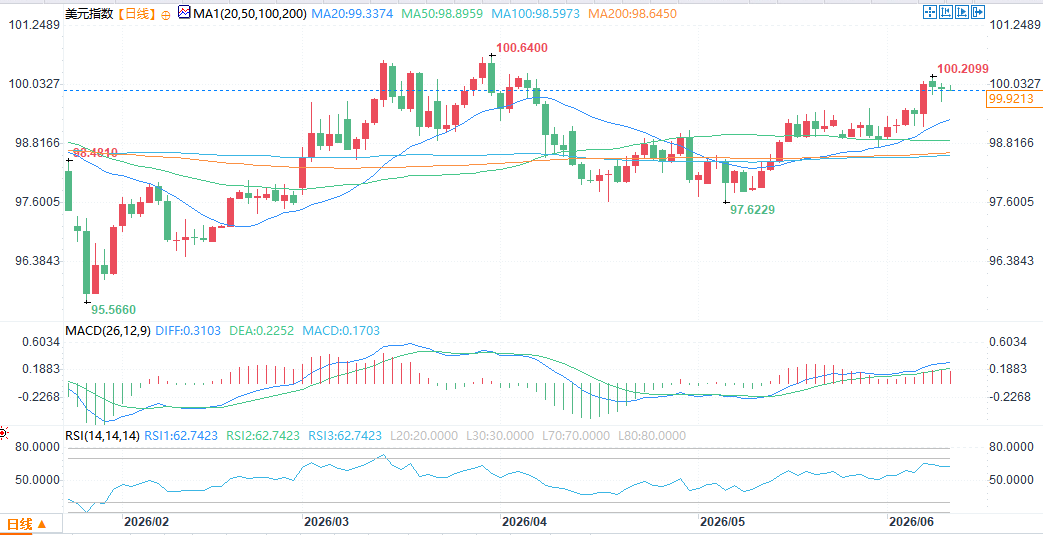
(US Dollar Index Daily Chart, Source: FX678)
The euro edged higher against the dollar on the day, currently trading around 1.1545, but this slight gain has little impact on the bearish technical outlook. Over the past three trading days, the pair has been trading within a narrow 50-pip range, trapped between the 1.1580 resistance level and the 1.1500 support level (a psychological level that has held since mid-May).
The euro's problems still stem from two aspects, and these two major structural weaknesses keep it consistently weak against the dollar.
First, the European Central Bank (ECB) is significantly lagging behind the yield curve in interest rate normalization. While the Federal Reserve has already pushed its benchmark interest rate to 3.75% through successive rate hikes and continues to send hawkish signals, ECB policymakers are still debating the path after the 25 basis point rate hike in June. This hesitation in policy pace has left the euro without support from the interest rate side. The market's inability to form sustained expectations of interest rate hikes for the euro naturally makes it difficult to drive a trend-driven rebound.
Second, the ongoing energy crisis continues to weigh on the Eurozone's growth prospects. High energy costs have not only squeezed the profit margins of manufacturing companies but also weakened the competitiveness of European products in the global market. More importantly, with winter restocking pressures looming, market concerns about energy supply have not truly dissipated. As long as the energy problem is not fundamentally resolved, the Eurozone economy will continue to face the risk of stagflation, and the medium- to long-term prospects for the euro remain bleak.
As long as the price remains below 1.1600, the bearish trend for EUR/USD remains intact. A break below 1.1500 could trigger a rapid decline towards 1.1440 (the March low). On the upside, only a sustained move above 1.1650 would indicate that selling pressure is waning.
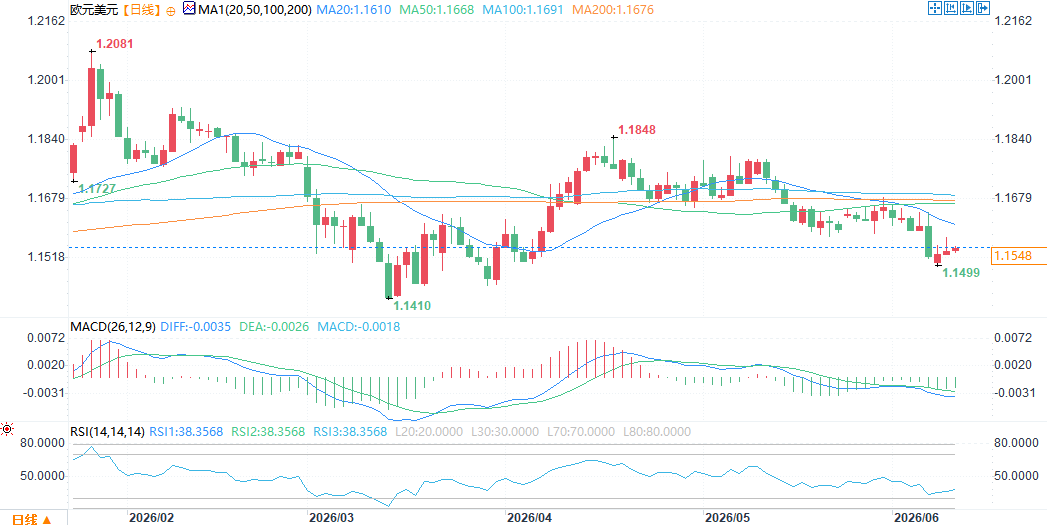
(Euro/USD daily chart, source: FX678)
The pound outperformed other currencies against the dollar, trading around 1.3375, as the market priced in a more aggressive tightening path from the Bank of England than from the European Central Bank.
The pound is benefiting from unique market expectations regarding the Bank of England's policy path. Unlike the US and the Eurozone, the UK's inflation problem is more endogenous—service sector inflation remains persistently high, and wage growth remains strong, putting greater pressure on the Bank of England to curb inflation. The market generally believes that the Bank of England will need to raise interest rates more aggressively than the European Central Bank to bring inflation back to its target level within a reasonable timeframe. This expectation provides differentiated interest rate support for the pound.
In contrast, the European Central Bank is still debating its path after the June rate hike, while the Federal Reserve, although already in a tightening cycle, is not pricing in aggressively further rate hikes this year. The Bank of England occupies a relatively middle position in this "interest rate divergence"—neither lagging behind the curve like the ECB nor nearing the policy endpoint like the Fed, but rather in the middle of its rate hike cycle. This "still in progress" positioning gives the pound a unique appeal among major currencies. As long as UK service sector inflation does not decline significantly, market bets on further rate hikes by the Bank of England will not diminish, and the pound will continue to have a story to tell.
However, this rebound is still tentative, with the exchange rate remaining below the 1.3400 resistance level (a key level that has suppressed the rally since early June), while support holds firmly at 1.3300. The short-term bias is neutral to slightly bullish.
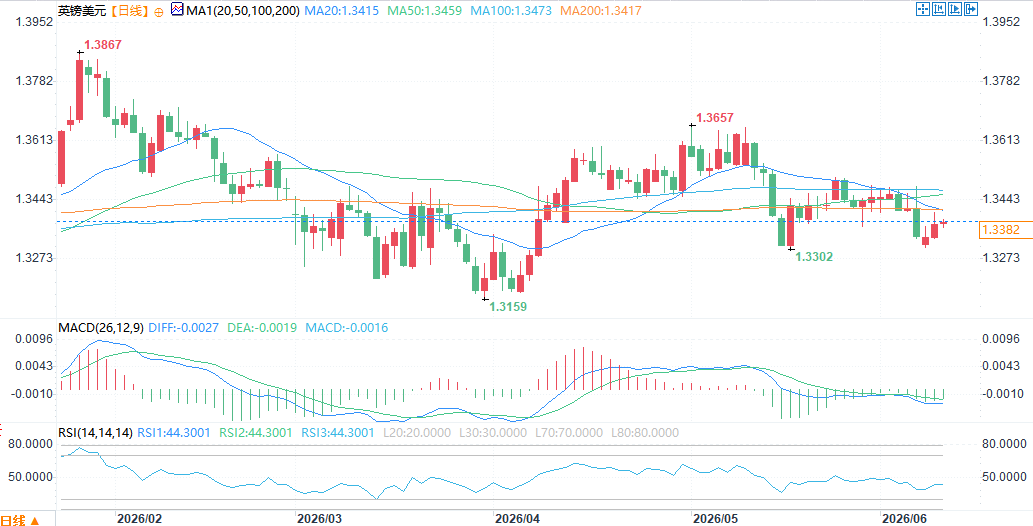
(GBP/USD daily chart, source: FX678)
Historically, gold price declines have typically been caused by a rise in the US dollar. However, the dollar has barely moved this week. This suggests that the gold sell-off is structural rather than fear-driven.
The real test will come when gold continues to fall toward $4,000—at which point it may trigger dollar buying due to the unwinding of leveraged positions across asset classes.
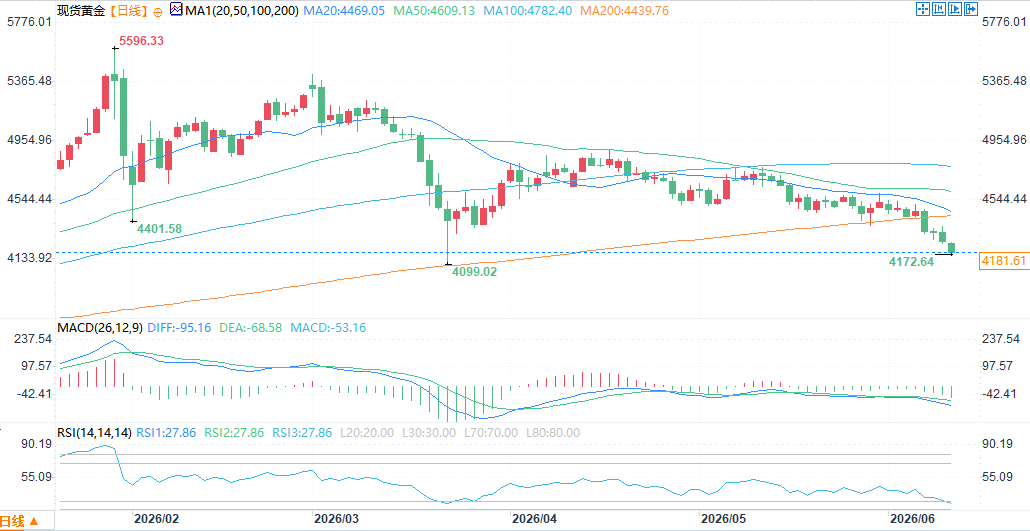
(Spot gold daily chart, source: FX678)
At 14:01 Beijing time on June 10, the US dollar index was at 99.87.
The repricing of expectations for Fed rate hikes has provided solid support for the dollar, and this support has lasted far longer than the sharp sell-off in precious metals suggests.
Interest rates are supporting the market, rather than driving it through safe-haven demand.
The US dollar index is consolidating below its 2026 high, with mixed signals across assets. Spot gold fell nearly 2% to around $4,175 per ounce, while silver fell nearly 3% to below $64 per ounce—a move typically indicative of safe-haven rotation and beneficial to the dollar.
However, the dollar has not extended its gains so far, suggesting that the sell-off in precious metals may be more driven by margin calls and forced liquidations than by widespread cash hedging.
What truly supports the US dollar is the interest rate channel. The Federal Reserve remains firmly committed to a data-driven approach, and recent US economic data has consistently exceeded expectations, keeping terminal interest rate expectations high. This interest rate advantage is particularly evident in the euro and yen, whose central banks remain hesitant to match the Fed's hawkish stance.
(US Dollar Index Daily Chart, Source: FX678)
Euro/Dollar: Trapped around 1.15
The euro edged higher against the dollar on the day, currently trading around 1.1545, but this slight gain has little impact on the bearish technical outlook. Over the past three trading days, the pair has been trading within a narrow 50-pip range, trapped between the 1.1580 resistance level and the 1.1500 support level (a psychological level that has held since mid-May).
The euro's problems still stem from two aspects, and these two major structural weaknesses keep it consistently weak against the dollar.
First, the European Central Bank (ECB) is significantly lagging behind the yield curve in interest rate normalization. While the Federal Reserve has already pushed its benchmark interest rate to 3.75% through successive rate hikes and continues to send hawkish signals, ECB policymakers are still debating the path after the 25 basis point rate hike in June. This hesitation in policy pace has left the euro without support from the interest rate side. The market's inability to form sustained expectations of interest rate hikes for the euro naturally makes it difficult to drive a trend-driven rebound.
Second, the ongoing energy crisis continues to weigh on the Eurozone's growth prospects. High energy costs have not only squeezed the profit margins of manufacturing companies but also weakened the competitiveness of European products in the global market. More importantly, with winter restocking pressures looming, market concerns about energy supply have not truly dissipated. As long as the energy problem is not fundamentally resolved, the Eurozone economy will continue to face the risk of stagflation, and the medium- to long-term prospects for the euro remain bleak.
As long as the price remains below 1.1600, the bearish trend for EUR/USD remains intact. A break below 1.1500 could trigger a rapid decline towards 1.1440 (the March low). On the upside, only a sustained move above 1.1650 would indicate that selling pressure is waning.
(Euro/USD daily chart, source: FX678)
British pound against the US dollar: Relative resilience emerges
The pound outperformed other currencies against the dollar, trading around 1.3375, as the market priced in a more aggressive tightening path from the Bank of England than from the European Central Bank.
The pound is benefiting from unique market expectations regarding the Bank of England's policy path. Unlike the US and the Eurozone, the UK's inflation problem is more endogenous—service sector inflation remains persistently high, and wage growth remains strong, putting greater pressure on the Bank of England to curb inflation. The market generally believes that the Bank of England will need to raise interest rates more aggressively than the European Central Bank to bring inflation back to its target level within a reasonable timeframe. This expectation provides differentiated interest rate support for the pound.
In contrast, the European Central Bank is still debating its path after the June rate hike, while the Federal Reserve, although already in a tightening cycle, is not pricing in aggressively further rate hikes this year. The Bank of England occupies a relatively middle position in this "interest rate divergence"—neither lagging behind the curve like the ECB nor nearing the policy endpoint like the Fed, but rather in the middle of its rate hike cycle. This "still in progress" positioning gives the pound a unique appeal among major currencies. As long as UK service sector inflation does not decline significantly, market bets on further rate hikes by the Bank of England will not diminish, and the pound will continue to have a story to tell.
However, this rebound is still tentative, with the exchange rate remaining below the 1.3400 resistance level (a key level that has suppressed the rally since early June), while support holds firmly at 1.3300. The short-term bias is neutral to slightly bullish.
(GBP/USD daily chart, source: FX678)
Cross-market collaboration
Historically, gold price declines have typically been caused by a rise in the US dollar. However, the dollar has barely moved this week. This suggests that the gold sell-off is structural rather than fear-driven.
The real test will come when gold continues to fall toward $4,000—at which point it may trigger dollar buying due to the unwinding of leveraged positions across asset classes.
(Spot gold daily chart, source: FX678)
At 14:01 Beijing time on June 10, the US dollar index was at 99.87.
- Risk Warning and Disclaimer
- The market involves risk, and trading may not be suitable for all investors. This article is for reference only and does not constitute personal investment advice, nor does it take into account certain users’ specific investment objectives, financial situation, or other needs. Any investment decisions made based on this information are at your own risk.