Crude oil futures markets are detached from reality; oil prices could surge within weeks.
2026-06-10 14:20:24
The Middle East conflict has lasted for more than three months, disrupting shipping in the Strait of Hormuz and reducing global crude oil supply by about 13 million barrels per day. Market participants, however, continue to hope that the conflict can be resolved quickly.
Under the influence of US President Trump's days-long touting of an imminent peace agreement, the crude oil futures market is mainly driven by sentiment, with oil prices severely out of touch with real fundamentals, especially inventory levels.
In fact, global oil inventories, including in the United States, are declining rapidly, and governments are using strategic reserves to fill the huge supply gap in the Middle East.
The International Energy Agency (IEA) stated explicitly: "Supply disruptions caused by the Strait of Hormuz are depleting global oil inventories at a record rate." The report added that global inventories (including floating oil at sea) decreased by 250 million barrels in March and April, averaging 4 million barrels per day.
Data from the U.S. Energy Information Administration (EIA) shows that as of May 29, U.S. crude oil and petroleum product inventories had plummeted to 1.53 billion barrels, the lowest level since 2004. U.S. gasoline inventories, as well as inventories at Cushing, the delivery point for West Texas Intermediate (WTI) crude oil futures, also declined significantly.
Every day shipping through the Strait of Hormuz is disrupted, inventory levels are further depleted. Industry executives warn that inventories may fall to critically low levels in the coming weeks . Even if the strait were to reopen unconditionally today, tanker cargoes would still take weeks to reach buyers. The reality is that Iran is demanding de facto control of the strait in negotiations with the United States, making the resumption of navigation a distant prospect.
Furthermore, even if shipping resumes, ship owners and operators will face enormous risks: the peace agreement could be shattered in an instant by an Israeli strike on Lebanon or by a tweet from Trump saying "blow them up."
Even if the strait resumes navigation today, crude oil supplies will take weeks or even months to reach end customers, which coincides with the summer peak demand period, making a huge supply-demand gap unavoidable.
To date, the market has relied on floating oil at sea, Russian crude oil released after sanctions were lifted (and Iranian crude oil which was briefly deregulated), and depletion of inventories to fill the gap. Fortunately, the Asian power had accumulated more than 1.2 billion barrels of commercial and strategic crude oil reserves before the conflict, and imports dropped sharply after oil prices broke through $100 per barrel, providing a buffer for the market.
Analysts and industry officials warn that with shipping in the Strait of Hormuz nearly disrupted, these buffers are dwindling day by day, and the market is nearing a tipping point.
While shrinking demand has temporarily prevented oil prices from soaring to record highs, this may be the only buffer against further price increases. In the coming weeks, inventories are likely to bottom out, and the futures market will eventually reflect the true impact of this most severe supply disruption in history.
Despite this, many traders are ignoring warnings from analysts and executives at oil giants. ExxonMobil and Chevron have both warned that if the Strait of Hormuz remains closed, low inventory levels could cause oil prices to surge within weeks.
"We are approaching unprecedented inventory levels, really, really low," said Neil Chapman, senior vice president of ExxonMobil, at Bernstein’s 42nd annual strategic decision-making conference at the end of May. He further noted, "Most institutional models show that once inventories hit low levels, spot Brent crude oil prices will surge to $150 to $160 per barrel ."
At the same conference, Chevron CEO Mike Wirth stated, "Market buffers and shock absorbers are being depleted, and the market's ability to absorb supply and demand imbalances has significantly weakened compared to the early stages of the conflict. In the coming weeks, the pressure will be directly transmitted to spot prices, with upward pressure on oil prices expected to increase further in June and especially in July ."
Inventories are depleting at a record pace, and shrinking demand may be the only shock absorber, but this will not be enough to prevent oil prices from soaring in the coming weeks unless shipping in the Strait of Hormuz at least partially returns to normal.
The biggest uncertainties at present lie in whether the months-long deadlock in US-Iran negotiations can achieve a breakthrough, and when the major Asian power will return to the oil market. In May, the country began to use its huge reserves, temporarily curbing the rise in oil prices.
Global inventory depletion will ultimately be limited. Although traders stubbornly cling to the hope of a peace agreement, the futures market will eventually reflect the true scale of supply losses.
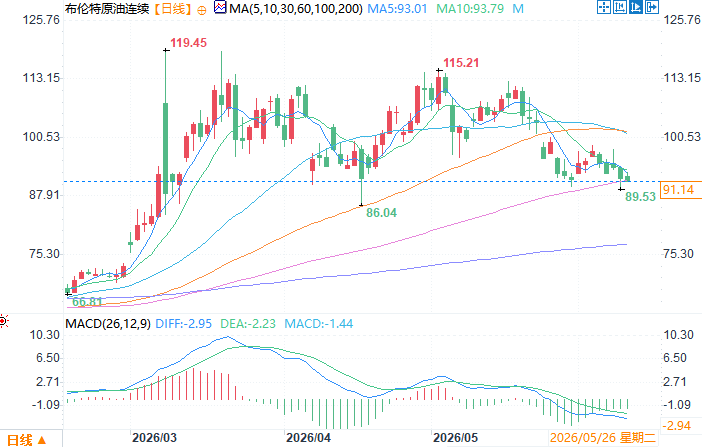
Brent crude oil daily chart source: EasyForex
At 14:20 Beijing time on June 10, Brent crude oil futures were trading at $90.89 per barrel.
Under the influence of US President Trump's days-long touting of an imminent peace agreement, the crude oil futures market is mainly driven by sentiment, with oil prices severely out of touch with real fundamentals, especially inventory levels.
Global inventories plummet
In fact, global oil inventories, including in the United States, are declining rapidly, and governments are using strategic reserves to fill the huge supply gap in the Middle East.
The International Energy Agency (IEA) stated explicitly: "Supply disruptions caused by the Strait of Hormuz are depleting global oil inventories at a record rate." The report added that global inventories (including floating oil at sea) decreased by 250 million barrels in March and April, averaging 4 million barrels per day.
Data from the U.S. Energy Information Administration (EIA) shows that as of May 29, U.S. crude oil and petroleum product inventories had plummeted to 1.53 billion barrels, the lowest level since 2004. U.S. gasoline inventories, as well as inventories at Cushing, the delivery point for West Texas Intermediate (WTI) crude oil futures, also declined significantly.
Every day shipping through the Strait of Hormuz is disrupted, inventory levels are further depleted. Industry executives warn that inventories may fall to critically low levels in the coming weeks . Even if the strait were to reopen unconditionally today, tanker cargoes would still take weeks to reach buyers. The reality is that Iran is demanding de facto control of the strait in negotiations with the United States, making the resumption of navigation a distant prospect.
Furthermore, even if shipping resumes, ship owners and operators will face enormous risks: the peace agreement could be shattered in an instant by an Israeli strike on Lebanon or by a tweet from Trump saying "blow them up."
A critical point is approaching; a huge supply-demand gap is expected this summer.
Even if the strait resumes navigation today, crude oil supplies will take weeks or even months to reach end customers, which coincides with the summer peak demand period, making a huge supply-demand gap unavoidable.
To date, the market has relied on floating oil at sea, Russian crude oil released after sanctions were lifted (and Iranian crude oil which was briefly deregulated), and depletion of inventories to fill the gap. Fortunately, the Asian power had accumulated more than 1.2 billion barrels of commercial and strategic crude oil reserves before the conflict, and imports dropped sharply after oil prices broke through $100 per barrel, providing a buffer for the market.
Analysts and industry officials warn that with shipping in the Strait of Hormuz nearly disrupted, these buffers are dwindling day by day, and the market is nearing a tipping point.
While shrinking demand has temporarily prevented oil prices from soaring to record highs, this may be the only buffer against further price increases. In the coming weeks, inventories are likely to bottom out, and the futures market will eventually reflect the true impact of this most severe supply disruption in history.
Despite this, many traders are ignoring warnings from analysts and executives at oil giants. ExxonMobil and Chevron have both warned that if the Strait of Hormuz remains closed, low inventory levels could cause oil prices to surge within weeks.
"We are approaching unprecedented inventory levels, really, really low," said Neil Chapman, senior vice president of ExxonMobil, at Bernstein’s 42nd annual strategic decision-making conference at the end of May. He further noted, "Most institutional models show that once inventories hit low levels, spot Brent crude oil prices will surge to $150 to $160 per barrel ."
At the same conference, Chevron CEO Mike Wirth stated, "Market buffers and shock absorbers are being depleted, and the market's ability to absorb supply and demand imbalances has significantly weakened compared to the early stages of the conflict. In the coming weeks, the pressure will be directly transmitted to spot prices, with upward pressure on oil prices expected to increase further in June and especially in July ."
Unknown variables: Peace negotiations and the needs of major Asian powers
Inventories are depleting at a record pace, and shrinking demand may be the only shock absorber, but this will not be enough to prevent oil prices from soaring in the coming weeks unless shipping in the Strait of Hormuz at least partially returns to normal.
The biggest uncertainties at present lie in whether the months-long deadlock in US-Iran negotiations can achieve a breakthrough, and when the major Asian power will return to the oil market. In May, the country began to use its huge reserves, temporarily curbing the rise in oil prices.
Global inventory depletion will ultimately be limited. Although traders stubbornly cling to the hope of a peace agreement, the futures market will eventually reflect the true scale of supply losses.
Brent crude oil daily chart source: EasyForex
At 14:20 Beijing time on June 10, Brent crude oil futures were trading at $90.89 per barrel.
- Risk Warning and Disclaimer
- The market involves risk, and trading may not be suitable for all investors. This article is for reference only and does not constitute personal investment advice, nor does it take into account certain users’ specific investment objectives, financial situation, or other needs. Any investment decisions made based on this information are at your own risk.