Intervention alarms sounded again: The US dollar rose for the ninth consecutive day, reaching 160.50 against the Japanese yen, nearing the limit of the Japanese government's tolerance.
2026-06-11 09:03:09
On Thursday (June 11) during the Asian session, the USD/JPY exchange rate opened lower but then rose, currently trading around 160.50.
On Wednesday, the USD/JPY pair hit a new high of 160.57, marking its ninth consecutive day of gains.
The reason behind the continuous rise in the exchange rate is the strong US inflation data, which has strengthened market expectations that the Federal Reserve will maintain high interest rates for a longer period of time.
At the same time, the market is highly vigilant about the possibility of Japanese authorities intervening in the foreign exchange market.

Data released Wednesday by the U.S. Bureau of Labor Statistics showed that U.S. inflation accelerated in May, with the year-on-year growth rate reaching its fastest pace in more than three years, driven by a sharp rise in energy prices triggered by ongoing tensions with Iran. Specifically, the U.S. Consumer Price Index (CPI) rose 4.2% year-on-year in May, up from 3.8% in April, largely in line with market expectations. This data broke the previous optimistic market expectations of a continuous decline in inflation, prompting investors to reassess the Federal Reserve's monetary policy path.
On a month-on-month basis, the CPI rose 0.5% in May, in line with expectations. The more closely watched core CPI (excluding volatile food and energy prices) showed a relatively moderate performance, rising 0.2% month-on-month and 2.9% year-on-year. Although core inflation did not show a significant deterioration, the sharp rebound in overall CPI is enough to raise market concerns. Analysts point out that energy prices are the main driver of this accelerated inflation, while service prices remain sticky, indicating that the process of inflation decline will not be smooth sailing.
Following the release of strong inflation data, financial markets' expectations for a Federal Reserve rate cut this year cooled rapidly. The CME FedWatch Tool showed that market expectations for a September rate cut had fallen sharply from over 50% the previous week to below 30%. Simultaneously, the dollar index rose briefly, and US Treasury yields climbed. The USD/JPY exchange rate, directly affected by the US-Japan interest rate differential, also received strong support, pushing the yen further down to near a six-week low.
However, the upside potential for the USD/JPY exchange rate may be significantly limited as market concerns continue to rise regarding potential foreign exchange intervention by Japanese authorities. Japanese Finance Minister Kanami Sato stated clearly in a public address on Tuesday that the government is closely monitoring currency market developments with a high degree of urgency. She emphasized that the Japanese government's previous stance of being prepared to take decisive measures to maintain market stability when necessary remains unchanged.
Market analysts pointed out that Minister Sato's wording was more hawkish than before. Although she did not explicitly reveal the specific red line for exchange rate intervention, many traders believe that, based on the past behavior of the Japanese Ministry of Finance, if the USD/JPY exchange rate clearly breaks through the 161.00 level, or even approaches the year's high of 162.00, the Japanese authorities are likely to intervene again, selling dollars and buying yen. In addition, the market is also watching whether the Bank of Japan will send signals in advance through non-public operations such as exchange rate checks.
It is important to note that simple currency intervention can usually only temporarily slow the depreciation of the yen, and is unlikely to reverse the long-term trend driven by the US-Japan interest rate differential. However, given the current market expectation that the Federal Reserve will maintain high interest rates while the Bank of Japan is raising rates slowly, the repeated "verbal intervention" by the Japanese government can still, to some extent, curb excessive short-selling by speculative funds, thus making the short-term upward trend of the USD/JPY exchange rate more volatile and cautious.
JPMorgan's chief FX strategist for Japan, Junya Tanase, stated unequivocally: "The fundamentals of the yen are quite weak, and this situation is unlikely to change significantly looking ahead to next year."
The bank gave the most pessimistic year-end USD/JPY forecast among major Wall Street institutions—164. Tanase pointed out that factors such as the still large USD/JPY interest rate differential, negative real interest rates in Japan, and continued capital outflows will continue to put pressure on the yen. As long as the Bank of Japan adopts a gradual tightening policy and the risk of fiscal-driven inflation persists, the yen's depreciation trend will be difficult to reverse.
In an email dated June 9, Abbas Keshvani, head of Asia macro strategy at RBC, noted that the market is testing the Japanese government's resolve to intervene—just five weeks after the Japanese authorities intervened in late April and early May to defend the yen, the spot rate had already returned to above 160.
Keshvani emphasized that market forces supporting a weaker yen remain strong, including the drag on Japan's terms of trade from rising energy prices and the reluctance of local asset managers to shift towards yen assets. Therefore, he stated explicitly, "If the decline in the USD/JPY is the result of intervention, we tend to adopt a 'buy the dip' strategy."
The USD/JPY pair is in a clear uptrend on the daily chart, with a solid overall bullish pattern. The 20-day, 50-day, 100-day, and 200-day moving averages are aligned in a bullish formation, with the 200-day moving average continuing to rise, indicating a clear long-term upward trend. Short-term moving average support is strong, and the pair has not broken below key moving averages during pullbacks, maintaining good bullish momentum.
Recently, prices have once again challenged previous highs of 160.46 and 160.47, and are currently trading around 160.50, having slightly broken through the previous high. Yesterday, prices even reached a new high of 160.57, indicating strong upward momentum. The key support level is around 158.96; if this support level is not effectively broken, the probability of the trend continuing is high.
From a short-term perspective, the candlestick chart shows consecutive positive days, with the price center continuing to move upwards and the bullish momentum stable. However, caution is advised regarding profit-taking pressure in the 160.5 to 161.0 range. A break below the 20-day moving average (MA20) with significant volume could trigger a temporary pullback; otherwise, the upward trend is likely to continue.
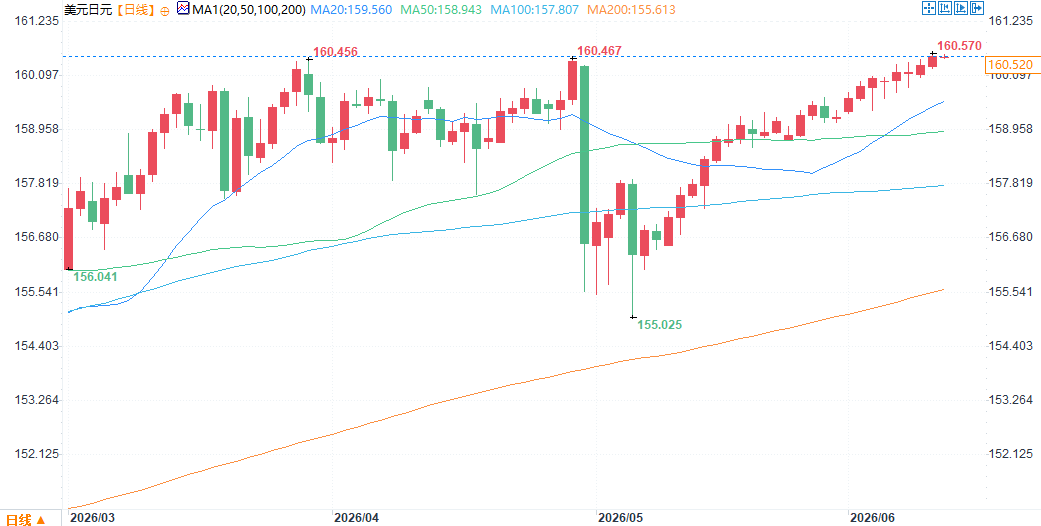
(USD/JPY daily chart, source: FX678)
At 9:02 AM Beijing time on June 11, the USD/JPY exchange rate was 160.53/54.
On Wednesday, the USD/JPY pair hit a new high of 160.57, marking its ninth consecutive day of gains.
The reason behind the continuous rise in the exchange rate is the strong US inflation data, which has strengthened market expectations that the Federal Reserve will maintain high interest rates for a longer period of time.
At the same time, the market is highly vigilant about the possibility of Japanese authorities intervening in the foreign exchange market.
Inflation drives the dollar higher
Data released Wednesday by the U.S. Bureau of Labor Statistics showed that U.S. inflation accelerated in May, with the year-on-year growth rate reaching its fastest pace in more than three years, driven by a sharp rise in energy prices triggered by ongoing tensions with Iran. Specifically, the U.S. Consumer Price Index (CPI) rose 4.2% year-on-year in May, up from 3.8% in April, largely in line with market expectations. This data broke the previous optimistic market expectations of a continuous decline in inflation, prompting investors to reassess the Federal Reserve's monetary policy path.
On a month-on-month basis, the CPI rose 0.5% in May, in line with expectations. The more closely watched core CPI (excluding volatile food and energy prices) showed a relatively moderate performance, rising 0.2% month-on-month and 2.9% year-on-year. Although core inflation did not show a significant deterioration, the sharp rebound in overall CPI is enough to raise market concerns. Analysts point out that energy prices are the main driver of this accelerated inflation, while service prices remain sticky, indicating that the process of inflation decline will not be smooth sailing.
Following the release of strong inflation data, financial markets' expectations for a Federal Reserve rate cut this year cooled rapidly. The CME FedWatch Tool showed that market expectations for a September rate cut had fallen sharply from over 50% the previous week to below 30%. Simultaneously, the dollar index rose briefly, and US Treasury yields climbed. The USD/JPY exchange rate, directly affected by the US-Japan interest rate differential, also received strong support, pushing the yen further down to near a six-week low.
Intervention risk limits the rate of increase
However, the upside potential for the USD/JPY exchange rate may be significantly limited as market concerns continue to rise regarding potential foreign exchange intervention by Japanese authorities. Japanese Finance Minister Kanami Sato stated clearly in a public address on Tuesday that the government is closely monitoring currency market developments with a high degree of urgency. She emphasized that the Japanese government's previous stance of being prepared to take decisive measures to maintain market stability when necessary remains unchanged.
Market analysts pointed out that Minister Sato's wording was more hawkish than before. Although she did not explicitly reveal the specific red line for exchange rate intervention, many traders believe that, based on the past behavior of the Japanese Ministry of Finance, if the USD/JPY exchange rate clearly breaks through the 161.00 level, or even approaches the year's high of 162.00, the Japanese authorities are likely to intervene again, selling dollars and buying yen. In addition, the market is also watching whether the Bank of Japan will send signals in advance through non-public operations such as exchange rate checks.
It is important to note that simple currency intervention can usually only temporarily slow the depreciation of the yen, and is unlikely to reverse the long-term trend driven by the US-Japan interest rate differential. However, given the current market expectation that the Federal Reserve will maintain high interest rates while the Bank of Japan is raising rates slowly, the repeated "verbal intervention" by the Japanese government can still, to some extent, curb excessive short-selling by speculative funds, thus making the short-term upward trend of the USD/JPY exchange rate more volatile and cautious.
Institutional Views
JPMorgan's chief FX strategist for Japan, Junya Tanase, stated unequivocally: "The fundamentals of the yen are quite weak, and this situation is unlikely to change significantly looking ahead to next year."
The bank gave the most pessimistic year-end USD/JPY forecast among major Wall Street institutions—164. Tanase pointed out that factors such as the still large USD/JPY interest rate differential, negative real interest rates in Japan, and continued capital outflows will continue to put pressure on the yen. As long as the Bank of Japan adopts a gradual tightening policy and the risk of fiscal-driven inflation persists, the yen's depreciation trend will be difficult to reverse.
In an email dated June 9, Abbas Keshvani, head of Asia macro strategy at RBC, noted that the market is testing the Japanese government's resolve to intervene—just five weeks after the Japanese authorities intervened in late April and early May to defend the yen, the spot rate had already returned to above 160.
Keshvani emphasized that market forces supporting a weaker yen remain strong, including the drag on Japan's terms of trade from rising energy prices and the reluctance of local asset managers to shift towards yen assets. Therefore, he stated explicitly, "If the decline in the USD/JPY is the result of intervention, we tend to adopt a 'buy the dip' strategy."
Technical Analysis
The USD/JPY pair is in a clear uptrend on the daily chart, with a solid overall bullish pattern. The 20-day, 50-day, 100-day, and 200-day moving averages are aligned in a bullish formation, with the 200-day moving average continuing to rise, indicating a clear long-term upward trend. Short-term moving average support is strong, and the pair has not broken below key moving averages during pullbacks, maintaining good bullish momentum.
Recently, prices have once again challenged previous highs of 160.46 and 160.47, and are currently trading around 160.50, having slightly broken through the previous high. Yesterday, prices even reached a new high of 160.57, indicating strong upward momentum. The key support level is around 158.96; if this support level is not effectively broken, the probability of the trend continuing is high.
From a short-term perspective, the candlestick chart shows consecutive positive days, with the price center continuing to move upwards and the bullish momentum stable. However, caution is advised regarding profit-taking pressure in the 160.5 to 161.0 range. A break below the 20-day moving average (MA20) with significant volume could trigger a temporary pullback; otherwise, the upward trend is likely to continue.
(USD/JPY daily chart, source: FX678)
At 9:02 AM Beijing time on June 11, the USD/JPY exchange rate was 160.53/54.
- Risk Warning and Disclaimer
- The market involves risk, and trading may not be suitable for all investors. This article is for reference only and does not constitute personal investment advice, nor does it take into account certain users’ specific investment objectives, financial situation, or other needs. Any investment decisions made based on this information are at your own risk.