Australian Dollar Rebounds After Hitting Bottom? US Inflation Remains Strong, Downward Trend Not Yet Over
2026-06-11 09:22:10
After falling below the 0.7 mark yesterday, the Australian dollar rebounded against the US dollar during the Asian session on Thursday (June 11). It touched 0.6987 in the early morning as persistently high US inflation supported the US dollar and dampened market expectations for a Federal Reserve rate cut. However, bargain hunting provided support for the exchange rate, and the Australian dollar has now rebounded to around 0.7005 against the US dollar.
The latest data released by the U.S. Bureau of Labor Statistics shows that the Consumer Price Index (CPI) rose 4.2% year-on-year in May, while the core CPI rose 0.2% month-on-month, slightly below market expectations. All other major indicators met forecasts. On the surface, the slight slowdown in core inflation seems to have given the Federal Reserve some breathing room. However, investors expecting interest rate cuts have almost no reason to celebrate.
First, overall inflation remains high, with the year-on-year increase of 4.2% still far from the Federal Reserve's 2% policy target. Second, structural inflationary pressures have not subsided—energy prices continue to rise due to the situation in Iran, service sector inflation remains sticky, and rent and wage increases are slow to decline. More importantly, peace talks between the US and Israel have broken down again, reigniting market concerns about an escalation of the Middle East situation, pushing oil prices higher and consequently raising inflation expectations.
The US Producer Price Index (PPI) data to be released later today is also not expected to shake the current inflation narrative. The market generally believes that the PPI will remain high, further confirming the stubbornness of inflation. Against this backdrop, the Federal Reserve's stance of maintaining high interest rates has become more resolute, and market expectations for rate cuts this year have been lowered from multiple times at the beginning of the year to just one or even zero now. As long as inflation does not show a clear and sustainable downward trend, the US dollar will continue to be supported.
Persistent inflationary pressures continue to provide solid support for the US dollar, while the Australian dollar is dragged down by a combination of factors.
First, risk aversion sentiment has risen significantly, with continued tensions in the Middle East causing global funds to flow more rapidly from high-risk currencies such as the Australian dollar to the traditional safe haven of the US dollar.
Secondly, the recent continued softening of prices for major Australian export commodities such as iron ore and coal has directly weakened the trade fundamentals of the Australian dollar. As a commodity currency, the Australian dollar is highly sensitive to commodity price trends, and a deterioration in export revenue expectations often leads to currency depreciation.
Furthermore, market expectations for further interest rate hikes by the Reserve Bank of Australia (RBA) have continued to cool, with the general consensus now that the current tightening cycle is nearing its end. Meanwhile, the Federal Reserve's stance on maintaining high interest rates is more resolute. This divergence in the monetary policy prospects of the two countries has further widened the yield spread between Australia and the US, putting additional pressure on the Australian dollar to flow out of the country.
The Australian dollar has now fallen below the 0.7 level against the US dollar, a move that validates the foresight of previous bearish views and indicates that market sentiment is evolving in a more pessimistic direction.
Whether the exchange rate can extend its decline further likely depends on the headlines regarding the situation between the US and Iran. If the conflict escalates, risk aversion will further push up the US dollar, and the Australian dollar may accelerate its decline. If the situation eases, the Australian dollar may experience a technical rebound, at which point short covering may push the exchange rate to briefly recover the 0.7 level.
However, regardless of whether there is a rebound or a further breakdown in the short term, from both fundamental and technical perspectives, the downward trend of the Australian dollar is not yet over. Until the macroeconomic landscape of a strong US and a weak Australian dollar is completely reversed, every rebound could become a new opportunity to short.
The Australian dollar is currently in a pullback phase against the US dollar on the daily chart, with an overall short-term bearish bias. The price has broken below key moving averages such as the 20-day and 50-day moving averages, with key support at 0.6987. If this support holds, the downside target could be the 0.6900 area. Resistance is concentrated around 0.7118 near the 20-day moving average, where any rebound will face significant resistance.
After encountering resistance at the previous high of 0.7277, the price quickly fell back, indicating a significant weakening of bullish momentum. The long-term moving average (MA200) remains upward, suggesting the overall trend has not completely turned bearish; the current movement is more likely a temporary pullback after an initial rise. While the short-term candlestick chart shows signs of bottoming out at a low level, no clear reversal signal has yet emerged, and the overall weak pattern remains unchanged. If the price fails to effectively recover above the MA20, it will likely continue its downward trend; however, if it can hold above 0.7050, a period of recovery may begin.
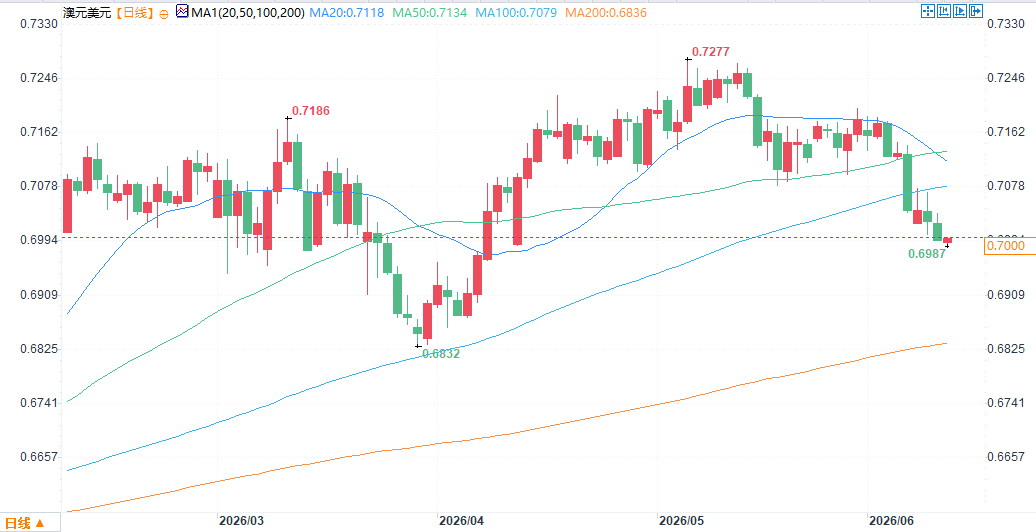
(AUD/USD daily chart, source: FX678)
At 09:21 Beijing time on June 11, the Australian dollar was trading at 0.7005/06 against the US dollar.
US inflation remains stubbornly persistent.
The latest data released by the U.S. Bureau of Labor Statistics shows that the Consumer Price Index (CPI) rose 4.2% year-on-year in May, while the core CPI rose 0.2% month-on-month, slightly below market expectations. All other major indicators met forecasts. On the surface, the slight slowdown in core inflation seems to have given the Federal Reserve some breathing room. However, investors expecting interest rate cuts have almost no reason to celebrate.
First, overall inflation remains high, with the year-on-year increase of 4.2% still far from the Federal Reserve's 2% policy target. Second, structural inflationary pressures have not subsided—energy prices continue to rise due to the situation in Iran, service sector inflation remains sticky, and rent and wage increases are slow to decline. More importantly, peace talks between the US and Israel have broken down again, reigniting market concerns about an escalation of the Middle East situation, pushing oil prices higher and consequently raising inflation expectations.
The US Producer Price Index (PPI) data to be released later today is also not expected to shake the current inflation narrative. The market generally believes that the PPI will remain high, further confirming the stubbornness of inflation. Against this backdrop, the Federal Reserve's stance of maintaining high interest rates has become more resolute, and market expectations for rate cuts this year have been lowered from multiple times at the beginning of the year to just one or even zero now. As long as inflation does not show a clear and sustainable downward trend, the US dollar will continue to be supported.
The Australian dollar is facing multiple pressures, and its downward trend is not yet over.
Persistent inflationary pressures continue to provide solid support for the US dollar, while the Australian dollar is dragged down by a combination of factors.
First, risk aversion sentiment has risen significantly, with continued tensions in the Middle East causing global funds to flow more rapidly from high-risk currencies such as the Australian dollar to the traditional safe haven of the US dollar.
Secondly, the recent continued softening of prices for major Australian export commodities such as iron ore and coal has directly weakened the trade fundamentals of the Australian dollar. As a commodity currency, the Australian dollar is highly sensitive to commodity price trends, and a deterioration in export revenue expectations often leads to currency depreciation.
Furthermore, market expectations for further interest rate hikes by the Reserve Bank of Australia (RBA) have continued to cool, with the general consensus now that the current tightening cycle is nearing its end. Meanwhile, the Federal Reserve's stance on maintaining high interest rates is more resolute. This divergence in the monetary policy prospects of the two countries has further widened the yield spread between Australia and the US, putting additional pressure on the Australian dollar to flow out of the country.
The Australian dollar has now fallen below the 0.7 level against the US dollar, a move that validates the foresight of previous bearish views and indicates that market sentiment is evolving in a more pessimistic direction.
Whether the exchange rate can extend its decline further likely depends on the headlines regarding the situation between the US and Iran. If the conflict escalates, risk aversion will further push up the US dollar, and the Australian dollar may accelerate its decline. If the situation eases, the Australian dollar may experience a technical rebound, at which point short covering may push the exchange rate to briefly recover the 0.7 level.
However, regardless of whether there is a rebound or a further breakdown in the short term, from both fundamental and technical perspectives, the downward trend of the Australian dollar is not yet over. Until the macroeconomic landscape of a strong US and a weak Australian dollar is completely reversed, every rebound could become a new opportunity to short.
Technical Analysis
The Australian dollar is currently in a pullback phase against the US dollar on the daily chart, with an overall short-term bearish bias. The price has broken below key moving averages such as the 20-day and 50-day moving averages, with key support at 0.6987. If this support holds, the downside target could be the 0.6900 area. Resistance is concentrated around 0.7118 near the 20-day moving average, where any rebound will face significant resistance.
After encountering resistance at the previous high of 0.7277, the price quickly fell back, indicating a significant weakening of bullish momentum. The long-term moving average (MA200) remains upward, suggesting the overall trend has not completely turned bearish; the current movement is more likely a temporary pullback after an initial rise. While the short-term candlestick chart shows signs of bottoming out at a low level, no clear reversal signal has yet emerged, and the overall weak pattern remains unchanged. If the price fails to effectively recover above the MA20, it will likely continue its downward trend; however, if it can hold above 0.7050, a period of recovery may begin.
(AUD/USD daily chart, source: FX678)
At 09:21 Beijing time on June 11, the Australian dollar was trading at 0.7005/06 against the US dollar.
- Risk Warning and Disclaimer
- The market involves risk, and trading may not be suitable for all investors. This article is for reference only and does not constitute personal investment advice, nor does it take into account certain users’ specific investment objectives, financial situation, or other needs. Any investment decisions made based on this information are at your own risk.