Short sellers bet on falling oil prices + inventories nearing red lines; industry giants warn of upside risks.
2026-06-11 13:50:38
The current crude oil futures market is generally optimistic, with traders ignoring the severity of supply disruptions in the Middle East and continuously increasing their short positions over the past two months. However, global crude oil inventories are being depleted at the fastest pace in history, with core U.S. delivery inventories nearing their bottom. Coupled with the approaching summer peak season for oil consumption, the futures market is severely diverging from spot fundamentals, and the risk of further upward movement in oil prices is accumulating.
Based on the position data as of June 2, since April, various asset management institutions have been gradually placing short orders, and their bearish attitude towards oil prices has become increasingly clear.
Data compiled by energy analyst John Kemp shows that short positions in Brent crude oil tripled from the end of March to the beginning of June, reaching a new high since January of this year as of June 2. The continuous reduction of long positions and the constant entry of short positions over eight weeks reflects the prevailing market view that the situation in the Middle East will soon change, and the crude oil supply gap will be quickly filled.
Futures prices are always influenced by market sentiment and news. Currently, most hedge funds and investment institutions are not worried about a substantial shortage of physical goods during the summer. Ceasefire-related news repeatedly disrupts the market. Whenever there is a signal that an agreement is about to be reached, the market sells off crude oil contracts in a concentrated manner; while when regional conflicts reignite and the ceasefire is on the verge of breaking down, funds will briefly buy back long positions. The market fluctuates repeatedly, and the trading logic is completely detached from real supply and demand.
The optimism in the futures market cannot mask the grim reality of the fundamentals.
The International Energy Agency (IEA) stated in its May report that global daily crude oil supply decreased by 13 million barrels due to shipping disruptions in the Strait of Hormuz. From March to April, global crude oil inventories, including floating oil at sea, decreased by a total of 250 million barrels, with an average daily reduction of 4 million barrels, setting a new historical record.
The inventory situation at Cushing, Oklahoma, the delivery point for West Texas Intermediate (WTI) crude oil, is particularly critical. At the current rate of consumption, it will fall below the minimum operating reserve level within weeks. Even if the Strait of Hormuz fully reopens to navigation, the market will not be able to escape its predicament immediately. Shipping companies need time to confirm navigation safety, and the transportation and delivery of crude oil at sea are also time-consuming. Moreover, it is currently the traditional peak season for oil consumption in summer, and the market simply does not have enough time to wait for supply to recover.
With land-based inventories and floating oil at sea continuously decreasing, future oil price increases can only be barely suppressed by a decline in demand.
The volatile situation and complex news have led many traders to choose to remain on the sidelines. In a report released Wednesday, ING commodity strategists Warren Patterson and Ewa Manthey stated that high market uncertainty and susceptibility to sudden news have resulted in a continued decline in total open interest in Brent crude oil on the Intercontinental Exchange, currently at its lowest level since August 2025.
Industry executives have issued clear warnings regarding future market trends. Chevron CEO Mike Wirth stated at a conference that the market's buffer resources are being depleted, significantly weakening its ability to absorb supply-demand imbalances. Pressure on the spot market will gradually be transmitted to prices, with oil prices facing stronger upward pressure in June and July. ING also believes that a settlement is unlikely in the short term, and the supply-demand imbalance in the crude oil market will continue to worsen. If supply disruptions extend into the third quarter, the traditional peak demand season, the potential for further price increases will expand.
In summary , the bearish sentiment in the futures market lacks fundamental support; dwindling inventories and tight supply are already established facts. Short-term news disturbances are unlikely to change the overall trend, and the upside risk for crude oil prices continues to rise.
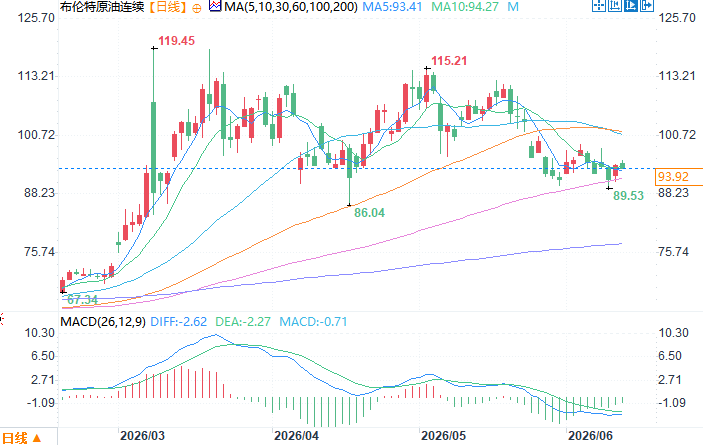
Brent crude oil daily chart source: EasyForex
At 13:50 Beijing time on June 11, Brent crude oil futures were trading at $93.36 per barrel.
Short sellers continued to increase their positions, and the market generally anticipated a rapid recovery in supply.
Based on the position data as of June 2, since April, various asset management institutions have been gradually placing short orders, and their bearish attitude towards oil prices has become increasingly clear.
Data compiled by energy analyst John Kemp shows that short positions in Brent crude oil tripled from the end of March to the beginning of June, reaching a new high since January of this year as of June 2. The continuous reduction of long positions and the constant entry of short positions over eight weeks reflects the prevailing market view that the situation in the Middle East will soon change, and the crude oil supply gap will be quickly filled.
Futures prices are always influenced by market sentiment and news. Currently, most hedge funds and investment institutions are not worried about a substantial shortage of physical goods during the summer. Ceasefire-related news repeatedly disrupts the market. Whenever there is a signal that an agreement is about to be reached, the market sells off crude oil contracts in a concentrated manner; while when regional conflicts reignite and the ceasefire is on the verge of breaking down, funds will briefly buy back long positions. The market fluctuates repeatedly, and the trading logic is completely detached from real supply and demand.
Inventories are declining sharply, and a crisis is gradually emerging in the spot market.
The optimism in the futures market cannot mask the grim reality of the fundamentals.
The International Energy Agency (IEA) stated in its May report that global daily crude oil supply decreased by 13 million barrels due to shipping disruptions in the Strait of Hormuz. From March to April, global crude oil inventories, including floating oil at sea, decreased by a total of 250 million barrels, with an average daily reduction of 4 million barrels, setting a new historical record.
The inventory situation at Cushing, Oklahoma, the delivery point for West Texas Intermediate (WTI) crude oil, is particularly critical. At the current rate of consumption, it will fall below the minimum operating reserve level within weeks. Even if the Strait of Hormuz fully reopens to navigation, the market will not be able to escape its predicament immediately. Shipping companies need time to confirm navigation safety, and the transportation and delivery of crude oil at sea are also time-consuming. Moreover, it is currently the traditional peak season for oil consumption in summer, and the market simply does not have enough time to wait for supply to recover.
With land-based inventories and floating oil at sea continuously decreasing, future oil price increases can only be barely suppressed by a decline in demand.
Trading activity cools down, industry giants warn of upside risks
The volatile situation and complex news have led many traders to choose to remain on the sidelines. In a report released Wednesday, ING commodity strategists Warren Patterson and Ewa Manthey stated that high market uncertainty and susceptibility to sudden news have resulted in a continued decline in total open interest in Brent crude oil on the Intercontinental Exchange, currently at its lowest level since August 2025.
Industry executives have issued clear warnings regarding future market trends. Chevron CEO Mike Wirth stated at a conference that the market's buffer resources are being depleted, significantly weakening its ability to absorb supply-demand imbalances. Pressure on the spot market will gradually be transmitted to prices, with oil prices facing stronger upward pressure in June and July. ING also believes that a settlement is unlikely in the short term, and the supply-demand imbalance in the crude oil market will continue to worsen. If supply disruptions extend into the third quarter, the traditional peak demand season, the potential for further price increases will expand.
In summary , the bearish sentiment in the futures market lacks fundamental support; dwindling inventories and tight supply are already established facts. Short-term news disturbances are unlikely to change the overall trend, and the upside risk for crude oil prices continues to rise.
Brent crude oil daily chart source: EasyForex
At 13:50 Beijing time on June 11, Brent crude oil futures were trading at $93.36 per barrel.
- Risk Warning and Disclaimer
- The market involves risk, and trading may not be suitable for all investors. This article is for reference only and does not constitute personal investment advice, nor does it take into account certain users’ specific investment objectives, financial situation, or other needs. Any investment decisions made based on this information are at your own risk.