US inflation rising to a three-year high reinforced expectations of interest rate hikes, sending gold to its lowest level since November of last year.
2026-06-11 09:49:15
Gold prices continued their decline in Asian trading on Thursday, briefly dipping to around $4,050 per ounce, their lowest level since November 2025. Market focus remained on stronger-than-expected US inflation data and changes in the Federal Reserve's future policy path. Strong inflation prompted investors to readjust their interest rate expectations, putting significant selling pressure on the gold market.

The latest data released by the U.S. Bureau of Labor Statistics shows that the Consumer Price Index (CPI) rose 4.2% year-on-year in May, higher than April's 3.8% and reaching its highest level in nearly three years, in line with market expectations. On a month-on-month basis, the CPI rose 0.5% in May, also in line with market forecasts. The core CPI, excluding food and energy prices, rose 0.2% month-on-month and 2.9% year-on-year, indicating that core inflation in the U.S. remains relatively resilient.
Rising inflationary pressures have prompted the market to lower its expectations for a near-term interest rate cut by the Federal Reserve. While the market widely expects the Fed to keep rates unchanged at its June meeting, interest rate futures indicate that investors are beginning to bet that the Fed may resume rate hikes later this year to address persistent inflation risks. Since gold itself does not generate interest income, the opportunity cost of holding gold increases in an environment of persistently high or even rising interest rates, leading funds to flow into higher-yielding dollar assets and the bond market.
Meanwhile, geopolitical tensions in the Middle East remain high. The U.S. Central Command stated that the U.S. launched military strikes against Iranian targets on Wednesday, calling the action a response to Iran's continued hostile behavior. Previously, U.S. President Trump had publicly stated that the U.S. would take stronger measures against Iran if a deal could not be reached. While geopolitical risks typically increase demand for gold as a safe-haven asset, the current market focus on rising inflation and the prospect of a hawkish Federal Reserve policy has prevented safe-haven factors from effectively preventing a decline in gold prices.
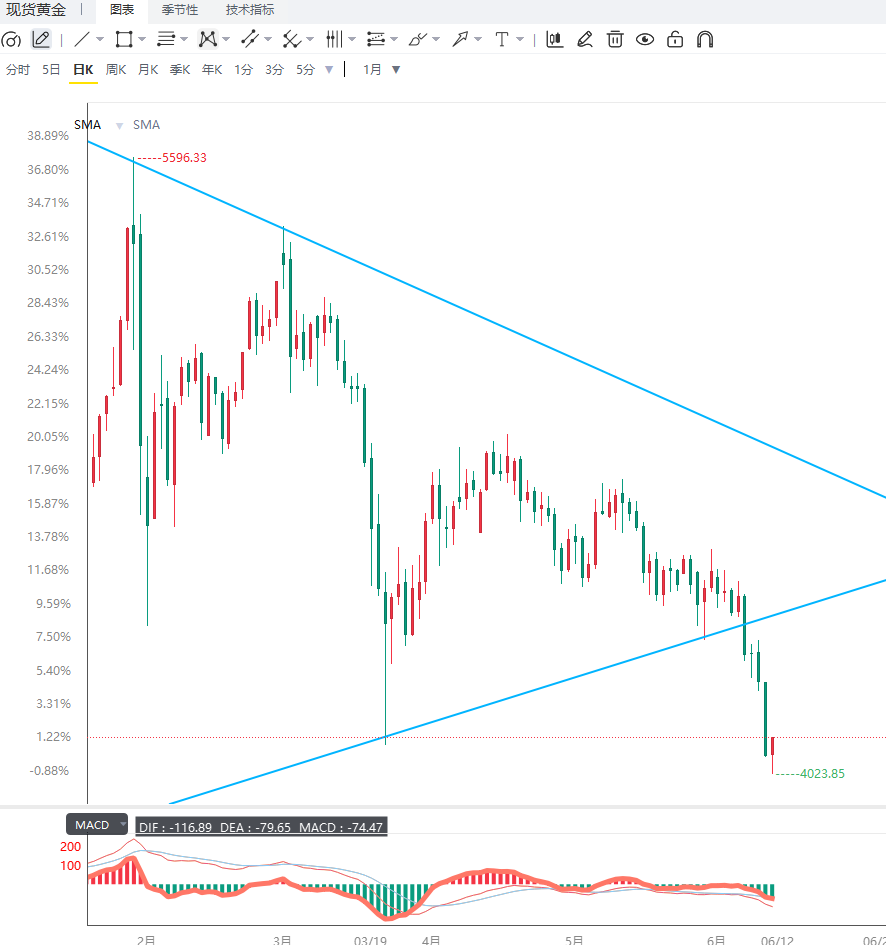
From a technical perspective, the daily chart shows that gold prices have broken below a previous key support level, and the overall trend has gradually shifted from high-level consolidation to a bearish dominance. Prices are trading below major short- and medium-term moving averages, indicating that selling pressure remains significant. The first key support level to watch is the psychological level of $4,000. A break below this level could see gold further test the $3,950 to $3,900 area. Initial resistance is seen around $4,150, with stronger resistance around $4,200. Technically, the RSI has entered weak territory, and the MACD has formed a death cross and continues to diverge downwards, indicating that the medium-term downward momentum has not yet fully dissipated.
From a 4-hour chart perspective, gold is showing a clear downward channel structure in the short term, with the moving average system maintaining a bearish alignment. Although some technical indicators suggest a possible brief oversold rebound after the continuous decline, the downtrend is expected to continue as long as the price cannot regain a foothold above $4200. In the short term, investors should pay attention to US economic data, speeches by Federal Reserve officials, and developments in the Middle East, as these factors could be significant catalysts affecting gold price fluctuations.
Editor's Summary : The current gold market is dominated by inflationary pressures and monetary policy expectations. Rising US inflation has reinforced market expectations that the Federal Reserve will maintain high interest rates for an extended period, or even further tighten policy, supporting the dollar and US Treasury yields and significantly suppressing gold, a non-interest-bearing asset. Although tensions in the Middle East may still temporarily boost safe-haven buying, gold's short-term trend remains downward until there is a clear shift in the high-interest-rate environment. Going forward, investors need to focus on subsequent changes in US inflation, the Federal Reserve's policy statements, and the development of global risk events to determine whether gold prices can stabilize at key support levels and find a new direction.
The latest data released by the U.S. Bureau of Labor Statistics shows that the Consumer Price Index (CPI) rose 4.2% year-on-year in May, higher than April's 3.8% and reaching its highest level in nearly three years, in line with market expectations. On a month-on-month basis, the CPI rose 0.5% in May, also in line with market forecasts. The core CPI, excluding food and energy prices, rose 0.2% month-on-month and 2.9% year-on-year, indicating that core inflation in the U.S. remains relatively resilient.
Rising inflationary pressures have prompted the market to lower its expectations for a near-term interest rate cut by the Federal Reserve. While the market widely expects the Fed to keep rates unchanged at its June meeting, interest rate futures indicate that investors are beginning to bet that the Fed may resume rate hikes later this year to address persistent inflation risks. Since gold itself does not generate interest income, the opportunity cost of holding gold increases in an environment of persistently high or even rising interest rates, leading funds to flow into higher-yielding dollar assets and the bond market.
Meanwhile, geopolitical tensions in the Middle East remain high. The U.S. Central Command stated that the U.S. launched military strikes against Iranian targets on Wednesday, calling the action a response to Iran's continued hostile behavior. Previously, U.S. President Trump had publicly stated that the U.S. would take stronger measures against Iran if a deal could not be reached. While geopolitical risks typically increase demand for gold as a safe-haven asset, the current market focus on rising inflation and the prospect of a hawkish Federal Reserve policy has prevented safe-haven factors from effectively preventing a decline in gold prices.
From a technical perspective, the daily chart shows that gold prices have broken below a previous key support level, and the overall trend has gradually shifted from high-level consolidation to a bearish dominance. Prices are trading below major short- and medium-term moving averages, indicating that selling pressure remains significant. The first key support level to watch is the psychological level of $4,000. A break below this level could see gold further test the $3,950 to $3,900 area. Initial resistance is seen around $4,150, with stronger resistance around $4,200. Technically, the RSI has entered weak territory, and the MACD has formed a death cross and continues to diverge downwards, indicating that the medium-term downward momentum has not yet fully dissipated.
From a 4-hour chart perspective, gold is showing a clear downward channel structure in the short term, with the moving average system maintaining a bearish alignment. Although some technical indicators suggest a possible brief oversold rebound after the continuous decline, the downtrend is expected to continue as long as the price cannot regain a foothold above $4200. In the short term, investors should pay attention to US economic data, speeches by Federal Reserve officials, and developments in the Middle East, as these factors could be significant catalysts affecting gold price fluctuations.
Editor's Summary : The current gold market is dominated by inflationary pressures and monetary policy expectations. Rising US inflation has reinforced market expectations that the Federal Reserve will maintain high interest rates for an extended period, or even further tighten policy, supporting the dollar and US Treasury yields and significantly suppressing gold, a non-interest-bearing asset. Although tensions in the Middle East may still temporarily boost safe-haven buying, gold's short-term trend remains downward until there is a clear shift in the high-interest-rate environment. Going forward, investors need to focus on subsequent changes in US inflation, the Federal Reserve's policy statements, and the development of global risk events to determine whether gold prices can stabilize at key support levels and find a new direction.
- Risk Warning and Disclaimer
- The market involves risk, and trading may not be suitable for all investors. This article is for reference only and does not constitute personal investment advice, nor does it take into account certain users’ specific investment objectives, financial situation, or other needs. Any investment decisions made based on this information are at your own risk.