Gold Trading Alert: Trump cancels airstrikes against Iran! Gold prices stage a dramatic rebound of 3.4%; could a peace agreement be signed this weekend, restarting the bull market?
2026-06-12 07:44:05
The spot gold market experienced a dramatic reversal on Thursday (June 11). Gold prices, which had initially fallen to a six-month low of $4,023.85 per ounce due to Middle East tensions, surged after news broke that US President Trump had abruptly canceled plans for military strikes against Iran, ultimately closing up 3.4% at $4,210.58 per ounce. In early Asian trading on Friday (June 12), spot gold briefly rose to $4,246.40 per ounce. This strong rebound erased all of Wednesday's losses and reignited market enthusiasm for gold as a safe-haven asset. Investors are beginning to reassess: with the emergence of signs of peace, a rapid cooling of risk aversion, falling oil prices, expectations of a Fed rate hike being lowered, and a weakening dollar, in this complex environment of intertwined geopolitical and macroeconomic factors, can gold continue its rebound? Has the bull market restarted?

On Thursday, global financial markets were entirely focused on the sharp de-escalation of tensions in the Middle East. Previously, Trump had threatened a major airstrike against Iran and expressed his desire to "seize" Hag Island, Iran's oil export hub, raising concerns that an escalation of the conflict would drive up oil prices and exacerbate global inflation. However, just hours before the planned strikes, Trump announced the cancellation of the plans and released a major positive development: the US and Iran could sign a peace agreement as early as this weekend, restarting shipping through the Strait of Hormuz.
According to Trump, the agreement has been approved by Iran's top leadership and has received support from a wide range of regional countries, including Israel, Saudi Arabia, the UAE, and Qatar. Iran's semi-official Fars News Agency also reported that Tehran is likely to approve the text of the agreement, although an official response has not yet been released. This conflict, which has lasted for more than three months, has resulted in thousands of deaths and severely disrupted global energy supply chains. If the agreement is ultimately reached, it will be a major diplomatic breakthrough, not only temporarily easing Iran's control over the Strait of Hormuz and ending the port blockade, but also potentially paving the way for future nuclear negotiations.
Ryan McKay, a commodities strategist at TD Securities, pointed out that while similar "agreement is imminent" news had repeatedly failed to materialize in the past, this time, if it comes to fruition, it will significantly help gold prices recover from their lows. The market reacted extremely quickly to this shift: risk aversion subsided rapidly, and risk assets were sought after.
Despite a temporary easing of geopolitical risks, US economic data provided additional support for gold. Wednesday's May Consumer Price Index (CPI) showed inflation rising at its fastest pace in three years, driven by soaring energy prices; Thursday's May Producer Price Index (PPI) also exceeded expectations, rising 1.1% month-on-month. These data remind investors that the transmission effect of the Middle East conflict on energy prices has not completely dissipated, and inflationary pressures remain.
Meanwhile, the CME FedWatch tool showed that the probability of a December rate hike by the Federal Reserve fell from 72% to 59% after Trump announced the cancellation of the stimulus measures, with some traders even betting on 55%. Investors are awaiting the first Fed meeting next week, chaired by new Chairman Warsh, and widely expect policymakers to keep interest rates unchanged. Initial jobless claims rose to 229,000, slightly higher than expected, further highlighting the uncertainty facing the economy.
In this environment, gold's "dual nature"—serving as both an inflation hedge and a safe-haven asset—is fully demonstrated. Even if a peace agreement is reached, the oil market may still take several months to fully recover, and the inflation transmission effect will continue to influence policy paths, providing long-term support for gold prices.
The surge in gold prices was not an isolated event, but rather a response to the broader global asset market. Oil prices fell significantly on Thursday, with Brent crude down 2.9% to $90.38 a barrel and U.S. crude down 2.6% to $87.71 a barrel. Market expectations of an agreement and the resumption of shipping through the Strait of Hormuz directly eased concerns about energy supply.
The dollar index fell 0.35% to 99.69 on Thursday, while major currencies such as the euro strengthened. Juan Perez, head of trading at Monex USA, analyzed that the market has gradually become accustomed to Trump's "escalate first, then de-escalate" negotiation pattern. When signs of peace emerged, funds quickly flowed into risk assets, putting pressure on the dollar. Wall Street's three major stock indexes closed sharply higher, with the Dow Jones Industrial Average up 1.86%, the S&P 500 up 1.75%, and the Nasdaq up 2.54%. Chip stocks led the gains, with the Philadelphia Semiconductor Index surging 7.9%. U.S. Treasury yields fell across the board, with the 10-year Treasury yield falling back to around 4.45%, reflecting a revision in investors' expectations for interest rate hikes.
These interconnected effects further amplified the rise in gold prices: a weaker dollar directly benefited dollar-denominated gold, while the reactions in the stock and bond markets indicated a rebound in overall market risk appetite.
In the short term, the recent rebound in gold prices has been largely complete, and some profit-taking may drive a technical correction. Uncertainties remain regarding the details of the agreement—including the release of frozen Iranian assets, the handling of the nuclear issue, and the attitude of hardliners within the Republican Party—and if negotiations falter, geopolitical risk premiums could quickly return, potentially providing renewed support for gold.
From a medium- to long-term perspective, even if a peace agreement is successfully signed, the global economy will still face multiple challenges: the lingering effects of high energy prices, sticky inflation, uncertainty surrounding the Federal Reserve's policy path, and broader geopolitical risks will all continue to support the attractiveness of gold as a diversified asset allocation.
Analysts generally believe that the $4,200 level has become a significant psychological barrier. If the agreement is quickly finalized and oil prices continue to decline, gold prices can hold steady and, along with a further weakening of the dollar, could test the resistance near the May 28 low of $4,366, followed by the 200-day moving average resistance near $4,446. Conversely, if the situation in the Middle East deteriorates again, gold may face some pressure. Overall, however, given the current macroeconomic backdrop, the downside for gold is limited, while its upside potential remains promising.
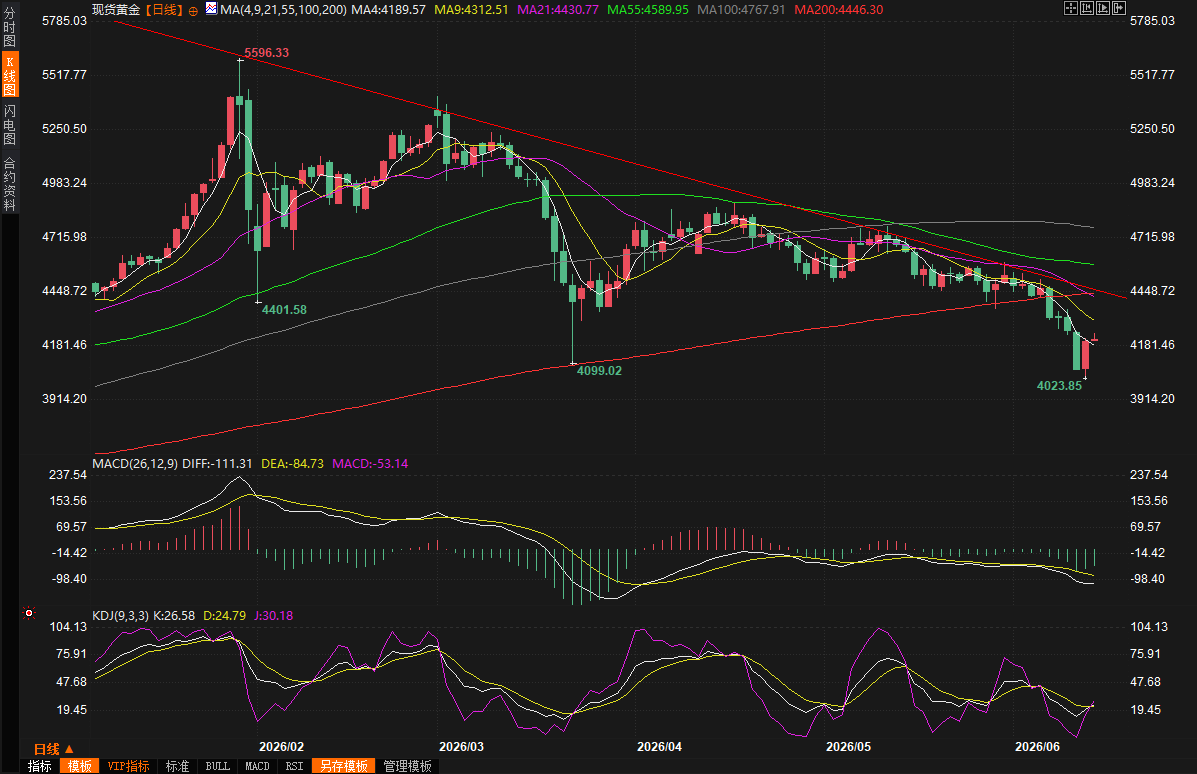
(Spot gold daily chart, source: FX678)
At 07:41 Beijing time, spot gold was trading at $4215.80 per ounce.
Geopolitical Dramatic Reversal: From the Brink of War to the Dawn of a Peace Agreement
On Thursday, global financial markets were entirely focused on the sharp de-escalation of tensions in the Middle East. Previously, Trump had threatened a major airstrike against Iran and expressed his desire to "seize" Hag Island, Iran's oil export hub, raising concerns that an escalation of the conflict would drive up oil prices and exacerbate global inflation. However, just hours before the planned strikes, Trump announced the cancellation of the plans and released a major positive development: the US and Iran could sign a peace agreement as early as this weekend, restarting shipping through the Strait of Hormuz.
According to Trump, the agreement has been approved by Iran's top leadership and has received support from a wide range of regional countries, including Israel, Saudi Arabia, the UAE, and Qatar. Iran's semi-official Fars News Agency also reported that Tehran is likely to approve the text of the agreement, although an official response has not yet been released. This conflict, which has lasted for more than three months, has resulted in thousands of deaths and severely disrupted global energy supply chains. If the agreement is ultimately reached, it will be a major diplomatic breakthrough, not only temporarily easing Iran's control over the Strait of Hormuz and ending the port blockade, but also potentially paving the way for future nuclear negotiations.
Ryan McKay, a commodities strategist at TD Securities, pointed out that while similar "agreement is imminent" news had repeatedly failed to materialize in the past, this time, if it comes to fruition, it will significantly help gold prices recover from their lows. The market reacted extremely quickly to this shift: risk aversion subsided rapidly, and risk assets were sought after.
Inflation data and Fed expectations intertwine: Macroeconomic support for gold's rebound.
Despite a temporary easing of geopolitical risks, US economic data provided additional support for gold. Wednesday's May Consumer Price Index (CPI) showed inflation rising at its fastest pace in three years, driven by soaring energy prices; Thursday's May Producer Price Index (PPI) also exceeded expectations, rising 1.1% month-on-month. These data remind investors that the transmission effect of the Middle East conflict on energy prices has not completely dissipated, and inflationary pressures remain.
Meanwhile, the CME FedWatch tool showed that the probability of a December rate hike by the Federal Reserve fell from 72% to 59% after Trump announced the cancellation of the stimulus measures, with some traders even betting on 55%. Investors are awaiting the first Fed meeting next week, chaired by new Chairman Warsh, and widely expect policymakers to keep interest rates unchanged. Initial jobless claims rose to 229,000, slightly higher than expected, further highlighting the uncertainty facing the economy.
In this environment, gold's "dual nature"—serving as both an inflation hedge and a safe-haven asset—is fully demonstrated. Even if a peace agreement is reached, the oil market may still take several months to fully recover, and the inflation transmission effect will continue to influence policy paths, providing long-term support for gold prices.
Market reaction: Oil prices fell, the dollar weakened, and the stock market rallied.
The surge in gold prices was not an isolated event, but rather a response to the broader global asset market. Oil prices fell significantly on Thursday, with Brent crude down 2.9% to $90.38 a barrel and U.S. crude down 2.6% to $87.71 a barrel. Market expectations of an agreement and the resumption of shipping through the Strait of Hormuz directly eased concerns about energy supply.
The dollar index fell 0.35% to 99.69 on Thursday, while major currencies such as the euro strengthened. Juan Perez, head of trading at Monex USA, analyzed that the market has gradually become accustomed to Trump's "escalate first, then de-escalate" negotiation pattern. When signs of peace emerged, funds quickly flowed into risk assets, putting pressure on the dollar. Wall Street's three major stock indexes closed sharply higher, with the Dow Jones Industrial Average up 1.86%, the S&P 500 up 1.75%, and the Nasdaq up 2.54%. Chip stocks led the gains, with the Philadelphia Semiconductor Index surging 7.9%. U.S. Treasury yields fell across the board, with the 10-year Treasury yield falling back to around 4.45%, reflecting a revision in investors' expectations for interest rate hikes.
These interconnected effects further amplified the rise in gold prices: a weaker dollar directly benefited dollar-denominated gold, while the reactions in the stock and bond markets indicated a rebound in overall market risk appetite.
Gold Market Outlook: Short-term pullback risk coexists with long-term support.
In the short term, the recent rebound in gold prices has been largely complete, and some profit-taking may drive a technical correction. Uncertainties remain regarding the details of the agreement—including the release of frozen Iranian assets, the handling of the nuclear issue, and the attitude of hardliners within the Republican Party—and if negotiations falter, geopolitical risk premiums could quickly return, potentially providing renewed support for gold.
From a medium- to long-term perspective, even if a peace agreement is successfully signed, the global economy will still face multiple challenges: the lingering effects of high energy prices, sticky inflation, uncertainty surrounding the Federal Reserve's policy path, and broader geopolitical risks will all continue to support the attractiveness of gold as a diversified asset allocation.
Analysts generally believe that the $4,200 level has become a significant psychological barrier. If the agreement is quickly finalized and oil prices continue to decline, gold prices can hold steady and, along with a further weakening of the dollar, could test the resistance near the May 28 low of $4,366, followed by the 200-day moving average resistance near $4,446. Conversely, if the situation in the Middle East deteriorates again, gold may face some pressure. Overall, however, given the current macroeconomic backdrop, the downside for gold is limited, while its upside potential remains promising.
(Spot gold daily chart, source: FX678)
At 07:41 Beijing time, spot gold was trading at $4215.80 per ounce.
- Risk Warning and Disclaimer
- The market involves risk, and trading may not be suitable for all investors. This article is for reference only and does not constitute personal investment advice, nor does it take into account certain users’ specific investment objectives, financial situation, or other needs. Any investment decisions made based on this information are at your own risk.