













Why did the euro surge and then fall back despite the ECB's interest rate hike and signals of peace between the US and Iran?
2026-06-12 09:35:38
On Friday (June 12) in early Asian trading, the euro rose against the dollar to around 1.1585, driven by the European Central Bank's first interest rate hike since 2023 and improved market risk sentiment. It then fell back and is currently trading around 1.1565, down about 0.13%.
On June 11 local time, the European Central Bank (ECB) announced a 25 basis point increase in each of the eurozone's three key interest rates. In a press release that day, the ECB stated that, effective June 17, the eurozone deposit facility rate, main refinancing rate, and marginal lending rate would be raised to 2.25%, 2.40%, and 2.65%, respectively. This is the ECB's first interest rate hike since July 2023, making it the first major economy central bank to resume raising interest rates this year.
The European Central Bank's interest rate hike was primarily aimed at addressing rising energy price pressures stemming from the Middle East conflict. Preliminary data released by Eurostat showed that the eurozone's consumer price index (CPI) rose 3.2% year-on-year in May, the highest level since September 2023, with energy prices rising 10.9% year-on-year and services inflation widening to 3.5%.
The eurozone's inflation rate of 3.2% in May was well above the European Central Bank's 2% target, and even core inflation, excluding energy and food prices, rose to 2.5%, indicating that the impact of the situation in the Middle East is pushing up prices. Energy costs are being passed on to households through gasoline, heating, and electricity prices; however, this transmission is now beginning to penetrate more broadly into the core inflation area.
The European Central Bank has simultaneously raised its inflation forecast for the Eurozone, projecting inflation at 3% in 2026 and 2.3% in 2027; its March forecasts were 2.6% in 2026 and 2% in 2027.
Like most central banks, the European Central Bank (ECB) is currently facing a policy dilemma: if it doesn't raise interest rates, inflation will remain high, damaging the credibility of its monetary policy; if it does raise rates, the risk of economic recession will increase, and the potential for a debt crisis will rise. This rate hike indicates that the ECB believes controlling inflation is more urgent.
In summary, the ECB's rate hike this time is more like a "precautionary rate hike," that is, to stabilize market expectations by taking action in advance, rather than waiting for inflation to get out of control and then responding passively. Taking action in advance is more prudent than remedial measures afterward.
US President Trump said he has canceled a new round of military strikes against Iran scheduled for Thursday, as negotiators are close to reaching an agreement on the final elements of a deal.
This news eased market concerns about the situation in the Middle East, causing oil prices to fall, global stock markets to rise, and risk-sensitive currencies such as the euro and the Australian dollar to be boosted.
At the same time, traffic through the Strait of Hormuz is expected to gradually recover, and energy prices, which had been driven up by concerns about supply disruptions, have rebounded. This has further eased the imported inflationary pressures facing the Eurozone and left more room for the European Central Bank's subsequent policy operations.
Nevertheless, uncertainty remains high. Trump has repeatedly stated that a deal is imminent, but these statements have ultimately failed to materialize. Iran has also not confirmed the US statements, and significant differences remain between the two sides on key issues.
If there are any signs of escalation in US-Iran tensions—such as a new military conflict or the Strait of Hormuz being blocked again—safe-haven funds could quickly flow back to the US dollar, thus creating a significant headwind for the euro against the dollar.
Therefore, investors should remain vigilant amid optimism, as any news of a breakdown in negotiations could trigger a rapid market reversal.
With the ECB's June rate hike now a done deal, market attention is shifting to the central bank's future policy path. At the press conference, Lagarde did not rule out further rate hikes, emphasizing that future decisions will depend entirely on economic data, particularly the inflation outlook and the transmission effects of energy prices.
She pointed out that if the Middle East conflict continues to drive up energy costs and cause inflation expectations to derail, the ECB will not hesitate to take further action. Currently, the market widely expects the ECB to raise interest rates by another 25 basis points in September or October, but the specific pace remains highly uncertain.
Meanwhile, the evolving situation in the Middle East remains a key variable influencing risk sentiment and the euro's trajectory. If a peace agreement is ultimately reached, oil shipments through the Strait of Hormuz are expected to gradually return to normal, and the decline in energy prices will alleviate inflationary pressures in the Eurozone, while simultaneously boosting global risk appetite. The euro may further benefit from rising risk assets.
However, if negotiations break down or tensions escalate again, safe-haven funds will flow back into the US dollar, potentially causing the dollar index to strengthen again, while the euro will face downward pressure against the dollar, and may even give back all of this week's gains.
In the short term, the euro's exchange rate will remain highly volatile under the dual influence of policy expectations and geopolitical risks.
The euro is currently in a weak downward channel against the US dollar on the daily chart, with the price around 1.1565, showing significant downward pressure.
Moving average system: The price is running below the MA20, MA50, MA100 and MA200. The short-term moving averages are close to a bearish alignment, while the medium and long-term moving averages are flat or slightly downward, forming layers of resistance, and the overall trend is weak.
MACD indicator: DIFF and DEA are below the zero axis, and the histogram is a weak green bar, indicating that although the bearish momentum has weakened, it still dominates the market.
RSI indicator: The RSI is 42, which is in the neutral to bearish range. It has not entered the oversold range, indicating that the downward momentum has not been fully released and there is still a risk of further decline in the short term.
Key support levels are the previous lows of 1.1410 and 1.1499, while resistance is the moving average cluster resistance zone of 1.1670-1.1700. If the price fails to quickly recover the MA20, it will likely continue its weakness; however, if it breaks through the moving average resistance with increased volume, a short-term rebound may be possible.
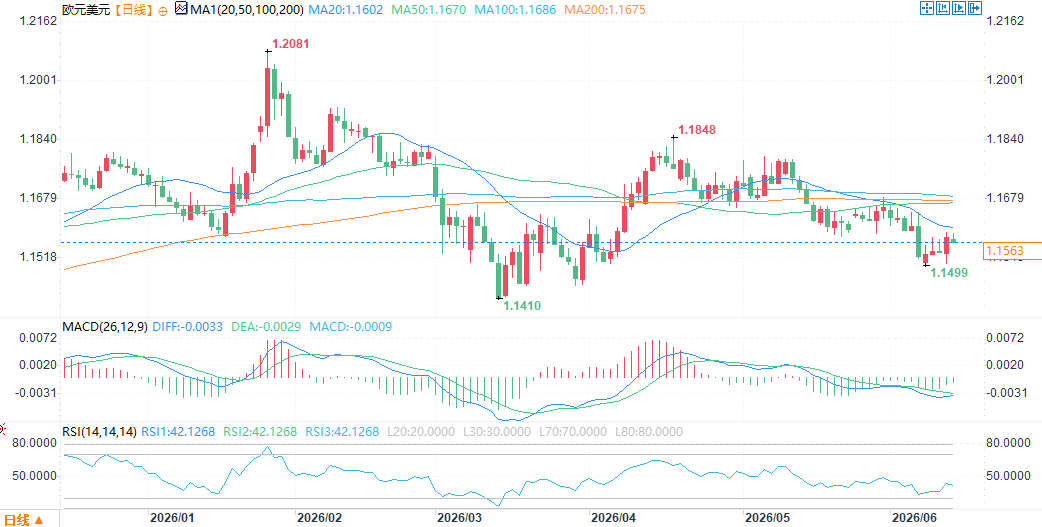
(Euro/USD daily chart, source: FX678)
At 9:35 AM Beijing time on June 12, the euro was trading at 1.1564/65 against the US dollar.
The European Central Bank raised interest rates by 25 basis points as expected, the first such increase since 2023.
On June 11 local time, the European Central Bank (ECB) announced a 25 basis point increase in each of the eurozone's three key interest rates. In a press release that day, the ECB stated that, effective June 17, the eurozone deposit facility rate, main refinancing rate, and marginal lending rate would be raised to 2.25%, 2.40%, and 2.65%, respectively. This is the ECB's first interest rate hike since July 2023, making it the first major economy central bank to resume raising interest rates this year.
The European Central Bank's interest rate hike was primarily aimed at addressing rising energy price pressures stemming from the Middle East conflict. Preliminary data released by Eurostat showed that the eurozone's consumer price index (CPI) rose 3.2% year-on-year in May, the highest level since September 2023, with energy prices rising 10.9% year-on-year and services inflation widening to 3.5%.
The eurozone's inflation rate of 3.2% in May was well above the European Central Bank's 2% target, and even core inflation, excluding energy and food prices, rose to 2.5%, indicating that the impact of the situation in the Middle East is pushing up prices. Energy costs are being passed on to households through gasoline, heating, and electricity prices; however, this transmission is now beginning to penetrate more broadly into the core inflation area.
The European Central Bank has simultaneously raised its inflation forecast for the Eurozone, projecting inflation at 3% in 2026 and 2.3% in 2027; its March forecasts were 2.6% in 2026 and 2% in 2027.
Like most central banks, the European Central Bank (ECB) is currently facing a policy dilemma: if it doesn't raise interest rates, inflation will remain high, damaging the credibility of its monetary policy; if it does raise rates, the risk of economic recession will increase, and the potential for a debt crisis will rise. This rate hike indicates that the ECB believes controlling inflation is more urgent.
In summary, the ECB's rate hike this time is more like a "precautionary rate hike," that is, to stabilize market expectations by taking action in advance, rather than waiting for inflation to get out of control and then responding passively. Taking action in advance is more prudent than remedial measures afterward.
Uncertainty remains high, and vigilance is needed against recurring situations.
US President Trump said he has canceled a new round of military strikes against Iran scheduled for Thursday, as negotiators are close to reaching an agreement on the final elements of a deal.
This news eased market concerns about the situation in the Middle East, causing oil prices to fall, global stock markets to rise, and risk-sensitive currencies such as the euro and the Australian dollar to be boosted.
At the same time, traffic through the Strait of Hormuz is expected to gradually recover, and energy prices, which had been driven up by concerns about supply disruptions, have rebounded. This has further eased the imported inflationary pressures facing the Eurozone and left more room for the European Central Bank's subsequent policy operations.
Nevertheless, uncertainty remains high. Trump has repeatedly stated that a deal is imminent, but these statements have ultimately failed to materialize. Iran has also not confirmed the US statements, and significant differences remain between the two sides on key issues.
If there are any signs of escalation in US-Iran tensions—such as a new military conflict or the Strait of Hormuz being blocked again—safe-haven funds could quickly flow back to the US dollar, thus creating a significant headwind for the euro against the dollar.
Therefore, investors should remain vigilant amid optimism, as any news of a breakdown in negotiations could trigger a rapid market reversal.
Outlook: Following the interest rate hike, market focus shifts to the subsequent path of interest rate action.
With the ECB's June rate hike now a done deal, market attention is shifting to the central bank's future policy path. At the press conference, Lagarde did not rule out further rate hikes, emphasizing that future decisions will depend entirely on economic data, particularly the inflation outlook and the transmission effects of energy prices.
She pointed out that if the Middle East conflict continues to drive up energy costs and cause inflation expectations to derail, the ECB will not hesitate to take further action. Currently, the market widely expects the ECB to raise interest rates by another 25 basis points in September or October, but the specific pace remains highly uncertain.
Meanwhile, the evolving situation in the Middle East remains a key variable influencing risk sentiment and the euro's trajectory. If a peace agreement is ultimately reached, oil shipments through the Strait of Hormuz are expected to gradually return to normal, and the decline in energy prices will alleviate inflationary pressures in the Eurozone, while simultaneously boosting global risk appetite. The euro may further benefit from rising risk assets.
However, if negotiations break down or tensions escalate again, safe-haven funds will flow back into the US dollar, potentially causing the dollar index to strengthen again, while the euro will face downward pressure against the dollar, and may even give back all of this week's gains.
In the short term, the euro's exchange rate will remain highly volatile under the dual influence of policy expectations and geopolitical risks.
Technical Analysis
The euro is currently in a weak downward channel against the US dollar on the daily chart, with the price around 1.1565, showing significant downward pressure.
Moving average system: The price is running below the MA20, MA50, MA100 and MA200. The short-term moving averages are close to a bearish alignment, while the medium and long-term moving averages are flat or slightly downward, forming layers of resistance, and the overall trend is weak.
MACD indicator: DIFF and DEA are below the zero axis, and the histogram is a weak green bar, indicating that although the bearish momentum has weakened, it still dominates the market.
RSI indicator: The RSI is 42, which is in the neutral to bearish range. It has not entered the oversold range, indicating that the downward momentum has not been fully released and there is still a risk of further decline in the short term.
Key support levels are the previous lows of 1.1410 and 1.1499, while resistance is the moving average cluster resistance zone of 1.1670-1.1700. If the price fails to quickly recover the MA20, it will likely continue its weakness; however, if it breaks through the moving average resistance with increased volume, a short-term rebound may be possible.
(Euro/USD daily chart, source: FX678)
At 9:35 AM Beijing time on June 12, the euro was trading at 1.1564/65 against the US dollar.
- Risk Warning and Disclaimer
- The market involves risk, and trading may not be suitable for all investors. This article is for reference only and does not constitute personal investment advice, nor does it take into account certain users’ specific investment objectives, financial situation, or other needs. Any investment decisions made based on this information are at your own risk.

