Oil prices continued to fall on Friday: "Dawn of peace" met with "demand ebb".
2026-06-12 16:34:43
Oil prices continued to fall during the European trading session on Friday (June 12). West Texas Intermediate crude futures for July delivery fell about 1.8% to around $86 a barrel, while Brent crude futures for August delivery fell 2% to around $88.50 a barrel.
US President Trump said that Washington has reached a framework agreement with Iran, fueling market expectations that the Middle East conflict may be nearing its end.
Trump said in the Oval Office that he expects the agreement to be signed "in the next few days"—although he has made similar statements on several occasions during the conflict.
He also stated that the Strait of Hormuz will be reopened once the agreement is finalized.

Trump stated earlier that he had canceled a planned new round of military strikes against Iran, citing that "the results of consultations with Iran have been submitted to and approved by Iran's supreme leadership."
He posted on social media that military action was no longer necessary given the smooth progress of the negotiations, and emphasized that the United States has always prioritized seeking a diplomatic solution.
However, Iran refuted Trump's claims. The official Iranian news agency Fars reported on social media that Iran has not yet approved any draft preliminary memorandum of understanding reached with Washington.
The report points out that the two sides still have differences on key issues and are still quite far from a final agreement.
In a subsequent post, Fars described Trump's announcement as a concession to his previous military threats, saying he failed to offer anything new beyond the proposals already submitted by Iran.
Fars further analyzed that Trump's statement was more like a "face-saving project"—wanting to show diplomatic achievements to the domestic audience while being unwilling to admit concessions on military deterrence.
Fars reported, "In fact, as of now, Iran has not only failed to give a final response, but the United States has reverted to its previous demands. However, given that the United States has accepted the text proposed by Iran, there is a possibility that the text will be reviewed again." This statement suggests that although an agreement has not yet been finalized, the two sides are still maintaining communication channels, and there is still room for future negotiations.
Overall, the Rashomon-like situation between the US and Iran over the agreement continues, thus dampening market optimism about the prospects for peace.
BMO Capital Markets points out that despite recent attacks between the US and Iran, oil prices have surprisingly remained relatively stable. The firm believes that ongoing diplomatic efforts, alternative shipping routes around the Strait of Hormuz, and a significant decrease in crude oil imports by Asian countries have collectively helped offset the upward pressure on oil prices from geopolitical risks.
Specifically, on the diplomatic front, although the US and Iran still have disagreements on the details of the agreement, frequent indirect negotiations and the mediation efforts of intermediary countries have alleviated market panic about the conflict spiraling out of control to some extent. Even with occasional military clashes, investors are still willing to believe that diplomatic channels have not been completely closed.
Regarding shipping alternatives, some tankers have begun to circumnavigate the Cape of Good Hope, which, despite the longer journey and higher costs, avoids the worst-case scenario of supply disruptions.
In addition, Gulf oil-producing countries such as Saudi Arabia and the UAE have increased crude oil exports to Asian customers, partially filling the gap left by the withdrawal of Iranian crude oil from the market.
Meanwhile, the sharp decline in Asian crude oil imports is one of the key variables suppressing oil prices. Asian purchases have decreased significantly in recent months, partly due to seasonal maintenance at domestic refineries, and partly due to previously high prices dampening purchasing intentions.
BMO points out that the cooling demand in Asia has effectively alleviated market panic over supply shortages and reduced the risk of buyers scrambling for spot goods. As long as Asian imports remain at their current relatively low levels, the global crude oil market's supply and demand balance will not experience extreme tension.
In summary, these three factors together form a buffer, allowing oil prices to remain relatively stable amid geopolitical turmoil.
Citibank echoed this view in a report on Friday. Citibank noted that since the outbreak of the Middle East conflict, a significant decline in crude oil imports by Asian importers has helped curb rising oil prices and reduced concerns about a supply war.
The bank estimates that Asian importers can keep imports around 8.7 million barrels per day without significantly depleting their inventories, meaning that demand from Asian importers is unlikely to provide significant upward momentum for oil prices in the short term.
Citigroup analysts believe that the cooling of import demand in Asian importing countries is not a temporary phenomenon, but rather the result of a combination of factors. Firstly, domestic refineries are entering a period of concentrated maintenance, limiting processing capacity in the short term and naturally reducing demand for imported crude oil. Secondly, the previously high oil prices led some buyers to adopt a wait-and-see approach or postpone their purchases, awaiting a more suitable price.
Furthermore, the release of strategic petroleum reserves by Asian importing countries has, to some extent, substituted for import demand. Citigroup points out that, unlike the "panic buying" that was widely feared at the beginning of the Middle East conflict, Asian importers have acted with unusual calm and restraint, a stark contrast to the frantic purchasing by other Asian importers.
From an inventory perspective, Citi estimates that Asian importers' current commercial and strategic inventories remain at relatively ample levels, with daily imports of 8.7 million barrels sufficient to meet current refinery operating needs without depleting inventory floor levels.
This means that even if oil prices fluctuate in the coming weeks, Asian importers are unlikely to be the main force driving up prices.
Citigroup further stated that if imports from Asian countries continue to remain below 9 million barrels per day, the global crude oil market's supply and demand balance will tilt towards a more relaxed state, which will to some extent offset the premium support brought by geopolitical risks. For oil prices, the "absence" of demand from Asian importing countries is becoming a real constraint that bullish investors must face.
US crude oil is currently in a pullback phase from its highs on the daily chart, with a short-term bearish trend. Prices have broken below the 20-day and 50-day moving averages, and the 20-day moving average is turning downwards, exerting downward pressure. However, it remains above the 200-day moving average, meaning the medium- to long-term upward trend has not been completely broken. Key support lies near previous lows, while moving averages and previous highs form multiple resistance levels.
In terms of indicators, the MACD indicator's DIFF line is running below the DEA line, and the green bars continue to expand, indicating that the bearish momentum is still ongoing. The RSI indicator is around 40, which has entered the weak zone but has not yet been oversold, suggesting that the downward momentum has not completely exhausted.
In summary, crude oil is currently in a high-level consolidation with a slightly weak bias, with short-term bears dominating the market. Prices are suppressed by moving averages, limiting the rebound potential. If the support level is broken, it could open up further downside potential; if the support holds, a technical rebound may occur, but the overall trend remains weak.
The trading strategy should be primarily bearish, with a focus on the effectiveness of the support levels below and subsequent changes in moving averages and indicators.
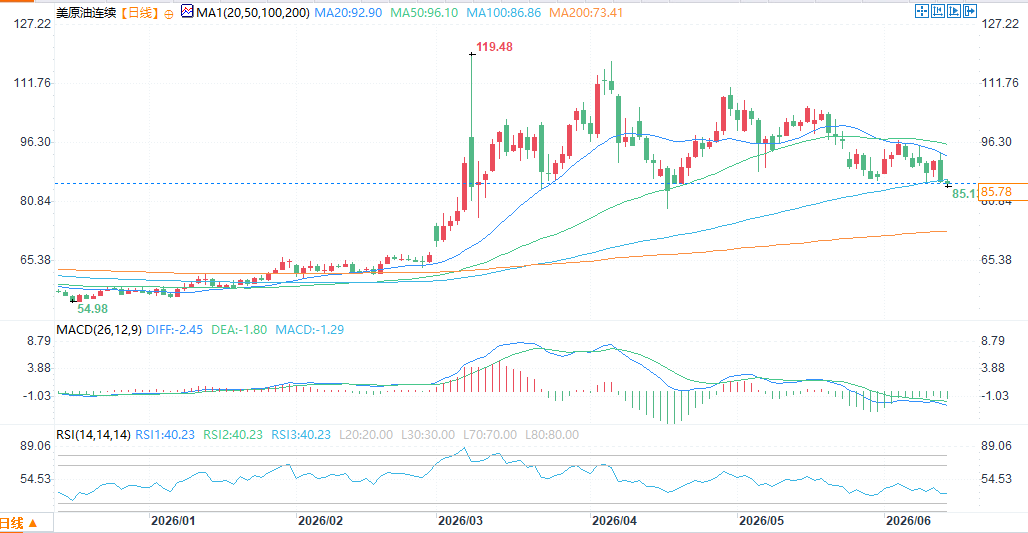
(US crude oil futures daily chart, source: FX678)
At 15:25 Beijing time on June 12, US crude oil futures were trading at $86.08 per barrel.
US President Trump said that Washington has reached a framework agreement with Iran, fueling market expectations that the Middle East conflict may be nearing its end.
Trump said in the Oval Office that he expects the agreement to be signed "in the next few days"—although he has made similar statements on several occasions during the conflict.
He also stated that the Strait of Hormuz will be reopened once the agreement is finalized.
Trump cancels military strike; Iran denies agreement reached.
Trump stated earlier that he had canceled a planned new round of military strikes against Iran, citing that "the results of consultations with Iran have been submitted to and approved by Iran's supreme leadership."
He posted on social media that military action was no longer necessary given the smooth progress of the negotiations, and emphasized that the United States has always prioritized seeking a diplomatic solution.
However, Iran refuted Trump's claims. The official Iranian news agency Fars reported on social media that Iran has not yet approved any draft preliminary memorandum of understanding reached with Washington.
The report points out that the two sides still have differences on key issues and are still quite far from a final agreement.
In a subsequent post, Fars described Trump's announcement as a concession to his previous military threats, saying he failed to offer anything new beyond the proposals already submitted by Iran.
Fars further analyzed that Trump's statement was more like a "face-saving project"—wanting to show diplomatic achievements to the domestic audience while being unwilling to admit concessions on military deterrence.
Fars reported, "In fact, as of now, Iran has not only failed to give a final response, but the United States has reverted to its previous demands. However, given that the United States has accepted the text proposed by Iran, there is a possibility that the text will be reviewed again." This statement suggests that although an agreement has not yet been finalized, the two sides are still maintaining communication channels, and there is still room for future negotiations.
Overall, the Rashomon-like situation between the US and Iran over the agreement continues, thus dampening market optimism about the prospects for peace.
BMO: Oil prices are relatively stable, with multiple factors offsetting geopolitical risks.
BMO Capital Markets points out that despite recent attacks between the US and Iran, oil prices have surprisingly remained relatively stable. The firm believes that ongoing diplomatic efforts, alternative shipping routes around the Strait of Hormuz, and a significant decrease in crude oil imports by Asian countries have collectively helped offset the upward pressure on oil prices from geopolitical risks.
Specifically, on the diplomatic front, although the US and Iran still have disagreements on the details of the agreement, frequent indirect negotiations and the mediation efforts of intermediary countries have alleviated market panic about the conflict spiraling out of control to some extent. Even with occasional military clashes, investors are still willing to believe that diplomatic channels have not been completely closed.
Regarding shipping alternatives, some tankers have begun to circumnavigate the Cape of Good Hope, which, despite the longer journey and higher costs, avoids the worst-case scenario of supply disruptions.
In addition, Gulf oil-producing countries such as Saudi Arabia and the UAE have increased crude oil exports to Asian customers, partially filling the gap left by the withdrawal of Iranian crude oil from the market.
Meanwhile, the sharp decline in Asian crude oil imports is one of the key variables suppressing oil prices. Asian purchases have decreased significantly in recent months, partly due to seasonal maintenance at domestic refineries, and partly due to previously high prices dampening purchasing intentions.
BMO points out that the cooling demand in Asia has effectively alleviated market panic over supply shortages and reduced the risk of buyers scrambling for spot goods. As long as Asian imports remain at their current relatively low levels, the global crude oil market's supply and demand balance will not experience extreme tension.
In summary, these three factors together form a buffer, allowing oil prices to remain relatively stable amid geopolitical turmoil.
Citigroup: Declining imports in Asian countries are weighing on oil prices and unlikely to provide support in the short term.
Citibank echoed this view in a report on Friday. Citibank noted that since the outbreak of the Middle East conflict, a significant decline in crude oil imports by Asian importers has helped curb rising oil prices and reduced concerns about a supply war.
The bank estimates that Asian importers can keep imports around 8.7 million barrels per day without significantly depleting their inventories, meaning that demand from Asian importers is unlikely to provide significant upward momentum for oil prices in the short term.
Citigroup analysts believe that the cooling of import demand in Asian importing countries is not a temporary phenomenon, but rather the result of a combination of factors. Firstly, domestic refineries are entering a period of concentrated maintenance, limiting processing capacity in the short term and naturally reducing demand for imported crude oil. Secondly, the previously high oil prices led some buyers to adopt a wait-and-see approach or postpone their purchases, awaiting a more suitable price.
Furthermore, the release of strategic petroleum reserves by Asian importing countries has, to some extent, substituted for import demand. Citigroup points out that, unlike the "panic buying" that was widely feared at the beginning of the Middle East conflict, Asian importers have acted with unusual calm and restraint, a stark contrast to the frantic purchasing by other Asian importers.
From an inventory perspective, Citi estimates that Asian importers' current commercial and strategic inventories remain at relatively ample levels, with daily imports of 8.7 million barrels sufficient to meet current refinery operating needs without depleting inventory floor levels.
This means that even if oil prices fluctuate in the coming weeks, Asian importers are unlikely to be the main force driving up prices.
Citigroup further stated that if imports from Asian countries continue to remain below 9 million barrels per day, the global crude oil market's supply and demand balance will tilt towards a more relaxed state, which will to some extent offset the premium support brought by geopolitical risks. For oil prices, the "absence" of demand from Asian importing countries is becoming a real constraint that bullish investors must face.
Technical Analysis
US crude oil is currently in a pullback phase from its highs on the daily chart, with a short-term bearish trend. Prices have broken below the 20-day and 50-day moving averages, and the 20-day moving average is turning downwards, exerting downward pressure. However, it remains above the 200-day moving average, meaning the medium- to long-term upward trend has not been completely broken. Key support lies near previous lows, while moving averages and previous highs form multiple resistance levels.
In terms of indicators, the MACD indicator's DIFF line is running below the DEA line, and the green bars continue to expand, indicating that the bearish momentum is still ongoing. The RSI indicator is around 40, which has entered the weak zone but has not yet been oversold, suggesting that the downward momentum has not completely exhausted.
In summary, crude oil is currently in a high-level consolidation with a slightly weak bias, with short-term bears dominating the market. Prices are suppressed by moving averages, limiting the rebound potential. If the support level is broken, it could open up further downside potential; if the support holds, a technical rebound may occur, but the overall trend remains weak.
The trading strategy should be primarily bearish, with a focus on the effectiveness of the support levels below and subsequent changes in moving averages and indicators.
(US crude oil futures daily chart, source: FX678)
At 15:25 Beijing time on June 12, US crude oil futures were trading at $86.08 per barrel.
- Risk Warning and Disclaimer
- The market involves risk, and trading may not be suitable for all investors. This article is for reference only and does not constitute personal investment advice, nor does it take into account certain users’ specific investment objectives, financial situation, or other needs. Any investment decisions made based on this information are at your own risk.