The Middle East is undergoing a dramatic shift! The Strait of Hormuz is about to reopen, and after the oil price crash, is now a good time to buy?
2026-06-15 10:03:05
On Monday (June 15) in early Asian trading, WTI crude oil prices fell sharply by nearly 5% to below $81, hitting a low of $80.25 per barrel, the lowest since April 17. It is currently trading at $80.90 per barrel, a drop of about 4.78%.
Trump announced an agreement with Iran, under which the US would lift its naval blockade. However, Trump also emphasized that if Iran fails to reach a final nuclear agreement with the US, he would resume military strikes against Tehran.

Pakistani Prime Minister Shebaz Sharif revealed on Sunday that the United States and Iran have formally reached a peace agreement, with both sides announcing an immediate and permanent cessation of all military operations, including those on the Lebanese front. This statement marks a significant turning point in the nearly four-month-long conflict between Iran and the United States, and tensions in the Middle East are expected to ease considerably.
Subsequently, US President Trump confirmed this development on the social media platform Truth Social. Trump stated, "The agreement with the Islamic Republic of Iran is now complete." He also announced that he had fully authorized the free opening of the Strait of Hormuz and ordered the US Navy to immediately lift the naval blockade against Iran.
The Strait of Hormuz has been effectively closed since the US-Israel airstrikes against Iran on February 28. As one of the world's most important oil shipping routes, its closure had triggered serious concerns in the market about disruptions to crude oil supplies. The US announcement of lifting the blockade and reopening the strait will effectively alleviate pressure on the global energy supply chain, but may also put downward pressure on oil prices in the short term.
The market will closely monitor the actual opening of the strait this Friday and the progress made by both sides on key issues such as nuclear issues and the lifting of sanctions during the subsequent 60-day negotiations.
The Strait of Hormuz has been effectively closed since the US-Israel airstrikes against Iran on February 28. As one of the world's most important oil shipping chokepoints, handling approximately 20% of global oil shipments daily, its closure triggered widespread panic in the market regarding a severe disruption to crude oil supplies, causing international oil prices to surge at one point.
The positive progress of the US-Iran peace agreement has directly led to a decline in WTI crude oil prices. The reopening of the Strait of Hormuz signifies a significant reduction in the risk of oil supply disruptions, which is the core driver of the downward pressure on oil prices. The "worst-case scenario" previously feared by the market—a prolonged closure of the Strait, an Iranian blockade of shipping, and a full-blown escalation of conflict in the Middle East—is being gradually ruled out. As the "risk premium" on the supply side rapidly diminishes, speculative long positions are forced to close, resulting in a clear long squeeze in the crude oil futures market.
Furthermore, the reopening of the Strait of Hormuz will release Iranian crude oil reserves that were previously unable to be exported due to sanctions, further increasing the supply in the global spot market. Market estimates suggest that the scale of Iran's floating crude oil storage at sea may be as high as tens of millions of barrels. If this supply is released in a concentrated manner in the short term, it will exert additional downward pressure on oil prices.
Overall, the shift from closure to imminent reopening of the Strait of Hormuz is fundamentally reshaping supply and demand expectations and risk pricing in the crude oil market, becoming a key variable in recent oil price trends.
However, market uncertainty remains high. Trump has made it clear that he will resume military strikes against Tehran if Iran fails to reach a final nuclear agreement with the United States. This tough stance casts a shadow over the recently reached peace agreement—the ceasefire is not the end; the real test lies in the implementation during the 60-day negotiation period.
Historically, the foundation of trust between the US and Iran is weak, and any deviation by either side in fulfilling its obligations could trigger renewed tensions. If Iran is accused of failing to meet its initial commitments in the memorandum, or if the US delays or shirks its responsibilities in areas such as unfreezing assets and lifting sanctions, Trump could very well use this as a pretext to restart military action. If the oil supply disruption is further prolonged, or even in the extreme scenario of the Strait of Hormuz being closed again, this could potentially drive up WTI prices in the short term.
Therefore, the current decline in oil prices is not without uncertainty, and the ongoing geopolitical situation remains a potential battleground for bulls. For participants in the crude oil market, the current price could be the start of a trend reversal or a temporary bottom—the key lies in the actual performance of both sides in the coming weeks. Bears are betting on a return to supply and a reduction in risk premiums; bulls are wagering on a breakdown in US-Iran negotiations and a resurgence of conflict.
In the short term, any news regarding a breakdown in negotiations, the reinstatement of sanctions, or the resumption of military operations could trigger a rapid rebound in oil prices. The market is closely watching the progress of implementation after the formal signing of the memorandum on June 19, as well as the statements made by all parties during the 60-day negotiation window.
In her latest commentary, Sally Olde, chief economist at National Australia Bank, noted that expectations of a diplomatic breakthrough to ease the US-Iran conflict have led to a decline in oil prices and boosted stock market performance.
Older further stated that the drop in oil prices has eased market concerns about inflation, and investors have now postponed their expectations for the next Fed rate hike to next year.
Market analyst Antonio DiGiacomo noted in an email that one of the most important aspects of this potential agreement between the US and Iran would be the reopening of the Strait of Hormuz. This strategic sea lane carries approximately one-fifth of the world's oil supply.
The senior market analyst added that once crude oil shipments can fully resume through this key corridor, it will significantly alleviate market concerns about supply shortages and help improve the outlook for stability in the global energy market.
Nick Twidale, chief market strategist at ATFX Global in Sydney, noted that the market is expected to remain cautious, focusing on how quickly the Strait of Hormuz can reopen and when oil supplies will truly return to normal. He emphasized that this process will certainly take months, not weeks.
"This is not a beautifully packaged, perfect peace treaty," Stephen Ines, managing partner at SPI Asset Management, noted in a report on Sunday. "It's a market-acceptable ceasefire framework that pushes the difficult issues into the future."
Ines warned, "But this agreement is still riddled with hidden bombs that could explode at any moment." He cautioned traders against confusing the opening gap with the overall market trend.
He emphasized that the market will now demand evidence—from Iran formally signing an agreement, to ships truly enjoying freedom of navigation in the Strait, and ultimately, whether Iran agrees to nuclear restrictions. In other words, the war premium is no longer the baseline scenario, but the "verification premium" still exists.
The American Petroleum Institute (API) weekly crude oil inventory report will be released later on Tuesday (June 17), marking the first key fundamental data release for the crude oil market since the opening of the Strait of Hormuz. This report is generally considered a leading indicator of the U.S. Energy Information Administration (EIA) official inventory data and is of significant guiding importance for short-term oil price fluctuations.
If the API report shows a larger-than-expected drop in crude oil inventories, it indicates that US crude oil demand remains strong and refinery utilization rates remain high. This could provide support for WTI prices amid fading geopolitical risk premiums, and may even trigger a short-term short-covering rally. Conversely, if inventory increases exceed expectations, it suggests weak demand or oversupply, which could further depress WTI prices, which have already fallen to a two-month low, accelerating their decline towards $78 or even lower levels.
It is particularly important to note that the interpretation of this round of inventory data must be considered in conjunction with the significant variable of the impending opening of the Strait of Hormuz. Even if the inventory data is strong, if the market anticipates a large-scale return of Iranian crude oil to the international market in the coming weeks, the upward reaction of oil prices could be significantly weakened.
In addition, the Cushing inventory changes and gasoline and distillate fuel inventory data in the API report are also worth noting, as these sub-indicators will provide a more comprehensive reflection of the supply and demand situation in the US refined product market. Market participants will be closely awaiting the release of the API data on Tuesday evening to determine whether oil prices can find fundamental support after the recent sharp decline.
US crude oil is currently showing a weak consolidation trend on the daily chart, with prices falling below short-term moving averages, indicating a strengthening of overall bearish signals.
In terms of moving averages, the price has broken below the MA20, MA50, and MA100, and the short-term moving averages are arranged in a bearish pattern. The current price is close to the $80 support level, with strong support at $78.97 and longer-term support around the MA200, currently around $73.49. The resistance levels above are around the MA50 and the previous $90 platform.
The MACD indicator's DIFF line remains above the DEA line, but the red bars are continuously shortening, indicating a significant weakening of upward momentum and a gradual dominance of bearish forces. The RSI has fallen back to near the neutral zone, with bullish momentum weakening and no oversold signal yet.
Overall, oil prices are bearish in the short term, with key support at the $80 level. A break below this level could lead to further declines. Upward resistance is significant, and no trend reversal signals have yet emerged. Therefore, a cautiously bearish approach is recommended, with close attention to the effectiveness of support levels.
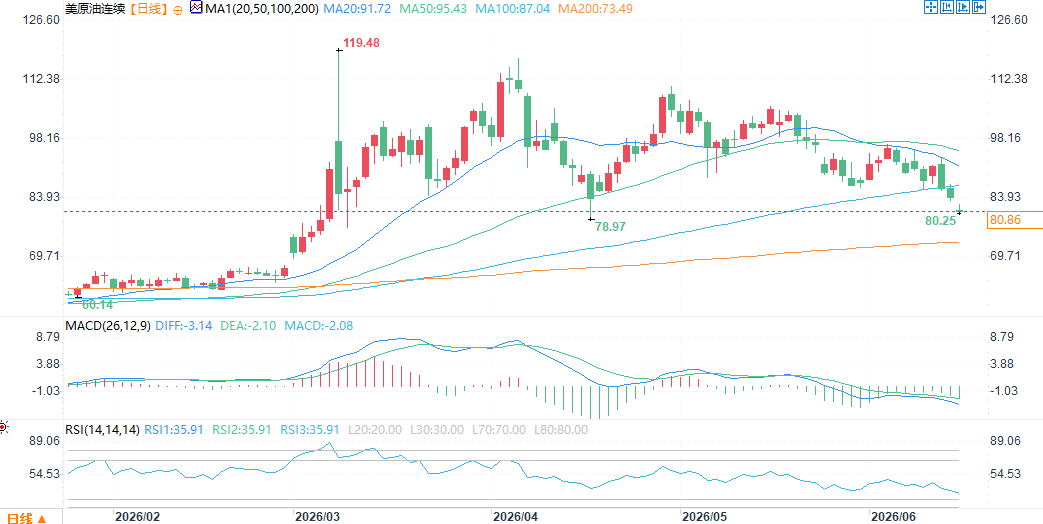
(US crude oil futures daily chart, source: FX678)
At 10:00 AM Beijing time on June 15, US crude oil futures were trading at $80.90 per barrel.
Trump announced an agreement with Iran, under which the US would lift its naval blockade. However, Trump also emphasized that if Iran fails to reach a final nuclear agreement with the US, he would resume military strikes against Tehran.
The US and Iran have reached a peace agreement, and the Strait of Hormuz is about to open.
Pakistani Prime Minister Shebaz Sharif revealed on Sunday that the United States and Iran have formally reached a peace agreement, with both sides announcing an immediate and permanent cessation of all military operations, including those on the Lebanese front. This statement marks a significant turning point in the nearly four-month-long conflict between Iran and the United States, and tensions in the Middle East are expected to ease considerably.
Subsequently, US President Trump confirmed this development on the social media platform Truth Social. Trump stated, "The agreement with the Islamic Republic of Iran is now complete." He also announced that he had fully authorized the free opening of the Strait of Hormuz and ordered the US Navy to immediately lift the naval blockade against Iran.
The Strait of Hormuz has been effectively closed since the US-Israel airstrikes against Iran on February 28. As one of the world's most important oil shipping routes, its closure had triggered serious concerns in the market about disruptions to crude oil supplies. The US announcement of lifting the blockade and reopening the strait will effectively alleviate pressure on the global energy supply chain, but may also put downward pressure on oil prices in the short term.
The market will closely monitor the actual opening of the strait this Friday and the progress made by both sides on key issues such as nuclear issues and the lifting of sanctions during the subsequent 60-day negotiations.
The lifting of the strait blockade eased supply-side pressures, putting downward pressure on oil prices.
The Strait of Hormuz has been effectively closed since the US-Israel airstrikes against Iran on February 28. As one of the world's most important oil shipping chokepoints, handling approximately 20% of global oil shipments daily, its closure triggered widespread panic in the market regarding a severe disruption to crude oil supplies, causing international oil prices to surge at one point.
The positive progress of the US-Iran peace agreement has directly led to a decline in WTI crude oil prices. The reopening of the Strait of Hormuz signifies a significant reduction in the risk of oil supply disruptions, which is the core driver of the downward pressure on oil prices. The "worst-case scenario" previously feared by the market—a prolonged closure of the Strait, an Iranian blockade of shipping, and a full-blown escalation of conflict in the Middle East—is being gradually ruled out. As the "risk premium" on the supply side rapidly diminishes, speculative long positions are forced to close, resulting in a clear long squeeze in the crude oil futures market.
Furthermore, the reopening of the Strait of Hormuz will release Iranian crude oil reserves that were previously unable to be exported due to sanctions, further increasing the supply in the global spot market. Market estimates suggest that the scale of Iran's floating crude oil storage at sea may be as high as tens of millions of barrels. If this supply is released in a concentrated manner in the short term, it will exert additional downward pressure on oil prices.
Overall, the shift from closure to imminent reopening of the Strait of Hormuz is fundamentally reshaping supply and demand expectations and risk pricing in the crude oil market, becoming a key variable in recent oil price trends.
Uncertainty Remains: Trump Retains Option to Resume Military Strike
However, market uncertainty remains high. Trump has made it clear that he will resume military strikes against Tehran if Iran fails to reach a final nuclear agreement with the United States. This tough stance casts a shadow over the recently reached peace agreement—the ceasefire is not the end; the real test lies in the implementation during the 60-day negotiation period.
Historically, the foundation of trust between the US and Iran is weak, and any deviation by either side in fulfilling its obligations could trigger renewed tensions. If Iran is accused of failing to meet its initial commitments in the memorandum, or if the US delays or shirks its responsibilities in areas such as unfreezing assets and lifting sanctions, Trump could very well use this as a pretext to restart military action. If the oil supply disruption is further prolonged, or even in the extreme scenario of the Strait of Hormuz being closed again, this could potentially drive up WTI prices in the short term.
Therefore, the current decline in oil prices is not without uncertainty, and the ongoing geopolitical situation remains a potential battleground for bulls. For participants in the crude oil market, the current price could be the start of a trend reversal or a temporary bottom—the key lies in the actual performance of both sides in the coming weeks. Bears are betting on a return to supply and a reduction in risk premiums; bulls are wagering on a breakdown in US-Iran negotiations and a resurgence of conflict.
In the short term, any news regarding a breakdown in negotiations, the reinstatement of sanctions, or the resumption of military operations could trigger a rapid rebound in oil prices. The market is closely watching the progress of implementation after the formal signing of the memorandum on June 19, as well as the statements made by all parties during the 60-day negotiation window.
Analyst Commentary
In her latest commentary, Sally Olde, chief economist at National Australia Bank, noted that expectations of a diplomatic breakthrough to ease the US-Iran conflict have led to a decline in oil prices and boosted stock market performance.
Older further stated that the drop in oil prices has eased market concerns about inflation, and investors have now postponed their expectations for the next Fed rate hike to next year.
Market analyst Antonio DiGiacomo noted in an email that one of the most important aspects of this potential agreement between the US and Iran would be the reopening of the Strait of Hormuz. This strategic sea lane carries approximately one-fifth of the world's oil supply.
The senior market analyst added that once crude oil shipments can fully resume through this key corridor, it will significantly alleviate market concerns about supply shortages and help improve the outlook for stability in the global energy market.
Nick Twidale, chief market strategist at ATFX Global in Sydney, noted that the market is expected to remain cautious, focusing on how quickly the Strait of Hormuz can reopen and when oil supplies will truly return to normal. He emphasized that this process will certainly take months, not weeks.
"This is not a beautifully packaged, perfect peace treaty," Stephen Ines, managing partner at SPI Asset Management, noted in a report on Sunday. "It's a market-acceptable ceasefire framework that pushes the difficult issues into the future."
Ines warned, "But this agreement is still riddled with hidden bombs that could explode at any moment." He cautioned traders against confusing the opening gap with the overall market trend.
He emphasized that the market will now demand evidence—from Iran formally signing an agreement, to ships truly enjoying freedom of navigation in the Strait, and ultimately, whether Iran agrees to nuclear restrictions. In other words, the war premium is no longer the baseline scenario, but the "verification premium" still exists.
Pay attention to inventory change data
The American Petroleum Institute (API) weekly crude oil inventory report will be released later on Tuesday (June 17), marking the first key fundamental data release for the crude oil market since the opening of the Strait of Hormuz. This report is generally considered a leading indicator of the U.S. Energy Information Administration (EIA) official inventory data and is of significant guiding importance for short-term oil price fluctuations.
If the API report shows a larger-than-expected drop in crude oil inventories, it indicates that US crude oil demand remains strong and refinery utilization rates remain high. This could provide support for WTI prices amid fading geopolitical risk premiums, and may even trigger a short-term short-covering rally. Conversely, if inventory increases exceed expectations, it suggests weak demand or oversupply, which could further depress WTI prices, which have already fallen to a two-month low, accelerating their decline towards $78 or even lower levels.
It is particularly important to note that the interpretation of this round of inventory data must be considered in conjunction with the significant variable of the impending opening of the Strait of Hormuz. Even if the inventory data is strong, if the market anticipates a large-scale return of Iranian crude oil to the international market in the coming weeks, the upward reaction of oil prices could be significantly weakened.
In addition, the Cushing inventory changes and gasoline and distillate fuel inventory data in the API report are also worth noting, as these sub-indicators will provide a more comprehensive reflection of the supply and demand situation in the US refined product market. Market participants will be closely awaiting the release of the API data on Tuesday evening to determine whether oil prices can find fundamental support after the recent sharp decline.
Technical Analysis
US crude oil is currently showing a weak consolidation trend on the daily chart, with prices falling below short-term moving averages, indicating a strengthening of overall bearish signals.
In terms of moving averages, the price has broken below the MA20, MA50, and MA100, and the short-term moving averages are arranged in a bearish pattern. The current price is close to the $80 support level, with strong support at $78.97 and longer-term support around the MA200, currently around $73.49. The resistance levels above are around the MA50 and the previous $90 platform.
The MACD indicator's DIFF line remains above the DEA line, but the red bars are continuously shortening, indicating a significant weakening of upward momentum and a gradual dominance of bearish forces. The RSI has fallen back to near the neutral zone, with bullish momentum weakening and no oversold signal yet.
Overall, oil prices are bearish in the short term, with key support at the $80 level. A break below this level could lead to further declines. Upward resistance is significant, and no trend reversal signals have yet emerged. Therefore, a cautiously bearish approach is recommended, with close attention to the effectiveness of support levels.
(US crude oil futures daily chart, source: FX678)
At 10:00 AM Beijing time on June 15, US crude oil futures were trading at $80.90 per barrel.
- Risk Warning and Disclaimer
- The market involves risk, and trading may not be suitable for all investors. This article is for reference only and does not constitute personal investment advice, nor does it take into account certain users’ specific investment objectives, financial situation, or other needs. Any investment decisions made based on this information are at your own risk.