The US-Iran peace agreement eased geopolitical risks, and gold rebounded to its weekly high, but expectations of a Fed rate hike still limited upside potential.
2026-06-15 10:08:58
Spot gold (XAU/USD) continued its rebound in Asian trading on Monday, rising to its highest level in a recent week. This followed the announcement by the United States and Iran of an agreement to end nearly four months of military conflict. The two sides plan to restore normal shipping in the Strait of Hormuz and lift the maritime blockade against Iranian ports once the agreement takes effect. The easing of geopolitical tensions improved market risk sentiment and reduced investor concerns about a continued surge in energy prices.

US President Donald Trump stated that the agreement reached by both sides will ensure long-term freedom of navigation in the Strait of Hormuz. However, Iran indicated that the final agreement negotiations over the next 60 days still depend on whether the US fulfills its commitments, including lifting the maritime blockade, ending military operations, and releasing frozen funds. This means that the current ceasefire agreement still carries the risk of further negotiations, and if the implementation of these commitments encounters setbacks, tensions in the Middle East could escalate again.
Gold typically attracts capital during periods of heightened global political and economic uncertainty, but its appeal may diminish in high-interest-rate environments as it does not generate interest. With easing concerns about escalating conflicts in the Middle East, investor expectations for a renewed rapid rise in US inflation have cooled, reducing pressure on the Federal Reserve to further tighten monetary policy.
According to the CME Group's FedWatch tool, the market currently expects a 64% probability of another Federal Reserve rate hike in December, down from about 69% the previous week. Although expectations for a rate hike have cooled somewhat, the possibility of US interest rates remaining high for an extended period remains, limiting the medium- to long-term upside potential for gold as a non-yielding asset.
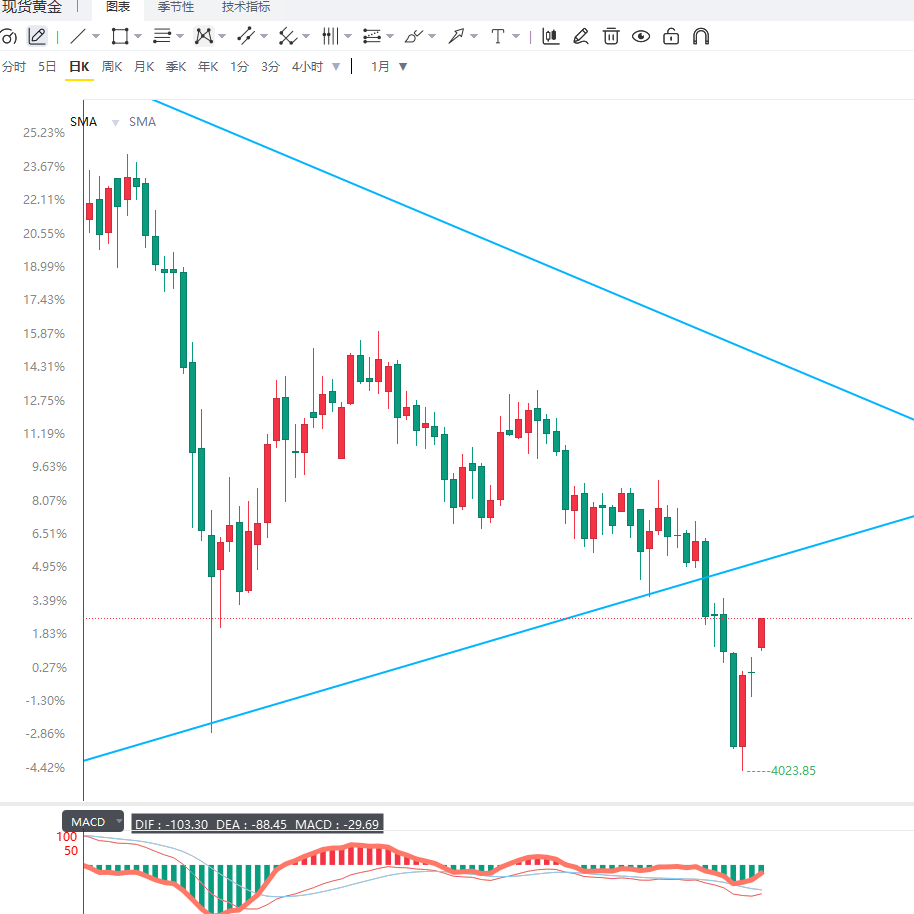
From a daily chart perspective, gold is currently still in a correction phase following its previous sharp decline, and the overall trend has not yet fully reversed. The price remains below the 100-day moving average of approximately $4760, while also facing resistance near the Bollinger Band's middle line, indicating that the medium- to long-term bearish structure still holds some advantage. The Relative Strength Index (RSI) remains around 42, below the key level, suggesting that market momentum remains insufficient, and short-term rebounds are more likely to be technical corrections than a trend reversal.
On the upside, gold first needs to break through the Bollinger Band middle line resistance near $4,400. If it holds above this level, it could potentially test the $4,680 area, with stronger resistance at $4,760 near the 100-day moving average. On the downside, the $4,150 area is currently a key support level. A break below this level could reopen downside potential and lead to further testing of previous lows.
From a 4-hour chart perspective, gold's short-term rebound momentum has strengthened, but the moving average system has not yet formed a clear bullish alignment, and the price is still in a consolidation and correction phase. If it can break through and stabilize above $4,400 in the short term, bullish sentiment may improve further; however, if the rebound is blocked and the price falls back below the key support area, the possibility of re-entering a downward channel cannot be ruled out. The overall short-term trend still needs to pay attention to the performance of the US dollar, expectations for Federal Reserve policy, and further developments in the Middle East situation.
Editor's Summary : The US-Iran peace agreement has temporarily eased market concerns about Middle East energy supply risks, impacting safe-haven demand for gold. However, as the final agreement still requires further negotiations and implementation, geopolitical risks have not been completely eliminated, providing some potential support for gold. Meanwhile, the Federal Reserve's high-interest-rate environment remains a significant factor limiting gold's rise. From a technical perspective, gold is currently in a recovery phase after an oversold condition; only a break above key moving averages and important resistance areas can confirm a stronger rebound trend. Until then, investors should remain wary of the risk of a pullback after the rebound.
US President Donald Trump stated that the agreement reached by both sides will ensure long-term freedom of navigation in the Strait of Hormuz. However, Iran indicated that the final agreement negotiations over the next 60 days still depend on whether the US fulfills its commitments, including lifting the maritime blockade, ending military operations, and releasing frozen funds. This means that the current ceasefire agreement still carries the risk of further negotiations, and if the implementation of these commitments encounters setbacks, tensions in the Middle East could escalate again.
Gold typically attracts capital during periods of heightened global political and economic uncertainty, but its appeal may diminish in high-interest-rate environments as it does not generate interest. With easing concerns about escalating conflicts in the Middle East, investor expectations for a renewed rapid rise in US inflation have cooled, reducing pressure on the Federal Reserve to further tighten monetary policy.
According to the CME Group's FedWatch tool, the market currently expects a 64% probability of another Federal Reserve rate hike in December, down from about 69% the previous week. Although expectations for a rate hike have cooled somewhat, the possibility of US interest rates remaining high for an extended period remains, limiting the medium- to long-term upside potential for gold as a non-yielding asset.
From a daily chart perspective, gold is currently still in a correction phase following its previous sharp decline, and the overall trend has not yet fully reversed. The price remains below the 100-day moving average of approximately $4760, while also facing resistance near the Bollinger Band's middle line, indicating that the medium- to long-term bearish structure still holds some advantage. The Relative Strength Index (RSI) remains around 42, below the key level, suggesting that market momentum remains insufficient, and short-term rebounds are more likely to be technical corrections than a trend reversal.
On the upside, gold first needs to break through the Bollinger Band middle line resistance near $4,400. If it holds above this level, it could potentially test the $4,680 area, with stronger resistance at $4,760 near the 100-day moving average. On the downside, the $4,150 area is currently a key support level. A break below this level could reopen downside potential and lead to further testing of previous lows.
From a 4-hour chart perspective, gold's short-term rebound momentum has strengthened, but the moving average system has not yet formed a clear bullish alignment, and the price is still in a consolidation and correction phase. If it can break through and stabilize above $4,400 in the short term, bullish sentiment may improve further; however, if the rebound is blocked and the price falls back below the key support area, the possibility of re-entering a downward channel cannot be ruled out. The overall short-term trend still needs to pay attention to the performance of the US dollar, expectations for Federal Reserve policy, and further developments in the Middle East situation.
Editor's Summary : The US-Iran peace agreement has temporarily eased market concerns about Middle East energy supply risks, impacting safe-haven demand for gold. However, as the final agreement still requires further negotiations and implementation, geopolitical risks have not been completely eliminated, providing some potential support for gold. Meanwhile, the Federal Reserve's high-interest-rate environment remains a significant factor limiting gold's rise. From a technical perspective, gold is currently in a recovery phase after an oversold condition; only a break above key moving averages and important resistance areas can confirm a stronger rebound trend. Until then, investors should remain wary of the risk of a pullback after the rebound.
- Risk Warning and Disclaimer
- The market involves risk, and trading may not be suitable for all investors. This article is for reference only and does not constitute personal investment advice, nor does it take into account certain users’ specific investment objectives, financial situation, or other needs. Any investment decisions made based on this information are at your own risk.