USD/JPY fluctuates around the 160 level: The US-Iran agreement puts pressure on the dollar, but interest rate differentials and the Bank of Japan's decision are key variables.
2026-06-15 16:52:00
On Monday (June 15), the US dollar fell slightly against the Japanese yen during the European session, currently trading around 160.10.
The peace agreement reached between the US and Iran eased concerns about inflation and interest rate hikes, putting pressure on the dollar. However, the significant interest rate differential between the US and Japan continues to provide structural support for the dollar against the yen, limiting further upside potential for the yen.
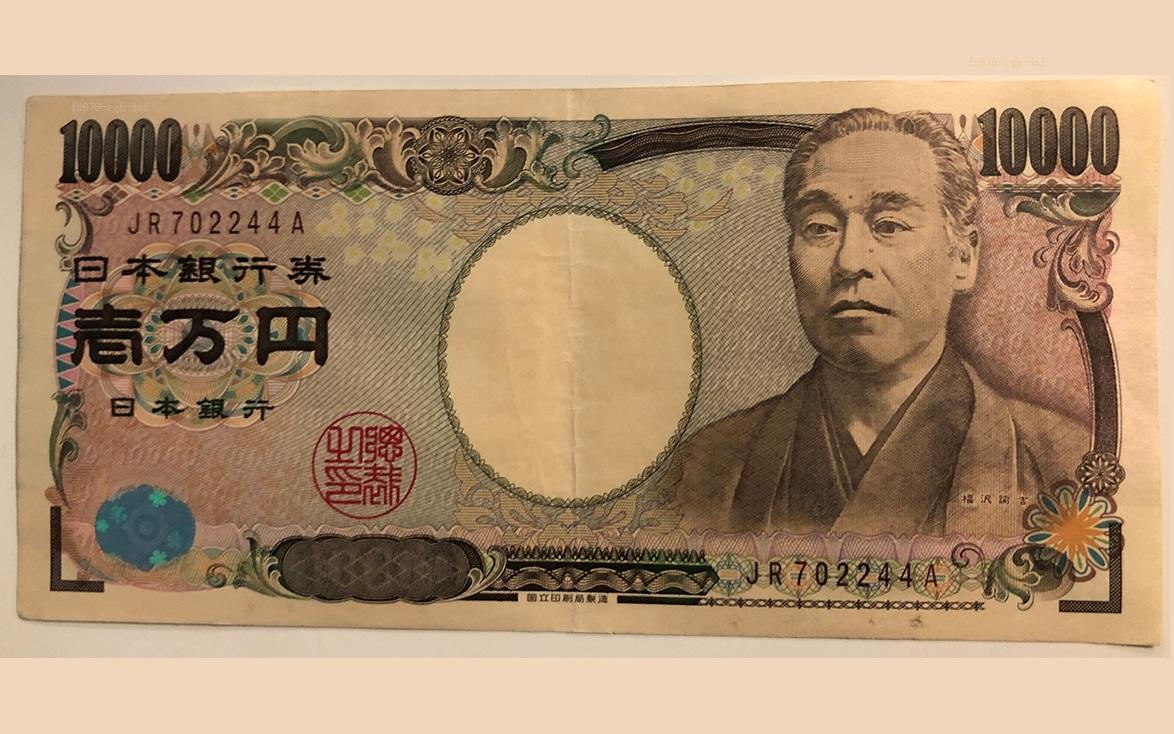
With the US and Iran reaching an agreement to end the conflict, market concerns about inflation and interest rate hikes have significantly eased, causing the dollar to fall. This breakthrough signifies that the nearly four-month-long war with Iran is about to enter a substantial ceasefire, and the global geopolitical risk premium is beginning to dissipate rapidly. The agreement announced by Washington and Tehran on Sunday will officially take effect this Friday, providing a respite for the global economy, which is suffering from soaring energy prices.
According to the agreement, US President Trump stated that the US would lift the maritime blockade on Iranian ports, allowing the Strait of Hormuz, a crucial passageway, to reopen. As a vital waterway carrying approximately 20% of the world's seaborne oil, the reopening of the Strait of Hormuz means that millions of barrels of crude oil will gradually resume daily supply, effectively easing tensions in the global energy market. Since the strait was effectively closed at the end of February, international oil prices surged to nearly $120 per barrel, exacerbating global inflationary pressures. Now, with the easing of supply-side risks, Brent crude and WTI crude futures both fell by more than 4% in early Asian trading on Monday, while the US dollar index weakened to around 99.40.
In a coordinated response, Britain, France, Germany, and Italy announced their willingness to lift sanctions on Iran after Iran takes steps regarding its nuclear program. This statement from the four European countries significantly boosted the smooth implementation of the agreement and signaled to the market the collective support of the Western world for the peace process.
Analysts point out that the lifting of sanctions will further unleash Iran's crude oil export capacity, bringing additional supply to the global oil market. However, with core issues such as Iran's nuclear program postponed to negotiations over the next 60 days, the market remains cautious, and any setbacks could reignite concerns.
Overall, the trend of improved risk appetite is expected to continue in the short term, and investors are closely watching Friday's signing ceremony and the progress of subsequent negotiations.
Following the landmark US-Iran peace agreement, market expectations for monetary policy have shifted dramatically. Previously, due to the closure of the Strait of Hormuz caused by the Iran war and oil prices soaring to nearly $120 per barrel, the market was concerned that runaway inflation might force the Federal Reserve to continue raising interest rates before the end of the year. However, with the peace agreement reached and the Strait of Hormuz set to reopen soon, these concerns are rapidly dissipating.
The CME FedWatch tool shows that the market expects the probability of the Federal Reserve keeping interest rates unchanged in December to surge to nearly 47%, far higher than last week's 28%. At the same time, the market's expectation of a rate hike before the end of the year has fallen sharply from over 50% at the peak of the conflict to below 30%. This dramatic shift reflects investors' belief that easing geopolitical risks will significantly reduce inflationary pressures, thereby reducing the need for further tightening by the Fed.
Analysts point out that oil prices, as a significant input factor to inflation, have a crucial impact on central bank policy paths. Brent crude and WTI crude futures both fell more than 4% in early Asian trading on Monday, hitting near two-month lows, providing strong evidence of easing inflationary pressures. If energy prices can remain at their current low levels, global inflation is expected to decline significantly in the coming months, providing central banks with greater policy flexibility.
However, the market remains cautious. The core issues of the US-Iran agreement, such as Iran's nuclear program, have been postponed to a 60-day negotiation period, and any breakdown in negotiations or reversals in the situation could reignite inflation concerns. Furthermore, the stickiness of core inflation—particularly in the service sector and wage growth—remains a key focus for the Federal Reserve. Therefore, despite a shift in short-term expectations to a dovish stance, the market will closely watch upcoming inflation data and Fed Chairman Warsh's remarks at Wednesday's press conference to confirm the sustainability of this shift in policy expectations.
News of the reopening of the Strait of Hormuz caused oil prices to plummet, with Brent crude and WTI crude futures both falling more than 4% in early Asian trading on Monday. This decline significantly eased global inflationary pressures and directly reduced high import costs for energy-dependent economies such as Japan. As one of the world's largest oil importers, Japan relies almost entirely on overseas energy supplies. The oil price plunge means reduced trade deficit pressure, lower production costs for businesses, and a decrease in the cost of living for residents. The yen thus gained solid support against the backdrop of this geopolitical breakthrough, with the USD/JPY pair trading around 160.10 on Monday, a slight pullback from previous highs.
However, the yen's upside potential remains limited. The significant interest rate differential between the US and Japan continues to provide structural support for the USD/JPY exchange rate—the Federal Reserve's benchmark interest rate remains in the 3.50% to 3.75% range, while the Bank of Japan's policy rate is only around 0.25%, a difference of over 300 basis points. Unless this interest rate differential fundamentally changes, it will be difficult for the yen to experience a sustained one-sided appreciation. Carry traders still tend to borrow low-interest yen and buy high-interest dollars, which will limit the yen's rebound to some extent.
Furthermore, the yen may receive additional domestic support. Traders are pricing in a potential rate hike by the Bank of Japan on Tuesday to curb domestic inflation. Although Japan's core inflation rate has already declined, the lagged effects of rising energy prices and the stickiness of service sector prices put pressure on the Bank of Japan to continue tightening policy. If the Bank of Japan unexpectedly raises rates on Tuesday, or releases a clear hawkish signal, the yen could receive a short-term boost.
However, even with a slight interest rate hike by the Bank of Japan, the interest rate differential between the US and Japan will remain at historically high levels, and the structural weakness of the yen is unlikely to reverse in the short term. The market is closely watching the Bank of Japan's policy statement to determine whether it will provide further clues about the future path of interest rate hikes.
According to the USD/JPY daily chart, the current exchange rate is in a high-level consolidation phase within a medium-term uptrend. The price is steadily rising along various moving averages, with the 20-day, 50-day, 100-day, and 200-day moving averages forming a bullish alignment, clearly indicating a medium-term uptrend. Recently, the price surged to around 160.59, reaching a new high for the period, before slightly retreating and currently consolidating around the 160 level.
On the moving average system, the price has consistently remained above all moving averages, indicating strong medium-term support. Key support levels below are the 20-day moving average (MA20) at 159.67 and the previous densely traded area around 159.20, with further strong support at the previous low of 155.03. Resistance above lies in the previous high range of 160.47-160.59; a break above this level could open up new upside potential.
In terms of indicators, the MACD is running above the zero axis, the DIFF and DEA maintain a golden cross, and although the red bars have contracted, they are still positive, indicating that the upward momentum has slowed down but has not subsided; the RSI is in the strong range near 58, has not yet entered overbought territory, and still has room to rise.
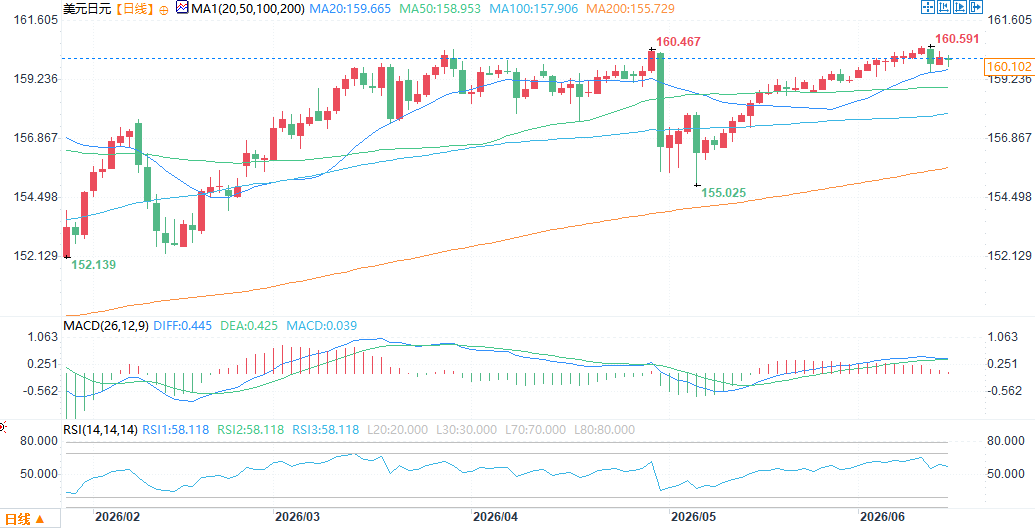
(USD/JPY daily chart, source: FX678)
At 16:31 Beijing time on June 15, the USD/JPY exchange rate was 160.10/11.
The peace agreement reached between the US and Iran eased concerns about inflation and interest rate hikes, putting pressure on the dollar. However, the significant interest rate differential between the US and Japan continues to provide structural support for the dollar against the yen, limiting further upside potential for the yen.
The US-Iran agreement eased inflationary pressures, weakening the dollar.
With the US and Iran reaching an agreement to end the conflict, market concerns about inflation and interest rate hikes have significantly eased, causing the dollar to fall. This breakthrough signifies that the nearly four-month-long war with Iran is about to enter a substantial ceasefire, and the global geopolitical risk premium is beginning to dissipate rapidly. The agreement announced by Washington and Tehran on Sunday will officially take effect this Friday, providing a respite for the global economy, which is suffering from soaring energy prices.
According to the agreement, US President Trump stated that the US would lift the maritime blockade on Iranian ports, allowing the Strait of Hormuz, a crucial passageway, to reopen. As a vital waterway carrying approximately 20% of the world's seaborne oil, the reopening of the Strait of Hormuz means that millions of barrels of crude oil will gradually resume daily supply, effectively easing tensions in the global energy market. Since the strait was effectively closed at the end of February, international oil prices surged to nearly $120 per barrel, exacerbating global inflationary pressures. Now, with the easing of supply-side risks, Brent crude and WTI crude futures both fell by more than 4% in early Asian trading on Monday, while the US dollar index weakened to around 99.40.
In a coordinated response, Britain, France, Germany, and Italy announced their willingness to lift sanctions on Iran after Iran takes steps regarding its nuclear program. This statement from the four European countries significantly boosted the smooth implementation of the agreement and signaled to the market the collective support of the Western world for the peace process.
Analysts point out that the lifting of sanctions will further unleash Iran's crude oil export capacity, bringing additional supply to the global oil market. However, with core issues such as Iran's nuclear program postponed to negotiations over the next 60 days, the market remains cautious, and any setbacks could reignite concerns.
Overall, the trend of improved risk appetite is expected to continue in the short term, and investors are closely watching Friday's signing ceremony and the progress of subsequent negotiations.
Market expectations for a Federal Reserve rate hike have plummeted.
Following the landmark US-Iran peace agreement, market expectations for monetary policy have shifted dramatically. Previously, due to the closure of the Strait of Hormuz caused by the Iran war and oil prices soaring to nearly $120 per barrel, the market was concerned that runaway inflation might force the Federal Reserve to continue raising interest rates before the end of the year. However, with the peace agreement reached and the Strait of Hormuz set to reopen soon, these concerns are rapidly dissipating.
The CME FedWatch tool shows that the market expects the probability of the Federal Reserve keeping interest rates unchanged in December to surge to nearly 47%, far higher than last week's 28%. At the same time, the market's expectation of a rate hike before the end of the year has fallen sharply from over 50% at the peak of the conflict to below 30%. This dramatic shift reflects investors' belief that easing geopolitical risks will significantly reduce inflationary pressures, thereby reducing the need for further tightening by the Fed.
Analysts point out that oil prices, as a significant input factor to inflation, have a crucial impact on central bank policy paths. Brent crude and WTI crude futures both fell more than 4% in early Asian trading on Monday, hitting near two-month lows, providing strong evidence of easing inflationary pressures. If energy prices can remain at their current low levels, global inflation is expected to decline significantly in the coming months, providing central banks with greater policy flexibility.
However, the market remains cautious. The core issues of the US-Iran agreement, such as Iran's nuclear program, have been postponed to a 60-day negotiation period, and any breakdown in negotiations or reversals in the situation could reignite inflation concerns. Furthermore, the stickiness of core inflation—particularly in the service sector and wage growth—remains a key focus for the Federal Reserve. Therefore, despite a shift in short-term expectations to a dovish stance, the market will closely watch upcoming inflation data and Fed Chairman Warsh's remarks at Wednesday's press conference to confirm the sustainability of this shift in policy expectations.
The plunge in oil prices is good for Japan, but interest rate differentials still constrain the yen.
News of the reopening of the Strait of Hormuz caused oil prices to plummet, with Brent crude and WTI crude futures both falling more than 4% in early Asian trading on Monday. This decline significantly eased global inflationary pressures and directly reduced high import costs for energy-dependent economies such as Japan. As one of the world's largest oil importers, Japan relies almost entirely on overseas energy supplies. The oil price plunge means reduced trade deficit pressure, lower production costs for businesses, and a decrease in the cost of living for residents. The yen thus gained solid support against the backdrop of this geopolitical breakthrough, with the USD/JPY pair trading around 160.10 on Monday, a slight pullback from previous highs.
However, the yen's upside potential remains limited. The significant interest rate differential between the US and Japan continues to provide structural support for the USD/JPY exchange rate—the Federal Reserve's benchmark interest rate remains in the 3.50% to 3.75% range, while the Bank of Japan's policy rate is only around 0.25%, a difference of over 300 basis points. Unless this interest rate differential fundamentally changes, it will be difficult for the yen to experience a sustained one-sided appreciation. Carry traders still tend to borrow low-interest yen and buy high-interest dollars, which will limit the yen's rebound to some extent.
Furthermore, the yen may receive additional domestic support. Traders are pricing in a potential rate hike by the Bank of Japan on Tuesday to curb domestic inflation. Although Japan's core inflation rate has already declined, the lagged effects of rising energy prices and the stickiness of service sector prices put pressure on the Bank of Japan to continue tightening policy. If the Bank of Japan unexpectedly raises rates on Tuesday, or releases a clear hawkish signal, the yen could receive a short-term boost.
However, even with a slight interest rate hike by the Bank of Japan, the interest rate differential between the US and Japan will remain at historically high levels, and the structural weakness of the yen is unlikely to reverse in the short term. The market is closely watching the Bank of Japan's policy statement to determine whether it will provide further clues about the future path of interest rate hikes.
Technical Analysis
According to the USD/JPY daily chart, the current exchange rate is in a high-level consolidation phase within a medium-term uptrend. The price is steadily rising along various moving averages, with the 20-day, 50-day, 100-day, and 200-day moving averages forming a bullish alignment, clearly indicating a medium-term uptrend. Recently, the price surged to around 160.59, reaching a new high for the period, before slightly retreating and currently consolidating around the 160 level.
On the moving average system, the price has consistently remained above all moving averages, indicating strong medium-term support. Key support levels below are the 20-day moving average (MA20) at 159.67 and the previous densely traded area around 159.20, with further strong support at the previous low of 155.03. Resistance above lies in the previous high range of 160.47-160.59; a break above this level could open up new upside potential.
In terms of indicators, the MACD is running above the zero axis, the DIFF and DEA maintain a golden cross, and although the red bars have contracted, they are still positive, indicating that the upward momentum has slowed down but has not subsided; the RSI is in the strong range near 58, has not yet entered overbought territory, and still has room to rise.
(USD/JPY daily chart, source: FX678)
At 16:31 Beijing time on June 15, the USD/JPY exchange rate was 160.10/11.
- Risk Warning and Disclaimer
- The market involves risk, and trading may not be suitable for all investors. This article is for reference only and does not constitute personal investment advice, nor does it take into account certain users’ specific investment objectives, financial situation, or other needs. Any investment decisions made based on this information are at your own risk.