Expectations of a US-Iran peace agreement weighed on oil prices, and the geopolitical risk premium for crude oil diminished.
2026-06-15 18:39:55
The recent sharp decline in international oil prices was primarily driven by a significant easing of geopolitical tensions between the US and Iran. Market expectations for a peace agreement between the two sides continued to rise, completely dispelling the previous panic over potential Middle Eastern oil supply disruptions, and causing the geopolitical risk premium for oil to evaporate rapidly. The agreement between the US and Iran to establish a preliminary peace framework suggests that the nearly four-month-long regional conflict may be coming to an end, significantly reducing uncertainty surrounding Middle Eastern oil production areas and shipping routes.
Market data shows that WTI crude oil futures fell 5.23% intraday, trading around $80.44; Brent crude oil also fell 4.31% to $83. The deep correction in the two benchmark crude oils directly reflects the market's repricing of geopolitical risks, and the excess risk premium generated by previous conflicts has been quickly stripped away.
Meanwhile, the fundamentals of US crude oil remained tight, with inventories falling sharply by 9.12 million barrels, far exceeding the market's expectation of a 4 million barrel decrease, marking eight consecutive weeks of destocking. Coupled with a 1.19 million barrel decrease in gasoline inventories, this fully confirms the recovery in domestic crude oil and refined oil demand and the tightening of supply, providing solid bottom support for oil prices and effectively preventing a one-sided plunge.
From a technical perspective, oil prices are trending weakly in the short term, having fallen below multiple short-term moving averages, including the 5-day, 10-day, and 20-day moving averages. Overall, future oil price movements will largely depend on the formal signing of the US-Iran peace agreement, the progress of the full resumption of navigation in the Strait of Hormuz, and marginal changes in US inventory data.
The core logic behind this round of collective correction in the energy market is the overall retreat of global geopolitical risk aversion. Previously, tensions in the Middle East had raised serious concerns about disruptions to shipping through the Strait of Hormuz and potential oil supply disruptions, resulting in a high geopolitical risk premium on oil prices. However, with the implementation of the US-Iran peace framework and the anticipated resumption of navigation through the Strait, traders have continuously revised pricing, significantly stripping away the risk premium. This has not only led to a sharp drop in oil prices but also weakened the European natural gas market. Dutch TTF natural gas futures fell 6.1% to €43.91 per megawatt-hour, and the overall safe-haven valuation of energy assets has declined significantly.
The profound impact of geopolitical situation on energy markets
As a crucial chokepoint for global crude oil transportation, the navigation status of the Strait of Hormuz has always been a key factor influencing international oil prices. The US has clearly stated that the Strait of Hormuz will officially resume full navigation on Friday, and at the same time, the US will lift its maritime blockade of major Iranian ports, completely loosening the core barrier that previously restricted Middle Eastern crude oil exports.
Despite the continued release of geopolitical advantages, which has temporarily alleviated extreme market panic regarding potential oil supply disruptions, the capital markets remain cautious and cautious, with a wait-and-see attitude prevailing. The core reason is that the current peace framework is only preliminary and has not yet been formally signed and implemented, and the restoration of shipping order will require a certain period. Multiple practical issues, such as mine clearance operations in waterways, maintenance and repair of Iranian port facilities, and the restoration of cross-border logistics systems, will all contribute to delays in shipping recovery. In the short term, oil transportation is unlikely to fully return to normal levels, and the market still faces considerable uncertainty.
Supply and demand inventory data and technical chart analysis
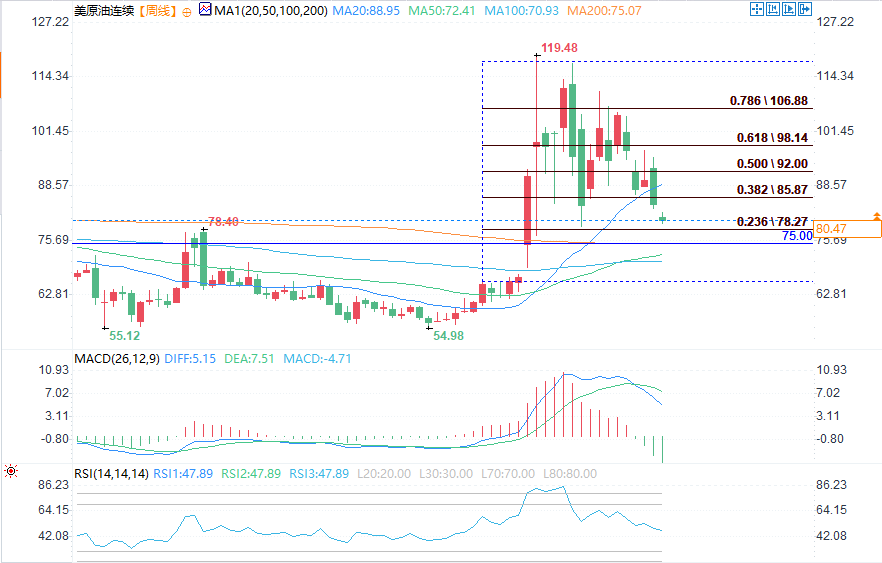
(WTI crude oil weekly chart source: FX678)
Looking at core supply and demand inventory data, the latest US inventory data showed a significant improvement, with the supply and demand situation continuing to tighten. Crude oil inventories fell by 9.12 million barrels, far exceeding the market's expected decrease of 4 million barrels, continuing the tight supply trend of eight consecutive weeks of destocking. Meanwhile, gasoline inventories decreased by 1.19 million barrels, reflecting a steady recovery in US end-user demand for refined oil products and a continued improvement in downstream market activity. This tight fundamental situation has become a key force in offsetting geopolitical headwinds and supporting oil prices.
US crude oil is in a deep correction phase after a major bull market on the weekly chart. The overall bullish structure over the long term has not been completely destroyed, but short-term bears have the upper hand.
The price has been charted using Fibonacci retracement levels of 66 and 118. The current price of 80.47 has stabilized above the 0.236 level of 78.27, which, combined with the previous consolidation platform at 78.40, forms a strong support zone between 78.2 and 78.4. The ultimate support level below is the 200-day moving average (MA200) at 75. If this level is broken, the medium- to long-term uptrend will be reversed.
The first short-term resistance level to watch is the 0.382 Fibonacci retracement at 85.87. Strong medium-term resistance lies at the weekly MA20 (88.95). The price's continued trading below this moving average confirms a weakening short-term weekly trend, and any rebound to around 89 is likely to encounter selling pressure. The medium- to long-term MA50, MA100, and MA200 remain in a bullish alignment, providing support for a broader bullish trend.
From a technical perspective, the weekly MACD has formed a death cross, with the DIFF (5.15) crossing below the DEA (7.51) and green bars appearing, indicating continued downward momentum in the medium term. However, the indicators are still above the zero line, showing no signs of extreme panic selling, and the probability of a deep plunge is limited. The RSI value of 47.89 is in the neutral range, neither below 30 (oversold buying zone) nor above 60 (bullish zone), and there is no bottom divergence structure. The short-term decline may continue, but there are no clear reversal signals yet.
In summary, crude oil is currently in a consolidation and bottoming-out phase. The short-term strategy is to use the 78.2-78.4 support level to attempt a rebound, targeting 85.87. Only if the rebound breaks through 89 and holds above the 20-day moving average (MA20) can the medium-term trend be repaired. Conversely, if the weekly close breaks below the 78 support zone, the price will likely test the key 75 level, the yearly moving average. 75 is a watershed between bullish and bearish trends; a break below this level would completely reverse the trend. Overall, trading should focus on observing the breakout direction of the 78 and 89 key ranges. Heavy, one-sided positions are not advisable at this time; a range-bound trading strategy is recommended.
Market Outlook and Key Observation Dimensions
For short-term trading, market participants need to focus on three key indicators: the progress of the formal signing of the US-Iran peace agreement, real-time shipping data in the Strait of Hormuz, and weekly updated US crude oil and refined product inventory data. These three variables will be the core factors influencing short-term oil price fluctuations.
The current oil market exhibits a typical balance between bullish and bearish forces, with clear and mutually restraining logic. The core bearish factor lies in the resolution of the US-Iran geopolitical stalemate, which has completely cleared the geopolitical risk premium that had been supporting oil prices, significantly weakening upward momentum. The bullish factor, on the other hand, comes from a persistently tight supply and demand fundamental, with US crude oil inventories declining for eight consecutive weeks, coupled with a seasonal rebound in oil demand, providing continuous bottom support for oil prices and preventing a one-sided downward trend.
Overall, international oil prices are expected to remain highly volatile in the short term, with no clear unilateral trend. Market movements will be driven alternately by geopolitical news and supply and demand inventory data. When geopolitical positives subside, fundamentals will support oil prices; when data is weak, geopolitical sentiment will dominate fluctuations. Repeated battles between bulls and bears will become the norm in the short-term market.
Market data shows that WTI crude oil futures fell 5.23% intraday, trading around $80.44; Brent crude oil also fell 4.31% to $83. The deep correction in the two benchmark crude oils directly reflects the market's repricing of geopolitical risks, and the excess risk premium generated by previous conflicts has been quickly stripped away.
Meanwhile, the fundamentals of US crude oil remained tight, with inventories falling sharply by 9.12 million barrels, far exceeding the market's expectation of a 4 million barrel decrease, marking eight consecutive weeks of destocking. Coupled with a 1.19 million barrel decrease in gasoline inventories, this fully confirms the recovery in domestic crude oil and refined oil demand and the tightening of supply, providing solid bottom support for oil prices and effectively preventing a one-sided plunge.
From a technical perspective, oil prices are trending weakly in the short term, having fallen below multiple short-term moving averages, including the 5-day, 10-day, and 20-day moving averages. Overall, future oil price movements will largely depend on the formal signing of the US-Iran peace agreement, the progress of the full resumption of navigation in the Strait of Hormuz, and marginal changes in US inventory data.
The core logic behind this round of collective correction in the energy market is the overall retreat of global geopolitical risk aversion. Previously, tensions in the Middle East had raised serious concerns about disruptions to shipping through the Strait of Hormuz and potential oil supply disruptions, resulting in a high geopolitical risk premium on oil prices. However, with the implementation of the US-Iran peace framework and the anticipated resumption of navigation through the Strait, traders have continuously revised pricing, significantly stripping away the risk premium. This has not only led to a sharp drop in oil prices but also weakened the European natural gas market. Dutch TTF natural gas futures fell 6.1% to €43.91 per megawatt-hour, and the overall safe-haven valuation of energy assets has declined significantly.
The profound impact of geopolitical situation on energy markets
As a crucial chokepoint for global crude oil transportation, the navigation status of the Strait of Hormuz has always been a key factor influencing international oil prices. The US has clearly stated that the Strait of Hormuz will officially resume full navigation on Friday, and at the same time, the US will lift its maritime blockade of major Iranian ports, completely loosening the core barrier that previously restricted Middle Eastern crude oil exports.
Despite the continued release of geopolitical advantages, which has temporarily alleviated extreme market panic regarding potential oil supply disruptions, the capital markets remain cautious and cautious, with a wait-and-see attitude prevailing. The core reason is that the current peace framework is only preliminary and has not yet been formally signed and implemented, and the restoration of shipping order will require a certain period. Multiple practical issues, such as mine clearance operations in waterways, maintenance and repair of Iranian port facilities, and the restoration of cross-border logistics systems, will all contribute to delays in shipping recovery. In the short term, oil transportation is unlikely to fully return to normal levels, and the market still faces considerable uncertainty.
Supply and demand inventory data and technical chart analysis
(WTI crude oil weekly chart source: FX678)
Looking at core supply and demand inventory data, the latest US inventory data showed a significant improvement, with the supply and demand situation continuing to tighten. Crude oil inventories fell by 9.12 million barrels, far exceeding the market's expected decrease of 4 million barrels, continuing the tight supply trend of eight consecutive weeks of destocking. Meanwhile, gasoline inventories decreased by 1.19 million barrels, reflecting a steady recovery in US end-user demand for refined oil products and a continued improvement in downstream market activity. This tight fundamental situation has become a key force in offsetting geopolitical headwinds and supporting oil prices.
US crude oil is in a deep correction phase after a major bull market on the weekly chart. The overall bullish structure over the long term has not been completely destroyed, but short-term bears have the upper hand.
The price has been charted using Fibonacci retracement levels of 66 and 118. The current price of 80.47 has stabilized above the 0.236 level of 78.27, which, combined with the previous consolidation platform at 78.40, forms a strong support zone between 78.2 and 78.4. The ultimate support level below is the 200-day moving average (MA200) at 75. If this level is broken, the medium- to long-term uptrend will be reversed.
The first short-term resistance level to watch is the 0.382 Fibonacci retracement at 85.87. Strong medium-term resistance lies at the weekly MA20 (88.95). The price's continued trading below this moving average confirms a weakening short-term weekly trend, and any rebound to around 89 is likely to encounter selling pressure. The medium- to long-term MA50, MA100, and MA200 remain in a bullish alignment, providing support for a broader bullish trend.
From a technical perspective, the weekly MACD has formed a death cross, with the DIFF (5.15) crossing below the DEA (7.51) and green bars appearing, indicating continued downward momentum in the medium term. However, the indicators are still above the zero line, showing no signs of extreme panic selling, and the probability of a deep plunge is limited. The RSI value of 47.89 is in the neutral range, neither below 30 (oversold buying zone) nor above 60 (bullish zone), and there is no bottom divergence structure. The short-term decline may continue, but there are no clear reversal signals yet.
In summary, crude oil is currently in a consolidation and bottoming-out phase. The short-term strategy is to use the 78.2-78.4 support level to attempt a rebound, targeting 85.87. Only if the rebound breaks through 89 and holds above the 20-day moving average (MA20) can the medium-term trend be repaired. Conversely, if the weekly close breaks below the 78 support zone, the price will likely test the key 75 level, the yearly moving average. 75 is a watershed between bullish and bearish trends; a break below this level would completely reverse the trend. Overall, trading should focus on observing the breakout direction of the 78 and 89 key ranges. Heavy, one-sided positions are not advisable at this time; a range-bound trading strategy is recommended.
Market Outlook and Key Observation Dimensions
For short-term trading, market participants need to focus on three key indicators: the progress of the formal signing of the US-Iran peace agreement, real-time shipping data in the Strait of Hormuz, and weekly updated US crude oil and refined product inventory data. These three variables will be the core factors influencing short-term oil price fluctuations.
The current oil market exhibits a typical balance between bullish and bearish forces, with clear and mutually restraining logic. The core bearish factor lies in the resolution of the US-Iran geopolitical stalemate, which has completely cleared the geopolitical risk premium that had been supporting oil prices, significantly weakening upward momentum. The bullish factor, on the other hand, comes from a persistently tight supply and demand fundamental, with US crude oil inventories declining for eight consecutive weeks, coupled with a seasonal rebound in oil demand, providing continuous bottom support for oil prices and preventing a one-sided downward trend.
Overall, international oil prices are expected to remain highly volatile in the short term, with no clear unilateral trend. Market movements will be driven alternately by geopolitical news and supply and demand inventory data. When geopolitical positives subside, fundamentals will support oil prices; when data is weak, geopolitical sentiment will dominate fluctuations. Repeated battles between bulls and bears will become the norm in the short-term market.
- Risk Warning and Disclaimer
- The market involves risk, and trading may not be suitable for all investors. This article is for reference only and does not constitute personal investment advice, nor does it take into account certain users’ specific investment objectives, financial situation, or other needs. Any investment decisions made based on this information are at your own risk.