Oil prices continued to be under pressure after four consecutive days of declines. The US-Iran agreement was signed, but issues such as Strait of Hormuz fees, mine clearance, and nuclear talks remain unresolved.
2026-06-17 16:19:32
On Wednesday (June 17) during the European session, US crude oil futures fell by more than 1% to around $74.30 per barrel, while Brent crude oil futures fell by more than 1.5% to around $78 per barrel. International oil prices are on track for their fifth consecutive day of decline.
The continued weakness in oil prices reflects rising market expectations for the eventual implementation of a US-Iran agreement.
US President Trump announced on the 14th that a memorandum of understanding on a ceasefire had been reached with Iran, and the formal signing ceremony will be held in Switzerland on the 19th.
The US-Iran Agreed Framework ostensibly comprises two core elements: an immediate 60-day ceasefire and negotiations on a long-term peace agreement during this period. However, when it comes to the specifics of each category, extremely limited information has been confirmed—the text of the short-term agreement has not yet been released, and the long-term agreement is nowhere to be seen.
Many key questions remain unresolved, including whether the Strait of Hormuz will reopen as scheduled, whether tolls will be levied, how long the mine clearance process will take, the future of the nuclear issue, and whether sanctions will be lifted.
The US and Iran have pledged in a memorandum of understanding to lift the maritime blockade simultaneously, but there is significant disagreement in the market regarding the pace of a full resumption of navigation in the Strait of Hormuz, with channel clearing and safety inspections introducing multiple uncertainties. Trump has publicly expressed optimism, claiming that maritime transport in the strait is expected to return to normal by this Friday; however, major international shipping companies are cautious, generally assessing that clearing the backlog of vessels and conducting safety verifications will take at least several weeks.
Currently, thousands of merchant ships of various types are stranded along the Persian Gulf waiting for navigation to resume, and the distribution and clearance progress of mines left in the waterway remain the core hidden dangers restricting the resumption of shipping.
To expedite the elimination of risks to shipping lanes, Tehran has proactively provided maps of mine locations throughout the Strait of Hormuz and its nearshore waters, and is willing to offer mine-clearing technical assistance. Once the ceasefire agreement is formally implemented, the UK, France, Germany, Italy, Japan, and Canada will launch a long-planned joint mine-clearing operation. This collaborative operational plan has been under continuous consultation and refinement since March of this year.
Even with multinational collaboration in clearing obstacles, the narrow waters of the strait and the limited range of mine distribution mean that complete mine clearance and elimination of waterway safety hazards will still take several months, making it difficult to completely eliminate shipping risk premiums in the short term.
The US and Iran have significant differences in their positions on the issue of toll fees for navigation in the Strait of Hormuz, creating new potential threats to the restoration of normal navigation.
Trump publicly stated that the memorandum of understanding reached by both sides will guarantee permanent freedom of navigation in the Strait and explicitly state that no transit fees will be charged to any passing vessels.
However, Iranian officials have sent a completely different signal, saying that they may levy special service fees on all types of ships passing through the Strait of Hormuz under the guise of waterway safety management and escort and mine clearance services. Prior to the outbreak of this round of conflict, ships passing through the Strait of Hormuz did not have to bear such passage-related fees.
In response to Iran's proposed toll collection plan, legal experts from multiple countries have offered their interpretations, pointing out that the Strait of Hormuz is a legally recognized international navigation strait, and according to the United Nations Convention on the Law of the Sea, coastal states have no right to unilaterally collect transit fees. The proposed toll collection plan is controversial as it violates current international law.
The US has not yet made a public statement on this matter, and the market cannot determine whether the US will formally object or engage in renewed competition with Iran. The ongoing disagreement over pricing rules continues to exacerbate uncertainty in the shipping market and raises concerns about rising transportation costs for global crude oil trade and the maritime supply chain.
Driven by the initial implementation of the US-Iran ceasefire agreement, international oil and natural gas prices have fallen significantly in the short term, and the geopolitical risk premium accumulated in the market has been released rapidly.
However, in the medium to long term, the potential pressure for continued price increases in energy products has not completely dissipated, and multiple constraints on both the supply and demand sides will continue to unfold.
On the one hand, even if both sides lift the maritime blockade, it will take at least several months to clear mines from the entire Strait of Hormuz, clear the backlog of thousands of merchant ships, and restore normal navigation in the waterway. In the short term, crude oil shipping capacity will be difficult to return to pre-conflict levels, and the global crude oil circulation channels will still be significantly obstructed. On the other hand, during this round of Middle East conflict, many oil and gas exploration platforms, oil pipelines, and port storage and transportation facilities along the coast have suffered varying degrees of damage. The survey, repair, and reconstruction of such energy infrastructure are complex and time-consuming, and the repair time will far exceed the progress of waterway clearing.
Constrained by both shipping bottlenecks and infrastructure damage, the elasticity of global oil and gas supply has contracted significantly. Once demand recovers, energy prices are likely to rebound again, and the market as a whole will maintain a pattern of rising prices rather than falling prices.
Both the US and Iran have made it clear that nuclear-related issues are not included in the current short-term framework agreement and will not be subject to any constraints in this ceasefire memorandum. Instead, they will be postponed to be discussed in depth in a subsequent long-term comprehensive agreement.
This also means that the market cannot get a definite answer at present. How to deal with Iran's stockpile of highly enriched uranium that can be used for weapons manufacturing, whether to permanently terminate the production of highly enriched uranium, and the implementation period of related restrictions are all subject to huge variables, and there is no clear solution yet.
Trump had previously signaled a conciliatory stance, stating that he did not rule out Iran continuing its low-enrichment uranium program, which produces uranium at a level sufficient only for civilian nuclear power plants and not for the manufacture of nuclear weapons.
The current short-term agreement only addresses issues such as navigation in the Taiwan Strait and a ceasefire. All core differences in the nuclear field will be subject to 60 days of special negotiations, leaving considerable room for future bargaining and continuing to bring uncertainty to the geopolitical and energy markets.
A senior U.S. official said Washington has discussed the possibility of lifting sanctions, as well as "a reconstruction fund of up to $300 billion."
The source stated that the fund did not originate from government grants but was established for companies intending to invest in Iran. Currently, the fund's structure and management methods are unclear.
The expectation of easing geopolitical tensions continues to generate risk premiums, which are directly reflected in the bearish technical structure of crude oil prices.
According to the daily chart, after reaching a high of 119.48, US crude oil futures began a continuous downward trend. The current price has fallen to around 75, breaking significantly below the 20, 50, and 100-day moving averages, forming a bearish pressure pattern. Only the 200-day moving average at 73.62 provides key support below.
In terms of indicators, the MACD is running below the zero axis, the DIFF continues to be below the DEA, and the green bearish bars are maintaining a high volume, indicating that the downward momentum has not yet clearly weakened; the RSI value has fallen back to 30.70, close to the 30 oversold dividing line, indicating a short-term technical rebound and correction demand, but no clear bottoming reversal signal has appeared.
In terms of price structure, the 89-94 range, a dense cluster of multiple moving averages above, forms strong resistance, and any rebound will face significant selling pressure. The first support level below is the 200-day moving average at 73.62. If this support is breached, the price will further test the previous support level of 68-70. Short-term market sentiment remains weak due to the positive impact of the US-Iran ceasefire, with a bearish trend dominating the market. Even if an oversold rebound occurs, its strength will be relatively limited, maintaining an overall bearish dominance and short-term oversold consolidation pattern.
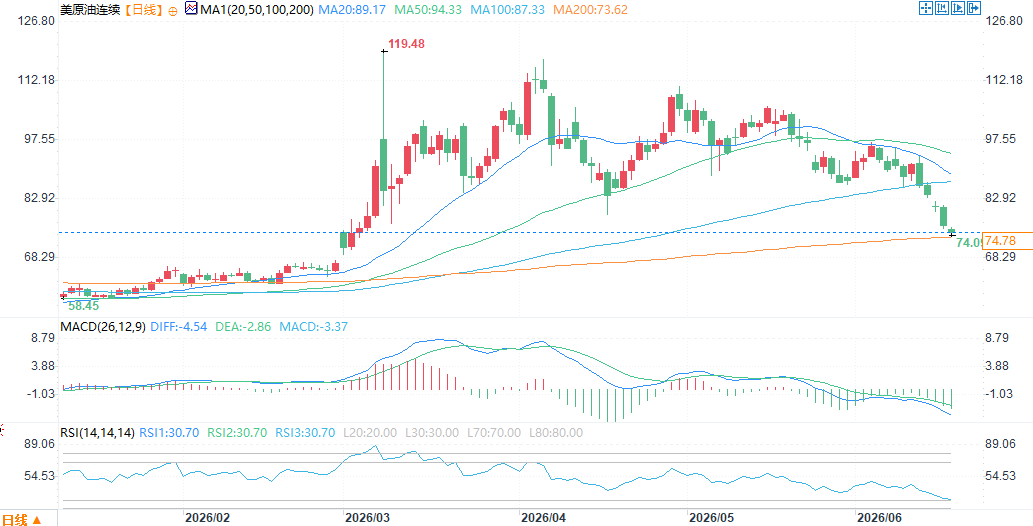
(US crude oil futures daily chart, source: FX678)
At 16:00 Beijing time on June 17, US crude oil futures were trading at $74.97 per barrel.
The continued weakness in oil prices reflects rising market expectations for the eventual implementation of a US-Iran agreement.
US President Trump announced on the 14th that a memorandum of understanding on a ceasefire had been reached with Iran, and the formal signing ceremony will be held in Switzerland on the 19th.
The US-Iran Agreed Framework ostensibly comprises two core elements: an immediate 60-day ceasefire and negotiations on a long-term peace agreement during this period. However, when it comes to the specifics of each category, extremely limited information has been confirmed—the text of the short-term agreement has not yet been released, and the long-term agreement is nowhere to be seen.
Many key questions remain unresolved, including whether the Strait of Hormuz will reopen as scheduled, whether tolls will be levied, how long the mine clearance process will take, the future of the nuclear issue, and whether sanctions will be lifted.
Will the Strait of Hormuz be reopened?
The US and Iran have pledged in a memorandum of understanding to lift the maritime blockade simultaneously, but there is significant disagreement in the market regarding the pace of a full resumption of navigation in the Strait of Hormuz, with channel clearing and safety inspections introducing multiple uncertainties. Trump has publicly expressed optimism, claiming that maritime transport in the strait is expected to return to normal by this Friday; however, major international shipping companies are cautious, generally assessing that clearing the backlog of vessels and conducting safety verifications will take at least several weeks.
Currently, thousands of merchant ships of various types are stranded along the Persian Gulf waiting for navigation to resume, and the distribution and clearance progress of mines left in the waterway remain the core hidden dangers restricting the resumption of shipping.
To expedite the elimination of risks to shipping lanes, Tehran has proactively provided maps of mine locations throughout the Strait of Hormuz and its nearshore waters, and is willing to offer mine-clearing technical assistance. Once the ceasefire agreement is formally implemented, the UK, France, Germany, Italy, Japan, and Canada will launch a long-planned joint mine-clearing operation. This collaborative operational plan has been under continuous consultation and refinement since March of this year.
Even with multinational collaboration in clearing obstacles, the narrow waters of the strait and the limited range of mine distribution mean that complete mine clearance and elimination of waterway safety hazards will still take several months, making it difficult to completely eliminate shipping risk premiums in the short term.
Can Iran impose tolls?
The US and Iran have significant differences in their positions on the issue of toll fees for navigation in the Strait of Hormuz, creating new potential threats to the restoration of normal navigation.
Trump publicly stated that the memorandum of understanding reached by both sides will guarantee permanent freedom of navigation in the Strait and explicitly state that no transit fees will be charged to any passing vessels.
However, Iranian officials have sent a completely different signal, saying that they may levy special service fees on all types of ships passing through the Strait of Hormuz under the guise of waterway safety management and escort and mine clearance services. Prior to the outbreak of this round of conflict, ships passing through the Strait of Hormuz did not have to bear such passage-related fees.
In response to Iran's proposed toll collection plan, legal experts from multiple countries have offered their interpretations, pointing out that the Strait of Hormuz is a legally recognized international navigation strait, and according to the United Nations Convention on the Law of the Sea, coastal states have no right to unilaterally collect transit fees. The proposed toll collection plan is controversial as it violates current international law.
The US has not yet made a public statement on this matter, and the market cannot determine whether the US will formally object or engage in renewed competition with Iran. The ongoing disagreement over pricing rules continues to exacerbate uncertainty in the shipping market and raises concerns about rising transportation costs for global crude oil trade and the maritime supply chain.
Will oil and gas prices return to normal?
Driven by the initial implementation of the US-Iran ceasefire agreement, international oil and natural gas prices have fallen significantly in the short term, and the geopolitical risk premium accumulated in the market has been released rapidly.
However, in the medium to long term, the potential pressure for continued price increases in energy products has not completely dissipated, and multiple constraints on both the supply and demand sides will continue to unfold.
On the one hand, even if both sides lift the maritime blockade, it will take at least several months to clear mines from the entire Strait of Hormuz, clear the backlog of thousands of merchant ships, and restore normal navigation in the waterway. In the short term, crude oil shipping capacity will be difficult to return to pre-conflict levels, and the global crude oil circulation channels will still be significantly obstructed. On the other hand, during this round of Middle East conflict, many oil and gas exploration platforms, oil pipelines, and port storage and transportation facilities along the coast have suffered varying degrees of damage. The survey, repair, and reconstruction of such energy infrastructure are complex and time-consuming, and the repair time will far exceed the progress of waterway clearing.
Constrained by both shipping bottlenecks and infrastructure damage, the elasticity of global oil and gas supply has contracted significantly. Once demand recovers, energy prices are likely to rebound again, and the market as a whole will maintain a pattern of rising prices rather than falling prices.
What will become of Iran's nuclear program?
Both the US and Iran have made it clear that nuclear-related issues are not included in the current short-term framework agreement and will not be subject to any constraints in this ceasefire memorandum. Instead, they will be postponed to be discussed in depth in a subsequent long-term comprehensive agreement.
This also means that the market cannot get a definite answer at present. How to deal with Iran's stockpile of highly enriched uranium that can be used for weapons manufacturing, whether to permanently terminate the production of highly enriched uranium, and the implementation period of related restrictions are all subject to huge variables, and there is no clear solution yet.
Trump had previously signaled a conciliatory stance, stating that he did not rule out Iran continuing its low-enrichment uranium program, which produces uranium at a level sufficient only for civilian nuclear power plants and not for the manufacture of nuclear weapons.
The current short-term agreement only addresses issues such as navigation in the Taiwan Strait and a ceasefire. All core differences in the nuclear field will be subject to 60 days of special negotiations, leaving considerable room for future bargaining and continuing to bring uncertainty to the geopolitical and energy markets.
Can Iran obtain sanctions relief or war damage compensation?
A senior U.S. official said Washington has discussed the possibility of lifting sanctions, as well as "a reconstruction fund of up to $300 billion."
The source stated that the fund did not originate from government grants but was established for companies intending to invest in Iran. Currently, the fund's structure and management methods are unclear.
Technical Analysis
The expectation of easing geopolitical tensions continues to generate risk premiums, which are directly reflected in the bearish technical structure of crude oil prices.
According to the daily chart, after reaching a high of 119.48, US crude oil futures began a continuous downward trend. The current price has fallen to around 75, breaking significantly below the 20, 50, and 100-day moving averages, forming a bearish pressure pattern. Only the 200-day moving average at 73.62 provides key support below.
In terms of indicators, the MACD is running below the zero axis, the DIFF continues to be below the DEA, and the green bearish bars are maintaining a high volume, indicating that the downward momentum has not yet clearly weakened; the RSI value has fallen back to 30.70, close to the 30 oversold dividing line, indicating a short-term technical rebound and correction demand, but no clear bottoming reversal signal has appeared.
In terms of price structure, the 89-94 range, a dense cluster of multiple moving averages above, forms strong resistance, and any rebound will face significant selling pressure. The first support level below is the 200-day moving average at 73.62. If this support is breached, the price will further test the previous support level of 68-70. Short-term market sentiment remains weak due to the positive impact of the US-Iran ceasefire, with a bearish trend dominating the market. Even if an oversold rebound occurs, its strength will be relatively limited, maintaining an overall bearish dominance and short-term oversold consolidation pattern.
(US crude oil futures daily chart, source: FX678)
At 16:00 Beijing time on June 17, US crude oil futures were trading at $74.97 per barrel.
- Risk Warning and Disclaimer
- The market involves risk, and trading may not be suitable for all investors. This article is for reference only and does not constitute personal investment advice, nor does it take into account certain users’ specific investment objectives, financial situation, or other needs. Any investment decisions made based on this information are at your own risk.