The Fed's hawkish stance, geopolitical peace efforts, and bearish institutional sentiment—silver is being torn apart by three forces. Who will dominate the next phase?
2026-06-18 16:31:24
On Thursday (June 18), spot silver prices fluctuated higher, rising more than 1.5% to around $69.10. During the Asian trading session, spot silver attracted a large influx of short-term buying, driving the price upward. The core driver was the significant easing of geopolitical tensions in the Middle East.
According to Iranian sources on June 18, US President Donald Trump and Iranian President Masoud Pezechioyan signed a memorandum of understanding remotely via electronic means. The core objective of the agreement is to completely end the long-standing hostile conflict between the two countries and restore normal navigation in the Strait of Hormuz.
Pakistani Prime Minister Shahbaz Sharif confirmed that the memorandum of understanding took effect immediately upon signing, significantly alleviating market concerns about potential disruptions to Middle Eastern energy supplies.
This breakthrough in diplomacy directly triggered a rapid decline in international crude oil prices. The risk premium in oil prices that had accumulated due to geopolitical conflicts was given up in a concentrated manner, and the market's panic about energy continuing to push up inflation cooled significantly, reducing bets on the Federal Reserve continuing to tighten monetary policy.
The increased investment value of interest-free precious metals, coupled with profit-taking and a weakening of the safe-haven dollar, boosted demand for silver. However, the hawkish stance of the Federal Reserve and the fading expectations of interest rate cuts this year limited the upside potential of silver prices, resulting in a moderate upward trend.
The Federal Reserve kept its benchmark interest rate unchanged as expected at its June policy meeting on Wednesday, but the overall policy signal was hawkish, clearly indicating that there is still a possibility of further rate hikes this year. This completely reversed the market's previous expectations of easing and became the core macroeconomic negative factor restricting the rebound of precious metals.
As a typical non-interest-bearing asset, silver does not generate fixed income such as interest or dividends. Its investment returns depend entirely on price fluctuations, and its valuation is highly sensitive to market interest rates and US Treasury yields.
With the Federal Reserve tightening monetary policy and maintaining high interest rates, the yields of interest-bearing assets such as US Treasury bonds and dollar deposits remain high, significantly increasing the opportunity cost of holding silver and causing the willingness to allocate funds to silver to continue to weaken.
Even though silver has inflation-hedging properties, its safe-haven and inflation-resistant premium will continue to be diluted under the pressure of high interest rates.
The Federal Reserve's current hawkish policy stance has reshaped the pricing logic of commodities and precious metals in the short term, effectively offsetting the positive support brought about by geopolitical easing.
Previously, the reconciliation between the US and Iran led to a decline in oil prices and a reduction in inflation concerns. Coupled with a short-term correction in the US dollar, this provided a temporary rebound for silver. However, the Federal Reserve's statement that it would not cut interest rates this year and might even raise them has raised the central level of real interest rates in the market, thus locking in the upper limit of silver prices.
Under this macroeconomic context, silver is unlikely to experience a sustained upward trend, as bullish momentum is insufficient and any rebound is more of a technical correction.
In the medium to long term, the Fed's hawkish stance will continue to suppress the upside potential of silver prices, becoming the core obstacle to a subsequent breakthrough in the silver market. The market is likely to maintain a weak and volatile structural pattern.
UBS believes that the recent rebound in silver prices during the Asian session was driven by a single factor and lacked sustainability. This price increase was mainly driven by short-term sentiment recovery due to easing geopolitical tensions between the US and Iran, representing an event-driven impulsive move rather than possessing fundamental or macroeconomic support for a sustained upward trend.
The Federal Reserve's June policy meeting released a clearly hawkish signal, and market expectations for a rate cut this year have largely subsided. Furthermore, half of the policymakers support another rate hike this year, and the expectation of continued high interest rates has further pushed US Treasury yields to high levels. As a non-interest-bearing asset, silver's high opportunity cost of holding it continues to suppress overall bullish valuations, becoming the core macroeconomic pressure currently limiting silver price increases.
There is also a lack of positive support on the supply and demand side. The photovoltaic industry's de-silvering process continues to advance, which has significantly dragged down the incremental demand for silver in the industry. At the same time, the high-price environment has stimulated the continuous increase in the supply of recycled silver, which has significantly narrowed the original supply and demand gap and weakened the marginal support of physical silver.
Overall, silver faces significant upward pressure and is unlikely to break out of its current consolidation pattern in the short term. Institutions recommend cautious buying on rallies, with the $70 level acting as a key strong resistance. Silver prices are expected to remain relatively stable throughout the third quarter, with little chance of a clear trend.
HSBC believes the market has solid support at the bottom, but the upside potential will be severely limited by multiple factors. The institution endorses data from the World Silver Institute, which shows that the global silver market has maintained a supply-demand deficit for six consecutive years. This long-term physical gap has built a solid bottom for silver prices, with very limited downside below $68 and a low risk of a deep correction.
However, the current macroeconomic environment significantly limits the upside potential of silver. The prolonged period of high interest rates by the Federal Reserve continues to put pressure on the valuation of non-interest-bearing precious metals. This is compounded by a sharp decline in demand for silver from the photovoltaic sector, and the inability of industrial demand to be offset by demand from other sectors, resulting in a continued weakening of the overall fundamentals for industrial silver consumption. The recent reconciliation between the US and Iran, which has driven down oil prices and cooled energy inflation expectations, can only provide a temporary emotional boost to silver and cannot reverse the pricing logic driven by monetary policy.
HSBC points out that this geopolitically driven rebound is a technical correction, not a trend reversal signal, and profit-taking pressure is likely to follow the surge. Institutions predict that the core trading range for silver prices this year will be between $68 and $88, with short-term price action mainly characterized by range-bound fluctuations. Chasing long positions is not cost-effective; waiting patiently for a turning point in fundamentals and macroeconomic expectations is a more prudent approach.
From the daily chart, spot silver has rebounded from its recent low of 61.48. Currently, the price has rebounded below the 20-day and 50-day moving averages (MA20 and MA50). The 200-day moving average (MA200) is located at 68.79, almost coinciding with the current price, forming a short-term support/resistance level. Key resistance levels are the MA50 (75.13) and the previous high of 89.34. Strong support levels are the previous lows of 60.96 and 61.48, forming a medium-term bottoming range.
In terms of indicators, the MACD lines are running below the zero axis, the DIFF is slightly close to the DEA, the green bars are extremely narrow, and the bearish momentum has weakened significantly, but a golden cross bullish signal has not yet formed; the RSI value is 43.53, which is in the neutral to weak range, with no overbought or oversold conditions, and the market lacks clear one-sided momentum.
In terms of price structure, the price has been falling continuously since the previous high of 89.34, breaking through short-term moving averages one after another, and is currently in a low-level recovery phase after the decline. The current price is under pressure from the 20-day moving average, and the rebound is weak, finding only slight support from the 200-day moving average. Only if it can hold above 69 will it have a chance to test the resistance level of the 75-day moving average; if it breaks below the 200-day moving average support, it will likely retest the lows near 61. The overall technical pattern is weak, and the short-term trend is mainly one of low-level consolidation, with the sustainability of the rebound questionable and no clear reversal signal appearing.
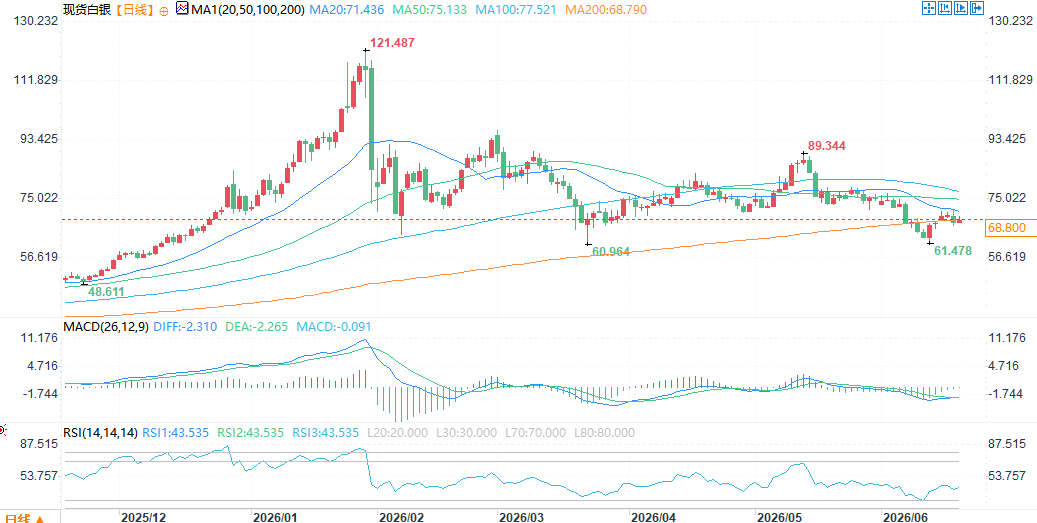
(Spot silver daily chart, source: EasyForex)
The US-Iran peace agreement boosts demand and eases concerns about energy inflation.
According to Iranian sources on June 18, US President Donald Trump and Iranian President Masoud Pezechioyan signed a memorandum of understanding remotely via electronic means. The core objective of the agreement is to completely end the long-standing hostile conflict between the two countries and restore normal navigation in the Strait of Hormuz.
Pakistani Prime Minister Shahbaz Sharif confirmed that the memorandum of understanding took effect immediately upon signing, significantly alleviating market concerns about potential disruptions to Middle Eastern energy supplies.
This breakthrough in diplomacy directly triggered a rapid decline in international crude oil prices. The risk premium in oil prices that had accumulated due to geopolitical conflicts was given up in a concentrated manner, and the market's panic about energy continuing to push up inflation cooled significantly, reducing bets on the Federal Reserve continuing to tighten monetary policy.
The increased investment value of interest-free precious metals, coupled with profit-taking and a weakening of the safe-haven dollar, boosted demand for silver. However, the hawkish stance of the Federal Reserve and the fading expectations of interest rate cuts this year limited the upside potential of silver prices, resulting in a moderate upward trend.
The Federal Reserve's decision to hold rates steady but retain the option to raise them may limit upside potential for silver prices.
The Federal Reserve kept its benchmark interest rate unchanged as expected at its June policy meeting on Wednesday, but the overall policy signal was hawkish, clearly indicating that there is still a possibility of further rate hikes this year. This completely reversed the market's previous expectations of easing and became the core macroeconomic negative factor restricting the rebound of precious metals.
As a typical non-interest-bearing asset, silver does not generate fixed income such as interest or dividends. Its investment returns depend entirely on price fluctuations, and its valuation is highly sensitive to market interest rates and US Treasury yields.
With the Federal Reserve tightening monetary policy and maintaining high interest rates, the yields of interest-bearing assets such as US Treasury bonds and dollar deposits remain high, significantly increasing the opportunity cost of holding silver and causing the willingness to allocate funds to silver to continue to weaken.
Even though silver has inflation-hedging properties, its safe-haven and inflation-resistant premium will continue to be diluted under the pressure of high interest rates.
The Federal Reserve's current hawkish policy stance has reshaped the pricing logic of commodities and precious metals in the short term, effectively offsetting the positive support brought about by geopolitical easing.
Previously, the reconciliation between the US and Iran led to a decline in oil prices and a reduction in inflation concerns. Coupled with a short-term correction in the US dollar, this provided a temporary rebound for silver. However, the Federal Reserve's statement that it would not cut interest rates this year and might even raise them has raised the central level of real interest rates in the market, thus locking in the upper limit of silver prices.
Under this macroeconomic context, silver is unlikely to experience a sustained upward trend, as bullish momentum is insufficient and any rebound is more of a technical correction.
In the medium to long term, the Fed's hawkish stance will continue to suppress the upside potential of silver prices, becoming the core obstacle to a subsequent breakthrough in the silver market. The market is likely to maintain a weak and volatile structural pattern.
Institutional Views
UBS believes that the recent rebound in silver prices during the Asian session was driven by a single factor and lacked sustainability. This price increase was mainly driven by short-term sentiment recovery due to easing geopolitical tensions between the US and Iran, representing an event-driven impulsive move rather than possessing fundamental or macroeconomic support for a sustained upward trend.
The Federal Reserve's June policy meeting released a clearly hawkish signal, and market expectations for a rate cut this year have largely subsided. Furthermore, half of the policymakers support another rate hike this year, and the expectation of continued high interest rates has further pushed US Treasury yields to high levels. As a non-interest-bearing asset, silver's high opportunity cost of holding it continues to suppress overall bullish valuations, becoming the core macroeconomic pressure currently limiting silver price increases.
There is also a lack of positive support on the supply and demand side. The photovoltaic industry's de-silvering process continues to advance, which has significantly dragged down the incremental demand for silver in the industry. At the same time, the high-price environment has stimulated the continuous increase in the supply of recycled silver, which has significantly narrowed the original supply and demand gap and weakened the marginal support of physical silver.
Overall, silver faces significant upward pressure and is unlikely to break out of its current consolidation pattern in the short term. Institutions recommend cautious buying on rallies, with the $70 level acting as a key strong resistance. Silver prices are expected to remain relatively stable throughout the third quarter, with little chance of a clear trend.
HSBC believes the market has solid support at the bottom, but the upside potential will be severely limited by multiple factors. The institution endorses data from the World Silver Institute, which shows that the global silver market has maintained a supply-demand deficit for six consecutive years. This long-term physical gap has built a solid bottom for silver prices, with very limited downside below $68 and a low risk of a deep correction.
However, the current macroeconomic environment significantly limits the upside potential of silver. The prolonged period of high interest rates by the Federal Reserve continues to put pressure on the valuation of non-interest-bearing precious metals. This is compounded by a sharp decline in demand for silver from the photovoltaic sector, and the inability of industrial demand to be offset by demand from other sectors, resulting in a continued weakening of the overall fundamentals for industrial silver consumption. The recent reconciliation between the US and Iran, which has driven down oil prices and cooled energy inflation expectations, can only provide a temporary emotional boost to silver and cannot reverse the pricing logic driven by monetary policy.
HSBC points out that this geopolitically driven rebound is a technical correction, not a trend reversal signal, and profit-taking pressure is likely to follow the surge. Institutions predict that the core trading range for silver prices this year will be between $68 and $88, with short-term price action mainly characterized by range-bound fluctuations. Chasing long positions is not cost-effective; waiting patiently for a turning point in fundamentals and macroeconomic expectations is a more prudent approach.
Technical Analysis
From the daily chart, spot silver has rebounded from its recent low of 61.48. Currently, the price has rebounded below the 20-day and 50-day moving averages (MA20 and MA50). The 200-day moving average (MA200) is located at 68.79, almost coinciding with the current price, forming a short-term support/resistance level. Key resistance levels are the MA50 (75.13) and the previous high of 89.34. Strong support levels are the previous lows of 60.96 and 61.48, forming a medium-term bottoming range.
In terms of indicators, the MACD lines are running below the zero axis, the DIFF is slightly close to the DEA, the green bars are extremely narrow, and the bearish momentum has weakened significantly, but a golden cross bullish signal has not yet formed; the RSI value is 43.53, which is in the neutral to weak range, with no overbought or oversold conditions, and the market lacks clear one-sided momentum.
In terms of price structure, the price has been falling continuously since the previous high of 89.34, breaking through short-term moving averages one after another, and is currently in a low-level recovery phase after the decline. The current price is under pressure from the 20-day moving average, and the rebound is weak, finding only slight support from the 200-day moving average. Only if it can hold above 69 will it have a chance to test the resistance level of the 75-day moving average; if it breaks below the 200-day moving average support, it will likely retest the lows near 61. The overall technical pattern is weak, and the short-term trend is mainly one of low-level consolidation, with the sustainability of the rebound questionable and no clear reversal signal appearing.
(Spot silver daily chart, source: EasyForex)
- Risk Warning and Disclaimer
- The market involves risk, and trading may not be suitable for all investors. This article is for reference only and does not constitute personal investment advice, nor does it take into account certain users’ specific investment objectives, financial situation, or other needs. Any investment decisions made based on this information are at your own risk.