Crude Oil Price Outlook: How Much Downside Potential Does WTI Crude Oil Have?
2026-06-23 02:02:05
News broke over the weekend that Iran had again taken measures to restrict navigation through the Strait of Hormuz, causing international crude oil prices to initially rise. However, the bullish momentum was short-lived, and oil prices quickly fell back, returning to near the weekend's closing price. WTI crude oil fell by approximately 3.28%, hovering near its intraday low.
This weakness is partly due to the fact that the Strait of Hormuz is not completely closed to navigation, although shipping data shows a significant decline in the number of vessels passing through; more importantly, the diplomatic situation in the Middle East has improved, leading to a rebound in market risk appetite. The first round of US-Iran talks concluded, with Iranian Foreign Minister Abbas Araqchi stating that the negotiations had made "significant progress," and the ceasefire negotiations in Lebanon also achieved substantial breakthroughs. Continued progress in peace talks is likely to continue to put downward pressure on oil prices in the short term.
However, the downside for crude oil is limited: the risk premium from geopolitical conflicts has been largely priced into oil prices, and global crude oil end-user demand remains resilient.
Replenishment demand is expected to support the oil market.
Tensions in the Middle East continue to ease, but the oil market remains generally bearish in the short term. Previous gains driven by geopolitical conflicts have largely been reversed, and oil prices are gradually approaching the trading range they were in before the conflict, with the war premium essentially cleared. Before the conflict, WTI crude oil traded in the $65-$66 per barrel range for an extended period; if prices continue to decline, this range will become a key support level.
However, in recent months, navigation through the Strait of Hormuz has been disrupted, leading to a severe imbalance in the global oil supply and demand, and a continued decline in inventories in various countries. Therefore, even if WTI falls back to pre-war prices, the possibility of a sustained sharp decline is unlikely.
Previously, many countries released strategic oil reserves to alleviate supply gaps caused by shipping disruptions; now that oil prices have fallen, countries are likely to take the opportunity to replenish their stocks. Major crude oil consuming countries such as China, Japan, and the United States may replenish their strategic reserves at lower prices, and stockpiling demand will be a significant force supporting oil prices in the coming weeks.
Meanwhile, oil production in countries like Iran and Venezuela continues to rise, offsetting some of the positive demand. Unless geopolitical conflicts in the Middle East escalate again, new supply will limit the potential for a significant rebound in oil prices.
The trend of the US dollar is also worth noting: a stronger dollar will put pressure on dollar-denominated commodities, and crude oil and precious metals will face additional downward pressure.
The probability of a sharp drop in oil prices is relatively low.
Although downside risks remain in the short term, the market is not currently in a state of precipitous drop in oil prices.
The future trend of crude oil prices will depend on the interplay between increased supply and market demand, with multiple positive factors still supporting the demand side.
First, strategic reserve replenishment plans by various countries will generate substantial new procurement demand; second, the peak summer driving season in the United States will continue to boost fuel consumption. Even with OPEC member countries and Iran gradually increasing production, strong seasonal demand for gasoline will maintain a tight inventory balance.
As long as crude oil demand remains strong in the third quarter, or if the resumption of production by oil-producing countries falls short of expectations, even if oil prices continue to weaken, the decline will be relatively mild, and there will be no one-sided sharp drop.
WTI Crude Oil Technical Analysis
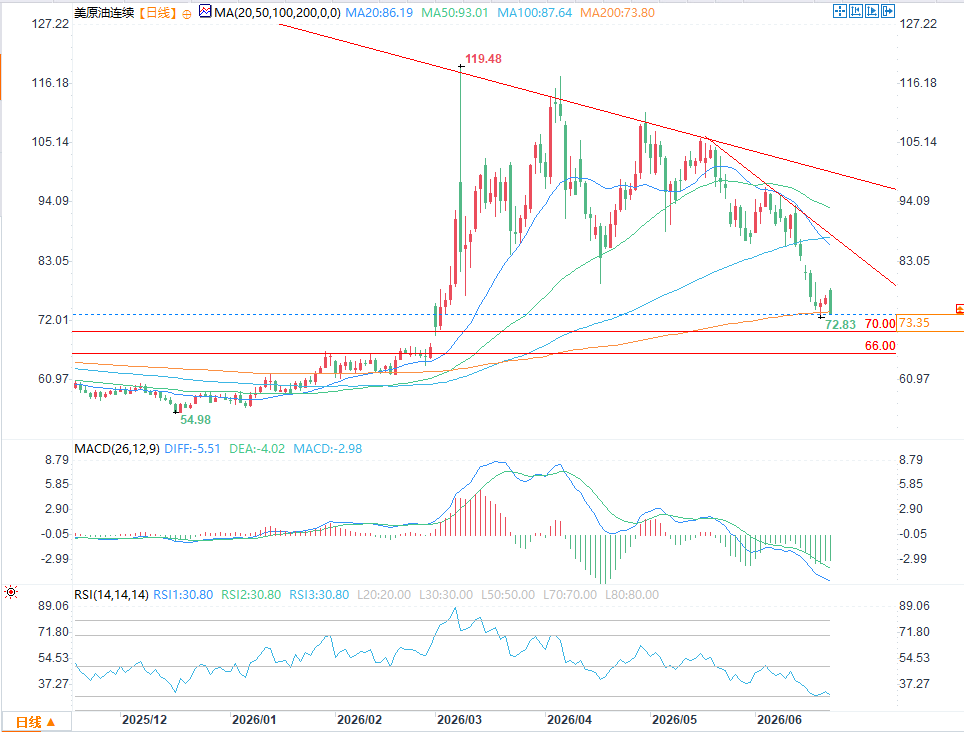
(WTI crude oil daily chart source: FX678)
From a technical chart perspective, WTI crude oil has been declining for several weeks, with various momentum indicators showing deep oversold conditions, suggesting a potential technical rebound. If geopolitical conflicts in the Middle East escalate again or key shipping routes such as the Strait of Hormuz are threatened, oil prices may see a rebound.
At the time of writing, WTI crude oil is trading in the $73-$74 per barrel range. This level is a key support level from the previous period, and oil prices held this range multiple times at the end of last week. The 200-day moving average also sits at this level, indicating strong support.
If the support level of $73-$74 is breached, the market will turn its attention to the psychological level of $70; after breaking below $70, the next key range will be the pre-war level of $66-$67.
On the upside, the first resistance level is at $76.10. This level served as strong support in the first half of the year but was subsequently broken, and has now reversed course to act as resistance to further oil price increases.
If oil prices stabilize above $76.10, the short-term technical outlook will improve, and a rebound to $80 is possible; if the situation in the Middle East deteriorates sharply again, oil prices may rise to the $85-$86 range.
This weakness is partly due to the fact that the Strait of Hormuz is not completely closed to navigation, although shipping data shows a significant decline in the number of vessels passing through; more importantly, the diplomatic situation in the Middle East has improved, leading to a rebound in market risk appetite. The first round of US-Iran talks concluded, with Iranian Foreign Minister Abbas Araqchi stating that the negotiations had made "significant progress," and the ceasefire negotiations in Lebanon also achieved substantial breakthroughs. Continued progress in peace talks is likely to continue to put downward pressure on oil prices in the short term.
However, the downside for crude oil is limited: the risk premium from geopolitical conflicts has been largely priced into oil prices, and global crude oil end-user demand remains resilient.
Replenishment demand is expected to support the oil market.
Tensions in the Middle East continue to ease, but the oil market remains generally bearish in the short term. Previous gains driven by geopolitical conflicts have largely been reversed, and oil prices are gradually approaching the trading range they were in before the conflict, with the war premium essentially cleared. Before the conflict, WTI crude oil traded in the $65-$66 per barrel range for an extended period; if prices continue to decline, this range will become a key support level.
However, in recent months, navigation through the Strait of Hormuz has been disrupted, leading to a severe imbalance in the global oil supply and demand, and a continued decline in inventories in various countries. Therefore, even if WTI falls back to pre-war prices, the possibility of a sustained sharp decline is unlikely.
Previously, many countries released strategic oil reserves to alleviate supply gaps caused by shipping disruptions; now that oil prices have fallen, countries are likely to take the opportunity to replenish their stocks. Major crude oil consuming countries such as China, Japan, and the United States may replenish their strategic reserves at lower prices, and stockpiling demand will be a significant force supporting oil prices in the coming weeks.
Meanwhile, oil production in countries like Iran and Venezuela continues to rise, offsetting some of the positive demand. Unless geopolitical conflicts in the Middle East escalate again, new supply will limit the potential for a significant rebound in oil prices.
The trend of the US dollar is also worth noting: a stronger dollar will put pressure on dollar-denominated commodities, and crude oil and precious metals will face additional downward pressure.
The probability of a sharp drop in oil prices is relatively low.
Although downside risks remain in the short term, the market is not currently in a state of precipitous drop in oil prices.
The future trend of crude oil prices will depend on the interplay between increased supply and market demand, with multiple positive factors still supporting the demand side.
First, strategic reserve replenishment plans by various countries will generate substantial new procurement demand; second, the peak summer driving season in the United States will continue to boost fuel consumption. Even with OPEC member countries and Iran gradually increasing production, strong seasonal demand for gasoline will maintain a tight inventory balance.
As long as crude oil demand remains strong in the third quarter, or if the resumption of production by oil-producing countries falls short of expectations, even if oil prices continue to weaken, the decline will be relatively mild, and there will be no one-sided sharp drop.
WTI Crude Oil Technical Analysis
(WTI crude oil daily chart source: FX678)
From a technical chart perspective, WTI crude oil has been declining for several weeks, with various momentum indicators showing deep oversold conditions, suggesting a potential technical rebound. If geopolitical conflicts in the Middle East escalate again or key shipping routes such as the Strait of Hormuz are threatened, oil prices may see a rebound.
At the time of writing, WTI crude oil is trading in the $73-$74 per barrel range. This level is a key support level from the previous period, and oil prices held this range multiple times at the end of last week. The 200-day moving average also sits at this level, indicating strong support.
If the support level of $73-$74 is breached, the market will turn its attention to the psychological level of $70; after breaking below $70, the next key range will be the pre-war level of $66-$67.
On the upside, the first resistance level is at $76.10. This level served as strong support in the first half of the year but was subsequently broken, and has now reversed course to act as resistance to further oil price increases.
If oil prices stabilize above $76.10, the short-term technical outlook will improve, and a rebound to $80 is possible; if the situation in the Middle East deteriorates sharply again, oil prices may rise to the $85-$86 range.
- Risk Warning and Disclaimer
- The market involves risk, and trading may not be suitable for all investors. This article is for reference only and does not constitute personal investment advice, nor does it take into account certain users’ specific investment objectives, financial situation, or other needs. Any investment decisions made based on this information are at your own risk.