Gold Trading Alert: US and Iran shake hands and make peace, gold prices rebound from a one-week low, but bulls face their strongest opponent yet?
2026-06-23 07:36:58
On Monday (June 22), spot gold prices rose 0.85%, closing at $4,191.18 per ounce, successfully recovering from the more than one-week low of $4,121.79 reached in the previous trading day. This move broke the recent slump, with the core driving factor being the substantial progress made in the US-Iran peace talks. The talks not only eased market concerns about Middle Eastern oil supplies but also signaled easing inflationary pressures through falling oil prices, providing support for gold as a safe-haven asset. However, at the same time, the increasingly hawkish policy shift of the Federal Reserve and rising expectations of interest rate hikes have also dampened the enthusiasm of gold bulls. Bank of America analysts bluntly stated that the target price of $6,000 per ounce for gold now seems unrealistic. On Tuesday (June 23) in early Asian trading, spot gold fluctuated narrowly, currently trading around $4,190 per ounce.
The core catalyst for this round of gold price increases was undoubtedly the positive progress made in the first round of high-level talks between the United States and Iran in Bielgenstöl, Switzerland. Following the talks, US Vice President Vance optimistically stated that the negotiations laid a "good foundation" for a final peace agreement. Although tensions remain in the Strait of Hormuz and in Lebanon, both sides agreed to establish a communication mechanism, ensure the safe passage of merchant ships, and open channels to address related conflict risks. Iran, on the other hand, secured a 60-day waiver from US sanctions, allowing it to export crude oil and petrochemical products and earn revenue, directly injecting new supply expectations into the market.
As a result, international oil prices fell sharply. Brent crude futures fell by more than 3%, and US crude oil also saw a significant decline. Saxo Bank analyst Ole Hansen pointed out that energy prices remain a key driver of the precious metals market in the short term. If US-Iran negotiations continue, it will bring additional supply to the global oil market, thereby depressing oil prices and alleviating some inflation concerns. This transmission path of "falling oil prices - easing inflation" traditionally supports gold. This is because gold tends to perform strongly in high inflation environments, while easing supply risks reduce extreme safe-haven demand, but also provides room for price recovery.
Furthermore, the de-escalation of the situation in Lebanon further boosted market optimism. The tense fighting that began last weekend has subsided, and while Israel maintains its military operations in southern Lebanon, overall ceasefire efforts are progressing. Iran's chief negotiator, Ghalibaf, confirmed that the two sides have finalized an agreement to release $12 billion in frozen assets. These positive developments combined significantly reduced investor concerns about a large-scale escalation of conflict in the Middle East, allowing gold to rebound.
While geopolitical factors offer short-term support, macroeconomic factors, particularly policy signals from the Federal Reserve, are becoming the biggest uncertainty facing gold. The CME FedWatch tool shows traders now expect an 89% probability of a December rate hike, a significant increase from before last week's Fed meeting. The market is even considering a September rate hike, with Bank of America and Deutsche Bank both adjusting their forecasts to suggest the Fed may raise rates by 25 basis points each in September, October, and December. The probability of at least a 25 basis point rate hike at the July meeting has also risen to 38.5%.
U.S. Treasury yields subsequently rose, with the two-year yield hitting a 16-month high and the 10-year yield also climbing significantly, steepening the yield curve. This reflects the market pricing in a more hawkish stance under the leadership of the new Federal Reserve Chairman, Warsh. Warsh removed forward guidance at last week's meeting, emphasizing the need to maintain price stability and further reinforcing his hawkish image. Against this backdrop, the dollar index rose 0.23% to 101, and a strong dollar typically puts direct pressure on dollar-denominated gold.
In its latest report, Bank of America explicitly stated that its previously set target price of $6,000/ounce for gold "currently appears unlikely to be achieved." This is because reaching this level would require the market to completely rule out expectations of interest rate hikes, which is currently the opposite. However, Bank of America also emphasized that its initial premise for a bullish outlook on gold—unconventional US macroeconomic policies—remains valid. This means that if geopolitical risks escalate again or economic data unexpectedly weakens, gold still has the potential to rebound, but the high-interest-rate environment will continue to pose a headwind in the short term.
Gold's price movements are also closely intertwined with broader financial markets. U.S. stocks diverged on Monday, with the Dow Jones Industrial Average rising slightly by 0.29%, driven by healthcare and industrial sectors, while the S&P 500 and Nasdaq Composite fell 0.37% and 1.32%, respectively, mainly dragged down by tech giants like Alphabet. SpaceX shares plummeted 16.4%, highlighting investor skepticism towards overvalued tech stocks. Meanwhile, falling oil prices were seen as a boon for consumers and businesses, but the Federal Reserve's hawkish stance, pushing up yields, also put downward pressure on stock prices.
In the bond market, traders are closely watching this week's upcoming PCE inflation data, the Federal Reserve's preferred core inflation gauge. Stronger-than-expected data would further solidify expectations of an interest rate hike. While the decline in energy prices is a positive factor, its transmission to consumer prices will take several months, meaning gold will still face the test of macroeconomic tightening in the short term.
In summary, the gold market is currently under the dual influence of easing geopolitical tensions and tightening macroeconomic policies. The ongoing US-Iran negotiations, particularly the technical talks this week and the resumption of shipping in the Strait of Hormuz, will continue to provide directional guidance for oil and gold prices. If a peace agreement progresses steadily towards the goal of a permanent agreement within 60 days, gold may consolidate around current levels; conversely, if the situation in Lebanon or the Strait of Hormuz deteriorates again, safe-haven buying could drive gold prices back up.
For investors, the short-term key lies in this week's PCE data and further statements from Federal Reserve officials. In the medium to long term, unconventional US macroeconomic policies and potential geopolitical risks continue to provide structural support for gold, but the high-interest-rate environment undoubtedly limits its upside potential. Ole Hansen's view is worth noting: energy price dynamics remain a core window for observing the precious metals market.
In summary, the optimistic expectations brought about by the US-Iran peace talks have injected vitality into gold, but the Federal Reserve's hawkish shift has also sounded alarm bells. Gold is not in a one-sided bull market; rather, it needs to find a balance amidst complex negotiations. In the coming weeks, the market will face further scrutiny from data and negotiation signals. Investors need to remain cautious and dynamically adjust their strategies to seize opportunities in the volatile gold market.
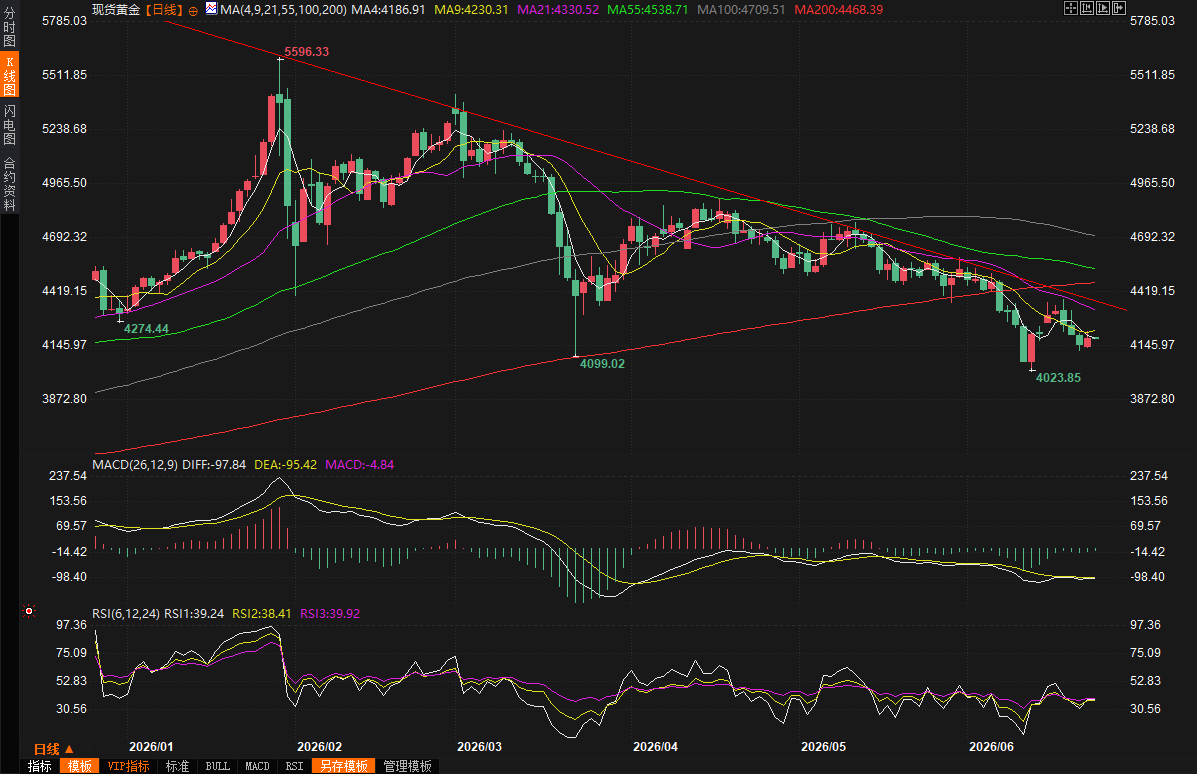
(Spot gold daily chart, source: FX678)
At 07:36 Beijing time, spot gold was trading at $4192.38 per ounce.
Geopolitical easing: US-Iran talks become the biggest booster for gold prices.
The core catalyst for this round of gold price increases was undoubtedly the positive progress made in the first round of high-level talks between the United States and Iran in Bielgenstöl, Switzerland. Following the talks, US Vice President Vance optimistically stated that the negotiations laid a "good foundation" for a final peace agreement. Although tensions remain in the Strait of Hormuz and in Lebanon, both sides agreed to establish a communication mechanism, ensure the safe passage of merchant ships, and open channels to address related conflict risks. Iran, on the other hand, secured a 60-day waiver from US sanctions, allowing it to export crude oil and petrochemical products and earn revenue, directly injecting new supply expectations into the market.
As a result, international oil prices fell sharply. Brent crude futures fell by more than 3%, and US crude oil also saw a significant decline. Saxo Bank analyst Ole Hansen pointed out that energy prices remain a key driver of the precious metals market in the short term. If US-Iran negotiations continue, it will bring additional supply to the global oil market, thereby depressing oil prices and alleviating some inflation concerns. This transmission path of "falling oil prices - easing inflation" traditionally supports gold. This is because gold tends to perform strongly in high inflation environments, while easing supply risks reduce extreme safe-haven demand, but also provides room for price recovery.
Furthermore, the de-escalation of the situation in Lebanon further boosted market optimism. The tense fighting that began last weekend has subsided, and while Israel maintains its military operations in southern Lebanon, overall ceasefire efforts are progressing. Iran's chief negotiator, Ghalibaf, confirmed that the two sides have finalized an agreement to release $12 billion in frozen assets. These positive developments combined significantly reduced investor concerns about a large-scale escalation of conflict in the Middle East, allowing gold to rebound.
Macroeconomic policy shift: Hawkish expectations from the Federal Reserve suppress long-term gold price potential.
While geopolitical factors offer short-term support, macroeconomic factors, particularly policy signals from the Federal Reserve, are becoming the biggest uncertainty facing gold. The CME FedWatch tool shows traders now expect an 89% probability of a December rate hike, a significant increase from before last week's Fed meeting. The market is even considering a September rate hike, with Bank of America and Deutsche Bank both adjusting their forecasts to suggest the Fed may raise rates by 25 basis points each in September, October, and December. The probability of at least a 25 basis point rate hike at the July meeting has also risen to 38.5%.
U.S. Treasury yields subsequently rose, with the two-year yield hitting a 16-month high and the 10-year yield also climbing significantly, steepening the yield curve. This reflects the market pricing in a more hawkish stance under the leadership of the new Federal Reserve Chairman, Warsh. Warsh removed forward guidance at last week's meeting, emphasizing the need to maintain price stability and further reinforcing his hawkish image. Against this backdrop, the dollar index rose 0.23% to 101, and a strong dollar typically puts direct pressure on dollar-denominated gold.
In its latest report, Bank of America explicitly stated that its previously set target price of $6,000/ounce for gold "currently appears unlikely to be achieved." This is because reaching this level would require the market to completely rule out expectations of interest rate hikes, which is currently the opposite. However, Bank of America also emphasized that its initial premise for a bullish outlook on gold—unconventional US macroeconomic policies—remains valid. This means that if geopolitical risks escalate again or economic data unexpectedly weakens, gold still has the potential to rebound, but the high-interest-rate environment will continue to pose a headwind in the short term.
Market Interplay: The interplay between stock market divergence, bond market adjustments, and gold.
Gold's price movements are also closely intertwined with broader financial markets. U.S. stocks diverged on Monday, with the Dow Jones Industrial Average rising slightly by 0.29%, driven by healthcare and industrial sectors, while the S&P 500 and Nasdaq Composite fell 0.37% and 1.32%, respectively, mainly dragged down by tech giants like Alphabet. SpaceX shares plummeted 16.4%, highlighting investor skepticism towards overvalued tech stocks. Meanwhile, falling oil prices were seen as a boon for consumers and businesses, but the Federal Reserve's hawkish stance, pushing up yields, also put downward pressure on stock prices.
In the bond market, traders are closely watching this week's upcoming PCE inflation data, the Federal Reserve's preferred core inflation gauge. Stronger-than-expected data would further solidify expectations of an interest rate hike. While the decline in energy prices is a positive factor, its transmission to consumer prices will take several months, meaning gold will still face the test of macroeconomic tightening in the short term.
Looking ahead: Gold is facing mixed signals; attention should be paid to the progress of negotiations and inflation data.
In summary, the gold market is currently under the dual influence of easing geopolitical tensions and tightening macroeconomic policies. The ongoing US-Iran negotiations, particularly the technical talks this week and the resumption of shipping in the Strait of Hormuz, will continue to provide directional guidance for oil and gold prices. If a peace agreement progresses steadily towards the goal of a permanent agreement within 60 days, gold may consolidate around current levels; conversely, if the situation in Lebanon or the Strait of Hormuz deteriorates again, safe-haven buying could drive gold prices back up.
For investors, the short-term key lies in this week's PCE data and further statements from Federal Reserve officials. In the medium to long term, unconventional US macroeconomic policies and potential geopolitical risks continue to provide structural support for gold, but the high-interest-rate environment undoubtedly limits its upside potential. Ole Hansen's view is worth noting: energy price dynamics remain a core window for observing the precious metals market.
In summary, the optimistic expectations brought about by the US-Iran peace talks have injected vitality into gold, but the Federal Reserve's hawkish shift has also sounded alarm bells. Gold is not in a one-sided bull market; rather, it needs to find a balance amidst complex negotiations. In the coming weeks, the market will face further scrutiny from data and negotiation signals. Investors need to remain cautious and dynamically adjust their strategies to seize opportunities in the volatile gold market.
(Spot gold daily chart, source: FX678)
At 07:36 Beijing time, spot gold was trading at $4192.38 per ounce.
- Risk Warning and Disclaimer
- The market involves risk, and trading may not be suitable for all investors. This article is for reference only and does not constitute personal investment advice, nor does it take into account certain users’ specific investment objectives, financial situation, or other needs. Any investment decisions made based on this information are at your own risk.