With US-Iran negotiations progressing and sanctions about to be lifted—how much will the return of Iranian crude oil push oil prices down?
2026-06-23 14:00:52
On Tuesday (June 23) during the Asian session, West Texas Intermediate (WTI) crude oil continued its weakness after a sharp drop in the previous trading day, trading around $73.10 per barrel, not far from the low since March reached last Thursday.
The US announced a temporary lifting of sanctions on Iranian oil exports as negotiations between the two countries progressed, putting pressure on oil prices; however, geopolitical risks have not completely dissipated, providing a floor for oil prices.
The mediators, Qatar and Pakistan, issued a joint statement on Monday announcing encouraging and substantial progress in the first round of high-level talks between the United States and Iran held in Burgenstock, Switzerland. The two sides agreed on a clear roadmap for reaching a comprehensive agreement within 60 days to end the current conflict, and established a high-level committee to oversee the overall political process, along with several special working groups on nuclear issues, sanctions easing, and dispute resolution.
This latest development marks a crucial step in the US-Iran dialogue from a temporary ceasefire to a long-term peace framework, significantly easing market concerns about a potential breakdown in negotiations.
Previously, Iran abruptly announced the re-closure of the Strait of Hormuz last Saturday, causing a brief disruption to shipping activities. Meanwhile, US President Trump issued a stern military threat on Truth Social, stating that he would take stronger action if Iran did not support a ceasefire in Lebanon. These tense signals exacerbated market volatility.
The joint statement emphasized that the talks were conducted in a "positive and constructive" atmosphere, with both delegations maintaining close communication. The mediators stated that a coordination mechanism for the Lebanese conflict had been established and a preliminary consensus had been reached on the safe passage through the Strait of Hormuz. This 60-day roadmap provides institutional guarantees for subsequent intensive technical negotiations and injects a degree of certainty into the global energy market and financial assets.
However, analysts caution that core disagreements such as restrictions on Iran's nuclear program, the unfreezing of frozen assets, and the issue of regional proxies remain unresolved, and the prospects for negotiations remain uncertain.
At the same time, the U.S. Treasury Department announced a temporary easing of sanctions on Iranian crude oil exports. This move is an initial step in fulfilling the provisional agreement signed by the U.S. and Iran last week, which aims to provide substantial economic benefits to Iran, and has directly put significant downward pressure on the global crude oil market.
Under the agreement, the United States granted temporary waivers to Iran for oil production, delivery, and sales within a 60-day negotiation window, allowing Iranian crude oil to re-enter the international market. This decision quickly altered market supply and demand expectations. The geopolitical risk premium that had accumulated due to concerns about conflict and blockade began to be released rapidly, with traders adjusting their positions, causing oil prices to come under pressure and fall.
Expectations of Iranian oil returning to the global market, coupled with positive signs of a gradual recovery in shipping activity across the Strait of Hormuz, have jointly driven WTI crude oil prices down significantly from recent highs above $78 to around $74 per barrel currently. The market generally expects that if subsequent negotiations proceed smoothly, Iran's daily exports could increase by 500,000 to 1 million barrels in the short term, which would further alleviate the global supply shortage.
However, the sanctions waivers are currently temporary, and their sustainability highly depends on the finalization of a comprehensive US-Iran agreement. In the short term, this policy downturn has dominated oil price movements, but investors should remain vigilant. If negotiations falter or the Lebanese ceasefire mechanism fails, geopolitical risk premiums could rebound rapidly, providing support for oil prices.
UBS Group holds a cautiously optimistic but downward-biased view on the future of WTI crude oil, predicting that the average price of Brent crude oil in 2026 will be in the range of $75-85, and WTI will be in the range of $70-80.
The agency believes that progress in US-Iran negotiations and sanctions waivers will accelerate supply recovery, but the geopolitical risk premium will not disappear immediately, and oil prices will remain highly volatile in the short term. The current consolidation around $74 is seen as a process of digesting negative factors, and the agency recommends gradually building long positions near key support levels while managing risk effectively.
UBS analysts point out that while global demand growth faces challenges, Asian recovery and inventory replenishment provide some support. In the medium to long term, accelerated energy transition and increased non-OPEC+ production will limit upside potential for oil prices, but OPEC+ production cut discipline and potential geopolitical tensions may provide a buffer.
Mitsubishi UFJ Global Market Research Department predicts that oil prices will show a trend of high at the beginning and low at the end in 2026, with an average price of about $78-82 per barrel for the whole year.
The agency believes that the progress of US-Iran peace talks is beneficial to the recovery of supply, but there are still uncertainties about the actual speed of navigation in the Strait of Hormuz and the pace of the resumption of Iranian exports. Geopolitical risk premiums will provide temporary support for oil prices, and investors are advised to buy on dips.
However, traders remain skeptical about the sustainability of the ceasefire. Significant differences remain between the two sides on core issues such as the strategic importance of the Strait of Hormuz, Iran's nuclear program, and frozen Iranian funds.
This means that geopolitical risk premiums have not completely disappeared, but continue to occupy a place in market pricing.
Oil prices consolidating around $73 indicates that the market is digesting the short-term negative impact of sanctions lifting while assessing the persistence of geopolitical risks. A decisive break below $73 could trigger a new round of declines; conversely, if geopolitical tensions deteriorate again, oil prices are expected to rebound from this support level.
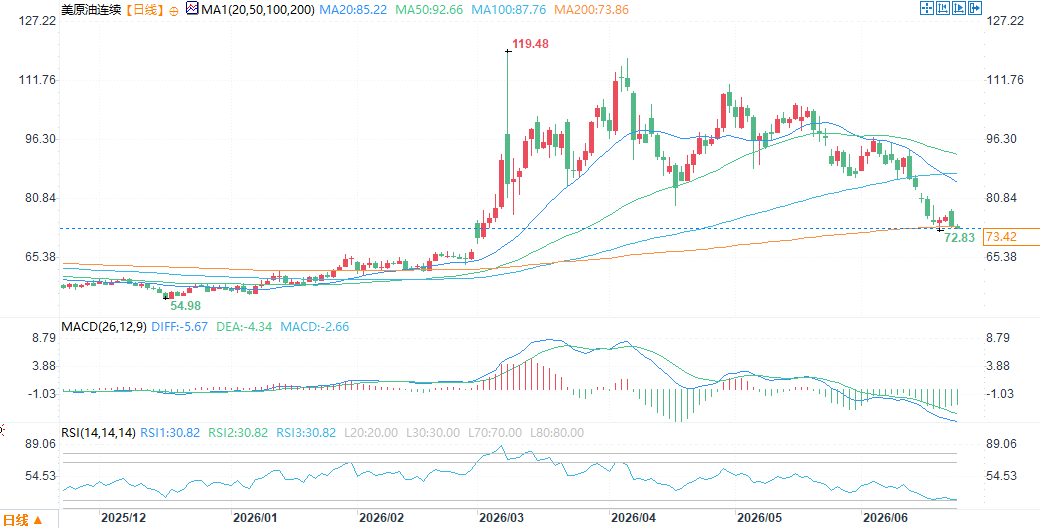
(US crude oil futures daily chart, source: FX678)
At 14:00 Beijing time on June 23, US crude oil futures were trading at $73.10 per barrel.
The US announced a temporary lifting of sanctions on Iranian oil exports as negotiations between the two countries progressed, putting pressure on oil prices; however, geopolitical risks have not completely dissipated, providing a floor for oil prices.
Progress made in US-Iran negotiations: 60-day roadmap reached
The mediators, Qatar and Pakistan, issued a joint statement on Monday announcing encouraging and substantial progress in the first round of high-level talks between the United States and Iran held in Burgenstock, Switzerland. The two sides agreed on a clear roadmap for reaching a comprehensive agreement within 60 days to end the current conflict, and established a high-level committee to oversee the overall political process, along with several special working groups on nuclear issues, sanctions easing, and dispute resolution.
This latest development marks a crucial step in the US-Iran dialogue from a temporary ceasefire to a long-term peace framework, significantly easing market concerns about a potential breakdown in negotiations.
Previously, Iran abruptly announced the re-closure of the Strait of Hormuz last Saturday, causing a brief disruption to shipping activities. Meanwhile, US President Trump issued a stern military threat on Truth Social, stating that he would take stronger action if Iran did not support a ceasefire in Lebanon. These tense signals exacerbated market volatility.
The joint statement emphasized that the talks were conducted in a "positive and constructive" atmosphere, with both delegations maintaining close communication. The mediators stated that a coordination mechanism for the Lebanese conflict had been established and a preliminary consensus had been reached on the safe passage through the Strait of Hormuz. This 60-day roadmap provides institutional guarantees for subsequent intensive technical negotiations and injects a degree of certainty into the global energy market and financial assets.
However, analysts caution that core disagreements such as restrictions on Iran's nuclear program, the unfreezing of frozen assets, and the issue of regional proxies remain unresolved, and the prospects for negotiations remain uncertain.
Sanctions Lifted: Oil Prices Face Short-Term Pressure
At the same time, the U.S. Treasury Department announced a temporary easing of sanctions on Iranian crude oil exports. This move is an initial step in fulfilling the provisional agreement signed by the U.S. and Iran last week, which aims to provide substantial economic benefits to Iran, and has directly put significant downward pressure on the global crude oil market.
Under the agreement, the United States granted temporary waivers to Iran for oil production, delivery, and sales within a 60-day negotiation window, allowing Iranian crude oil to re-enter the international market. This decision quickly altered market supply and demand expectations. The geopolitical risk premium that had accumulated due to concerns about conflict and blockade began to be released rapidly, with traders adjusting their positions, causing oil prices to come under pressure and fall.
Expectations of Iranian oil returning to the global market, coupled with positive signs of a gradual recovery in shipping activity across the Strait of Hormuz, have jointly driven WTI crude oil prices down significantly from recent highs above $78 to around $74 per barrel currently. The market generally expects that if subsequent negotiations proceed smoothly, Iran's daily exports could increase by 500,000 to 1 million barrels in the short term, which would further alleviate the global supply shortage.
However, the sanctions waivers are currently temporary, and their sustainability highly depends on the finalization of a comprehensive US-Iran agreement. In the short term, this policy downturn has dominated oil price movements, but investors should remain vigilant. If negotiations falter or the Lebanese ceasefire mechanism fails, geopolitical risk premiums could rebound rapidly, providing support for oil prices.
Institutional Views
UBS Group holds a cautiously optimistic but downward-biased view on the future of WTI crude oil, predicting that the average price of Brent crude oil in 2026 will be in the range of $75-85, and WTI will be in the range of $70-80.
The agency believes that progress in US-Iran negotiations and sanctions waivers will accelerate supply recovery, but the geopolitical risk premium will not disappear immediately, and oil prices will remain highly volatile in the short term. The current consolidation around $74 is seen as a process of digesting negative factors, and the agency recommends gradually building long positions near key support levels while managing risk effectively.
UBS analysts point out that while global demand growth faces challenges, Asian recovery and inventory replenishment provide some support. In the medium to long term, accelerated energy transition and increased non-OPEC+ production will limit upside potential for oil prices, but OPEC+ production cut discipline and potential geopolitical tensions may provide a buffer.
Mitsubishi UFJ Global Market Research Department predicts that oil prices will show a trend of high at the beginning and low at the end in 2026, with an average price of about $78-82 per barrel for the whole year.
The agency believes that the progress of US-Iran peace talks is beneficial to the recovery of supply, but there are still uncertainties about the actual speed of navigation in the Strait of Hormuz and the pace of the resumption of Iranian exports. Geopolitical risk premiums will provide temporary support for oil prices, and investors are advised to buy on dips.
Geopolitical risks have not disappeared
However, traders remain skeptical about the sustainability of the ceasefire. Significant differences remain between the two sides on core issues such as the strategic importance of the Strait of Hormuz, Iran's nuclear program, and frozen Iranian funds.
This means that geopolitical risk premiums have not completely disappeared, but continue to occupy a place in market pricing.
Oil prices consolidating around $73 indicates that the market is digesting the short-term negative impact of sanctions lifting while assessing the persistence of geopolitical risks. A decisive break below $73 could trigger a new round of declines; conversely, if geopolitical tensions deteriorate again, oil prices are expected to rebound from this support level.
(US crude oil futures daily chart, source: FX678)
At 14:00 Beijing time on June 23, US crude oil futures were trading at $73.10 per barrel.
- Risk Warning and Disclaimer
- The market involves risk, and trading may not be suitable for all investors. This article is for reference only and does not constitute personal investment advice, nor does it take into account certain users’ specific investment objectives, financial situation, or other needs. Any investment decisions made based on this information are at your own risk.