June Crude Oil Price Trend Analysis: Multiple Negative Factors Suppress Prices, Opportunities for Both Downward Movement and Rebound Coexist
2026-06-24 00:16:45
In late June 2026, the international crude oil market remained under pressure, with both WTI and Brent crude oil benchmark prices declining in tandem, exhibiting an overall weak and volatile pattern. Multiple negative factors, including signs of easing geopolitical tensions in the Middle East, the easing of US sanctions on Iranian oil exports, and the gradual resumption of shipping in the Strait of Hormuz, continued to suppress oil prices. Meanwhile, several international investment banks and institutions released their latest forecasts for short-term and medium-to-long-term oil price trends, intensifying the battle between bulls and bears in the market.
During trading on June 23, the international crude oil spot market saw a significant decline. WTI crude oil fell 1.07% to around $73, while Brent crude oil fell 1.25% to around $77. The core driver of the continued weakness in oil prices stemmed from marginal improvements in the Middle East geopolitical situation. Currently, the Middle East is showing potential signs of peace, and market focus has shifted to expectations of a recovery in crude oil supply. Traders are generally betting that global crude oil circulation will continue to rise, thereby driving oil prices down further.
I. Technical Analysis: Both major crude oil varieties continued to weaken, with key support levels gradually shifting downwards.
From a technical perspective, WTI light sweet crude oil continued its downward trend on Tuesday, clearly demonstrating an overall weak pattern. The market's short-term focus is shifting downwards, with the primary target for oil prices at the key level of $70 per barrel. If this support level is effectively broken, oil prices will further fill the previous gap, potentially falling to around $67 per barrel, a price level that coincided with the initial outbreak of the current Middle East geopolitical conflict.
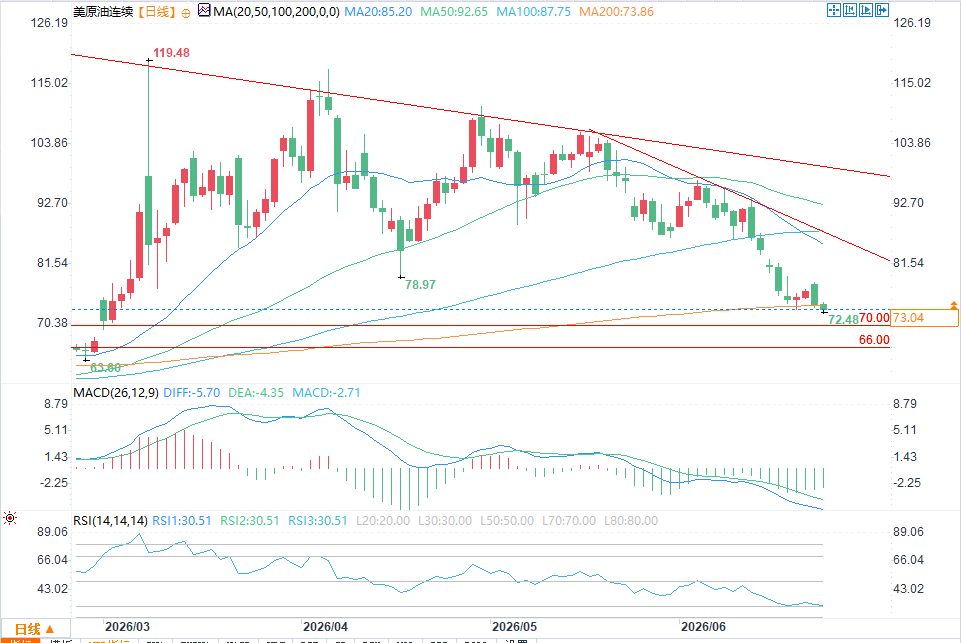
(WTI crude oil daily chart source: FX678)
Brent crude oil's price movement is highly correlated with WTI crude oil, exhibiting a synchronized weakness. Currently, Brent crude is approaching the $73/barrel gap-filling level, and a further decline to the $70/barrel mark is highly probable. In terms of resistance levels, short-term rebounds in Brent crude are concentrated at the 200-day exponential moving average (EMA), which lies below the important psychological level of $85/barrel and will continue to limit the upside potential of oil prices.
The technical trading logic is clear: The current weakness in oil prices and signs of exhaustion present a short-selling window, with the overall market favoring selling on rallies. Only a decisive break above the $85/barrel resistance level can completely reverse the short-term weakness and usher in a bullish phase. From a long-term technical perspective, the current downward trend in oil prices has not yet ended, with an ultimate target of $60/barrel. However, constrained by the pace of supply chain recovery, this deep decline is likely to occur several months later.
II. Key Negative Factors: Iran's sanctions waivers granted, supply recovery expectations rising.
The core reason for the continued decline in oil prices is the implementation of the US policy to ease sanctions on Iranian oil exports. The US Treasury Department officially announced that it would grant Iran a 60-day waiver for oil and petroleum product exports, with the waiver initially expiring on August 21, 2026. Following the policy's implementation, market expectations for increased global crude oil supply surged, directly breaking through support levels for crude oil prices. Brent crude oil prices fell to $76.5 per barrel, a new low since early March, and again breached the key $80 per barrel mark.
Meanwhile, the navigation conditions in the Strait of Hormuz, a key shipping route in the Middle East, continued to improve, with ship traffic steadily recovering, further strengthening expectations of a recovery in crude oil supply and exacerbating downward pressure on oil prices.
ING Bank analysts pointed out that the temporary ceasefire between the US and Iran and the implementation of sanctions waivers for Iran have directly led to a sustained increase in oil shipments through the Strait of Hormuz, becoming a major driver of weakening oil prices.
However, the market should not be overly bearish on short-term oil prices, as the current pace of crude oil supply recovery is far from returning to normal levels. Data from Commerzbank shows that current vessel traffic in the Strait of Hormuz remains significantly lower than pre-conflict levels. Previously, the strait saw an average of over 100 vessels passing through daily, including approximately 30 oil tankers. Current capacity has not yet recovered to that level, indicating a clear lag in supply chain recovery. This is a key factor limiting a significant decline in oil prices. Therefore, multiple institutions agree that the potential for further sharp drops in oil prices in the short term is relatively limited.
III. Institutional Forecast: Short-term weak fluctuations, medium- to long-term downward trend.
Regarding the future trend of oil prices, major international investment banks have successively updated their latest price forecasts, with an overall bearish tone, while also clarifying the divergent pattern of short-term fluctuations and long-term weakness.
Rabobank's energy strategy team has significantly lowered its price forecasts for the two major crude oil benchmarks, citing the implementation of the Versailles Memorandum of Understanding and the continued recovery of navigation in the Strait of Hormuz as the core reasons for the adjustment. The bank predicts that Brent crude oil prices will be $79/barrel in the third quarter of 2026 and fall to $78/barrel in the fourth quarter; WTI crude oil prices are expected to be $75.50/barrel and $74/barrel respectively during the same period. In the medium to long term, the downward trend in oil prices is clear, with Brent crude oil expected to fall to $74.50/barrel in 2027 and further decline to $71/barrel in 2028. This corresponds to WTI crude oil prices of $70/barrel in 2027 and $66.50/barrel in 2028, with the overall international oil price expected to maintain a downward trend until 2028.
From a long-term perspective, multiple fundamental factors support the continued weakness of oil prices: First, the UAE's withdrawal from OPEC and the expansion of the Fujairah pipeline have increased the region's autonomy in crude oil supply; second, the continuous release of new crude oil production capacity in the United States and South America has resulted in ample incremental supply of crude oil globally; and third, the weak global economic growth momentum and sluggish expansion of crude oil demand in the next three to five years will drive oil prices to gradually converge towards the marginal extraction cost of crude oil in the United States.
IV. Market Outlook: The market is expected to remain weak with some fluctuations, but opportunities for a short-term rebound still exist.
In summary, the current international crude oil market is in a weak cycle where geopolitical headwinds have been exhausted and supply continues to recover. In the short term, the market will mainly fluctuate downwards, with limited room for rebounds and pressure on rallies remaining the core trend.
However, the market is not experiencing a one-sided decline, and opportunities for periodic rebounds still exist. On the one hand, the resumption of shipping in the Strait of Hormuz involves fluctuations in shipping capacity and uncertainties in the pace of recovery, which will provide a slight boost to oil prices in the short term. On the other hand, the repair period for the damage to the crude oil supply chain caused by the current geopolitical conflicts in the Middle East is long, and it is difficult to fully recover in the short term. The rigid constraints on the supply side will prevent a precipitous drop in oil prices. In addition, the recovery in global energy demand during the summer, coupled with the tight LNG supply, will also indirectly provide support for crude oil prices.
On the risk front, the fragility of the US-Iran geopolitical situation remains the biggest uncertainty factor. The temporary ceasefire is not stable. If the situation fluctuates and shipping is disrupted, oil prices may see a significant rebound in stages, and overall market volatility will remain high.
During trading on June 23, the international crude oil spot market saw a significant decline. WTI crude oil fell 1.07% to around $73, while Brent crude oil fell 1.25% to around $77. The core driver of the continued weakness in oil prices stemmed from marginal improvements in the Middle East geopolitical situation. Currently, the Middle East is showing potential signs of peace, and market focus has shifted to expectations of a recovery in crude oil supply. Traders are generally betting that global crude oil circulation will continue to rise, thereby driving oil prices down further.
I. Technical Analysis: Both major crude oil varieties continued to weaken, with key support levels gradually shifting downwards.
From a technical perspective, WTI light sweet crude oil continued its downward trend on Tuesday, clearly demonstrating an overall weak pattern. The market's short-term focus is shifting downwards, with the primary target for oil prices at the key level of $70 per barrel. If this support level is effectively broken, oil prices will further fill the previous gap, potentially falling to around $67 per barrel, a price level that coincided with the initial outbreak of the current Middle East geopolitical conflict.
(WTI crude oil daily chart source: FX678)
Brent crude oil's price movement is highly correlated with WTI crude oil, exhibiting a synchronized weakness. Currently, Brent crude is approaching the $73/barrel gap-filling level, and a further decline to the $70/barrel mark is highly probable. In terms of resistance levels, short-term rebounds in Brent crude are concentrated at the 200-day exponential moving average (EMA), which lies below the important psychological level of $85/barrel and will continue to limit the upside potential of oil prices.
The technical trading logic is clear: The current weakness in oil prices and signs of exhaustion present a short-selling window, with the overall market favoring selling on rallies. Only a decisive break above the $85/barrel resistance level can completely reverse the short-term weakness and usher in a bullish phase. From a long-term technical perspective, the current downward trend in oil prices has not yet ended, with an ultimate target of $60/barrel. However, constrained by the pace of supply chain recovery, this deep decline is likely to occur several months later.
II. Key Negative Factors: Iran's sanctions waivers granted, supply recovery expectations rising.
The core reason for the continued decline in oil prices is the implementation of the US policy to ease sanctions on Iranian oil exports. The US Treasury Department officially announced that it would grant Iran a 60-day waiver for oil and petroleum product exports, with the waiver initially expiring on August 21, 2026. Following the policy's implementation, market expectations for increased global crude oil supply surged, directly breaking through support levels for crude oil prices. Brent crude oil prices fell to $76.5 per barrel, a new low since early March, and again breached the key $80 per barrel mark.
Meanwhile, the navigation conditions in the Strait of Hormuz, a key shipping route in the Middle East, continued to improve, with ship traffic steadily recovering, further strengthening expectations of a recovery in crude oil supply and exacerbating downward pressure on oil prices.
ING Bank analysts pointed out that the temporary ceasefire between the US and Iran and the implementation of sanctions waivers for Iran have directly led to a sustained increase in oil shipments through the Strait of Hormuz, becoming a major driver of weakening oil prices.
However, the market should not be overly bearish on short-term oil prices, as the current pace of crude oil supply recovery is far from returning to normal levels. Data from Commerzbank shows that current vessel traffic in the Strait of Hormuz remains significantly lower than pre-conflict levels. Previously, the strait saw an average of over 100 vessels passing through daily, including approximately 30 oil tankers. Current capacity has not yet recovered to that level, indicating a clear lag in supply chain recovery. This is a key factor limiting a significant decline in oil prices. Therefore, multiple institutions agree that the potential for further sharp drops in oil prices in the short term is relatively limited.
III. Institutional Forecast: Short-term weak fluctuations, medium- to long-term downward trend.
Regarding the future trend of oil prices, major international investment banks have successively updated their latest price forecasts, with an overall bearish tone, while also clarifying the divergent pattern of short-term fluctuations and long-term weakness.
Rabobank's energy strategy team has significantly lowered its price forecasts for the two major crude oil benchmarks, citing the implementation of the Versailles Memorandum of Understanding and the continued recovery of navigation in the Strait of Hormuz as the core reasons for the adjustment. The bank predicts that Brent crude oil prices will be $79/barrel in the third quarter of 2026 and fall to $78/barrel in the fourth quarter; WTI crude oil prices are expected to be $75.50/barrel and $74/barrel respectively during the same period. In the medium to long term, the downward trend in oil prices is clear, with Brent crude oil expected to fall to $74.50/barrel in 2027 and further decline to $71/barrel in 2028. This corresponds to WTI crude oil prices of $70/barrel in 2027 and $66.50/barrel in 2028, with the overall international oil price expected to maintain a downward trend until 2028.
From a long-term perspective, multiple fundamental factors support the continued weakness of oil prices: First, the UAE's withdrawal from OPEC and the expansion of the Fujairah pipeline have increased the region's autonomy in crude oil supply; second, the continuous release of new crude oil production capacity in the United States and South America has resulted in ample incremental supply of crude oil globally; and third, the weak global economic growth momentum and sluggish expansion of crude oil demand in the next three to five years will drive oil prices to gradually converge towards the marginal extraction cost of crude oil in the United States.
IV. Market Outlook: The market is expected to remain weak with some fluctuations, but opportunities for a short-term rebound still exist.
In summary, the current international crude oil market is in a weak cycle where geopolitical headwinds have been exhausted and supply continues to recover. In the short term, the market will mainly fluctuate downwards, with limited room for rebounds and pressure on rallies remaining the core trend.
However, the market is not experiencing a one-sided decline, and opportunities for periodic rebounds still exist. On the one hand, the resumption of shipping in the Strait of Hormuz involves fluctuations in shipping capacity and uncertainties in the pace of recovery, which will provide a slight boost to oil prices in the short term. On the other hand, the repair period for the damage to the crude oil supply chain caused by the current geopolitical conflicts in the Middle East is long, and it is difficult to fully recover in the short term. The rigid constraints on the supply side will prevent a precipitous drop in oil prices. In addition, the recovery in global energy demand during the summer, coupled with the tight LNG supply, will also indirectly provide support for crude oil prices.
On the risk front, the fragility of the US-Iran geopolitical situation remains the biggest uncertainty factor. The temporary ceasefire is not stable. If the situation fluctuates and shipping is disrupted, oil prices may see a significant rebound in stages, and overall market volatility will remain high.
- Risk Warning and Disclaimer
- The market involves risk, and trading may not be suitable for all investors. This article is for reference only and does not constitute personal investment advice, nor does it take into account certain users’ specific investment objectives, financial situation, or other needs. Any investment decisions made based on this information are at your own risk.