Three core disagreements over a US-Iran ceasefire have been revealed, could a rebound in the oil market be imminent?
2026-06-24 08:30:11
On Wednesday (June 24) in early Asian trading, US crude oil futures continued their weakness, currently trading around $72.90 per barrel. The weakness in the oil market reflects the fading war premium.
However, this optimistic outlook is facing challenges due to serious disagreements over the details of the agreement. The first round of talks between Iran and Washington in Switzerland concluded on Monday, with both sides reaching a framework agreement aimed at ending the war. However, disagreements on several key issues have cast serious doubt on the feasibility of this fragile peace agreement.
Despite President Trump’s optimism about the progress of the negotiations and signs of easing tensions, such as the easing of travel restrictions on the Iranian national football team, significant differences remain between the two sides on core issues such as nuclear facility inspections, the use of frozen assets, and the conflict in Lebanon. Meanwhile, public opinion and Congress in the United States are also showing signs of division.
Trump said optimistically at a rally in Pennsylvania on Tuesday that the U.S. and Iran were "getting along quite well" and that negotiations were progressing smoothly overall, marking a significant easing of tensions.
As a concrete signal, the U.S. Department of Homeland Security adjusted its policy, easing travel restrictions on the Iranian national football team. The team was allowed to enter Seattle from Tijuana, Mexico, two days before their next World Cup match, providing an extra day of respite. This move is seen as a positive sign of easing people-to-people exchanges between the two countries and helps boost public confidence in the peace process.
In addition, commercial navigation in the Strait of Hormuz has been fully restored under the preliminary framework agreement, international oil prices have fallen rapidly, and tensions in the global energy market have been initially eased.
The UN shipping agencies also acted swiftly to coordinate the evacuation of approximately 11,000 seafarers stranded due to the closure of shipping lanes, preventing a further humanitarian crisis. These early achievements not only boosted market confidence but also created a relatively favorable atmosphere for subsequent technical negotiations; however, the long-term stability of the agreement still depends on resolving the core differences.
The issue of nuclear facility inspections is one of the focal points of contention between the two sides. Trump claimed on social media that Iran had "fully agreed to accept the highest level of inspections indefinitely," but Tehran explicitly denied discussing its nuclear program in the talks and refused to agree to invite IAEA inspectors back to the damaged nuclear facility. These contradictory statements expose the fragility of the agreement's foundation.
On the issue of how to use the frozen assets, the two sides also hold differing views. Trump stated that the unfrozen Iranian overseas funds would be used specifically to purchase food and medical supplies from the United States; while Iran's Permanent Representative to Geneva, Ali Bahreini, emphasized that the use of the funds would be decided by Iran itself, and the US had no right to interfere. Although the US has agreed to grant Iran a 60-day sanctions waiver to allow it to sell oil, the ownership of control over the funds remains disputed.
Regarding the future management of the Strait of Hormuz, Iran and Oman issued a joint statement emphasizing their "sovereign rights" over the waterway and stating that they would cooperate in managing shipping and costs; however, US Secretary of State Rubio made it clear that no final agreement would allow Iran to impose passage fees, with the two sides holding sharply contrasting positions.
The disagreements over the Lebanon conflict have become a major obstacle to advancing the US-Iran framework agreement. Iran strongly demands that the complete withdrawal of Israeli troops from Lebanon be included in the core terms of the final agreement to ensure the security space of its regional ally, Hezbollah; while Israel firmly opposes this, emphasizing that it will continue to maintain a security buffer zone in southern Lebanon and reserves the right to take necessary military action to "eliminate" the ongoing threat to Israeli soldiers and border citizens. This difference in positions directly tests the inclusiveness and enforceability of the agreement.
On Tuesday, Lebanese state media reported that an Israeli shelling attack killed two people, prompting Hezbollah to accuse the attack of a serious violation of the ceasefire agreement and further highlighting the fragility of the ceasefire in the region. Although both sides launched a new round of direct negotiations in Washington on the same day in an attempt to resolve the conflict through diplomatic channels, reaching a compromise in the short term is unlikely. Israel stated that any withdrawal arrangement must be linked to a reliable security guarantee mechanism, while Iran insists that a complete withdrawal is a prerequisite for lasting peace in the region.
Analysts point out that the unresolved conflict in Lebanon will directly impact the overall credibility of the US-Iran agreement. A further escalation of the situation in Lebanon could trigger a chain reaction, affecting other hotspots such as Syria and Yemen, and threatening the recently restored stability of navigation in the Strait of Hormuz and the downward trend in international oil prices. Currently, market attention to this regional issue is rising, and investors need to closely monitor the progress of negotiations in Washington. If a balanced solution cannot be reached within the 60-day roadmap, the vulnerability of the agreement will be further amplified, and the geopolitical risk premium in the Middle East may rise again.
Public opinion in the United States regarding the situation with Iran is clearly divided. A recent poll shows that only 35% of Americans believe the U.S. is in a better position regarding Iran than before the war, while over 40% of respondents believe the position is weaker or are skeptical. This data highlights public doubts about the actual effectiveness of a peace agreement, as well as fatigue with the oil price fluctuations and economic pressures caused by war. Most Americans want a swift end to the conflict, prioritizing economic stability and the safety of their citizens.
Political divisions within Congress are also prominent. The Republican-controlled Senate, disregarding Trump's opposition, passed a war powers resolution by a vote of 50-48, demanding a halt to military action against Iraq. While the resolution is largely symbolic, the bipartisan vote of four Republican senators in favor exposes a significant divide within the party between isolationists and interventionists. Analysts believe this move is related to midterm election pressure, with some senators worried that the costs of war will impact their electoral prospects.
The power struggle between the White House and Congress has further exacerbated uncertainty. The Trump administration emphasizes the progress made in the negotiations, while Congress questions the reliability of the agreement. This division weakens the US's international negotiating position and adds further uncertainty to the agreement's implementation. Investors need to pay attention to subsequent legislative developments and public opinion trends, as these factors will directly affect risk pricing in the global energy market.
The US-Iran Agreed Framework provided a brief window for de-escalation in the Middle East. The reopening of the Strait of Hormuz and oil export exemptions stabilized the global energy supply chain in the short term. However, if core disagreements such as inspections, asset usage, and Lebanon cannot be resolved through subsequent technical negotiations, the fragility of the agreement could trigger a rebound in oil prices and a resurgence of regional tensions. Investors need to pay attention to the progress of the 60-day roadmap, updates to IAEA inspections, and details of sanctions implementation, as these factors will directly determine Iran's economic recovery potential and its exposure to international market risks.
Q1: What are the main contents of the framework agreement reached in the negotiations between the US, Iran and Switzerland?
A: The agreement primarily establishes a 60-day roadmap, including ending military operations, restoring freedom of navigation in the Strait of Hormuz, and establishing a high-level monitoring committee and working groups on nuclear and sanctions issues. Both sides agreed to promote de-escalation of the conflict in Lebanon, but did not reach a consensus on a final nuclear agreement. This framework lays the foundation for subsequent technical negotiations, aiming to transform a temporary ceasefire into a lasting peace.
Q2: Why did the verification issue become the biggest point of contention?
A: Trump stated that Iran agreed to accept the highest level of IAEA inspections indefinitely and return the damaged facilities, but Iran denied discussing details of its nuclear program. The inspections involve the disposal of Iran's uranium enrichment stockpile (such as on-site dilution) and access permissions to facilities, directly impacting the limitation of Iran's nuclear capabilities and U.S. security concerns. Failure to resolve these issues will hinder the full lifting of sanctions and the implementation of the agreement.
Q3: What impact will the unfreezing of frozen assets have on the Iranian economy and global markets?
A: The US is pushing for the funds primarily to be used for consumer goods purchases (such as US agricultural products) and has established a monitoring mechanism; Iran emphasizes its autonomy. The unfreezing is expected to release billions of dollars in liquidity, helping Iran stabilize its economy and increase oil exports. However, disputes may delay the arrival of the funds, providing short-term benefits to oil price stability, while the long-term impact depends on the compliance of their use.
Q4: What does the resumption of navigation in the Strait of Hormuz mean for oil prices and global shipping?
A: The Strait of Hormuz handles approximately 20% of global oil trade. Its reopening has pushed oil prices back to pre-war levels and accelerated the evacuation of stranded sailors. However, the conflict between the Iran-Omani cooperation in managing the Strait and the US opposition to toll fees could affect long-term stability. The market needs to be wary of any disruption risks to the energy supply chain.
Q5: How will the conflict in Lebanon affect the prospects of the overall agreement?
A: Iran demands a complete withdrawal of Israeli troops, while Israel insists on the existence of a safe zone, revealing the fragility of the ceasefire (the shelling incident). The new round of negotiations in Washington aims to resolve this, but if unresolved, it will hinder the implementation of the US-Iran agreement, increase regional instability, and indirectly affect energy market confidence.
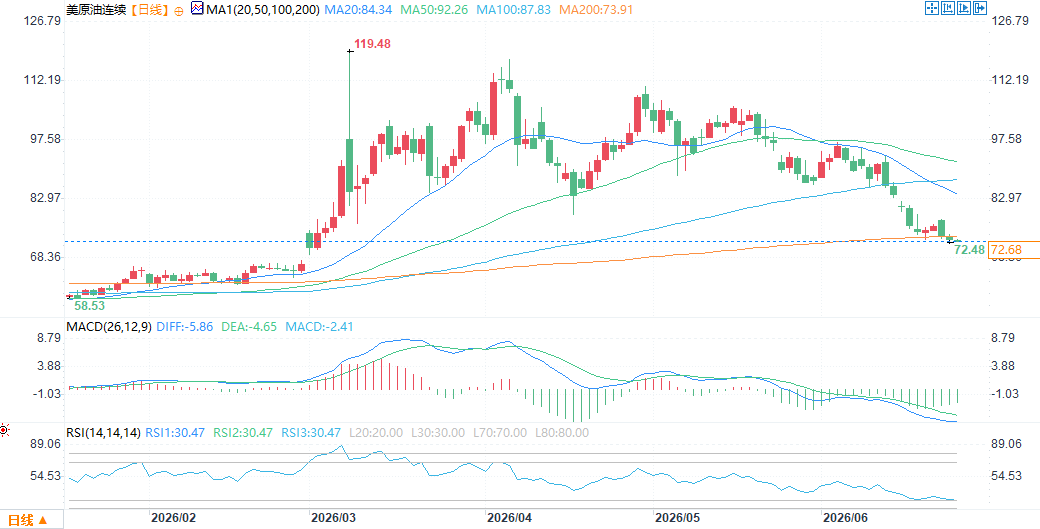
(US crude oil futures daily chart, source: FX678)
At 8:10 AM Beijing time on June 24, US crude oil futures were trading at $72.89 per barrel.
However, this optimistic outlook is facing challenges due to serious disagreements over the details of the agreement. The first round of talks between Iran and Washington in Switzerland concluded on Monday, with both sides reaching a framework agreement aimed at ending the war. However, disagreements on several key issues have cast serious doubt on the feasibility of this fragile peace agreement.
Despite President Trump’s optimism about the progress of the negotiations and signs of easing tensions, such as the easing of travel restrictions on the Iranian national football team, significant differences remain between the two sides on core issues such as nuclear facility inspections, the use of frozen assets, and the conflict in Lebanon. Meanwhile, public opinion and Congress in the United States are also showing signs of division.
Negotiation progress and initial signs of easing
Trump said optimistically at a rally in Pennsylvania on Tuesday that the U.S. and Iran were "getting along quite well" and that negotiations were progressing smoothly overall, marking a significant easing of tensions.
As a concrete signal, the U.S. Department of Homeland Security adjusted its policy, easing travel restrictions on the Iranian national football team. The team was allowed to enter Seattle from Tijuana, Mexico, two days before their next World Cup match, providing an extra day of respite. This move is seen as a positive sign of easing people-to-people exchanges between the two countries and helps boost public confidence in the peace process.
In addition, commercial navigation in the Strait of Hormuz has been fully restored under the preliminary framework agreement, international oil prices have fallen rapidly, and tensions in the global energy market have been initially eased.
The UN shipping agencies also acted swiftly to coordinate the evacuation of approximately 11,000 seafarers stranded due to the closure of shipping lanes, preventing a further humanitarian crisis. These early achievements not only boosted market confidence but also created a relatively favorable atmosphere for subsequent technical negotiations; however, the long-term stability of the agreement still depends on resolving the core differences.
Key points of contention: verification, funding, and control of the Taiwan Strait.
The issue of nuclear facility inspections is one of the focal points of contention between the two sides. Trump claimed on social media that Iran had "fully agreed to accept the highest level of inspections indefinitely," but Tehran explicitly denied discussing its nuclear program in the talks and refused to agree to invite IAEA inspectors back to the damaged nuclear facility. These contradictory statements expose the fragility of the agreement's foundation.
On the issue of how to use the frozen assets, the two sides also hold differing views. Trump stated that the unfrozen Iranian overseas funds would be used specifically to purchase food and medical supplies from the United States; while Iran's Permanent Representative to Geneva, Ali Bahreini, emphasized that the use of the funds would be decided by Iran itself, and the US had no right to interfere. Although the US has agreed to grant Iran a 60-day sanctions waiver to allow it to sell oil, the ownership of control over the funds remains disputed.
Regarding the future management of the Strait of Hormuz, Iran and Oman issued a joint statement emphasizing their "sovereign rights" over the waterway and stating that they would cooperate in managing shipping and costs; however, US Secretary of State Rubio made it clear that no final agreement would allow Iran to impose passage fees, with the two sides holding sharply contrasting positions.
The Lebanese Conflict and Israel's Role
The disagreements over the Lebanon conflict have become a major obstacle to advancing the US-Iran framework agreement. Iran strongly demands that the complete withdrawal of Israeli troops from Lebanon be included in the core terms of the final agreement to ensure the security space of its regional ally, Hezbollah; while Israel firmly opposes this, emphasizing that it will continue to maintain a security buffer zone in southern Lebanon and reserves the right to take necessary military action to "eliminate" the ongoing threat to Israeli soldiers and border citizens. This difference in positions directly tests the inclusiveness and enforceability of the agreement.
On Tuesday, Lebanese state media reported that an Israeli shelling attack killed two people, prompting Hezbollah to accuse the attack of a serious violation of the ceasefire agreement and further highlighting the fragility of the ceasefire in the region. Although both sides launched a new round of direct negotiations in Washington on the same day in an attempt to resolve the conflict through diplomatic channels, reaching a compromise in the short term is unlikely. Israel stated that any withdrawal arrangement must be linked to a reliable security guarantee mechanism, while Iran insists that a complete withdrawal is a prerequisite for lasting peace in the region.
Analysts point out that the unresolved conflict in Lebanon will directly impact the overall credibility of the US-Iran agreement. A further escalation of the situation in Lebanon could trigger a chain reaction, affecting other hotspots such as Syria and Yemen, and threatening the recently restored stability of navigation in the Strait of Hormuz and the downward trend in international oil prices. Currently, market attention to this regional issue is rising, and investors need to closely monitor the progress of negotiations in Washington. If a balanced solution cannot be reached within the 60-day roadmap, the vulnerability of the agreement will be further amplified, and the geopolitical risk premium in the Middle East may rise again.
Domestic public opinion and political division in the United States
Public opinion in the United States regarding the situation with Iran is clearly divided. A recent poll shows that only 35% of Americans believe the U.S. is in a better position regarding Iran than before the war, while over 40% of respondents believe the position is weaker or are skeptical. This data highlights public doubts about the actual effectiveness of a peace agreement, as well as fatigue with the oil price fluctuations and economic pressures caused by war. Most Americans want a swift end to the conflict, prioritizing economic stability and the safety of their citizens.
Political divisions within Congress are also prominent. The Republican-controlled Senate, disregarding Trump's opposition, passed a war powers resolution by a vote of 50-48, demanding a halt to military action against Iraq. While the resolution is largely symbolic, the bipartisan vote of four Republican senators in favor exposes a significant divide within the party between isolationists and interventionists. Analysts believe this move is related to midterm election pressure, with some senators worried that the costs of war will impact their electoral prospects.
The power struggle between the White House and Congress has further exacerbated uncertainty. The Trump administration emphasizes the progress made in the negotiations, while Congress questions the reliability of the agreement. This division weakens the US's international negotiating position and adds further uncertainty to the agreement's implementation. Investors need to pay attention to subsequent legislative developments and public opinion trends, as these factors will directly affect risk pricing in the global energy market.
Editor's Summary
The US-Iran Agreed Framework provided a brief window for de-escalation in the Middle East. The reopening of the Strait of Hormuz and oil export exemptions stabilized the global energy supply chain in the short term. However, if core disagreements such as inspections, asset usage, and Lebanon cannot be resolved through subsequent technical negotiations, the fragility of the agreement could trigger a rebound in oil prices and a resurgence of regional tensions. Investors need to pay attention to the progress of the 60-day roadmap, updates to IAEA inspections, and details of sanctions implementation, as these factors will directly determine Iran's economic recovery potential and its exposure to international market risks.
Frequently Asked Questions
Q1: What are the main contents of the framework agreement reached in the negotiations between the US, Iran and Switzerland?
A: The agreement primarily establishes a 60-day roadmap, including ending military operations, restoring freedom of navigation in the Strait of Hormuz, and establishing a high-level monitoring committee and working groups on nuclear and sanctions issues. Both sides agreed to promote de-escalation of the conflict in Lebanon, but did not reach a consensus on a final nuclear agreement. This framework lays the foundation for subsequent technical negotiations, aiming to transform a temporary ceasefire into a lasting peace.
Q2: Why did the verification issue become the biggest point of contention?
A: Trump stated that Iran agreed to accept the highest level of IAEA inspections indefinitely and return the damaged facilities, but Iran denied discussing details of its nuclear program. The inspections involve the disposal of Iran's uranium enrichment stockpile (such as on-site dilution) and access permissions to facilities, directly impacting the limitation of Iran's nuclear capabilities and U.S. security concerns. Failure to resolve these issues will hinder the full lifting of sanctions and the implementation of the agreement.
Q3: What impact will the unfreezing of frozen assets have on the Iranian economy and global markets?
A: The US is pushing for the funds primarily to be used for consumer goods purchases (such as US agricultural products) and has established a monitoring mechanism; Iran emphasizes its autonomy. The unfreezing is expected to release billions of dollars in liquidity, helping Iran stabilize its economy and increase oil exports. However, disputes may delay the arrival of the funds, providing short-term benefits to oil price stability, while the long-term impact depends on the compliance of their use.
Q4: What does the resumption of navigation in the Strait of Hormuz mean for oil prices and global shipping?
A: The Strait of Hormuz handles approximately 20% of global oil trade. Its reopening has pushed oil prices back to pre-war levels and accelerated the evacuation of stranded sailors. However, the conflict between the Iran-Omani cooperation in managing the Strait and the US opposition to toll fees could affect long-term stability. The market needs to be wary of any disruption risks to the energy supply chain.
Q5: How will the conflict in Lebanon affect the prospects of the overall agreement?
A: Iran demands a complete withdrawal of Israeli troops, while Israel insists on the existence of a safe zone, revealing the fragility of the ceasefire (the shelling incident). The new round of negotiations in Washington aims to resolve this, but if unresolved, it will hinder the implementation of the US-Iran agreement, increase regional instability, and indirectly affect energy market confidence.
(US crude oil futures daily chart, source: FX678)
At 8:10 AM Beijing time on June 24, US crude oil futures were trading at $72.89 per barrel.
- Risk Warning and Disclaimer
- The market involves risk, and trading may not be suitable for all investors. This article is for reference only and does not constitute personal investment advice, nor does it take into account certain users’ specific investment objectives, financial situation, or other needs. Any investment decisions made based on this information are at your own risk.