Fund managers believe that the pullback in gold prices presents a good opportunity to buy, and short-term fluctuations do not change the long-term bullish outlook.
2026-06-24 10:14:30
Multiple short-term negative factors continue to suppress gold prices, leading to a significant market correction. A senior portfolio manager from a well-known asset management company offers a new perspective: this decline is not a market reversal, but rather creates a favorable entry window for medium- to long-term investors. The underlying logic of de-dollarization driving a long-term bull market in gold remains solid, coupled with rising global inflation and central banks' continued diversification of reserve allocations. Gold prices still have significant upside potential by the end of the year, with short-term interest rate fluctuations only causing temporary volatility.
In an interview, Jerry Prior, Chief Operating Officer and Senior Portfolio Manager of the Mount Lucas Managed Futures Index Strategy ETF (NYSE: KMLM), analyzed that the recent decline in gold prices was mainly due to two core factors: first, Federal Reserve Chairman Kevin Warsh released hawkish monetary policy signals that leaned towards tightening, leading the market to raise its expectations for long-term high interest rates; and second, the easing of risk aversion due to geopolitical conflicts in the Middle East led to the withdrawal of funds from gold as a safe-haven asset.
Pryer stated, "The collective exit of speculative funds, sovereign wealth funds, and algorithmic trend-following funds has contributed to this round of gold price adjustments. The current market's speculative positioning structure has undergone an extreme reversal, and the vast majority of negative expectations have already been fully reflected in gold prices."
He added that even if gold prices dip below $4,000 per ounce in the short term, it will only be a temporary phenomenon. Once the Middle East oil supply chain stabilizes, central banks will resume gold purchases to replenish foreign exchange reserves, providing a bottom support for gold prices.
Jerry Price believes that the most crucial long-term variable in the gold market in recent years is the long-term demand of countries around the world to reduce the proportion of dollar assets in their reserves and promote reserve diversification. The instrumentalization of the dollar is the core driving force for countries to continuously increase their gold holdings, and this trend is unlikely to be reversed in the short term.
He said, "The core driver of this long-term rise in gold prices is the global de-dollarization process. Countries are looking for stable assets to preserve value outside of the US dollar and US Treasury bonds. Even if Middle Eastern oil-producing countries resume crude oil exports and capital flows back, the newly added surplus capital will not be allocated to US Treasury bonds in large quantities, but will continue to flow into the gold market."
While maintaining a long-term bullish view on gold, Price did not ignore short-term risks. He stated that persistently high market interest rates and stabilizing inflation expectations would both suppress gold's performance in the short term. Gold is a non-interest-bearing asset, and rising interest rates increase the opportunity cost of holding gold; even in a high-inflation environment, gold prices may weaken.
He stated, "Gold is an important defensive asset in an asset portfolio. The retail funds that entered the market in large quantities earlier have basically been cleared out. There is no need to worry excessively about panic selling causing significant losses when entering the market now. Investors should not let short-term interest rate fluctuations interfere with their judgment, but should focus on the long-term logic of macroeconomic structure."
He further explained that the relocation of industrial chains and the restructuring of global supply chains have disrupted the low-inflation environment brought about by globalization in the past. In the future, the central level of inflation will be higher than the pre-pandemic level for a long time. The situation in the past, which relied on low-priced imported goods to suppress inflation in developed economies, no longer exists, and inflation is unlikely to return to the low range of the past two decades.
Taking all macroeconomic conditions into account, Price believes that this round of gold price correction is not the beginning of a bear market, but rather a normal correction within a long-term upward cycle. With central bank gold demand recovering and de-dollarization continuing to attract incremental funds into the market, gold prices are expected to rise to around $4,500 per ounce by the end of the year.
He stated, "The ongoing de-dollarization process, coupled with the recovery of Middle Eastern oil production capacity, will attract a large influx of bullish funds, and gold prices will embark on a new round of upward movement."
In summary, the recent pullback in gold prices is attributed to short-term expectations of Fed tightening and waning risk aversion, but the market has already fully priced in downside risks. The three structural supports – de-dollarization, global reserve diversification, and high medium- to long-term inflation – remain effective in the long term, and short-term fluctuations will not alter the long-term bullish trend for gold.
This adjustment provides investors with an ideal time to position themselves. In the future, all that is needed is for Middle Eastern crude oil supply to recover and central bank gold purchase demand to be released, and gold prices are expected to rebound, with a clear upward target by the end of the year.
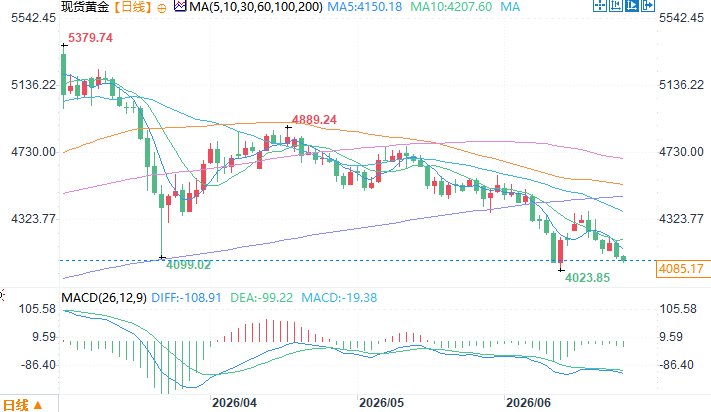
Spot gold daily chart source: EasyForex
At 10:14 AM Beijing time on June 24, spot gold was trading at $4082.17 per ounce.
Multiple short-term negative factors triggered a decline in gold prices, but downside risks have been largely digested.
In an interview, Jerry Prior, Chief Operating Officer and Senior Portfolio Manager of the Mount Lucas Managed Futures Index Strategy ETF (NYSE: KMLM), analyzed that the recent decline in gold prices was mainly due to two core factors: first, Federal Reserve Chairman Kevin Warsh released hawkish monetary policy signals that leaned towards tightening, leading the market to raise its expectations for long-term high interest rates; and second, the easing of risk aversion due to geopolitical conflicts in the Middle East led to the withdrawal of funds from gold as a safe-haven asset.
Pryer stated, "The collective exit of speculative funds, sovereign wealth funds, and algorithmic trend-following funds has contributed to this round of gold price adjustments. The current market's speculative positioning structure has undergone an extreme reversal, and the vast majority of negative expectations have already been fully reflected in gold prices."
He added that even if gold prices dip below $4,000 per ounce in the short term, it will only be a temporary phenomenon. Once the Middle East oil supply chain stabilizes, central banks will resume gold purchases to replenish foreign exchange reserves, providing a bottom support for gold prices.
De-dollarization creates long-term structural benefits, and the trend of central bank gold purchases is difficult to reverse.
Jerry Price believes that the most crucial long-term variable in the gold market in recent years is the long-term demand of countries around the world to reduce the proportion of dollar assets in their reserves and promote reserve diversification. The instrumentalization of the dollar is the core driving force for countries to continuously increase their gold holdings, and this trend is unlikely to be reversed in the short term.
He said, "The core driver of this long-term rise in gold prices is the global de-dollarization process. Countries are looking for stable assets to preserve value outside of the US dollar and US Treasury bonds. Even if Middle Eastern oil-producing countries resume crude oil exports and capital flows back, the newly added surplus capital will not be allocated to US Treasury bonds in large quantities, but will continue to flow into the gold market."
Short-term interest rate fluctuations cause volatility; investors should focus on long-term macroeconomic themes.
While maintaining a long-term bullish view on gold, Price did not ignore short-term risks. He stated that persistently high market interest rates and stabilizing inflation expectations would both suppress gold's performance in the short term. Gold is a non-interest-bearing asset, and rising interest rates increase the opportunity cost of holding gold; even in a high-inflation environment, gold prices may weaken.
He stated, "Gold is an important defensive asset in an asset portfolio. The retail funds that entered the market in large quantities earlier have basically been cleared out. There is no need to worry excessively about panic selling causing significant losses when entering the market now. Investors should not let short-term interest rate fluctuations interfere with their judgment, but should focus on the long-term logic of macroeconomic structure."
He further explained that the relocation of industrial chains and the restructuring of global supply chains have disrupted the low-inflation environment brought about by globalization in the past. In the future, the central level of inflation will be higher than the pre-pandemic level for a long time. The situation in the past, which relied on low-priced imported goods to suppress inflation in developed economies, no longer exists, and inflation is unlikely to return to the low range of the past two decades.
Gold prices have clear upside potential by the end of the year; the current correction is merely a temporary pause in a long-term bull market.
Taking all macroeconomic conditions into account, Price believes that this round of gold price correction is not the beginning of a bear market, but rather a normal correction within a long-term upward cycle. With central bank gold demand recovering and de-dollarization continuing to attract incremental funds into the market, gold prices are expected to rise to around $4,500 per ounce by the end of the year.
He stated, "The ongoing de-dollarization process, coupled with the recovery of Middle Eastern oil production capacity, will attract a large influx of bullish funds, and gold prices will embark on a new round of upward movement."
Summarize
In summary, the recent pullback in gold prices is attributed to short-term expectations of Fed tightening and waning risk aversion, but the market has already fully priced in downside risks. The three structural supports – de-dollarization, global reserve diversification, and high medium- to long-term inflation – remain effective in the long term, and short-term fluctuations will not alter the long-term bullish trend for gold.
This adjustment provides investors with an ideal time to position themselves. In the future, all that is needed is for Middle Eastern crude oil supply to recover and central bank gold purchase demand to be released, and gold prices are expected to rebound, with a clear upward target by the end of the year.
Spot gold daily chart source: EasyForex
At 10:14 AM Beijing time on June 24, spot gold was trading at $4082.17 per ounce.
- Risk Warning and Disclaimer
- The market involves risk, and trading may not be suitable for all investors. This article is for reference only and does not constitute personal investment advice, nor does it take into account certain users’ specific investment objectives, financial situation, or other needs. Any investment decisions made based on this information are at your own risk.