WTI hits three-month low: Easing supply concerns weigh on oil prices, while disagreements in nuclear talks limit declines.
2026-06-24 10:18:47
On Wednesday (June 24) during the Asian session, US benchmark crude oil futures (WTI) entered a consolidation phase, once touching $72.34 per barrel, a new low since early March, and is currently trading around $72.90 per barrel.
Despite the continued presence of geopolitical risk premiums, supply-side negative factors such as the resumption of shipping in the Strait of Hormuz and temporary waivers of sanctions on Iranian crude oil exports continue to exert downward pressure, resulting in a weak rebound in oil prices.

Easing supply concerns are the direct cause of recent downward pressure on oil prices.
According to Iran's Fars News Agency, citing military sources, a limited number of ships have been permitted to pass through the Strait of Hormuz daily, coordinated by the Iranian Revolutionary Guard Navy. The resumption of navigation on this strategic waterway signifies the gradual restoration of energy transport routes previously disrupted by geopolitical conflicts.
At the same time, the U.S. Treasury Department issued a 60-day temporary sanctions waiver under the framework of a broader peace agreement, allowing the production, delivery, and sale of Iranian crude oil, petroleum, and petrochemical products. The waiver period lasts until August 21.
This move, coupled with progress in US-Iran peace talks and a temporary halt to the Lebanese conflict, has strengthened market expectations of continued easing on the supply side, providing fundamental support for further declines in oil prices.
Despite recent generally bearish supply-side news, international oil prices have not experienced a sustained sharp decline, with short sellers showing significant hesitation around current price levels. The core reason lies in the severely contradictory statements from the US and Iran regarding nuclear facility inspections, making it difficult for geopolitical risk premiums to fully dissipate and limiting the market's potential for unilateral downside.
US President Trump stated on social media that Iran has "fully and thoroughly agreed to accept the highest level of nuclear inspections in the long term (indefinitely)" and regarded this as an important outcome of the Swiss negotiations.
However, Iranian state media quickly responded, citing the Ministry of Foreign Affairs, stating that Tehran did not make any new commitments regarding nuclear inspections during the talks, nor did it agree to allow International Atomic Energy Agency (IAEA) inspectors to return to the damaged facility.
The two sides' statements are diametrically opposed, exposing the fragility of the preliminary framework agreement at the implementation level. Market participants cannot completely rule out the possibility of the situation deteriorating again or even a resurgence of conflict in the future.
This information asymmetry directly drives up the geopolitical risk premium. Even though the Strait of Hormuz has reopened to navigation and sanctions waivers have been implemented, if the verification dispute cannot be resolved through technical negotiations within the 60-day roadmap, the Iranian nuclear issue could still become a key uncertainty triggering oil price volatility.
Currently, while WTI crude oil prices have fallen somewhat from the peak of the conflict, they still maintain a certain premium, reflecting traders' cautious attitude towards the reliability of the agreement. Although short sellers have the logic of increased supply to support their positions, they are unwilling to build large positions during risk event windows to avoid a rapid rebound caused by sudden news.
Analysts point out that with geopolitical risks not yet fully resolved, oil prices may fluctuate at high levels in the short term. Investors need to closely monitor subsequent statements from the IAEA, the latest remarks from the Trump administration, and official responses from Iran, as these factors will directly affect the rise and fall of risk premiums and the direction of the oil market. If the disputes over the verification continue to escalate, oil prices are likely to experience a sudden surge; conversely, if both sides reach a preliminary compromise, it may open up further room for a correction.
Following the initial breakthrough in negotiations between the US, Iran, and Switzerland, Goldman Sachs lowered its 2026 oil price forecast, believing that the resumption of navigation in the Strait of Hormuz will significantly increase global oil supply and alleviate the inventory shortages previously caused by the conflict.
The bank currently projects a WTI target of around $75 per barrel for the fourth quarter of 2026, with the average WTI price for the year likely to fluctuate between $70 and $78. In the short term, although geopolitical risk premiums remain due to the ongoing investigation disagreements, the faster-than-expected return of supply, coupled with slowing global demand growth, will limit the upside potential for oil prices.
JPMorgan Chase maintains its bearish stance on the oil market in 2026, forecasting WTI at around $55-58.
The bank believes that although current geopolitical tensions are pushing up prices, the US-Iran framework agreement and the resumption of navigation in the Strait of Hormuz will release a large amount of idle capacity. Coupled with non-OPEC supply growth and slowing global demand growth (affected by economic uncertainty), the oil market will turn to a significant surplus in the second half of the year.
Chief Commodity Strategist Natasha Kaneva pointed out that the return of Iranian oil to the market will accelerate inventory accumulation, forcing OPEC+ to further cut production to stabilize prices, but this will be difficult to completely offset supply pressure. In the short term, WTI may remain volatile between $70 and $80 due to disagreements over inspections, but downside risks increase as the 60-day exemption period progresses and actual exports increase.
From a technical perspective, oil prices are currently in the low range since early March, with the 200-day simple moving average (SMA) providing significant technical support. The previous failure of oil prices to break below this key level indicates some buying interest at this level, making short sellers cautious about further downside bets.
However, from a broader technical perspective, the recent downtrend in oil prices has not yet shown clear signs of reversal. In the absence of strong positive catalysts, the current consolidation is more likely to be seen as a continuation of the downtrend rather than a trend reversal.
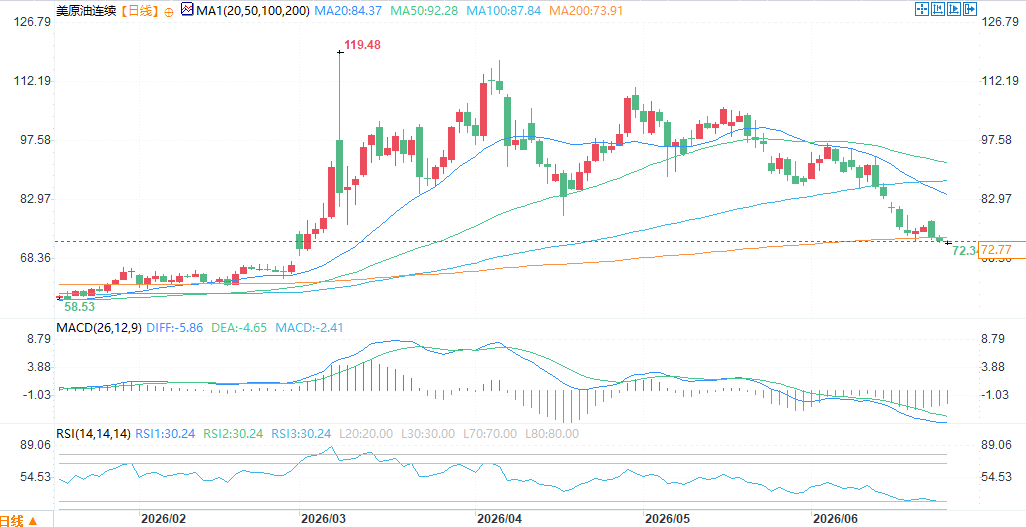
(US crude oil futures daily chart, source: FX678)
At 10:18 AM Beijing time on June 24, US crude oil futures were trading at $72.88 per barrel.
Despite the continued presence of geopolitical risk premiums, supply-side negative factors such as the resumption of shipping in the Strait of Hormuz and temporary waivers of sanctions on Iranian crude oil exports continue to exert downward pressure, resulting in a weak rebound in oil prices.
Supply-side pressures: Resumption of cross-strait navigation coupled with sanctions waivers
Easing supply concerns are the direct cause of recent downward pressure on oil prices.
According to Iran's Fars News Agency, citing military sources, a limited number of ships have been permitted to pass through the Strait of Hormuz daily, coordinated by the Iranian Revolutionary Guard Navy. The resumption of navigation on this strategic waterway signifies the gradual restoration of energy transport routes previously disrupted by geopolitical conflicts.
At the same time, the U.S. Treasury Department issued a 60-day temporary sanctions waiver under the framework of a broader peace agreement, allowing the production, delivery, and sale of Iranian crude oil, petroleum, and petrochemical products. The waiver period lasts until August 21.
This move, coupled with progress in US-Iran peace talks and a temporary halt to the Lebanese conflict, has strengthened market expectations of continued easing on the supply side, providing fundamental support for further declines in oil prices.
Conflicting Stances on Nuclear Issues: Geopolitical Risk Premium Limits Short Selling
Despite recent generally bearish supply-side news, international oil prices have not experienced a sustained sharp decline, with short sellers showing significant hesitation around current price levels. The core reason lies in the severely contradictory statements from the US and Iran regarding nuclear facility inspections, making it difficult for geopolitical risk premiums to fully dissipate and limiting the market's potential for unilateral downside.
US President Trump stated on social media that Iran has "fully and thoroughly agreed to accept the highest level of nuclear inspections in the long term (indefinitely)" and regarded this as an important outcome of the Swiss negotiations.
However, Iranian state media quickly responded, citing the Ministry of Foreign Affairs, stating that Tehran did not make any new commitments regarding nuclear inspections during the talks, nor did it agree to allow International Atomic Energy Agency (IAEA) inspectors to return to the damaged facility.
The two sides' statements are diametrically opposed, exposing the fragility of the preliminary framework agreement at the implementation level. Market participants cannot completely rule out the possibility of the situation deteriorating again or even a resurgence of conflict in the future.
This information asymmetry directly drives up the geopolitical risk premium. Even though the Strait of Hormuz has reopened to navigation and sanctions waivers have been implemented, if the verification dispute cannot be resolved through technical negotiations within the 60-day roadmap, the Iranian nuclear issue could still become a key uncertainty triggering oil price volatility.
Currently, while WTI crude oil prices have fallen somewhat from the peak of the conflict, they still maintain a certain premium, reflecting traders' cautious attitude towards the reliability of the agreement. Although short sellers have the logic of increased supply to support their positions, they are unwilling to build large positions during risk event windows to avoid a rapid rebound caused by sudden news.
Analysts point out that with geopolitical risks not yet fully resolved, oil prices may fluctuate at high levels in the short term. Investors need to closely monitor subsequent statements from the IAEA, the latest remarks from the Trump administration, and official responses from Iran, as these factors will directly affect the rise and fall of risk premiums and the direction of the oil market. If the disputes over the verification continue to escalate, oil prices are likely to experience a sudden surge; conversely, if both sides reach a preliminary compromise, it may open up further room for a correction.
Institutional Views
Following the initial breakthrough in negotiations between the US, Iran, and Switzerland, Goldman Sachs lowered its 2026 oil price forecast, believing that the resumption of navigation in the Strait of Hormuz will significantly increase global oil supply and alleviate the inventory shortages previously caused by the conflict.
The bank currently projects a WTI target of around $75 per barrel for the fourth quarter of 2026, with the average WTI price for the year likely to fluctuate between $70 and $78. In the short term, although geopolitical risk premiums remain due to the ongoing investigation disagreements, the faster-than-expected return of supply, coupled with slowing global demand growth, will limit the upside potential for oil prices.
JPMorgan Chase maintains its bearish stance on the oil market in 2026, forecasting WTI at around $55-58.
The bank believes that although current geopolitical tensions are pushing up prices, the US-Iran framework agreement and the resumption of navigation in the Strait of Hormuz will release a large amount of idle capacity. Coupled with non-OPEC supply growth and slowing global demand growth (affected by economic uncertainty), the oil market will turn to a significant surplus in the second half of the year.
Chief Commodity Strategist Natasha Kaneva pointed out that the return of Iranian oil to the market will accelerate inventory accumulation, forcing OPEC+ to further cut production to stabilize prices, but this will be difficult to completely offset supply pressure. In the short term, WTI may remain volatile between $70 and $80 due to disagreements over inspections, but downside risks increase as the 60-day exemption period progresses and actual exports increase.
Technical Analysis
From a technical perspective, oil prices are currently in the low range since early March, with the 200-day simple moving average (SMA) providing significant technical support. The previous failure of oil prices to break below this key level indicates some buying interest at this level, making short sellers cautious about further downside bets.
However, from a broader technical perspective, the recent downtrend in oil prices has not yet shown clear signs of reversal. In the absence of strong positive catalysts, the current consolidation is more likely to be seen as a continuation of the downtrend rather than a trend reversal.
(US crude oil futures daily chart, source: FX678)
At 10:18 AM Beijing time on June 24, US crude oil futures were trading at $72.88 per barrel.
- Risk Warning and Disclaimer
- The market involves risk, and trading may not be suitable for all investors. This article is for reference only and does not constitute personal investment advice, nor does it take into account certain users’ specific investment objectives, financial situation, or other needs. Any investment decisions made based on this information are at your own risk.