Rising expectations of a Federal Reserve rate hike have weakened safe-haven demand, causing gold to fall below $4,100 and hit a new low for the period.
2026-06-24 10:01:10
The international gold market continued its weak performance on Wednesday, with spot gold (XAU/USD) falling back to around $4,086 in Asian trading, further declining from its previous high. Gold has faced significant selling pressure recently as geopolitical risks in the Middle East have eased and the market is reassessing the outlook for the Federal Reserve's monetary policy.

Since the outbreak of the conflict between the US and Iran in late February, gold prices surged due to safe-haven demand, even hitting record highs. However, with the recent phase-one agreement reached between the two sides, market concerns about energy supply disruptions and further regional escalation have significantly eased. Crude oil prices have continued to decline, and risk appetite in global financial markets has improved, leading some funds to gradually withdraw from the gold market.
Despite a slight decline in energy prices, the inflationary impact of the previous surge in oil prices has not completely dissipated. The market generally believes that the energy cost transmission effect will continue to be reflected in US inflation data in the coming months, thus increasing the necessity for the Federal Reserve to maintain its tight monetary policy. Last week's interest rate meeting chaired by Federal Reserve Chairman Kevin Warsh has become the focus of recent market attention. The policy signals released at the meeting were clearly hawkish, with several officials emphasizing that inflation risks remain above the target level and stating the need to maintain policy flexibility to address future changes in price pressures.
As a result, market expectations for another interest rate hike this year have risen rapidly. Data from the CME Group's FedWatch tool shows that traders now expect an 86.1% probability of a Fed rate hike in December, compared to only about 61% before last week's policy meeting. This significant increase in rate hike expectations has pushed up the dollar index and US Treasury yields, thereby diminishing the attractiveness of gold as a non-interest-bearing asset.
Meanwhile, robust US economic data further reinforced market expectations that the Federal Reserve would maintain its tightening stance. Resilient job market, continued growth in consumer spending, and expansion in service sector activity convinced investors that the US economy still has the capacity to withstand a higher interest rate environment. On the institutional front, Deutsche Bank analyst Michael Xu stated that the Fed's policy repricing and strong US macroeconomic data are key reasons for the recent continued pullback in gold prices. The firm has lowered its gold price forecast, expecting the average gold price in the third quarter to be around $4,300 , a significant decrease from its previous forecast, while adjusting its fourth-quarter forecast to around $4,800 .
The market will now focus on the US May Personal Consumption Expenditures Price Index (PCE) to be released on Thursday. As one of the Federal Reserve's most closely watched inflation indicators, PCE data can directly influence market expectations regarding future interest rate trends. If the data continues to show persistent inflationary pressures, it could further strengthen expectations of interest rate hikes, thus putting additional pressure on gold. Conversely, if inflation shows signs of slowing, it could alleviate market tightening expectations and provide gold with a chance for a short-term rebound.
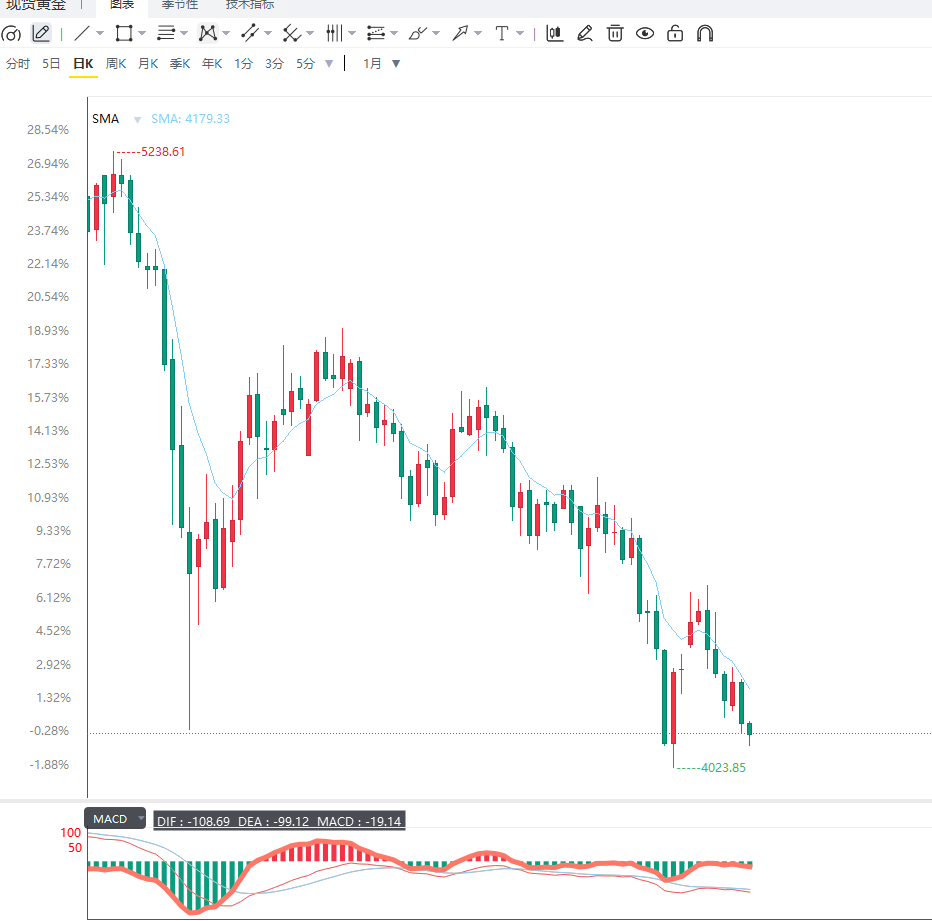
From a daily chart perspective, gold has entered a mid-term correction phase after falling from its historical highs. Prices have broken through multiple key moving average supports, and the overall trend has gradually shifted from a strong upward movement to a high-level correction. Currently, the market is testing the important psychological level of $4050 , which also coincides with a previous area of dense trading volume, making it a significant reference point for short-term price movements. A decisive break below $4050 could lead to further declines towards the psychological level of $4000 and the support area around $3920. On the upside, the key resistance zone to watch is $4200 to $4250. Only a retest of this area will allow the bulls to regain control.
From a 4-hour chart perspective, gold continues to trade within a descending channel, with short-term moving averages maintaining a bearish alignment, indicating persistent selling pressure. Although recent sharp declines have created some oversold conditions, the rebound momentum remains weak. If the price can break through $4200 and establish effective stabilization, a short-term technical correction may occur; however, if the $4050 support level is breached, the bears may push the price further towards the $4000 area. Meanwhile, the persistently high US dollar index and firm US Treasury yields continue to exert downward pressure on gold. Against the backdrop of weakening safe-haven demand and a shift towards a more hawkish monetary policy outlook, gold's short-term trend remains biased towards a downward consolidation.
Editor's Summary : The current gold market is undergoing a shift from a logic driven by geopolitical safe-haven demand to one driven by monetary policy. With the easing of tensions between the US and Iran, the risk premium in the Middle East has significantly decreased, depriving gold of some key supporting factors. Meanwhile, the rapidly rising expectations of a Fed rate hike this year further enhance the attractiveness of dollar assets, exerting sustained downward pressure on gold prices. Going forward, market focus will be on US PCE inflation data, employment market performance, and speeches by Fed officials. In the short term, the $4100 level will become a crucial battleground for gold bulls and bears. If inflation remains high and rate hike expectations strengthen further, gold still faces the risk of further correction; conversely, if economic data shows signs of cooling, it may provide an opportunity for a phased rebound in gold prices.
Since the outbreak of the conflict between the US and Iran in late February, gold prices surged due to safe-haven demand, even hitting record highs. However, with the recent phase-one agreement reached between the two sides, market concerns about energy supply disruptions and further regional escalation have significantly eased. Crude oil prices have continued to decline, and risk appetite in global financial markets has improved, leading some funds to gradually withdraw from the gold market.
Despite a slight decline in energy prices, the inflationary impact of the previous surge in oil prices has not completely dissipated. The market generally believes that the energy cost transmission effect will continue to be reflected in US inflation data in the coming months, thus increasing the necessity for the Federal Reserve to maintain its tight monetary policy. Last week's interest rate meeting chaired by Federal Reserve Chairman Kevin Warsh has become the focus of recent market attention. The policy signals released at the meeting were clearly hawkish, with several officials emphasizing that inflation risks remain above the target level and stating the need to maintain policy flexibility to address future changes in price pressures.
As a result, market expectations for another interest rate hike this year have risen rapidly. Data from the CME Group's FedWatch tool shows that traders now expect an 86.1% probability of a Fed rate hike in December, compared to only about 61% before last week's policy meeting. This significant increase in rate hike expectations has pushed up the dollar index and US Treasury yields, thereby diminishing the attractiveness of gold as a non-interest-bearing asset.
Meanwhile, robust US economic data further reinforced market expectations that the Federal Reserve would maintain its tightening stance. Resilient job market, continued growth in consumer spending, and expansion in service sector activity convinced investors that the US economy still has the capacity to withstand a higher interest rate environment. On the institutional front, Deutsche Bank analyst Michael Xu stated that the Fed's policy repricing and strong US macroeconomic data are key reasons for the recent continued pullback in gold prices. The firm has lowered its gold price forecast, expecting the average gold price in the third quarter to be around $4,300 , a significant decrease from its previous forecast, while adjusting its fourth-quarter forecast to around $4,800 .
The market will now focus on the US May Personal Consumption Expenditures Price Index (PCE) to be released on Thursday. As one of the Federal Reserve's most closely watched inflation indicators, PCE data can directly influence market expectations regarding future interest rate trends. If the data continues to show persistent inflationary pressures, it could further strengthen expectations of interest rate hikes, thus putting additional pressure on gold. Conversely, if inflation shows signs of slowing, it could alleviate market tightening expectations and provide gold with a chance for a short-term rebound.
From a daily chart perspective, gold has entered a mid-term correction phase after falling from its historical highs. Prices have broken through multiple key moving average supports, and the overall trend has gradually shifted from a strong upward movement to a high-level correction. Currently, the market is testing the important psychological level of $4050 , which also coincides with a previous area of dense trading volume, making it a significant reference point for short-term price movements. A decisive break below $4050 could lead to further declines towards the psychological level of $4000 and the support area around $3920. On the upside, the key resistance zone to watch is $4200 to $4250. Only a retest of this area will allow the bulls to regain control.
From a 4-hour chart perspective, gold continues to trade within a descending channel, with short-term moving averages maintaining a bearish alignment, indicating persistent selling pressure. Although recent sharp declines have created some oversold conditions, the rebound momentum remains weak. If the price can break through $4200 and establish effective stabilization, a short-term technical correction may occur; however, if the $4050 support level is breached, the bears may push the price further towards the $4000 area. Meanwhile, the persistently high US dollar index and firm US Treasury yields continue to exert downward pressure on gold. Against the backdrop of weakening safe-haven demand and a shift towards a more hawkish monetary policy outlook, gold's short-term trend remains biased towards a downward consolidation.
Editor's Summary : The current gold market is undergoing a shift from a logic driven by geopolitical safe-haven demand to one driven by monetary policy. With the easing of tensions between the US and Iran, the risk premium in the Middle East has significantly decreased, depriving gold of some key supporting factors. Meanwhile, the rapidly rising expectations of a Fed rate hike this year further enhance the attractiveness of dollar assets, exerting sustained downward pressure on gold prices. Going forward, market focus will be on US PCE inflation data, employment market performance, and speeches by Fed officials. In the short term, the $4100 level will become a crucial battleground for gold bulls and bears. If inflation remains high and rate hike expectations strengthen further, gold still faces the risk of further correction; conversely, if economic data shows signs of cooling, it may provide an opportunity for a phased rebound in gold prices.
- Risk Warning and Disclaimer
- The market involves risk, and trading may not be suitable for all investors. This article is for reference only and does not constitute personal investment advice, nor does it take into account certain users’ specific investment objectives, financial situation, or other needs. Any investment decisions made based on this information are at your own risk.