The expectation of a US interest rate hike and the risk of Japanese intervention are balancing each other, causing the USD/JPY exchange rate to fluctuate at high levels.
2026-06-24 13:15:15
During Wednesday's Asian morning session, the USD/JPY exchange rate remained relatively stable with sideways movement, with limited fluctuations and the price hovering around 161.55.
Currently, the currency pair is caught in a typical battle between bulls and bears. The continued rise in expectations of a Fed rate hike is providing strong support for the US dollar, which is beneficial for the exchange rate to rise. However, the continued depreciation of the yen has raised expectations of Japanese government intervention, which greatly limits the upside potential of the USD/JPY pair. These two core factors are mutually restraining each other and dominating the short-term foreign exchange market trend.
In its latest monetary policy meeting in June, the Federal Reserve announced that it would maintain the benchmark interest rate range at 3.50% to 3.75%. Fed Chairman Kevin Warsh held his first post-meeting press conference, stating that price stability will be the core guiding principle for the Fed's future monetary policy formulation and adjustments.
The overall tone of this meeting was hawkish, which was interpreted by the market as a policy direction towards tightening, providing strong support for the US dollar exchange rate.
With policy signals taking effect, market pricing in a Fed rate hike this year has rapidly intensified. According to data from the CME FedWatch Tool, the market now anticipates a 25 basis point or greater rate hike at the Fed's July meeting, rising to 37.4%, a significant increase from 8.5% a week ago; the probability of a September rate hike has surged to 70.2%, far exceeding the previous level of 29.1%. This shift in monetary policy expectations has become the core driver supporting the dollar's strength.
Against the backdrop of a strong US dollar, the Japanese yen has continued to weaken, with its exchange rate deviating from its reasonable range. This has drawn serious attention from the Japanese government, and the risk of market intervention in the foreign exchange market has rapidly increased.
Recently, Japanese Finance Minister Satsuki Katayama and U.S. Treasury Secretary Scott Bessant held a phone call to discuss the yen's exchange rate trend and bilateral monetary policy coordination. Japanese Chief Cabinet Secretary Minoru Kihara also publicly stated on Tuesday that if abnormal fluctuations occur in the foreign exchange market, Japan will take appropriate measures to stabilize the exchange rate in a timely manner.
Takeru Yamamoto, a trader at Sumitomo Mitsui Trust Bank in New York, said: "Japan may hope to send a signal through high-level talks between Japan and the United States, indicating policy coordination between the two sides, while also suggesting that the threshold for Japan to intervene in the foreign exchange market is not high."
The market generally believes that Japan's statement is intended to deter speculative foreign exchange funds and prevent disorderly depreciation of the yen. This expectation has effectively suppressed the upside potential of the USD/JPY exchange rate and limited the upward trend of the exchange rate.
In addition to expectations of official intervention, the potential adjustment of the Bank of Japan's monetary policy also provides marginal support for the yen's exchange rate.
The Bank of Japan's June monetary policy meeting summary showed that most policy committee members supported raising the policy rate. The core reason given was the continued spread of inflation risks in Japan, with the core consumer price index continuing to recover and gradually approaching the central bank's 2% inflation target. This presented an opportunity for a shift in the monetary policy easing cycle, providing fundamental support for the yen to escape its weak position.
In summary, the USD/JPY pair is expected to continue its oscillating and range-bound trading pattern in the short term. The Federal Reserve's hawkish stance and rising expectations of interest rate hikes provide support for the exchange rate, while the Japanese government's intervention and the Bank of Japan's potential interest rate adjustments continue to limit the upside potential of the exchange rate.
The key factors to watch in the future market are changes in expectations for Federal Reserve policy, the pace of Japanese intervention, and the performance of Japanese domestic inflation data. With alternating bullish and bearish factors, it is unlikely that the USD/JPY exchange rate will break out of its one-sided trend in the short term.
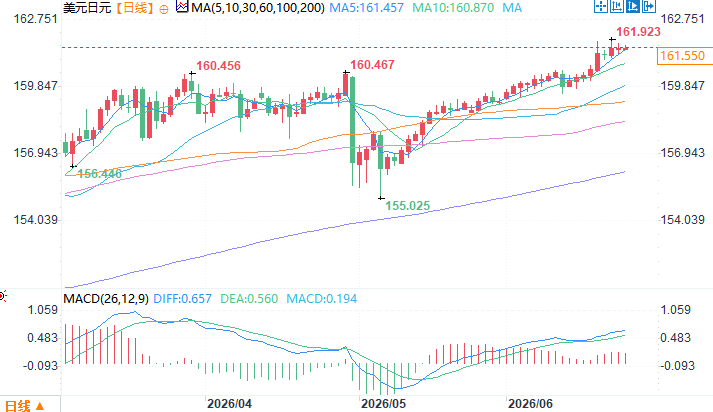
USD/JPY Daily Chart Source: EasyForex
At 13:14 Beijing time on June 24, the USD/JPY exchange rate was 161.54/55.
Currently, the currency pair is caught in a typical battle between bulls and bears. The continued rise in expectations of a Fed rate hike is providing strong support for the US dollar, which is beneficial for the exchange rate to rise. However, the continued depreciation of the yen has raised expectations of Japanese government intervention, which greatly limits the upside potential of the USD/JPY pair. These two core factors are mutually restraining each other and dominating the short-term foreign exchange market trend.
The Federal Reserve's hawkish signals have significantly increased market expectations for interest rate hikes.
In its latest monetary policy meeting in June, the Federal Reserve announced that it would maintain the benchmark interest rate range at 3.50% to 3.75%. Fed Chairman Kevin Warsh held his first post-meeting press conference, stating that price stability will be the core guiding principle for the Fed's future monetary policy formulation and adjustments.
The overall tone of this meeting was hawkish, which was interpreted by the market as a policy direction towards tightening, providing strong support for the US dollar exchange rate.
With policy signals taking effect, market pricing in a Fed rate hike this year has rapidly intensified. According to data from the CME FedWatch Tool, the market now anticipates a 25 basis point or greater rate hike at the Fed's July meeting, rising to 37.4%, a significant increase from 8.5% a week ago; the probability of a September rate hike has surged to 70.2%, far exceeding the previous level of 29.1%. This shift in monetary policy expectations has become the core driver supporting the dollar's strength.
The yen's depreciation triggered intervention warnings, and Japanese policy deterrence suppressed the exchange rate's rise.
Against the backdrop of a strong US dollar, the Japanese yen has continued to weaken, with its exchange rate deviating from its reasonable range. This has drawn serious attention from the Japanese government, and the risk of market intervention in the foreign exchange market has rapidly increased.
Recently, Japanese Finance Minister Satsuki Katayama and U.S. Treasury Secretary Scott Bessant held a phone call to discuss the yen's exchange rate trend and bilateral monetary policy coordination. Japanese Chief Cabinet Secretary Minoru Kihara also publicly stated on Tuesday that if abnormal fluctuations occur in the foreign exchange market, Japan will take appropriate measures to stabilize the exchange rate in a timely manner.
Takeru Yamamoto, a trader at Sumitomo Mitsui Trust Bank in New York, said: "Japan may hope to send a signal through high-level talks between Japan and the United States, indicating policy coordination between the two sides, while also suggesting that the threshold for Japan to intervene in the foreign exchange market is not high."
The market generally believes that Japan's statement is intended to deter speculative foreign exchange funds and prevent disorderly depreciation of the yen. This expectation has effectively suppressed the upside potential of the USD/JPY exchange rate and limited the upward trend of the exchange rate.
The Bank of Japan's policy shift is building momentum, laying the foundation for the yen's subsequent stabilization.
In addition to expectations of official intervention, the potential adjustment of the Bank of Japan's monetary policy also provides marginal support for the yen's exchange rate.
The Bank of Japan's June monetary policy meeting summary showed that most policy committee members supported raising the policy rate. The core reason given was the continued spread of inflation risks in Japan, with the core consumer price index continuing to recover and gradually approaching the central bank's 2% inflation target. This presented an opportunity for a shift in the monetary policy easing cycle, providing fundamental support for the yen to escape its weak position.
Summarize
In summary, the USD/JPY pair is expected to continue its oscillating and range-bound trading pattern in the short term. The Federal Reserve's hawkish stance and rising expectations of interest rate hikes provide support for the exchange rate, while the Japanese government's intervention and the Bank of Japan's potential interest rate adjustments continue to limit the upside potential of the exchange rate.
The key factors to watch in the future market are changes in expectations for Federal Reserve policy, the pace of Japanese intervention, and the performance of Japanese domestic inflation data. With alternating bullish and bearish factors, it is unlikely that the USD/JPY exchange rate will break out of its one-sided trend in the short term.
USD/JPY Daily Chart Source: EasyForex
At 13:14 Beijing time on June 24, the USD/JPY exchange rate was 161.54/55.
- Risk Warning and Disclaimer
- The market involves risk, and trading may not be suitable for all investors. This article is for reference only and does not constitute personal investment advice, nor does it take into account certain users’ specific investment objectives, financial situation, or other needs. Any investment decisions made based on this information are at your own risk.