Conflicting signals from US-Iran nuclear talks and rising expectations of a Fed rate hike: Euro falls to a one-year low.
2026-06-24 13:59:07
On Wednesday (June 24) during the Asian session, the euro is on track to fall for the third consecutive trading day against the US dollar, having touched a more than one-year low of 1.1360 at one point. It is currently trading around 1.1365, down about 0.15% on the day.
Despite the dominance of a strong dollar, the euro still faces the risk of further decline.

The fundamental reason for the continued weakness of the euro lies in the overall strength of the US dollar. Market expectations that the Federal Reserve will raise interest rates this year to combat persistent inflation continue to rise, providing core support for the dollar.
According to the latest data from the CME FedWatch tool, traders are pricing in an 86.1% probability of a Fed rate hike in December, a significant increase of 25 percentage points from last week. This substantial shift is primarily driven by stronger-than-expected US retail sales, manufacturing PMI, and labor market data. These data indicate that the US economy is more resilient than the market anticipated, and while the decline in inflation is slow, it is manageable, alleviating investors' concerns about a hard landing for the economy.
Recent hawkish signals from Federal Reserve officials have further solidified market sentiment, and traders' expectations for the number of rate cuts this year have significantly decreased. Against this backdrop, the interest rate differential between the US dollar and other major currencies has widened significantly, attracting global capital inflows into dollar assets and driving the dollar index to a 13-month high.
The Eurozone's economic recovery has been relatively slow. Although the European Central Bank has maintained a relatively hawkish stance, its support for the euro has been significantly weakened compared to the policy divergence of the Federal Reserve.
Traders are currently focused on whether the interest rate differential between the US and Europe will widen further, which has directly led to continued pressure on the euro in euro-dollar cross rates, and the downside risk remains in the short term.
At the same time, the contradictory statements made by the US and Iran on the Iranian nuclear program have allowed the geopolitical risk premium to be maintained, further boosting the demand for the US dollar as a safe haven.
US President Trump insisted that Iran had “fully agreed to accept the highest level of inspections indefinitely,” but the Iranian Foreign Ministry quickly denied making any new commitments regarding nuclear facility inspections during negotiations in Switzerland, with the two sides’ statements being seriously contradictory.
This information asymmetry directly amplifies market concerns about the reliability of the agreement's implementation. Even though the Strait of Hormuz has resumed navigation and sanctions waivers have been implemented, the verification dispute may still cause new variables within the 60-day roadmap.
Analysts point out that the nuclear issue, as one of the core contradictions in the Middle East, has injected a persistent premium into the global energy market and risk asset pricing due to its uncertainty, prompting investors to increase their holdings of traditional safe-haven assets such as the US dollar. Driven by this risk aversion, the US dollar index has performed strongly, completely overshadowing any potential support for the euro from the European Central Bank's policies.
In the short term, if the IAEA's subsequent technical negotiations fail to make progress, or if conflicts in regions such as Lebanon recur, the geopolitical risk premium is expected to further push up the US dollar exchange rate.
Investors should closely monitor Trump's latest statements, Iran's official response, and updates from relevant international institutions, as these factors will directly affect the safe-haven appeal of the US dollar and the euro's performance.
JPMorgan Chase believes the macroeconomic environment is shifting in favor of the US dollar, while negative factors for the euro are intensifying. Key drivers include the widening divergence in economic growth between the US and Europe (US data is more robust, while the Eurozone is relatively weak), a hawkish shift in Federal Reserve policy (a stable labor market and surprisingly high inflation pushing up expectations of interest rate hikes), and deteriorating terms of trade in the Eurozone (such as geopolitical conflicts affecting energy prices) and a relative decline in stock market performance.
Mitsubishi UFJ Financial Group expects the US dollar to weaken further in 2026, supporting a gradual rise in the euro against the dollar. In the baseline scenario, the Fed's gradual easing cycle (factors such as the labor market) will narrow yield spreads, while German spending and European fiscal dynamics will provide additional support for the euro. Although European political risks such as French fiscal concerns may limit gains, the overall trend of capital inflows into European bonds/equities is favorable.
According to the daily chart, the Euro/USD pair is currently continuing its downward trend, with a clear downtrend. The moving average system has turned into a resistance pattern, with the price having broken significantly below the 20-day, 50-day, 100-day, and 200-day moving averages. The short-term 20-day moving average (1.1542) and the medium-term 50-day moving average (1.1635) form layers of resistance above, while the medium- and long-term moving averages are turning downwards, indicating a strong downward momentum.
The MACD indicator's DIFF (-0.0062) remains below the DEA (-0.0044), with the green momentum bars continuing to expand, indicating sustained bearish pressure and no golden cross signal for a bottoming out. The RSI indicator has fallen to 27.38, approaching the oversold threshold of 20, suggesting a slight short-term technical rebound, but this does not change the overall downward trend.
In terms of price movement, after encountering resistance at the double top of 1.1848, the price gradually weakened, breaking through the key support level of 1.1649 and reaching a low of 1.1360. The previous low of 1.1410 has been effectively broken, leaving no strong support zone in the short term, further opening up downside potential. The first resistance level is the 20-day moving average at 1.1542, followed by the previous consolidation level at 1.1649.
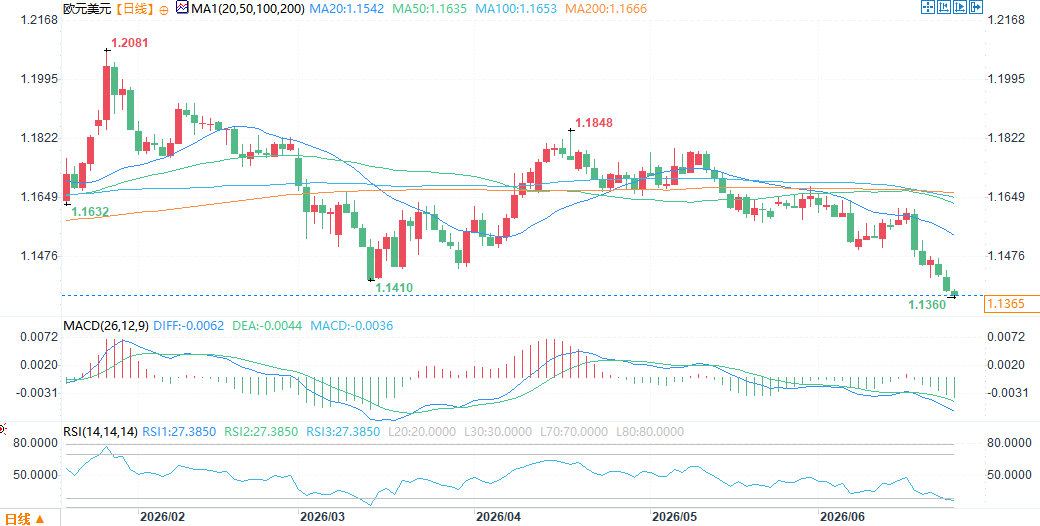
(Euro/USD daily chart, source: FX678)
At 13:58 Beijing time on June 24, the euro was trading at 1.1365/66 against the US dollar.
Despite the dominance of a strong dollar, the euro still faces the risk of further decline.
Rising expectations of a Fed rate hike and a broad-based strengthening of the US dollar
The fundamental reason for the continued weakness of the euro lies in the overall strength of the US dollar. Market expectations that the Federal Reserve will raise interest rates this year to combat persistent inflation continue to rise, providing core support for the dollar.
According to the latest data from the CME FedWatch tool, traders are pricing in an 86.1% probability of a Fed rate hike in December, a significant increase of 25 percentage points from last week. This substantial shift is primarily driven by stronger-than-expected US retail sales, manufacturing PMI, and labor market data. These data indicate that the US economy is more resilient than the market anticipated, and while the decline in inflation is slow, it is manageable, alleviating investors' concerns about a hard landing for the economy.
Recent hawkish signals from Federal Reserve officials have further solidified market sentiment, and traders' expectations for the number of rate cuts this year have significantly decreased. Against this backdrop, the interest rate differential between the US dollar and other major currencies has widened significantly, attracting global capital inflows into dollar assets and driving the dollar index to a 13-month high.
The Eurozone's economic recovery has been relatively slow. Although the European Central Bank has maintained a relatively hawkish stance, its support for the euro has been significantly weakened compared to the policy divergence of the Federal Reserve.
Traders are currently focused on whether the interest rate differential between the US and Europe will widen further, which has directly led to continued pressure on the euro in euro-dollar cross rates, and the downside risk remains in the short term.
The conflict over the US-Iran nuclear issue maintains geopolitical risk premium
At the same time, the contradictory statements made by the US and Iran on the Iranian nuclear program have allowed the geopolitical risk premium to be maintained, further boosting the demand for the US dollar as a safe haven.
US President Trump insisted that Iran had “fully agreed to accept the highest level of inspections indefinitely,” but the Iranian Foreign Ministry quickly denied making any new commitments regarding nuclear facility inspections during negotiations in Switzerland, with the two sides’ statements being seriously contradictory.
This information asymmetry directly amplifies market concerns about the reliability of the agreement's implementation. Even though the Strait of Hormuz has resumed navigation and sanctions waivers have been implemented, the verification dispute may still cause new variables within the 60-day roadmap.
Analysts point out that the nuclear issue, as one of the core contradictions in the Middle East, has injected a persistent premium into the global energy market and risk asset pricing due to its uncertainty, prompting investors to increase their holdings of traditional safe-haven assets such as the US dollar. Driven by this risk aversion, the US dollar index has performed strongly, completely overshadowing any potential support for the euro from the European Central Bank's policies.
In the short term, if the IAEA's subsequent technical negotiations fail to make progress, or if conflicts in regions such as Lebanon recur, the geopolitical risk premium is expected to further push up the US dollar exchange rate.
Investors should closely monitor Trump's latest statements, Iran's official response, and updates from relevant international institutions, as these factors will directly affect the safe-haven appeal of the US dollar and the euro's performance.
Institutional Views
JPMorgan Chase believes the macroeconomic environment is shifting in favor of the US dollar, while negative factors for the euro are intensifying. Key drivers include the widening divergence in economic growth between the US and Europe (US data is more robust, while the Eurozone is relatively weak), a hawkish shift in Federal Reserve policy (a stable labor market and surprisingly high inflation pushing up expectations of interest rate hikes), and deteriorating terms of trade in the Eurozone (such as geopolitical conflicts affecting energy prices) and a relative decline in stock market performance.
Mitsubishi UFJ Financial Group expects the US dollar to weaken further in 2026, supporting a gradual rise in the euro against the dollar. In the baseline scenario, the Fed's gradual easing cycle (factors such as the labor market) will narrow yield spreads, while German spending and European fiscal dynamics will provide additional support for the euro. Although European political risks such as French fiscal concerns may limit gains, the overall trend of capital inflows into European bonds/equities is favorable.
Technical Analysis
According to the daily chart, the Euro/USD pair is currently continuing its downward trend, with a clear downtrend. The moving average system has turned into a resistance pattern, with the price having broken significantly below the 20-day, 50-day, 100-day, and 200-day moving averages. The short-term 20-day moving average (1.1542) and the medium-term 50-day moving average (1.1635) form layers of resistance above, while the medium- and long-term moving averages are turning downwards, indicating a strong downward momentum.
The MACD indicator's DIFF (-0.0062) remains below the DEA (-0.0044), with the green momentum bars continuing to expand, indicating sustained bearish pressure and no golden cross signal for a bottoming out. The RSI indicator has fallen to 27.38, approaching the oversold threshold of 20, suggesting a slight short-term technical rebound, but this does not change the overall downward trend.
In terms of price movement, after encountering resistance at the double top of 1.1848, the price gradually weakened, breaking through the key support level of 1.1649 and reaching a low of 1.1360. The previous low of 1.1410 has been effectively broken, leaving no strong support zone in the short term, further opening up downside potential. The first resistance level is the 20-day moving average at 1.1542, followed by the previous consolidation level at 1.1649.
(Euro/USD daily chart, source: FX678)
At 13:58 Beijing time on June 24, the euro was trading at 1.1365/66 against the US dollar.
- Risk Warning and Disclaimer
- The market involves risk, and trading may not be suitable for all investors. This article is for reference only and does not constitute personal investment advice, nor does it take into account certain users’ specific investment objectives, financial situation, or other needs. Any investment decisions made based on this information are at your own risk.