













Attacked shortly after opening! Another "thunderstorm" in the Hormuz region, is the geopolitical premium for oil prices making a comeback?
2026-06-26 08:23:50
On Friday (June 26) in early Asian trading, US crude oil futures saw a slight pullback after rising 2% the previous day, currently trading around 71.60.
The United Nations International Maritime Organization (IMO) suspended its evacuation operations on Thursday, escorting ships through the Strait of Hormuz after a cargo ship reported being attacked near Oman.
This event reignited market concerns about the effectiveness of the initial agreement to end the war with Iran, causing international oil prices to rise by about 2%.

The UK Navy's UKMTO reported that a cargo ship was hit by a catapult near Oman. Two US officials told the media that Iran fired on the ship. Four sources confirmed that the ship was the Singapore-flagged Ever Lovely. A security source said the ship was likely attacked by a drone.
Just hours before the incident, Tehran had warned the vessel against taking routes not approved by the authorities.
The Persian Gulf Straits Authority, established by Iran to manage ships passing through the Strait of Hormuz, stated that it cannot guarantee safe passage for vessels that do not follow its prescribed routes.
Iran's Islamic Revolutionary Guard Corps further stated on Thursday that ships can only pass safely through the strait via routes designated by Iran, and emphasized that it will take action against ships that do not comply with the regulations.
British maritime security firm Ambrey said the Iranian Revolutionary Guard also ordered two Panamanian-flagged vessels to change course on Thursday.
The U.S. government did not immediately respond publicly to the attack. However, President Trump warned earlier this month that the U.S. might bomb Iran again if it did not comply with agreements aimed at ending the war and reopening the Straits of Hormuz.
In a statement, IMO Secretary General Arsenio Dominguez said that the IMO has decided to "temporarily suspend the program to reassess whether the vessels on our evacuation list and all vessels in the region still enjoy the necessary safety guarantees."
The IMO emphasized that the vessel suspected of being attacked was not part of its evacuation plan.
The IMO has been assisting hundreds of stranded ships and thousands of sailors to leave the Strait of Hormuz, where they have been trapped for months since the start of the war in late February.
The evacuation plan was launched on Tuesday. Under the plan, ships and crew members can voluntarily choose to leave the Gulf region via two routes, one through Iranian waters and the other through Omani waters, both monitored by the United States.
This decision to suspend the agreement highlights the fragility of the security situation in the Taiwan Strait and the real challenges facing the implementation of the peace agreement.
Analysts point out that this incident has reignited market concerns about how long it will take for Gulf oil shipments to return to normal levels.
Previously, U.S. Energy Secretary Wright stated that traffic through the Strait of Hormuz was approaching pre-war levels of February 28, with at least 20 million barrels of crude oil being transported through the waterway in the past 24 hours.
However, this attack demonstrates that the security situation in the Strait is far from "normal," and geopolitical risk premiums may be re-incorporated into oil prices.
The attack occurred shortly after U.S. Secretary of State Marco Rubio concluded a visit to the Gulf region. He told reporters that if Iran threatened or blocked ships in the Strait of Hormuz, "then we'll be in trouble."
Rubio's trip was intended to reassure Gulf allies about concerns over the initial peace agreement, but this incident may further deepen their doubts about the reliability of the agreement's implementation.
At the same time, Iran continues to assert its control over the Strait of Hormuz, sending a strong signal.
Statements regarding the framework ceasefire agreement remain contradictory—significant differences persist among the parties on issues such as economic incentives against Iran, nuclear inspections, control of the Straits of Hormuz, and Israel's military operations in Lebanon.
Iran's chief negotiator, Qalibaf, said on Thursday that the US claim that Iran would use unfrozen assets to purchase US agricultural products was untrue.
According to the daily chart, US crude oil futures have entered a deep downtrend, with prices falling continuously from the year's high of $119.48 to the current price of $71.60. The previous bullish moving average system has completely turned downwards. The short-term 20-day moving average (MA20) (82.63), medium-term 50-day moving average (MA50) (91.61), and 100-day moving average (MA100) (87.97) are all above the price, forming layers of resistance. Only the long-term 200-day moving average (MA200) provides temporary support, but the oil price has already broken below this moving average, indicating that bears dominate the market.
In terms of indicators, the MACD is completely in the downtrend zone, with the DIFF at -6.19 consistently below the DEA at -5.24, and the green histogram bars continuing to expand, indicating that downward momentum is still being released. The RSI value is 31.37, close to the oversold zone of 30, suggesting a slight oversold rebound in the short term, but no clear bottom divergence reversal signal has appeared.
Overall, the medium- to long-term downtrend is clear. Only short-term indicators are oversold, suggesting a weak corrective rebound. This rebound will likely be met with selling pressure. Only a sustained move above the 20-day moving average and a MACD golden cross can reverse the short-term downtrend.
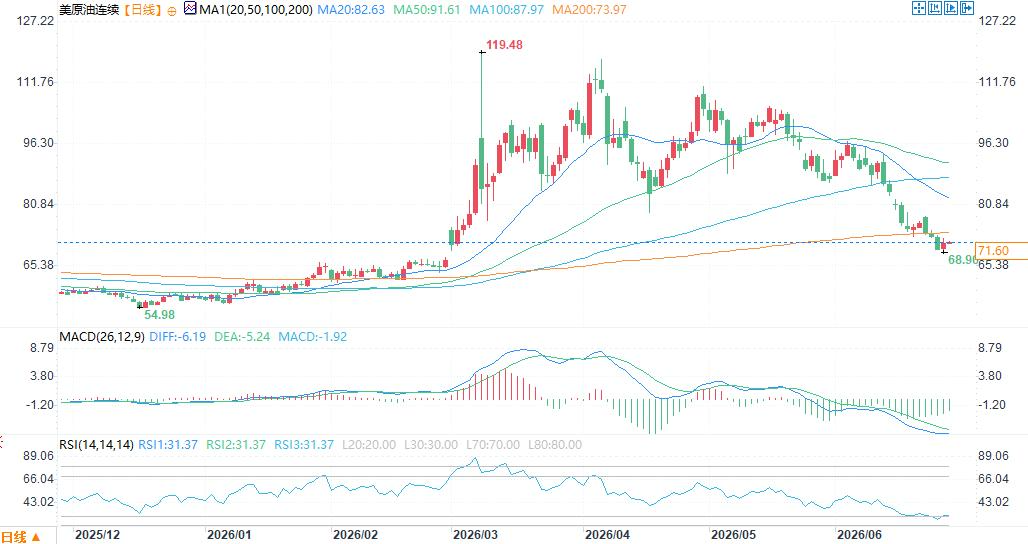
(US crude oil futures daily chart, source: FX678)
At 8:20 a.m. Beijing time on June 26, US crude oil futures were trading at $71.64 per barrel.
The United Nations International Maritime Organization (IMO) suspended its evacuation operations on Thursday, escorting ships through the Strait of Hormuz after a cargo ship reported being attacked near Oman.
This event reignited market concerns about the effectiveness of the initial agreement to end the war with Iran, causing international oil prices to rise by about 2%.
Attack: Cargo ship attacked, US and Iran blame each other
The UK Navy's UKMTO reported that a cargo ship was hit by a catapult near Oman. Two US officials told the media that Iran fired on the ship. Four sources confirmed that the ship was the Singapore-flagged Ever Lovely. A security source said the ship was likely attacked by a drone.
Just hours before the incident, Tehran had warned the vessel against taking routes not approved by the authorities.
The Persian Gulf Straits Authority, established by Iran to manage ships passing through the Strait of Hormuz, stated that it cannot guarantee safe passage for vessels that do not follow its prescribed routes.
Iran's Islamic Revolutionary Guard Corps further stated on Thursday that ships can only pass safely through the strait via routes designated by Iran, and emphasized that it will take action against ships that do not comply with the regulations.
British maritime security firm Ambrey said the Iranian Revolutionary Guard also ordered two Panamanian-flagged vessels to change course on Thursday.
The U.S. government did not immediately respond publicly to the attack. However, President Trump warned earlier this month that the U.S. might bomb Iran again if it did not comply with agreements aimed at ending the war and reopening the Straits of Hormuz.
IMO Suspends Evacuation Plan: An Emergency Halt Due to Safety Considerations
In a statement, IMO Secretary General Arsenio Dominguez said that the IMO has decided to "temporarily suspend the program to reassess whether the vessels on our evacuation list and all vessels in the region still enjoy the necessary safety guarantees."
The IMO emphasized that the vessel suspected of being attacked was not part of its evacuation plan.
The IMO has been assisting hundreds of stranded ships and thousands of sailors to leave the Strait of Hormuz, where they have been trapped for months since the start of the war in late February.
The evacuation plan was launched on Tuesday. Under the plan, ships and crew members can voluntarily choose to leave the Gulf region via two routes, one through Iranian waters and the other through Omani waters, both monitored by the United States.
This decision to suspend the agreement highlights the fragility of the security situation in the Taiwan Strait and the real challenges facing the implementation of the peace agreement.
Oil Price Reaction and Market Impact: Geopolitical Risk Premium May Make a Comeback
Analysts point out that this incident has reignited market concerns about how long it will take for Gulf oil shipments to return to normal levels.
Previously, U.S. Energy Secretary Wright stated that traffic through the Strait of Hormuz was approaching pre-war levels of February 28, with at least 20 million barrels of crude oil being transported through the waterway in the past 24 hours.
However, this attack demonstrates that the security situation in the Strait is far from "normal," and geopolitical risk premiums may be re-incorporated into oil prices.
Diplomacy and Differences: Rubio reassures allies, Iran takes a hard line.
The attack occurred shortly after U.S. Secretary of State Marco Rubio concluded a visit to the Gulf region. He told reporters that if Iran threatened or blocked ships in the Strait of Hormuz, "then we'll be in trouble."
Rubio's trip was intended to reassure Gulf allies about concerns over the initial peace agreement, but this incident may further deepen their doubts about the reliability of the agreement's implementation.
At the same time, Iran continues to assert its control over the Strait of Hormuz, sending a strong signal.
Statements regarding the framework ceasefire agreement remain contradictory—significant differences persist among the parties on issues such as economic incentives against Iran, nuclear inspections, control of the Straits of Hormuz, and Israel's military operations in Lebanon.
Iran's chief negotiator, Qalibaf, said on Thursday that the US claim that Iran would use unfrozen assets to purchase US agricultural products was untrue.
Technical Analysis
According to the daily chart, US crude oil futures have entered a deep downtrend, with prices falling continuously from the year's high of $119.48 to the current price of $71.60. The previous bullish moving average system has completely turned downwards. The short-term 20-day moving average (MA20) (82.63), medium-term 50-day moving average (MA50) (91.61), and 100-day moving average (MA100) (87.97) are all above the price, forming layers of resistance. Only the long-term 200-day moving average (MA200) provides temporary support, but the oil price has already broken below this moving average, indicating that bears dominate the market.
In terms of indicators, the MACD is completely in the downtrend zone, with the DIFF at -6.19 consistently below the DEA at -5.24, and the green histogram bars continuing to expand, indicating that downward momentum is still being released. The RSI value is 31.37, close to the oversold zone of 30, suggesting a slight oversold rebound in the short term, but no clear bottom divergence reversal signal has appeared.
Overall, the medium- to long-term downtrend is clear. Only short-term indicators are oversold, suggesting a weak corrective rebound. This rebound will likely be met with selling pressure. Only a sustained move above the 20-day moving average and a MACD golden cross can reverse the short-term downtrend.
(US crude oil futures daily chart, source: FX678)
At 8:20 a.m. Beijing time on June 26, US crude oil futures were trading at $71.64 per barrel.
- Risk Warning and Disclaimer
- The market involves risk, and trading may not be suitable for all investors. This article is for reference only and does not constitute personal investment advice, nor does it take into account certain users’ specific investment objectives, financial situation, or other needs. Any investment decisions made based on this information are at your own risk.

