Rising US PCE inflation strengthens expectations of interest rate hikes, keeping the US dollar index fluctuating at high levels.
2026-06-26 14:31:27
On Friday during Asian trading hours, the US dollar index (DXY) continued to fluctuate at high levels, trading around 101.50 . The latest US inflation data further strengthened market expectations that the Federal Reserve would maintain its tightening policy, providing support for the dollar. Market focus is gradually shifting to the upcoming release of the University of Michigan consumer sentiment index and consumer inflation expectations data.
Data released by the U.S. Bureau of Economic Analysis shows that the personal consumption expenditures (PCE) price index rose 4.1% year-on-year in May, up from 3.3% in April, and the first time it has exceeded 4% in nearly three years. Rising energy prices were a significant factor driving the overall inflation rebound, while continued tensions in the Middle East kept international oil prices high, further strengthening market expectations that the pace of decline in U.S. inflation would slow.
Meanwhile, the core PCE price index, which is closely watched by the Federal Reserve, rose 3.4% year-on-year, a further increase from the previous value of 3.3% , reaching its highest level since October 2023. The continued resilience of core inflation reflects persistent price pressures in the US service sector, leading the market to widely believe that the Federal Reserve is unlikely to quickly shift to an easing policy in the short term.
The interest rate market reacted swiftly. According to the CME Group's FedWatch tool, the market currently expects a 63.4% probability of a rate hike at the Federal Reserve's September meeting. As the market readjusts its monetary policy expectations, US Treasury yields remain relatively high, giving the US dollar index renewed upward momentum.
Meanwhile, market participants remain highly focused on the Federal Reserve's policy path. Scott Anderson, chief U.S. economist at BMO, stated that persistently high U.S. PCE inflation means the Fed still needs to maintain a wait-and-see stance, and even further rate hikes cannot be ruled out. He pointed out that service sector inflation is highly sticky, and even if energy prices fall in the future, it will be difficult to quickly and significantly reduce overall core inflation. Therefore, the hawkish and dovish divisions within the Fed regarding monetary policy will likely persist for some time.
Currently, the dollar's performance remains driven by both the US economic fundamentals and monetary policy expectations. If consumer confidence and inflation expectations continue to be strong, the dollar index is likely to continue its rebound; conversely, if economic data shows signs of slowing, it may weaken market bets on further interest rate hikes, and the dollar's rise may slow down.
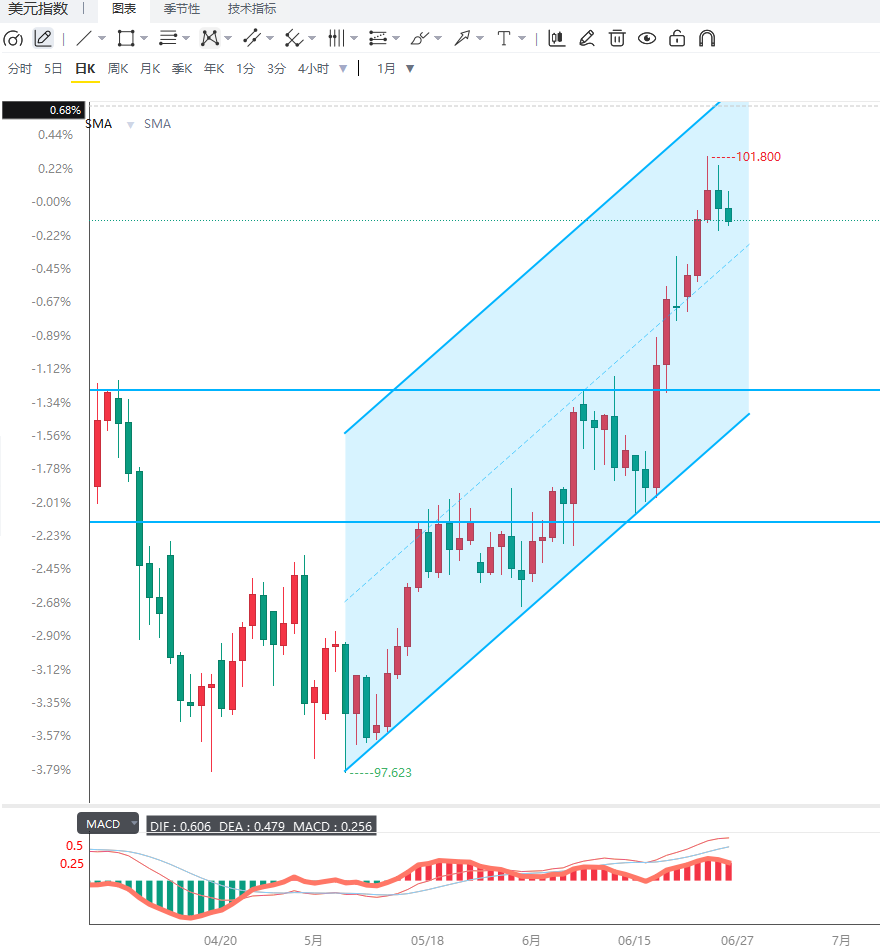
From a daily chart perspective, the US dollar index has stabilized and rebounded after a period of adjustment, currently trading near major moving averages and maintaining an overall slightly bullish trend. The area around 101.20 has become a key short-term support level. If it can continue to hold above this area, the index is expected to further challenge the resistance levels of 102.00 and 102.50 ; however, a break below 101.20 may lead to a pullback to the support level around 100.80 . Daily momentum has recovered somewhat, and the medium- to long-term trend remains bullish.
From a 4-hour chart perspective, the US dollar index has regained its position above the short-term moving average, and the MACD is near the zero line and gradually forming a golden cross, with the red momentum bars starting to expand, indicating that short-term buying power has strengthened. If it effectively breaks through 102.00 , it is expected to open up further upside potential, targeting 102.50 ; if it encounters resistance and falls back, attention should be paid to whether the support levels of 101.20 and 100.80 can be effectively held. Overall, the short-term trend remains mainly one of oscillation with a slight upward bias.
Editor's Summary : High US inflation data has kept market expectations for further monetary tightening by the Federal Reserve this year strong, becoming a key factor supporting the US dollar index. Although there is still some disagreement in the market regarding the future policy path, the strong stickiness of core inflation means that the dollar still has a fundamental advantage in the short term. Going forward, consumer confidence indices, speeches by Federal Reserve officials, and subsequent employment and inflation data will continue to influence market judgments on interest rate policy and will also determine whether the US dollar index can further expand its rebound.
Data released by the U.S. Bureau of Economic Analysis shows that the personal consumption expenditures (PCE) price index rose 4.1% year-on-year in May, up from 3.3% in April, and the first time it has exceeded 4% in nearly three years. Rising energy prices were a significant factor driving the overall inflation rebound, while continued tensions in the Middle East kept international oil prices high, further strengthening market expectations that the pace of decline in U.S. inflation would slow.
Meanwhile, the core PCE price index, which is closely watched by the Federal Reserve, rose 3.4% year-on-year, a further increase from the previous value of 3.3% , reaching its highest level since October 2023. The continued resilience of core inflation reflects persistent price pressures in the US service sector, leading the market to widely believe that the Federal Reserve is unlikely to quickly shift to an easing policy in the short term.
The interest rate market reacted swiftly. According to the CME Group's FedWatch tool, the market currently expects a 63.4% probability of a rate hike at the Federal Reserve's September meeting. As the market readjusts its monetary policy expectations, US Treasury yields remain relatively high, giving the US dollar index renewed upward momentum.
Meanwhile, market participants remain highly focused on the Federal Reserve's policy path. Scott Anderson, chief U.S. economist at BMO, stated that persistently high U.S. PCE inflation means the Fed still needs to maintain a wait-and-see stance, and even further rate hikes cannot be ruled out. He pointed out that service sector inflation is highly sticky, and even if energy prices fall in the future, it will be difficult to quickly and significantly reduce overall core inflation. Therefore, the hawkish and dovish divisions within the Fed regarding monetary policy will likely persist for some time.
Currently, the dollar's performance remains driven by both the US economic fundamentals and monetary policy expectations. If consumer confidence and inflation expectations continue to be strong, the dollar index is likely to continue its rebound; conversely, if economic data shows signs of slowing, it may weaken market bets on further interest rate hikes, and the dollar's rise may slow down.
From a daily chart perspective, the US dollar index has stabilized and rebounded after a period of adjustment, currently trading near major moving averages and maintaining an overall slightly bullish trend. The area around 101.20 has become a key short-term support level. If it can continue to hold above this area, the index is expected to further challenge the resistance levels of 102.00 and 102.50 ; however, a break below 101.20 may lead to a pullback to the support level around 100.80 . Daily momentum has recovered somewhat, and the medium- to long-term trend remains bullish.
From a 4-hour chart perspective, the US dollar index has regained its position above the short-term moving average, and the MACD is near the zero line and gradually forming a golden cross, with the red momentum bars starting to expand, indicating that short-term buying power has strengthened. If it effectively breaks through 102.00 , it is expected to open up further upside potential, targeting 102.50 ; if it encounters resistance and falls back, attention should be paid to whether the support levels of 101.20 and 100.80 can be effectively held. Overall, the short-term trend remains mainly one of oscillation with a slight upward bias.
Editor's Summary : High US inflation data has kept market expectations for further monetary tightening by the Federal Reserve this year strong, becoming a key factor supporting the US dollar index. Although there is still some disagreement in the market regarding the future policy path, the strong stickiness of core inflation means that the dollar still has a fundamental advantage in the short term. Going forward, consumer confidence indices, speeches by Federal Reserve officials, and subsequent employment and inflation data will continue to influence market judgments on interest rate policy and will also determine whether the US dollar index can further expand its rebound.
- Risk Warning and Disclaimer
- The market involves risk, and trading may not be suitable for all investors. This article is for reference only and does not constitute personal investment advice, nor does it take into account certain users’ specific investment objectives, financial situation, or other needs. Any investment decisions made based on this information are at your own risk.