Gold has fallen for four consecutive weeks, hovering around the $4,000 mark; short-term price movements will depend on the non-farm payrolls data.
2026-06-29 13:26:31
International gold prices were in a weak state last week, with the price barely holding the key support level of $4,000 per ounce, marking the fourth consecutive week of decline and the longest losing streak since August 2023.
The recent weakness in gold prices stems from a confluence of negative factors, including geopolitical tensions, energy inflation, a shift in Federal Reserve policy, and a strengthening US dollar. Currently, market sentiment is divided, and while short-term downward pressure on gold prices has not yet fully dissipated, its medium- to long-term investment value remains prominent. This week's US non-farm payroll data will be a key watershed moment in determining the short-term trend of gold.
Recent geopolitical conflicts in Iran have disrupted global energy markets, pushing up international oil prices and raising concerns about rising inflation, which has put sustained downward pressure on gold prices. At the same time, the Federal Reserve's monetary policy stance has shifted significantly, abandoning its dovish stance and adopting a hawkish tone, signaling the possibility of an interest rate hike this year. This has gradually alleviated market inflation concerns, further depressing precious metal asset prices.
Against the backdrop of a resilient US economy, the market is once again demonstrating the trading logic of the relatively strong US economy, continuously attracting global capital inflows into US assets, providing strong support for the strengthening of the US dollar, and indirectly putting pressure on gold prices.
Christopher Vecchio, head of futures and FX strategy at Tastylive, stated that after maintaining a neutral stance on gold for four consecutive months, he has officially turned bearish on the future of gold following the latest Federal Reserve interest rate meeting. Although the Fed kept interest rates unchanged at this meeting, the latest economic projections indicate that officials support a rate hike this year, and Fed Chairman Kevin Warsh has explicitly stated that price stability is a primary policy objective.
"Capital costs and short-term interest rates are the core factors driving gold prices," said Vecchio. "Gold trading should focus on the two-year Treasury yield. If the Federal Reserve continues to raise interest rates, gold prices could fall to the $3,000 range." While the two-year Treasury yield has slightly declined, it remains near its high for the year.
Many senior market analysts remain cautious about the short-term trend of gold.
Alex Kuptsikevich, chief market analyst at Forex Financial, stated that even if gold prices temporarily hold the $4,000 level, the stability of this support remains questionable. The daily chart for gold has formed a bearish death cross, clearly signaling a downtrend. Last week, bears exerted sustained pressure on gold prices, only slightly relenting at the end of Friday's trading session. Furthermore, multiple attempts to break through the 50-week moving average failed. The $4,000 level, a key support zone formed at the end of last year, will inevitably see intense battles between bulls and bears.
David Morrison, senior market analyst at Trade Nation, said the short-term downtrend in gold has not ended. He said, "Although the daily MACD indicator for gold has entered oversold territory, the degree of oversoldness is far lower than in March of this year, and the bears still have ample room to push down gold prices and clear out long positions in the market."
FOREX market analyst Fawad Razaqzada said that this week's market movements will determine whether gold can form a bottom. If this rebound fails again, gold prices are likely to break down and fall back to the $3,500 per ounce range. Short-term resistance is concentrated at $4,098 and $4,200.
Despite a concentrated release of short-term negative factors, the medium- to long-term fundamentals for gold have not completely deteriorated. Industry analysts generally believe that current gold prices offer excellent long-term investment value and are unlikely to remain below $4,000 for an extended period. While central banks have slowed their gold purchases, continued official gold buying continues to provide solid support for the market.
Meanwhile, the market is divided on the Fed's interest rate hike path. Fahad Tariq, senior vice president of Jefferies equity research, said that the market is currently over-priced in expectations of an interest rate hike this year, and considering the decline in oil prices and fiscal and political factors, the feasibility of the Fed raising interest rates this year is not high.
The upcoming US non-farm payroll data this week will be key to influencing Federal Reserve policy and driving gold price movements.
FXTM Senior Market Analyst Lukman Otunuga stated that if the non-farm payroll data exceeds expectations, it will reinforce the Federal Reserve's hawkish stance, increasing the probability of a July rate hike. Gold prices are likely to fall below the $4,000 mark, targeting the $3,900 and $3,740 range. Conversely, if the data weakens, gold prices are expected to rebound, recovering to the $4,100 and $4,250 range. The non-farm payroll report will be released on Thursday, and market liquidity will be somewhat reduced on Friday due to the US Independence Day holiday.
In summary, gold faces high downside risk in the short term due to hawkish expectations from the Federal Reserve, a stronger dollar, and technical breakdowns, with the battle for the $4,000 mark entering a crucial phase. However, central bank gold purchases and uncertainties surrounding interest rate hikes limit the potential for a significant drop in gold prices. Short-term market movements will depend on the performance of non-farm payroll data, while gold retains its investment value in the medium to long term, and the structural market dynamics of bullish and bearish forces will continue.
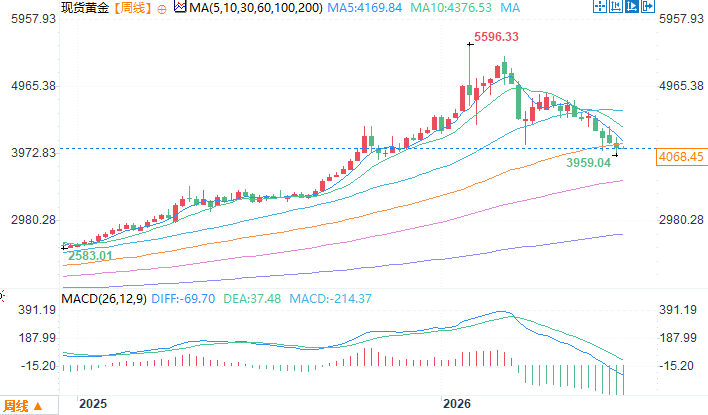
Spot gold weekly chart source: EasyForex
At 10:28 AM Beijing time on June 29, spot gold was trading at $4068.05 per ounce.
The recent weakness in gold prices stems from a confluence of negative factors, including geopolitical tensions, energy inflation, a shift in Federal Reserve policy, and a strengthening US dollar. Currently, market sentiment is divided, and while short-term downward pressure on gold prices has not yet fully dissipated, its medium- to long-term investment value remains prominent. This week's US non-farm payroll data will be a key watershed moment in determining the short-term trend of gold.
Multiple negative factors combined to put continued downward pressure on gold prices.
Recent geopolitical conflicts in Iran have disrupted global energy markets, pushing up international oil prices and raising concerns about rising inflation, which has put sustained downward pressure on gold prices. At the same time, the Federal Reserve's monetary policy stance has shifted significantly, abandoning its dovish stance and adopting a hawkish tone, signaling the possibility of an interest rate hike this year. This has gradually alleviated market inflation concerns, further depressing precious metal asset prices.
Against the backdrop of a resilient US economy, the market is once again demonstrating the trading logic of the relatively strong US economy, continuously attracting global capital inflows into US assets, providing strong support for the strengthening of the US dollar, and indirectly putting pressure on gold prices.
Christopher Vecchio, head of futures and FX strategy at Tastylive, stated that after maintaining a neutral stance on gold for four consecutive months, he has officially turned bearish on the future of gold following the latest Federal Reserve interest rate meeting. Although the Fed kept interest rates unchanged at this meeting, the latest economic projections indicate that officials support a rate hike this year, and Fed Chairman Kevin Warsh has explicitly stated that price stability is a primary policy objective.
"Capital costs and short-term interest rates are the core factors driving gold prices," said Vecchio. "Gold trading should focus on the two-year Treasury yield. If the Federal Reserve continues to raise interest rates, gold prices could fall to the $3,000 range." While the two-year Treasury yield has slightly declined, it remains near its high for the year.
The technical pattern has broken down, solidifying the short-term bearish advantage.
Many senior market analysts remain cautious about the short-term trend of gold.
Alex Kuptsikevich, chief market analyst at Forex Financial, stated that even if gold prices temporarily hold the $4,000 level, the stability of this support remains questionable. The daily chart for gold has formed a bearish death cross, clearly signaling a downtrend. Last week, bears exerted sustained pressure on gold prices, only slightly relenting at the end of Friday's trading session. Furthermore, multiple attempts to break through the 50-week moving average failed. The $4,000 level, a key support zone formed at the end of last year, will inevitably see intense battles between bulls and bears.
David Morrison, senior market analyst at Trade Nation, said the short-term downtrend in gold has not ended. He said, "Although the daily MACD indicator for gold has entered oversold territory, the degree of oversoldness is far lower than in March of this year, and the bears still have ample room to push down gold prices and clear out long positions in the market."
FOREX market analyst Fawad Razaqzada said that this week's market movements will determine whether gold can form a bottom. If this rebound fails again, gold prices are likely to break down and fall back to the $3,500 per ounce range. Short-term resistance is concentrated at $4,098 and $4,200.
The divergence between bulls and bears has intensified, but the medium- to long-term bottom support remains solid.
Despite a concentrated release of short-term negative factors, the medium- to long-term fundamentals for gold have not completely deteriorated. Industry analysts generally believe that current gold prices offer excellent long-term investment value and are unlikely to remain below $4,000 for an extended period. While central banks have slowed their gold purchases, continued official gold buying continues to provide solid support for the market.
Meanwhile, the market is divided on the Fed's interest rate hike path. Fahad Tariq, senior vice president of Jefferies equity research, said that the market is currently over-priced in expectations of an interest rate hike this year, and considering the decline in oil prices and fiscal and political factors, the feasibility of the Fed raising interest rates this year is not high.
Key data is coming, and the future direction of the market is about to be determined.
The upcoming US non-farm payroll data this week will be key to influencing Federal Reserve policy and driving gold price movements.
FXTM Senior Market Analyst Lukman Otunuga stated that if the non-farm payroll data exceeds expectations, it will reinforce the Federal Reserve's hawkish stance, increasing the probability of a July rate hike. Gold prices are likely to fall below the $4,000 mark, targeting the $3,900 and $3,740 range. Conversely, if the data weakens, gold prices are expected to rebound, recovering to the $4,100 and $4,250 range. The non-farm payroll report will be released on Thursday, and market liquidity will be somewhat reduced on Friday due to the US Independence Day holiday.
Summarize
In summary, gold faces high downside risk in the short term due to hawkish expectations from the Federal Reserve, a stronger dollar, and technical breakdowns, with the battle for the $4,000 mark entering a crucial phase. However, central bank gold purchases and uncertainties surrounding interest rate hikes limit the potential for a significant drop in gold prices. Short-term market movements will depend on the performance of non-farm payroll data, while gold retains its investment value in the medium to long term, and the structural market dynamics of bullish and bearish forces will continue.
Spot gold weekly chart source: EasyForex
At 10:28 AM Beijing time on June 29, spot gold was trading at $4068.05 per ounce.
- Risk Warning and Disclaimer
- The market involves risk, and trading may not be suitable for all investors. This article is for reference only and does not constitute personal investment advice, nor does it take into account certain users’ specific investment objectives, financial situation, or other needs. Any investment decisions made based on this information are at your own risk.