Expectations of yen intervention coupled with geopolitical risks kept the USD/JPY exchange rate at high levels.
2026-06-29 13:26:35
The USD/JPY pair edged higher against the yen in Asian trading on Monday, hovering around 161.80 , continuing its recent upward trend with a slight bias towards higher levels. The current rise is primarily supported by safe-haven demand for the dollar, especially given the uncertainty surrounding US-Iran negotiations over the Hormuz situation, which has led to a temporary return of funds to dollar assets.
The US and Iran have agreed to a temporary truce in military confrontations in the Gulf region and plan to hold a new round of negotiations in Qatar. Despite the short-term de-escalation of the conflict, the market remains cautious about the effectiveness of the agreement's implementation, which continues to support the safe-haven appeal of the US dollar and keeps the USD/JPY pair relatively strong. However, policy risks from Japan are rising significantly, becoming a key factor limiting further appreciation of the exchange rate. Japanese officials have recently emphasized their intention to intervene appropriately in response to excessive exchange rate volatility, making the market highly wary of a rapid depreciation of the yen. If the exchange rate approaches key psychological levels, the risk of actual intervention could escalate rapidly, thus exerting significant downward pressure on the USD/JPY pair.
Meanwhile, expectations for the Bank of Japan's policy are also undergoing marginal changes. Bank of Japan Governor Naoki Tamura recently stated that the central bank should gradually raise interest rates and, if necessary, accelerate the pace of tightening to address inflation risks from external shocks. This statement reinforced market expectations for the normalization of Japan's monetary policy, strengthening medium-term support for the yen.
From an overall structural perspective, USD/JPY is currently in a two-way game between "safe-haven support from the US dollar and the risk of policy intervention by the Japanese yen." While maintaining a slightly bullish bias in the short term, its upside potential is clearly constrained by policy. The market's focus will shift to the US non-farm payroll data released this Thursday, which will influence the short-term direction of the US dollar. Meanwhile, the Bank of Japan's meeting on July 30-31 will also be a key event, with the market closely watching its inflation forecasts and signals regarding the interest rate path.
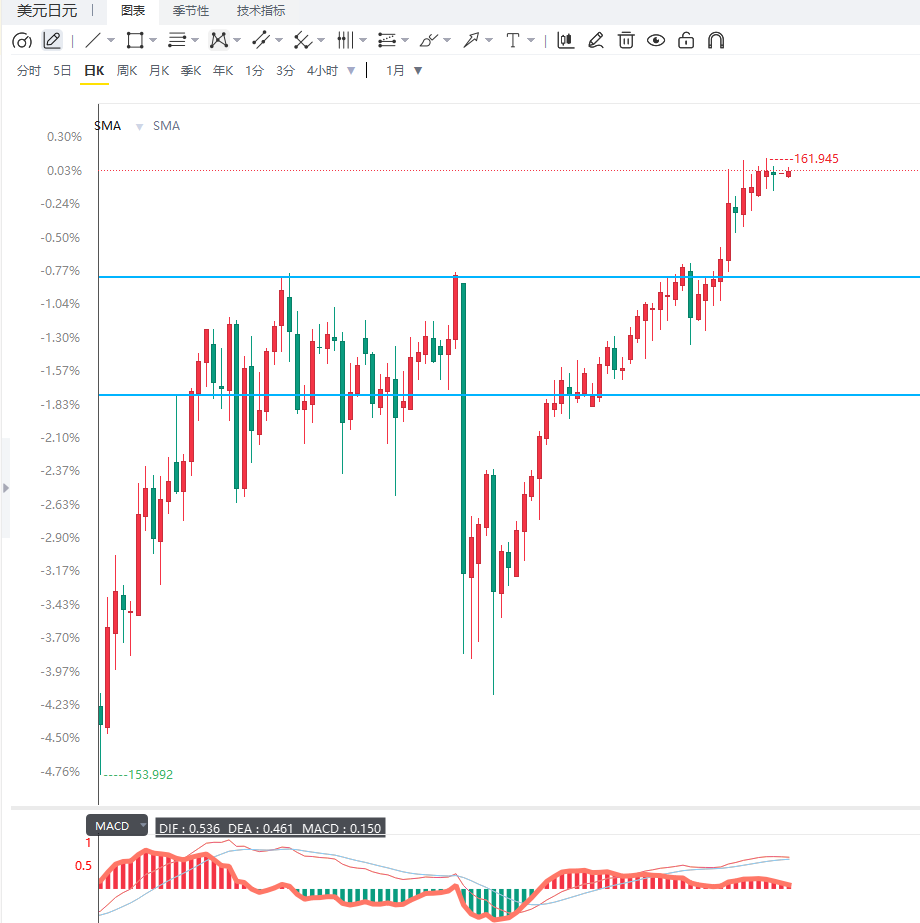
From a daily chart perspective, USD/JPY maintains a high-level consolidation and upward trend, with the price continuing to trade above 160. The overall trend remains bullish, but it is approaching historical high resistance levels, significantly increasing volatility risk. The key resistance level is currently in the 162.50-163.50 area, which could trigger stronger expectations of policy intervention, thereby limiting further upside potential.
On the downside support level, the first thing to watch is around 160.80 , which is a short-term dividing line between bullish and bearish sentiment. If this level is broken, a pullback to the 159.50-158.80 range is possible, as this area has been tested multiple times recently as a support zone. Overall, the daily trend remains bullish, but the risk-reward ratio is gradually decreasing.
From a 4-hour chart perspective, after a continuous upward move, the exchange rate has entered a high-level consolidation phase. The moving average system remains in a bullish alignment, but the slope is slowing, indicating a weakening of upward momentum. Momentum indicators are in a high-level oscillation state, suggesting a clear divergence between profit-taking and chasing rallies in the market. If the exchange rate fails to break through the 162 level effectively, it may enter a high-level consolidation phase; if it falls back and breaks below 160.80, it may turn into a short-term correction phase.
Editor's Summary : Overall, the current rise in USD/JPY is primarily driven by safe-haven demand for the US dollar, but expectations of Japanese policy intervention and the normalization process of monetary policy are creating a clear balance. The market faces dual pressures from policy and sentiment in the 161-163 range, limiting the upside potential of the exchange rate. In the medium term, the yen's movement will depend more on the Bank of Japan's policy path and the pace of foreign exchange intervention than solely on the US dollar. Ahead of the US non-farm payroll data and the Bank of Japan's July meeting, USD/JPY is likely to maintain a high-level consolidation pattern, with a new macroeconomic catalyst needed for a trend breakout.
The US and Iran have agreed to a temporary truce in military confrontations in the Gulf region and plan to hold a new round of negotiations in Qatar. Despite the short-term de-escalation of the conflict, the market remains cautious about the effectiveness of the agreement's implementation, which continues to support the safe-haven appeal of the US dollar and keeps the USD/JPY pair relatively strong. However, policy risks from Japan are rising significantly, becoming a key factor limiting further appreciation of the exchange rate. Japanese officials have recently emphasized their intention to intervene appropriately in response to excessive exchange rate volatility, making the market highly wary of a rapid depreciation of the yen. If the exchange rate approaches key psychological levels, the risk of actual intervention could escalate rapidly, thus exerting significant downward pressure on the USD/JPY pair.
Meanwhile, expectations for the Bank of Japan's policy are also undergoing marginal changes. Bank of Japan Governor Naoki Tamura recently stated that the central bank should gradually raise interest rates and, if necessary, accelerate the pace of tightening to address inflation risks from external shocks. This statement reinforced market expectations for the normalization of Japan's monetary policy, strengthening medium-term support for the yen.
From an overall structural perspective, USD/JPY is currently in a two-way game between "safe-haven support from the US dollar and the risk of policy intervention by the Japanese yen." While maintaining a slightly bullish bias in the short term, its upside potential is clearly constrained by policy. The market's focus will shift to the US non-farm payroll data released this Thursday, which will influence the short-term direction of the US dollar. Meanwhile, the Bank of Japan's meeting on July 30-31 will also be a key event, with the market closely watching its inflation forecasts and signals regarding the interest rate path.
From a daily chart perspective, USD/JPY maintains a high-level consolidation and upward trend, with the price continuing to trade above 160. The overall trend remains bullish, but it is approaching historical high resistance levels, significantly increasing volatility risk. The key resistance level is currently in the 162.50-163.50 area, which could trigger stronger expectations of policy intervention, thereby limiting further upside potential.
On the downside support level, the first thing to watch is around 160.80 , which is a short-term dividing line between bullish and bearish sentiment. If this level is broken, a pullback to the 159.50-158.80 range is possible, as this area has been tested multiple times recently as a support zone. Overall, the daily trend remains bullish, but the risk-reward ratio is gradually decreasing.
From a 4-hour chart perspective, after a continuous upward move, the exchange rate has entered a high-level consolidation phase. The moving average system remains in a bullish alignment, but the slope is slowing, indicating a weakening of upward momentum. Momentum indicators are in a high-level oscillation state, suggesting a clear divergence between profit-taking and chasing rallies in the market. If the exchange rate fails to break through the 162 level effectively, it may enter a high-level consolidation phase; if it falls back and breaks below 160.80, it may turn into a short-term correction phase.
Editor's Summary : Overall, the current rise in USD/JPY is primarily driven by safe-haven demand for the US dollar, but expectations of Japanese policy intervention and the normalization process of monetary policy are creating a clear balance. The market faces dual pressures from policy and sentiment in the 161-163 range, limiting the upside potential of the exchange rate. In the medium term, the yen's movement will depend more on the Bank of Japan's policy path and the pace of foreign exchange intervention than solely on the US dollar. Ahead of the US non-farm payroll data and the Bank of Japan's July meeting, USD/JPY is likely to maintain a high-level consolidation pattern, with a new macroeconomic catalyst needed for a trend breakout.
- Risk Warning and Disclaimer
- The market involves risk, and trading may not be suitable for all investors. This article is for reference only and does not constitute personal investment advice, nor does it take into account certain users’ specific investment objectives, financial situation, or other needs. Any investment decisions made based on this information are at your own risk.