The US dollar index continued to fluctuate at high levels; however, further downward adjustments should be anticipated.
2026-06-29 15:08:32
The US dollar index remained relatively stable during Monday's Asian session, hovering around 101.20 , indicating that the dollar has entered a short-term consolidation phase after previous fluctuations. Currently, the market lacks a clear directional trend and is largely in a wait-and-see mode, awaiting further clarification from key economic data and geopolitical events.

From a fundamental perspective, this week will be a crucial "data window" influencing the dollar's trajectory. The market will focus on the upcoming US non-farm payrolls (NFP) report, as well as the JOLTS job openings data and the ISM manufacturing and services PMI data. These data will collectively form a comprehensive assessment of the US labor market and economic momentum, directly impacting market repricing of the Federal Reserve's policy path.
Traders are currently pricing in a near 90% probability of at least one Fed rate hike this year, reflecting a strong market consensus on sticky inflation and continued policy tightening. Against this backdrop, the downside potential for the dollar is somewhat supported. At the same time, the market is paying close attention to changes in the Fed's policy communication mechanism. With new Chairman Kevin Walsh emphasizing reduced forward guidance and increased reliance on data, uncertainty surrounding the Fed's policy path has increased. This means that the future dollar's performance will be more directly driven by economic data, rather than priced in by policy expectations.
At the geopolitical level, the conflict between the United States and Iran over the Strait of Hormuz has recently shown signs of de-escalation, with both sides agreeing to temporarily halt military confrontation and resume negotiations. This change has alleviated market concerns about disruptions to the energy supply chain to some extent, thereby weakening the safe-haven demand for the US dollar. However, overall, the situation in the region remains highly sensitive, and any breakdown in negotiations or escalation of conflict could quickly reignite safe-haven buying of the US dollar.
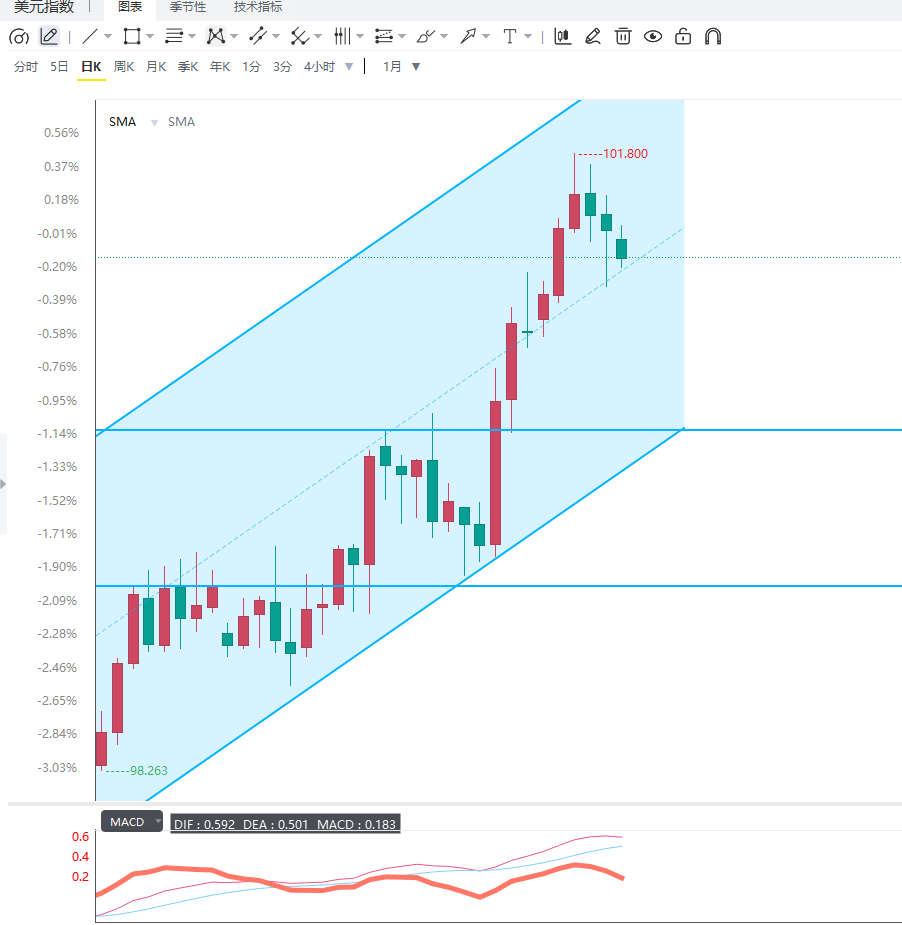
Structurally, the US dollar is currently in a state of equilibrium between strong policy expectations and short-term risk sentiment fluctuations. Without a clear directional catalyst, the DXY is more likely to remain in a high-level consolidation range. From a daily chart perspective, the US dollar index has re-entered a consolidation phase after its previous pullback, currently fluctuating around the 101.00-101.50 range , maintaining an overall high-level consolidation pattern. The trend structure has not yet formed a clear reversal, but short-term upward momentum has slowed.
The upside resistance level to watch is the 101.80-102.20 area , which has been a resistance level multiple times in the past. A successful break above this level could reopen upside potential. Support is located around 100.70 . A break below this level could lead to a further retest of the 100.20-100.00 area , which is a key psychological and structural support level in the medium term.
From a 4-hour chart perspective, the US dollar index is consolidating sideways, with the moving average system gradually flattening, indicating insufficient short-term trend momentum. Momentum indicators are in neutral territory, and the market lacks a directional signal. If the index continues to hold above 101.20, there is still a chance to test 101.80; if it falls below 101.00, it may enter a short-term correction phase.
Editor's Summary <br/>Overall, the US dollar index is currently in a typical "pre-data-driven consolidation phase," with the market remaining cautious ahead of key data releases such as non-farm payrolls and PMI figures. The Federal Reserve's policy is highly dependent on data performance, significantly increasing short-term volatility in the dollar. In the medium term, the dollar's trajectory will continue to be driven by both interest rate expectations and risk sentiment. Until US economic data provides a clear direction, the DXY is likely to maintain a high-level consolidation around 101, awaiting new macroeconomic catalysts to disrupt the current equilibrium.
From a fundamental perspective, this week will be a crucial "data window" influencing the dollar's trajectory. The market will focus on the upcoming US non-farm payrolls (NFP) report, as well as the JOLTS job openings data and the ISM manufacturing and services PMI data. These data will collectively form a comprehensive assessment of the US labor market and economic momentum, directly impacting market repricing of the Federal Reserve's policy path.
Traders are currently pricing in a near 90% probability of at least one Fed rate hike this year, reflecting a strong market consensus on sticky inflation and continued policy tightening. Against this backdrop, the downside potential for the dollar is somewhat supported. At the same time, the market is paying close attention to changes in the Fed's policy communication mechanism. With new Chairman Kevin Walsh emphasizing reduced forward guidance and increased reliance on data, uncertainty surrounding the Fed's policy path has increased. This means that the future dollar's performance will be more directly driven by economic data, rather than priced in by policy expectations.
At the geopolitical level, the conflict between the United States and Iran over the Strait of Hormuz has recently shown signs of de-escalation, with both sides agreeing to temporarily halt military confrontation and resume negotiations. This change has alleviated market concerns about disruptions to the energy supply chain to some extent, thereby weakening the safe-haven demand for the US dollar. However, overall, the situation in the region remains highly sensitive, and any breakdown in negotiations or escalation of conflict could quickly reignite safe-haven buying of the US dollar.
Structurally, the US dollar is currently in a state of equilibrium between strong policy expectations and short-term risk sentiment fluctuations. Without a clear directional catalyst, the DXY is more likely to remain in a high-level consolidation range. From a daily chart perspective, the US dollar index has re-entered a consolidation phase after its previous pullback, currently fluctuating around the 101.00-101.50 range , maintaining an overall high-level consolidation pattern. The trend structure has not yet formed a clear reversal, but short-term upward momentum has slowed.
The upside resistance level to watch is the 101.80-102.20 area , which has been a resistance level multiple times in the past. A successful break above this level could reopen upside potential. Support is located around 100.70 . A break below this level could lead to a further retest of the 100.20-100.00 area , which is a key psychological and structural support level in the medium term.
From a 4-hour chart perspective, the US dollar index is consolidating sideways, with the moving average system gradually flattening, indicating insufficient short-term trend momentum. Momentum indicators are in neutral territory, and the market lacks a directional signal. If the index continues to hold above 101.20, there is still a chance to test 101.80; if it falls below 101.00, it may enter a short-term correction phase.
Editor's Summary <br/>Overall, the US dollar index is currently in a typical "pre-data-driven consolidation phase," with the market remaining cautious ahead of key data releases such as non-farm payrolls and PMI figures. The Federal Reserve's policy is highly dependent on data performance, significantly increasing short-term volatility in the dollar. In the medium term, the dollar's trajectory will continue to be driven by both interest rate expectations and risk sentiment. Until US economic data provides a clear direction, the DXY is likely to maintain a high-level consolidation around 101, awaiting new macroeconomic catalysts to disrupt the current equilibrium.
- Risk Warning and Disclaimer
- The market involves risk, and trading may not be suitable for all investors. This article is for reference only and does not constitute personal investment advice, nor does it take into account certain users’ specific investment objectives, financial situation, or other needs. Any investment decisions made based on this information are at your own risk.