Warsh launches five special reviews; dollar index fluctuates at high levels; "price stability" returns to the Fed's primary mission.
2026-06-30 08:30:12
On Tuesday (June 30) in early Asian trading, the US dollar index fluctuated at high levels and is currently trading slightly higher, around 101.15.
Despite the relatively stable short-term performance of the exchange rate, investors' attention has shifted to deeper adjustments in the Federal Reserve's policy.
According to the latest media reports, Federal Reserve Chairman Kevin Warsh has launched a comprehensive review of the Fed's operations within just weeks of taking office, aiming to rebuild the central bank's credibility, which has been damaged during the past five years when inflation has remained above the 2% target.
Warsh clearly declared that "price stability" has once again become the Fed's top priority, and a profound transformation encompassing communication methods, asset portfolios, data models, and policy frameworks has begun.
At its June Federal Open Market Committee (FOMC) meeting, the Federal Reserve significantly streamlined its usual policy language in its statement, removed the signatures of officials, and abandoned the conventional practice of indicating future interest rate trends.
In his letter to all 20,000+ employees on June 2, Warsh conveyed a concise and powerful message: the Federal Reserve's responsibility is to maintain a balance of purchasing power for the American people.
“We are the Federal Reserve,” he wrote in the letter, promising greater transparency and “open, clear discussions” in advancing what he called “systemic change.” This statement set the tone for his tenure as central banker.
Warsh established five task forces to conduct a comprehensive assessment of the Federal Reserve's monetary policy framework from multiple dimensions. The review focuses on core areas such as communication strategies, portfolio management, data utilization, structural factors, and inflation models, aiming to cover the entire chain of monetary policy from formulation to implementation.
Specifically, the working group will examine whether the Federal Reserve's communication with the market and the public is clear and effective enough; assess whether the current holdings of $6.7 trillion in Treasury bonds and mortgage-backed securities should be maintained; explore whether emerging data sources can supplement or even replace traditional economic indicators; analyze the impact of artificial intelligence, productivity, and labor market changes on policy; and examine whether existing inflation models are still applicable.
The five working groups are expected to complete their review by the end of the year, at which point policymakers will collectively discuss and decide which reform recommendations will ultimately be implemented.
To effectively advance this important work, Warsh meticulously assembled a cross-disciplinary collaborative team that brought together external policy advisors and senior economists from within the Federal Reserve.
This team combines an external perspective with in-depth internal expertise, ensuring that decisions are both strategically sound and technically accurate. Senior advisors include Paul Winfrey, who held a senior position in the first Trump administration, and Daniel Hale, a renowned fellow at the Hoover Institution.
They will work closely with senior Federal Reserve economists Daniel Kowitz and Eric Engstrom to contribute policy insights and data analysis support. The formation of this team marks a significant acceleration of the project and is expected to provide solid intellectual support for future work.
Warsh's strong emphasis on price stability reflects his determination to rebuild the Federal Reserve's credibility—previous Powell failed to keep inflation at the 2% target level.
Former Federal Reserve Vice Chairman Donald Cohn pointed out that refocusing on inflation is a manifestation of central bank independence. "Price stability itself is a symbol of independence because it is usually associated with a hawkish policy stance," Cohn added, noting that if inflation remains high, Warsh may eventually face real pressure to raise interest rates.
It is worth noting that before returning to the Federal Reserve, Warsh had stated that inflation close to 2% was acceptable; however, after taking office, he adopted a more resolute stance—that persistent inflation above 2% is incompatible with true price stability.
Warsh refused to provide "forward guidance" on future interest rate decisions, arguing that the market should respond to real-time economic data rather than predetermined policy signals.
He made it clear that he would lead the Federal Reserve in a neutral, data-driven manner.
While Volcker and Greenspan were both adept at this approach to varying degrees, it hasn't been the norm for the Federal Reserve over the past two decades. A Fed chairman willing to remain flexible and rely on data rather than rigidly adhering to a policy path is, in a way, refreshing.
Warsh's reform ideas elicited mixed reactions on Wall Street. Long-term Treasury yields and market-implied inflation expectations have declined, indicating increased investor confidence in inflation control; however, traders remain deeply divided on the Fed's next move (rate hikes, a prolonged pause, or rate cuts).
Meanwhile, as volatility returns, the Dow Jones, S&P 500, and Nasdaq are diverging, and investors are reassessing the prospects for interest rates, inflation, and economic growth.
Within the Federal Reserve, the changes have brought both anticipation and caution. Former Fed Governor and Trump economic advisor Stephen Milan stated that while eliminating forward guidance may increase daily uncertainty, it will help reduce the risk of major policy mistakes in the long run.
Most employees were willing to participate in the review, but some had reservations about the policy path taken under the previous leadership. The simplified policy statements and anonymous internal discussions were intended to encourage more open debate.
According to the daily chart, the US dollar index maintains a medium-term bullish trend. The price started a strong upward movement from the May low of 97.62, reaching a high of 101.80 before slightly pulling back for consolidation. Currently, the moving average system is in a bullish alignment, with the MA20, MA50, MA100, and MA200 providing support from bottom to top. In the short term, the price has retraced to above the MA20 (100.44), while the medium-term moving averages continue to rise, indicating that the medium-to-long-term upward structure remains intact.
In terms of indicators, the MACD is in the bullish zone above the zero line, the DIFF at 0.5673 continues to be above the DEA at 0.5133, and the red bars maintain positive volume. Although the bullish momentum has weakened from its peak, there is no bearish reversal signal. The RSI value is 65.35, close to the oversold threshold of 70, indicating that the bullish power has been overdrawn and there is short-term pressure for a pullback to digest the pressure.
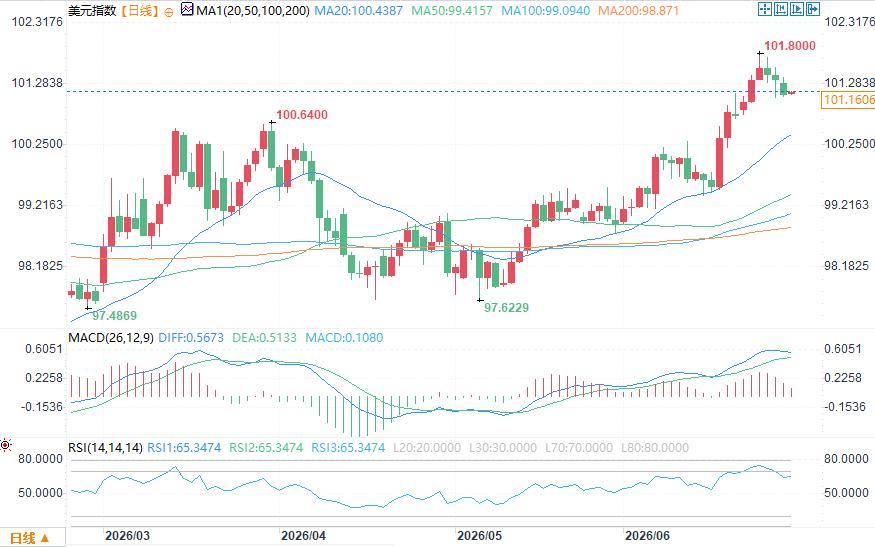
(US Dollar Index Daily Chart, Source: FX678)
At 8:16 AM Beijing time on June 30, the US dollar index was at 101.16.
Despite the relatively stable short-term performance of the exchange rate, investors' attention has shifted to deeper adjustments in the Federal Reserve's policy.
According to the latest media reports, Federal Reserve Chairman Kevin Warsh has launched a comprehensive review of the Fed's operations within just weeks of taking office, aiming to rebuild the central bank's credibility, which has been damaged during the past five years when inflation has remained above the 2% target.
Warsh clearly declared that "price stability" has once again become the Fed's top priority, and a profound transformation encompassing communication methods, asset portfolios, data models, and policy frameworks has begun.
The new chairman's concise declaration: "We are the Federal Reserve."
At its June Federal Open Market Committee (FOMC) meeting, the Federal Reserve significantly streamlined its usual policy language in its statement, removed the signatures of officials, and abandoned the conventional practice of indicating future interest rate trends.
In his letter to all 20,000+ employees on June 2, Warsh conveyed a concise and powerful message: the Federal Reserve's responsibility is to maintain a balance of purchasing power for the American people.
“We are the Federal Reserve,” he wrote in the letter, promising greater transparency and “open, clear discussions” in advancing what he called “systemic change.” This statement set the tone for his tenure as central banker.
Five special reviews: covering the entire monetary policy chain
Warsh established five task forces to conduct a comprehensive assessment of the Federal Reserve's monetary policy framework from multiple dimensions. The review focuses on core areas such as communication strategies, portfolio management, data utilization, structural factors, and inflation models, aiming to cover the entire chain of monetary policy from formulation to implementation.
Specifically, the working group will examine whether the Federal Reserve's communication with the market and the public is clear and effective enough; assess whether the current holdings of $6.7 trillion in Treasury bonds and mortgage-backed securities should be maintained; explore whether emerging data sources can supplement or even replace traditional economic indicators; analyze the impact of artificial intelligence, productivity, and labor market changes on policy; and examine whether existing inflation models are still applicable.
The five working groups are expected to complete their review by the end of the year, at which point policymakers will collectively discuss and decide which reform recommendations will ultimately be implemented.
Core Team: A combination of external consultants and internal experts
To effectively advance this important work, Warsh meticulously assembled a cross-disciplinary collaborative team that brought together external policy advisors and senior economists from within the Federal Reserve.
This team combines an external perspective with in-depth internal expertise, ensuring that decisions are both strategically sound and technically accurate. Senior advisors include Paul Winfrey, who held a senior position in the first Trump administration, and Daniel Hale, a renowned fellow at the Hoover Institution.
They will work closely with senior Federal Reserve economists Daniel Kowitz and Eric Engstrom to contribute policy insights and data analysis support. The formation of this team marks a significant acceleration of the project and is expected to provide solid intellectual support for future work.
Returning to Independence: Price Stability as the Cornerstone of Credibility
Warsh's strong emphasis on price stability reflects his determination to rebuild the Federal Reserve's credibility—previous Powell failed to keep inflation at the 2% target level.
Former Federal Reserve Vice Chairman Donald Cohn pointed out that refocusing on inflation is a manifestation of central bank independence. "Price stability itself is a symbol of independence because it is usually associated with a hawkish policy stance," Cohn added, noting that if inflation remains high, Warsh may eventually face real pressure to raise interest rates.
It is worth noting that before returning to the Federal Reserve, Warsh had stated that inflation close to 2% was acceptable; however, after taking office, he adopted a more resolute stance—that persistent inflation above 2% is incompatible with true price stability.
Say Goodbye to Forward-Looking Guidance: Returning to Data-Driven Approach
Warsh refused to provide "forward guidance" on future interest rate decisions, arguing that the market should respond to real-time economic data rather than predetermined policy signals.
He made it clear that he would lead the Federal Reserve in a neutral, data-driven manner.
While Volcker and Greenspan were both adept at this approach to varying degrees, it hasn't been the norm for the Federal Reserve over the past two decades. A Fed chairman willing to remain flexible and rely on data rather than rigidly adhering to a policy path is, in a way, refreshing.
Market and internal reactions: mixed reviews, divergent expectations.
Warsh's reform ideas elicited mixed reactions on Wall Street. Long-term Treasury yields and market-implied inflation expectations have declined, indicating increased investor confidence in inflation control; however, traders remain deeply divided on the Fed's next move (rate hikes, a prolonged pause, or rate cuts).
Meanwhile, as volatility returns, the Dow Jones, S&P 500, and Nasdaq are diverging, and investors are reassessing the prospects for interest rates, inflation, and economic growth.
Within the Federal Reserve, the changes have brought both anticipation and caution. Former Fed Governor and Trump economic advisor Stephen Milan stated that while eliminating forward guidance may increase daily uncertainty, it will help reduce the risk of major policy mistakes in the long run.
Most employees were willing to participate in the review, but some had reservations about the policy path taken under the previous leadership. The simplified policy statements and anonymous internal discussions were intended to encourage more open debate.
Technical Analysis
According to the daily chart, the US dollar index maintains a medium-term bullish trend. The price started a strong upward movement from the May low of 97.62, reaching a high of 101.80 before slightly pulling back for consolidation. Currently, the moving average system is in a bullish alignment, with the MA20, MA50, MA100, and MA200 providing support from bottom to top. In the short term, the price has retraced to above the MA20 (100.44), while the medium-term moving averages continue to rise, indicating that the medium-to-long-term upward structure remains intact.
In terms of indicators, the MACD is in the bullish zone above the zero line, the DIFF at 0.5673 continues to be above the DEA at 0.5133, and the red bars maintain positive volume. Although the bullish momentum has weakened from its peak, there is no bearish reversal signal. The RSI value is 65.35, close to the oversold threshold of 70, indicating that the bullish power has been overdrawn and there is short-term pressure for a pullback to digest the pressure.
(US Dollar Index Daily Chart, Source: FX678)
At 8:16 AM Beijing time on June 30, the US dollar index was at 101.16.
- Risk Warning and Disclaimer
- The market involves risk, and trading may not be suitable for all investors. This article is for reference only and does not constitute personal investment advice, nor does it take into account certain users’ specific investment objectives, financial situation, or other needs. Any investment decisions made based on this information are at your own risk.