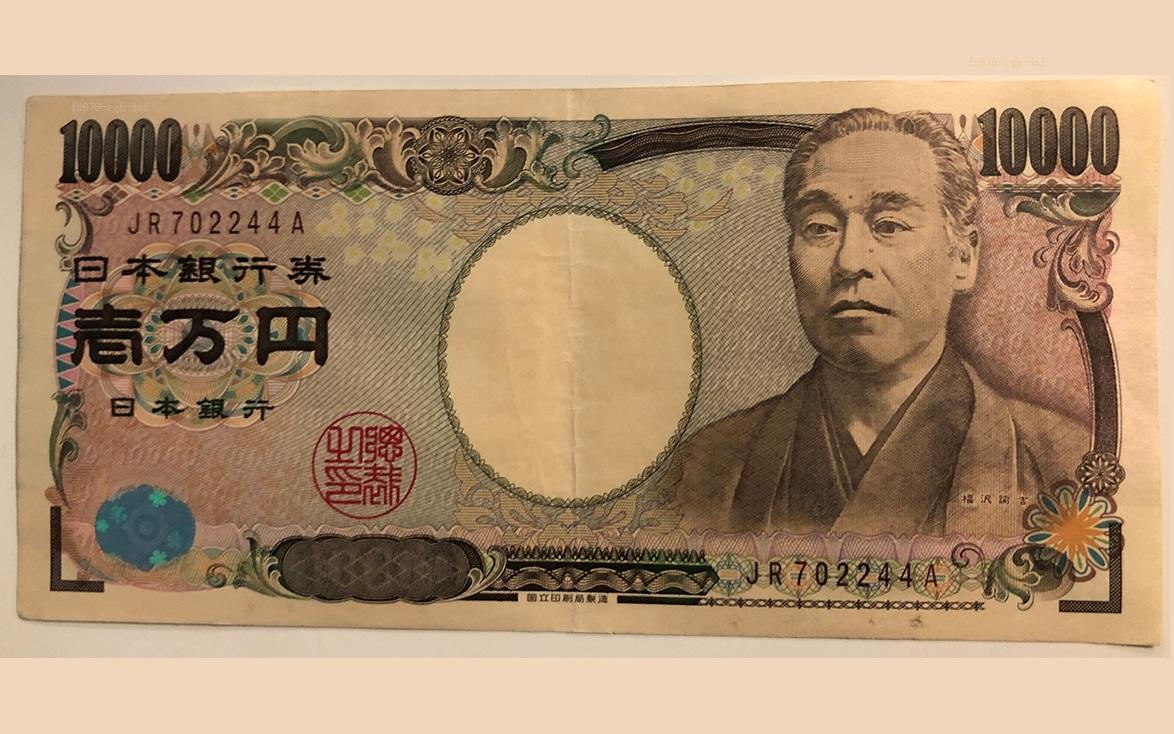
Is the "final warning" a ticket to short selling? The yen plunges to a 1986 low, and the Bank of Japan's interest rate hike becomes a mere formality.
2026-06-30 14:07:48
On Tuesday (June 30) during the Asian session, the US dollar broke through the 162 level against the Japanese yen for the first time since 1986, once touching a 40-year high of 162.40, and is currently trading around 162.35.
Japanese Finance Minister Satsuki Katayama immediately reiterated that the authorities are ready to take appropriate measures to deal with exchange rate fluctuations, including the possibility of decisive intervention.
Government sources revealed that the "final warning" issued hours before the intervention on April 30 remains in effect, suggesting that Tokyo could intervene again at any time.
However, with the US-Japan interest rate differential continuing to widen and yen carry trade dominating the market, the market's sensitivity to official statements is decreasing, and some analysts believe that intervention may be delayed until the 163-165 range before it is truly implemented.
At a regular press conference on Tuesday, when asked about the yen falling below the 162 mark, Finance Minister Satsuki Katayama said, "Ultimately, it's about being prepared to respond appropriately to exchange rate fluctuations." She reiterated the government's consistent stance.
When asked if her sense of urgency had changed, Katayama said her stance remained unchanged, noting that the phrase “appropriate action” “includes the possibility of taking decisive measures, which was confirmed in a recent online meeting with the United States.”
Chief Cabinet Secretary Minoru Kihara also stated at a separate press conference that the government will build an economic structure capable of withstanding exchange rate fluctuations, and is prepared to take action in the market if necessary. Both declined to comment on the current exchange rate level.
Key signal: Government sources privately indicated that the "final warning" issued on April 30—which came hours before the last intervention—remains in effect. This statement underscores the risk that authorities may take sudden action in the currency market.
From late April to early May, the Japanese government intervened in the foreign exchange market with a record 11.7 trillion yen (approximately US$72.17 billion), briefly boosting the yen. However, as the market repriced the Federal Reserve's interest rate hike path, the yen quickly returned to a depreciation trend.
The yen's recent drop below 162 without triggering a clear signal of official intervention is fueling market speculation that the government's "tolerance threshold" for a weaker yen may have shifted upward. The lack of intervention itself is signaling that authorities may be waiting for a more favorable opportunity or a higher price level.
Despite the Bank of Japan raising interest rates again this month, the downward pressure on the yen has not subsided – the market interprets this rate hike more as a symbolic adjustment than a substantial measure sufficient to reverse the exchange rate trend.
The root cause lies in the significant interest rate differential between the US and Japan. Japanese interest rates are far lower than those in the US, creating a substantial interest rate differential that favors the dollar. This continuously attracts investors to borrow low-cost yen and invest in higher-yielding currencies. As long as this structural interest rate differential pattern remains unchanged, the yen will struggle to escape its fundamental trend of weakening.
The depreciation of the yen has a mixed impact on the Japanese economy: on the one hand, it pushes up import costs and exacerbates inflationary pressures; on the other hand, it increases the profit margins of export companies when priced in yen. This duality makes the government's decision on whether to intervene more difficult, forcing it to repeatedly weigh the balance between controlling inflation and protecting corporate profits.
Goldman Sachs believes that Japan's unilateral intervention has limited effect on curbing the depreciation of the yen, and that the threshold for intervention is high under the current strong dollar cycle.
The agency expects that the Japanese Ministry of Finance and the Bank of Japan may only consider substantive action when the dollar rises to the 163-165 yen range, but the intervention effect will be greatly reduced in the absence of a synchronized shift or clear coordination signal from the Federal Reserve.
JPMorgan Chase points out that the Japanese government's cautious attitude toward rising financing costs limits the Bank of Japan's room for aggressive interest rate hikes, while the resilience of the US economy supports a strong dollar, putting further downward pressure on the yen in the short term.
The agency observed that the market's response to verbal warnings from Japanese officials is gradually becoming less sensitive, and it will be difficult to change the exchange rate trend unless accompanied by large-scale actual intervention or international coordination.
Looking ahead, JPMorgan Chase expects that if the Federal Reserve initiates a rate-cutting cycle in the second half of the year, the pressure on the yen to depreciate may ease. However, before that, the 163 level will become an important psychological and intervention reference point.
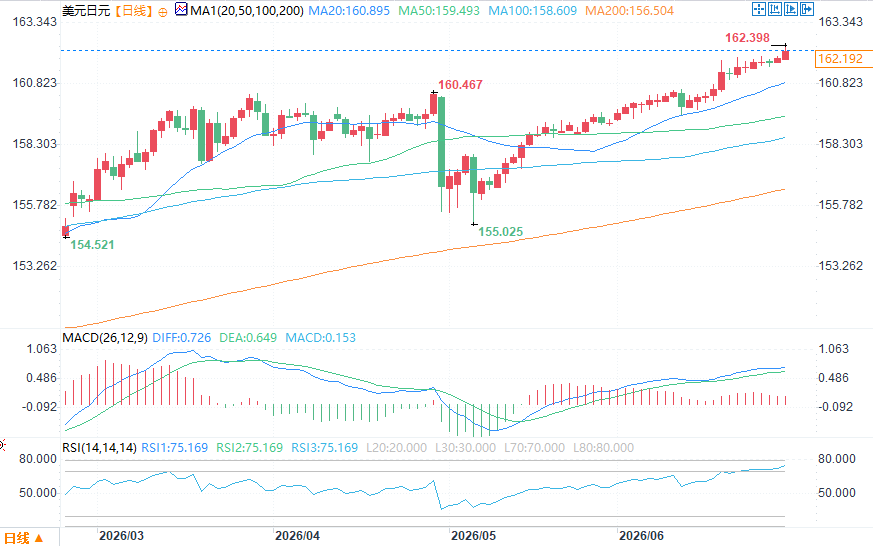
(USD/JPY daily chart, source: FX678)
At 14:07 Beijing time on June 30, the USD/JPY exchange rate was 162.35/36.
Japanese Finance Minister Satsuki Katayama immediately reiterated that the authorities are ready to take appropriate measures to deal with exchange rate fluctuations, including the possibility of decisive intervention.
Government sources revealed that the "final warning" issued hours before the intervention on April 30 remains in effect, suggesting that Tokyo could intervene again at any time.
However, with the US-Japan interest rate differential continuing to widen and yen carry trade dominating the market, the market's sensitivity to official statements is decreasing, and some analysts believe that intervention may be delayed until the 163-165 range before it is truly implemented.
Officials stated that the wording remains unchanged and the "final warning" is still in effect.
At a regular press conference on Tuesday, when asked about the yen falling below the 162 mark, Finance Minister Satsuki Katayama said, "Ultimately, it's about being prepared to respond appropriately to exchange rate fluctuations." She reiterated the government's consistent stance.
When asked if her sense of urgency had changed, Katayama said her stance remained unchanged, noting that the phrase “appropriate action” “includes the possibility of taking decisive measures, which was confirmed in a recent online meeting with the United States.”
Chief Cabinet Secretary Minoru Kihara also stated at a separate press conference that the government will build an economic structure capable of withstanding exchange rate fluctuations, and is prepared to take action in the market if necessary. Both declined to comment on the current exchange rate level.
Key signal: Government sources privately indicated that the "final warning" issued on April 30—which came hours before the last intervention—remains in effect. This statement underscores the risk that authorities may take sudden action in the currency market.
Intervention History and Market Speculation: The 11.7 trillion yen injection had a fleeting effect.
From late April to early May, the Japanese government intervened in the foreign exchange market with a record 11.7 trillion yen (approximately US$72.17 billion), briefly boosting the yen. However, as the market repriced the Federal Reserve's interest rate hike path, the yen quickly returned to a depreciation trend.
The yen's recent drop below 162 without triggering a clear signal of official intervention is fueling market speculation that the government's "tolerance threshold" for a weaker yen may have shifted upward. The lack of intervention itself is signaling that authorities may be waiting for a more favorable opportunity or a higher price level.
Fundamental pressures: Interest rate differentials dominate, rate hikes unlikely to halt the downward trend.
Despite the Bank of Japan raising interest rates again this month, the downward pressure on the yen has not subsided – the market interprets this rate hike more as a symbolic adjustment than a substantial measure sufficient to reverse the exchange rate trend.
The root cause lies in the significant interest rate differential between the US and Japan. Japanese interest rates are far lower than those in the US, creating a substantial interest rate differential that favors the dollar. This continuously attracts investors to borrow low-cost yen and invest in higher-yielding currencies. As long as this structural interest rate differential pattern remains unchanged, the yen will struggle to escape its fundamental trend of weakening.
The depreciation of the yen has a mixed impact on the Japanese economy: on the one hand, it pushes up import costs and exacerbates inflationary pressures; on the other hand, it increases the profit margins of export companies when priced in yen. This duality makes the government's decision on whether to intervene more difficult, forcing it to repeatedly weigh the balance between controlling inflation and protecting corporate profits.
Institutional view: Intervention may be postponed to the 163-165 range.
Goldman Sachs believes that Japan's unilateral intervention has limited effect on curbing the depreciation of the yen, and that the threshold for intervention is high under the current strong dollar cycle.
The agency expects that the Japanese Ministry of Finance and the Bank of Japan may only consider substantive action when the dollar rises to the 163-165 yen range, but the intervention effect will be greatly reduced in the absence of a synchronized shift or clear coordination signal from the Federal Reserve.
JPMorgan Chase points out that the Japanese government's cautious attitude toward rising financing costs limits the Bank of Japan's room for aggressive interest rate hikes, while the resilience of the US economy supports a strong dollar, putting further downward pressure on the yen in the short term.
The agency observed that the market's response to verbal warnings from Japanese officials is gradually becoming less sensitive, and it will be difficult to change the exchange rate trend unless accompanied by large-scale actual intervention or international coordination.
Looking ahead, JPMorgan Chase expects that if the Federal Reserve initiates a rate-cutting cycle in the second half of the year, the pressure on the yen to depreciate may ease. However, before that, the 163 level will become an important psychological and intervention reference point.
(USD/JPY daily chart, source: FX678)
At 14:07 Beijing time on June 30, the USD/JPY exchange rate was 162.35/36.
- Risk Warning and Disclaimer
- The market involves risk, and trading may not be suitable for all investors. This article is for reference only and does not constitute personal investment advice, nor does it take into account certain users’ specific investment objectives, financial situation, or other needs. Any investment decisions made based on this information are at your own risk.