Supply recovery coupled with weak industrial demand may severely limit the upside potential for oil prices.
2026-07-01 15:45:41
On Wednesday (July 1), during the Asian and European sessions, international oil prices continued to fluctuate at low levels. Currently, WTI oil prices are near the zero line, trading around $69.48.
On June 17, the United States and Iran signed a memorandum of understanding, formally ending the nearly four-month-long military conflict, restarting the shipping route through the Strait of Hormuz, a vital global energy route, and launching a 60-day series of negotiations aimed at finalizing a permanent peace agreement.
It is worth noting that on the eve of the agreement's implementation, the two sides had a brief military clash over Iranian attacks on transit ships, and the repeated geopolitical risks once again disturbed the crude oil market.
With the ceasefire agreement taking effect, shipping in the Strait of Hormuz, which had been almost completely halted due to the conflict, quickly rebounded, with crude oil transport volumes surging. This directly reversed previous market expectations of tight supply and led to a significant decline in international oil prices.
After the blockade was lifted, Iran's crude oil exports rebounded rapidly from stagnation to a surge.
Iranian Parliament Speaker and chief negotiator Mohammad Bagher Ghalibaf confirmed that Iran's crude oil exports have exceeded 40 million barrels after the United States lifted its maritime blockade of Iranian ports two weeks ago, completely ending a two-month stagnation of zero exports.
The data from the third-party ship tracking agency Tanker Tracking Network is more optimistic. Statistics show that since the lifting of the sanctions, Iran's crude oil exports have reached 50 million barrels . This data is based on satellite imagery, shore-based photography, and real-time ship identification system monitoring, and has high market reference value.
As supply recovers, the pricing logic for Iranian crude oil trade has also changed significantly.
Iranian Parliament Speaker Qalibaf stated that the current price of Iranian crude oil is at a 20% premium compared to pre-war levels , completely reversing the previous discounted trading pattern.
Before the war , Iranian crude oil was priced at a discount of $10 to $15 per barrel to Brent crude oil benchmark prices due to the risk of long-term sanctions, in order to attract buyers.
With the easing of geopolitical risks and the smooth flow of export channels, Iran's bargaining power for crude oil has increased significantly, and its trade profitability has improved markedly.
Regarding the control of the Strait of Hormuz, the interim agreement between the US and Iran clearly stipulates a 60-day free passage policy, during which all transit vessels can pass free of charge. However, Iran has made it clear that it will firmly maintain its administrative sovereignty over the Strait of Hormuz.
Iran has emphasized that sovereignty over the strait is shared by Iran and Oman, and that the navigation rules are formulated under Iran's leadership. Iran will never relinquish its territorial waters and shipping rights.
The follow-up control plan for the expiration of the 60-day temporary policy has not yet been finalized. At present, ships can choose to pass through the southern channel off the coast of Oman or the northern channel controlled by Iran. The long-term governance pattern of the waterway remains uncertain.
The US-Iran asset dispute continues, with funds not restricted by the US in their use. In addition to energy trade, the US-Iran dispute has also extended to the area of asset unfreezing.
Iranian Parliament Speaker Qalibaf publicly refuted US President Trump's suggestion that Iran would unfreeze its assets to purchase US agricultural products.
It stated that of Iran's approximately $24 billion in frozen overseas assets, $12 billion will be transferred to the country's central bank account, which can be used to purchase various necessary materials globally without restrictions on currency or price, and is not limited to purchasing US agricultural products.
U.S. domestic crude oil supply and demand inventory data further enrich market fundamentals.
Data from the American Petroleum Institute (API) showed that U.S. crude oil inventories fell sharply by 6.072 million barrels in the week ending June 26, a significant deterioration from the previous week's decline of 765,000 barrels.
Looking at the detailed data, the reason for the inventory reduction is that U.S. commercial crude oil inventories, excluding the Strategic Petroleum Reserve (SPR), have been declining for more than two consecutive months, with a cumulative decrease of 59.4 million barrels over 11 weeks, showing a very strong pace of destocking.
However, due to the continued release of strategic petroleum reserves, the overall U.S. crude oil inventory has only decreased by 8 million barrels this year.
Of particular concern is that the U.S. Strategic Petroleum Reserve has fallen to its lowest level in over forty years, with reserves continuing to decline. In the week ending June 26, another 5.5 million barrels were released, bringing the total reserves down to 325.7 million barrels, a new low in over forty years, even lower than the lows reached during the large-scale releases by the Biden administration in 2023. Currently, the reserve capacity is 399 million barrels below its maximum capacity, indicating a continued shrinking of the U.S. energy reserve safety margin.
However, production is also showing a steady recovery. Data from the U.S. Energy Information Administration (EIA) shows that as of the week ending June 19, U.S. crude oil production rose to 13.819 million barrels per day, a slight increase of 13,000 barrels per day week-on-week and an increase of 384,000 barrels per day year-on-year, indicating a continued release of domestic crude oil production capacity.
Ultimately, the performance of oil product inventories was mixed. As of the week ending June 26, U.S. gasoline inventories decreased by 2.106 million barrels, reversing the increase in the previous week. Moreover, current gasoline inventories are 5% lower than the five-year average for the same period, indicating a tight inventory situation.
Distillate fuel inventories continued to increase, with a weekly increase of 2.9 million barrels, marking two consecutive weeks of inventory accumulation. However, overall inventories are still 10% lower than the five-year average.
Cushing, the core delivery hub for WTI crude oil futures, saw its inventory increase by 503,000 barrels, ending its previous destocking trend and slightly raising the pressure on futures delivery inventory.
Overall, this reflects a shortage of fuel for civilian transportation, but also a sluggish supply of fuel for industrial and chemical industries. In other words, the drop in oil prices reflects not only the supply recovery brought about by the passage of ships through the Taiwan Strait, but also the weak demand for crude oil due to the contraction of industrial demand.
Overall, the current crude oil market presents a pattern of "geopolitical supply recovery but weak industrial demand".
The resumption of navigation in the Strait of Hormuz and the continued export of Iranian crude oil in the short term are suppressing oil prices. However, the United States' extremely low strategic reserves, tight refined product inventories, and the lack of a long-term control plan for the Strait of Hormuz will become potential support for a subsequent rebound in oil prices. But weak industrial demand will further limit the extent of the rebound.
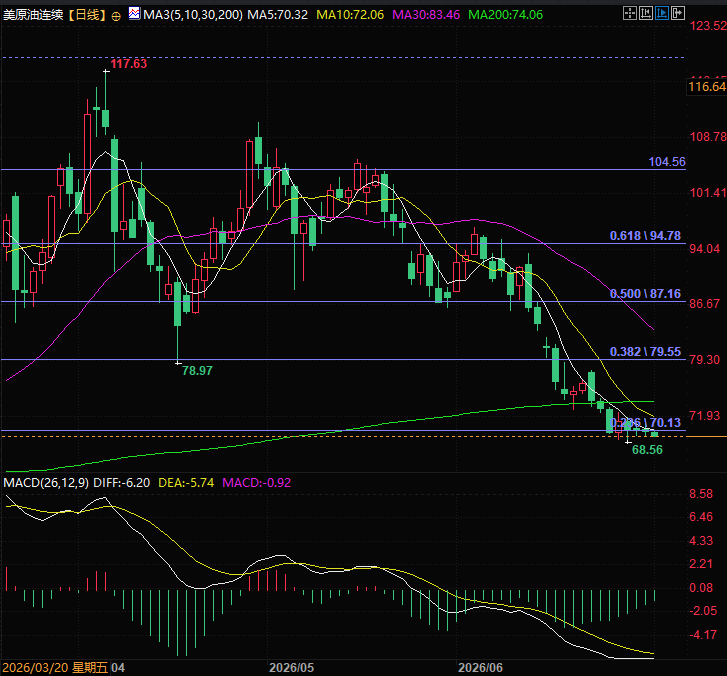
Technically, the rate of decline in oil prices has slowed significantly, and the MACD histogram is converging, indicating that the bearish momentum is waning. Currently, the price is fluctuating around 70.13. If it falls below 70 during the day, it is likely to rebound, while if it rises above 70, it will pull back. In terms of news, pay attention to opportunities when negative news does not lead to a decline and opportunities when positive news leads to a rebound. However, the overall rebound range and duration may be very limited.
 )
)
(WTI crude oil futures daily chart, source: EasyForex)
At 15:41 Beijing time, WTI crude oil futures were trading at $69.27 per barrel.
On June 17, the United States and Iran signed a memorandum of understanding, formally ending the nearly four-month-long military conflict, restarting the shipping route through the Strait of Hormuz, a vital global energy route, and launching a 60-day series of negotiations aimed at finalizing a permanent peace agreement.
It is worth noting that on the eve of the agreement's implementation, the two sides had a brief military clash over Iranian attacks on transit ships, and the repeated geopolitical risks once again disturbed the crude oil market.
With the ceasefire agreement taking effect, shipping in the Strait of Hormuz, which had been almost completely halted due to the conflict, quickly rebounded, with crude oil transport volumes surging. This directly reversed previous market expectations of tight supply and led to a significant decline in international oil prices.
Iran's crude oil exports surge, ending a long period of stagnation.
After the blockade was lifted, Iran's crude oil exports rebounded rapidly from stagnation to a surge.
Iranian Parliament Speaker and chief negotiator Mohammad Bagher Ghalibaf confirmed that Iran's crude oil exports have exceeded 40 million barrels after the United States lifted its maritime blockade of Iranian ports two weeks ago, completely ending a two-month stagnation of zero exports.
The data from the third-party ship tracking agency Tanker Tracking Network is more optimistic. Statistics show that since the lifting of the sanctions, Iran's crude oil exports have reached 50 million barrels . This data is based on satellite imagery, shore-based photography, and real-time ship identification system monitoring, and has high market reference value.
Iranian crude oil pricing reverses, realizing pre-war premium trading.
As supply recovers, the pricing logic for Iranian crude oil trade has also changed significantly.
Iranian Parliament Speaker Qalibaf stated that the current price of Iranian crude oil is at a 20% premium compared to pre-war levels , completely reversing the previous discounted trading pattern.
Before the war , Iranian crude oil was priced at a discount of $10 to $15 per barrel to Brent crude oil benchmark prices due to the risk of long-term sanctions, in order to attract buyers.
With the easing of geopolitical risks and the smooth flow of export channels, Iran's bargaining power for crude oil has increased significantly, and its trade profitability has improved markedly.
The question of who controls the Strait of Hormuz remains uncertain for a long time.
Regarding the control of the Strait of Hormuz, the interim agreement between the US and Iran clearly stipulates a 60-day free passage policy, during which all transit vessels can pass free of charge. However, Iran has made it clear that it will firmly maintain its administrative sovereignty over the Strait of Hormuz.
Iran has emphasized that sovereignty over the strait is shared by Iran and Oman, and that the navigation rules are formulated under Iran's leadership. Iran will never relinquish its territorial waters and shipping rights.
The follow-up control plan for the expiration of the 60-day temporary policy has not yet been finalized. At present, ships can choose to pass through the southern channel off the coast of Oman or the northern channel controlled by Iran. The long-term governance pattern of the waterway remains uncertain.
The US-Iran asset dispute continues, with funds not restricted by the US in their use. In addition to energy trade, the US-Iran dispute has also extended to the area of asset unfreezing.
Iranian Parliament Speaker Qalibaf publicly refuted US President Trump's suggestion that Iran would unfreeze its assets to purchase US agricultural products.
It stated that of Iran's approximately $24 billion in frozen overseas assets, $12 billion will be transferred to the country's central bank account, which can be used to purchase various necessary materials globally without restrictions on currency or price, and is not limited to purchasing US agricultural products.
US crude oil inventories: Commercial inventories continue to decline, strategic reserves offset the overall decrease.
U.S. domestic crude oil supply and demand inventory data further enrich market fundamentals.
Data from the American Petroleum Institute (API) showed that U.S. crude oil inventories fell sharply by 6.072 million barrels in the week ending June 26, a significant deterioration from the previous week's decline of 765,000 barrels.
Looking at the detailed data, the reason for the inventory reduction is that U.S. commercial crude oil inventories, excluding the Strategic Petroleum Reserve (SPR), have been declining for more than two consecutive months, with a cumulative decrease of 59.4 million barrels over 11 weeks, showing a very strong pace of destocking.
However, due to the continued release of strategic petroleum reserves, the overall U.S. crude oil inventory has only decreased by 8 million barrels this year.
Of particular concern is that the U.S. Strategic Petroleum Reserve has fallen to its lowest level in over forty years, with reserves continuing to decline. In the week ending June 26, another 5.5 million barrels were released, bringing the total reserves down to 325.7 million barrels, a new low in over forty years, even lower than the lows reached during the large-scale releases by the Biden administration in 2023. Currently, the reserve capacity is 399 million barrels below its maximum capacity, indicating a continued shrinking of the U.S. energy reserve safety margin.
However, production is also showing a steady recovery. Data from the U.S. Energy Information Administration (EIA) shows that as of the week ending June 19, U.S. crude oil production rose to 13.819 million barrels per day, a slight increase of 13,000 barrels per day week-on-week and an increase of 384,000 barrels per day year-on-year, indicating a continued release of domestic crude oil production capacity.
Ultimately, the performance of oil product inventories was mixed. As of the week ending June 26, U.S. gasoline inventories decreased by 2.106 million barrels, reversing the increase in the previous week. Moreover, current gasoline inventories are 5% lower than the five-year average for the same period, indicating a tight inventory situation.
Distillate fuel inventories continued to increase, with a weekly increase of 2.9 million barrels, marking two consecutive weeks of inventory accumulation. However, overall inventories are still 10% lower than the five-year average.
Cushing, the core delivery hub for WTI crude oil futures, saw its inventory increase by 503,000 barrels, ending its previous destocking trend and slightly raising the pressure on futures delivery inventory.
Overall, this reflects a shortage of fuel for civilian transportation, but also a sluggish supply of fuel for industrial and chemical industries. In other words, the drop in oil prices reflects not only the supply recovery brought about by the passage of ships through the Taiwan Strait, but also the weak demand for crude oil due to the contraction of industrial demand.
Market Outlook: The tug-of-war between bulls and bears continues in the crude oil market.
Overall, the current crude oil market presents a pattern of "geopolitical supply recovery but weak industrial demand".
The resumption of navigation in the Strait of Hormuz and the continued export of Iranian crude oil in the short term are suppressing oil prices. However, the United States' extremely low strategic reserves, tight refined product inventories, and the lack of a long-term control plan for the Strait of Hormuz will become potential support for a subsequent rebound in oil prices. But weak industrial demand will further limit the extent of the rebound.
Technically, the rate of decline in oil prices has slowed significantly, and the MACD histogram is converging, indicating that the bearish momentum is waning. Currently, the price is fluctuating around 70.13. If it falls below 70 during the day, it is likely to rebound, while if it rises above 70, it will pull back. In terms of news, pay attention to opportunities when negative news does not lead to a decline and opportunities when positive news leads to a rebound. However, the overall rebound range and duration may be very limited.
)(WTI crude oil futures daily chart, source: EasyForex)
At 15:41 Beijing time, WTI crude oil futures were trading at $69.27 per barrel.
- Risk Warning and Disclaimer
- The market involves risk, and trading may not be suitable for all investors. This article is for reference only and does not constitute personal investment advice, nor does it take into account certain users’ specific investment objectives, financial situation, or other needs. Any investment decisions made based on this information are at your own risk.