Japanese manufacturing confidence hit a five-year high, but the yen exchange rate is falling—where does this "temperature difference" in the Japanese economy come from?
2026-07-01 15:54:58
On Wednesday (July 1), during the European session, the USD/JPY pair continued its upward trend and is currently trading around 162.70.
The Bank of Japan's latest Tankan survey for June showed that the business sentiment index for large manufacturers rose to 22 from 17 in March, far exceeding market expectations of 16.
This reading not only represents the fifth consecutive quarter of improvement but also marks the highest level since March 2018, highlighting the resilience of Japan's industrial sector amid heightened geopolitical uncertainty.
The large non-manufacturing business climate index also saw a moderate rebound, rising slightly from 36 to 37, marking the first improvement in five quarters. This simultaneous improvement in both sectors reflects a synergistic recovery in domestic and external demand within the Japanese economy.
The Bank of Japan attributed the strong performance of manufacturing confidence primarily to robust demand for semiconductors and artificial intelligence-related products, sectors that continue to support a broad technology supply chain. Several officials also noted that an increasing number of companies have successfully passed on rising raw material costs to downstream customers, helping to maintain profitability.
In addition, some manufacturers have benefited from a "rush to order" effect triggered by uncertainty in the Middle East – customers are placing orders in advance to ensure supply security. This factor has provided additional support for the current quarter's business climate readings, but it has also raised questions about the sustainability of future momentum after this demand has been brought forward.
Despite the current strong assessment, businesses are turning conservative about the outlook for the next three months. Large manufacturers expect the business climate index to fall to 17 in September, while large non-manufacturing companies expect it to drop even more sharply to 28. This discrepancy in expectations suggests that the business sector has doubts about the sustainability of the current growth momentum.
Of particular note is that most of the survey questionnaires were collected before the initial peace agreement between the US and Iran was reached. This means that the surveyed companies were still assessing their business environment against the backdrop of geopolitical tensions in the Middle East and high energy prices.
Therefore, the current readings reflect, to some extent, the business sentiment under "wartime" conditions, rather than normal business expectations.
In summary, this short-term survey conveyed two core messages.
In the short term, the Japanese corporate sector has entered the second half of the year with a relatively strong performance. Structural support for AI demand, smooth cost pass-through, and a short-term boost from some advance orders have collectively elevated the current economic outlook. This is undoubtedly a positive sign for market participants focused on the sustainability of Japan's economic recovery.
However, the medium-term outlook faces three uncertainties.
First, the easing of tensions in the Middle East may weaken the sustainability of the "order rush" effect, and some of the demand released in advance may become a drag in the coming quarters.
Secondly, while the demand for AI is promising, its growth path is not linear, and companies may overestimate the short-term driving effect of this field.
Third, the pace of the Bank of Japan's monetary policy normalization, the yen's exchange rate trend, and changes in the external demand environment will all have a substantial impact on business confidence.
For the yen exchange rate, the improvement in Tankan data itself is a marginal positive for the yen, but the market's focus is on whether this improvement can be translated into a basis for the Bank of Japan to accelerate policy normalization.
Currently, despite strong manufacturing confidence, companies' cautious outlook and inflationary pressures have not yet fully translated into sustainable wage growth, meaning the Bank of Japan will remain cautious about its interest rate hike path.
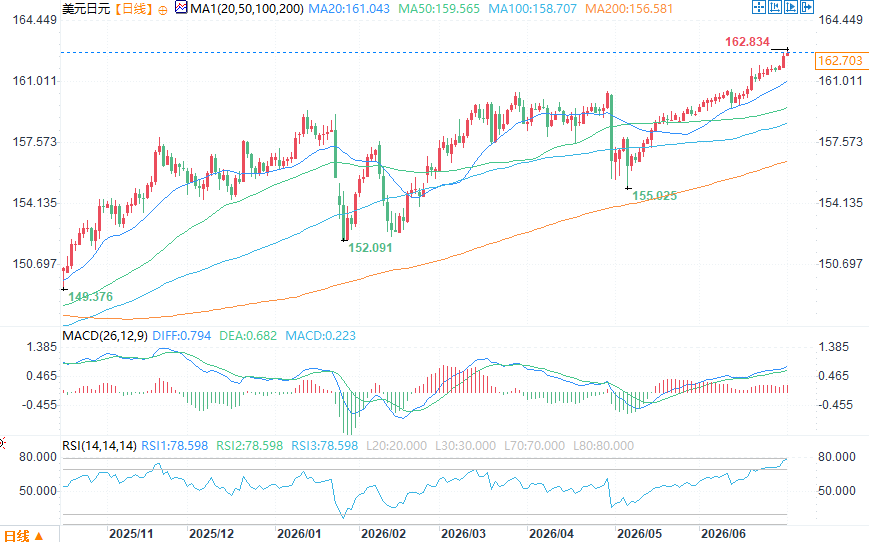
(USD/JPY daily chart, source: FX678)
At 15:21 Beijing time on July 1, the USD/JPY exchange rate was 162.65/66.
The Bank of Japan's latest Tankan survey for June showed that the business sentiment index for large manufacturers rose to 22 from 17 in March, far exceeding market expectations of 16.
This reading not only represents the fifth consecutive quarter of improvement but also marks the highest level since March 2018, highlighting the resilience of Japan's industrial sector amid heightened geopolitical uncertainty.
The large non-manufacturing business climate index also saw a moderate rebound, rising slightly from 36 to 37, marking the first improvement in five quarters. This simultaneous improvement in both sectors reflects a synergistic recovery in domestic and external demand within the Japanese economy.
Driving factors: AI demand and cost pass-through support
The Bank of Japan attributed the strong performance of manufacturing confidence primarily to robust demand for semiconductors and artificial intelligence-related products, sectors that continue to support a broad technology supply chain. Several officials also noted that an increasing number of companies have successfully passed on rising raw material costs to downstream customers, helping to maintain profitability.
In addition, some manufacturers have benefited from a "rush to order" effect triggered by uncertainty in the Middle East – customers are placing orders in advance to ensure supply security. This factor has provided additional support for the current quarter's business climate readings, but it has also raised questions about the sustainability of future momentum after this demand has been brought forward.
Weakening Outlook: Businesses Become More Cautious About the Next Three Months
Despite the current strong assessment, businesses are turning conservative about the outlook for the next three months. Large manufacturers expect the business climate index to fall to 17 in September, while large non-manufacturing companies expect it to drop even more sharply to 28. This discrepancy in expectations suggests that the business sector has doubts about the sustainability of the current growth momentum.
Of particular note is that most of the survey questionnaires were collected before the initial peace agreement between the US and Iran was reached. This means that the surveyed companies were still assessing their business environment against the backdrop of geopolitical tensions in the Middle East and high energy prices.
Therefore, the current readings reflect, to some extent, the business sentiment under "wartime" conditions, rather than normal business expectations.
Data Meaning: From "Wartime Prosperity" to Return to Normalcy
In summary, this short-term survey conveyed two core messages.
In the short term, the Japanese corporate sector has entered the second half of the year with a relatively strong performance. Structural support for AI demand, smooth cost pass-through, and a short-term boost from some advance orders have collectively elevated the current economic outlook. This is undoubtedly a positive sign for market participants focused on the sustainability of Japan's economic recovery.
However, the medium-term outlook faces three uncertainties.
First, the easing of tensions in the Middle East may weaken the sustainability of the "order rush" effect, and some of the demand released in advance may become a drag in the coming quarters.
Secondly, while the demand for AI is promising, its growth path is not linear, and companies may overestimate the short-term driving effect of this field.
Third, the pace of the Bank of Japan's monetary policy normalization, the yen's exchange rate trend, and changes in the external demand environment will all have a substantial impact on business confidence.
Impact on the market
For the yen exchange rate, the improvement in Tankan data itself is a marginal positive for the yen, but the market's focus is on whether this improvement can be translated into a basis for the Bank of Japan to accelerate policy normalization.
Currently, despite strong manufacturing confidence, companies' cautious outlook and inflationary pressures have not yet fully translated into sustainable wage growth, meaning the Bank of Japan will remain cautious about its interest rate hike path.
(USD/JPY daily chart, source: FX678)
At 15:21 Beijing time on July 1, the USD/JPY exchange rate was 162.65/66.
- Risk Warning and Disclaimer
- The market involves risk, and trading may not be suitable for all investors. This article is for reference only and does not constitute personal investment advice, nor does it take into account certain users’ specific investment objectives, financial situation, or other needs. Any investment decisions made based on this information are at your own risk.