With the market already betting on a September rate hike, will Warsh dampen the enthusiasm of dollar bulls?
2026-07-01 16:21:43
On Wednesday (July 1), during the European session, the US dollar index fluctuated at high levels and is currently trading slightly higher around 101.35.
Supported by multiple positive factors, the US dollar has continued its recent upward trend. Investors remain optimistic about the prospects for US economic growth, while the Federal Reserve's hawkish shift in policy continues to provide upward momentum for the dollar.
Markets are awaiting a speech by Federal Reserve Chairman Warsh at the European Central Bank Forum in Portugal later Wednesday, where they will closely watch whether his policy tone further reinforces a hawkish stance.
The Federal Reserve kept its benchmark interest rate unchanged at the target range of 3.50%-3.75% at its June policy meeting, but removed wording from the policy statement that had previously suggested a tendency to cut rates in the future.
This adjustment has been interpreted by the market as a substantial shift in the Federal Reserve's policy tone under the leadership of new Chairman Warsh. This hawkish turn has already begun to influence market pricing.
According to calculations by the well-known FedWatch tool, federal funds futures have priced in a probability of more than 60% for a September rate hike.
This means that the market is gradually digesting the possibility of at least one interest rate hike this year, and the rising expectations of an interest rate hike are one of the core drivers of the recent strengthening of the US dollar.
Dollar bulls' confidence also stems from the resilience of US economic data. Non-farm payrolls have exceeded market expectations for three consecutive months, providing data-driven support for the Federal Reserve's hawkish stance.
Markets are awaiting Thursday's June jobs report, with economists expecting 110,000 new jobs and the unemployment rate to remain unchanged at 4.3%.
Ray Attril, head of foreign exchange strategy at a well-known institution, pointed out: "All the evidence, and the Fed's own assessment, indicates that the labor market has proven resilient. In terms of the Fed's dual mandate, the labor market has clearly not sent any signals that a rate cut should be considered."
This assessment is crucial for the dollar's trajectory: if the June non-farm payroll report exceeds expectations again, it will further strengthen expectations of interest rate hikes and push the dollar index higher; however, if there are any signs of weakening in the employment data, it may trigger a dovish reassessment of the monetary policy path in the market, thereby putting pressure on the dollar.
From a technical perspective, after the US dollar index stabilized above 101.00, the short-term moving average system has recovered somewhat. The upside target is the recent high around 101.80, while the psychological level of 101.00 is currently the key support level.
In the short term, the direction of the US dollar index will depend on the following three variables:
First, the policy signals from Warsh's speech. If he continues the hawkish tone of the June meeting, it will further boost the dollar.
Second, the actual reading of Thursday's non-farm payroll report. Employment data is a key indicator of the resilience of the labor market and will directly affect the market's pricing in the probability of a September rate hike.
Third, the evolution of the geopolitical situation. Uncertainty surrounding the US-Iran negotiations persists, and if geopolitical risks escalate, the safe-haven appeal of the US dollar will play a further role.
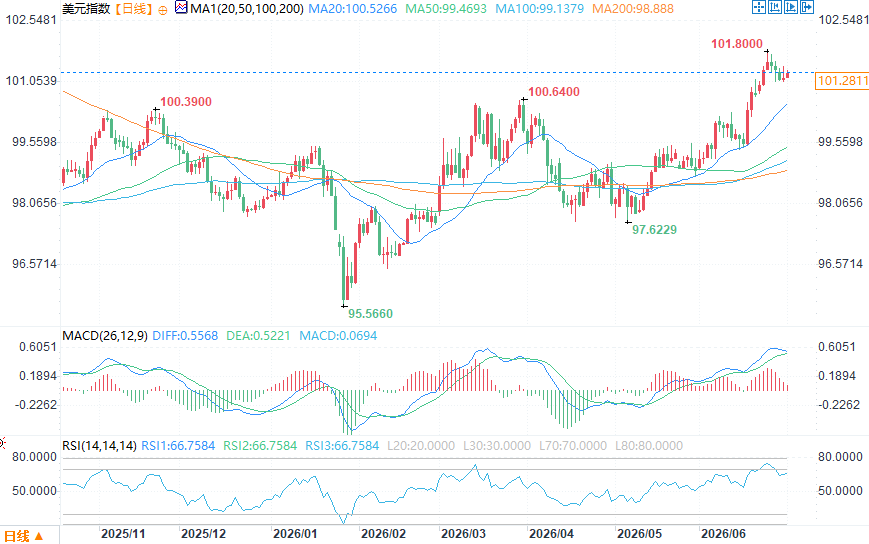
(US Dollar Index Daily Chart, Source: FX678)
At 15:53 Beijing time on July 1, the US dollar index was at 101.35.
Supported by multiple positive factors, the US dollar has continued its recent upward trend. Investors remain optimistic about the prospects for US economic growth, while the Federal Reserve's hawkish shift in policy continues to provide upward momentum for the dollar.
Markets are awaiting a speech by Federal Reserve Chairman Warsh at the European Central Bank Forum in Portugal later Wednesday, where they will closely watch whether his policy tone further reinforces a hawkish stance.
Policy-driven: June meeting confirms hawkish shift
The Federal Reserve kept its benchmark interest rate unchanged at the target range of 3.50%-3.75% at its June policy meeting, but removed wording from the policy statement that had previously suggested a tendency to cut rates in the future.
This adjustment has been interpreted by the market as a substantial shift in the Federal Reserve's policy tone under the leadership of new Chairman Warsh. This hawkish turn has already begun to influence market pricing.
According to calculations by the well-known FedWatch tool, federal funds futures have priced in a probability of more than 60% for a September rate hike.
This means that the market is gradually digesting the possibility of at least one interest rate hike this year, and the rising expectations of an interest rate hike are one of the core drivers of the recent strengthening of the US dollar.
Data Support: The Resilience of the Job Market Provides Confidence for Tightening
Dollar bulls' confidence also stems from the resilience of US economic data. Non-farm payrolls have exceeded market expectations for three consecutive months, providing data-driven support for the Federal Reserve's hawkish stance.
Markets are awaiting Thursday's June jobs report, with economists expecting 110,000 new jobs and the unemployment rate to remain unchanged at 4.3%.
Ray Attril, head of foreign exchange strategy at a well-known institution, pointed out: "All the evidence, and the Fed's own assessment, indicates that the labor market has proven resilient. In terms of the Fed's dual mandate, the labor market has clearly not sent any signals that a rate cut should be considered."
This assessment is crucial for the dollar's trajectory: if the June non-farm payroll report exceeds expectations again, it will further strengthen expectations of interest rate hikes and push the dollar index higher; however, if there are any signs of weakening in the employment data, it may trigger a dovish reassessment of the monetary policy path in the market, thereby putting pressure on the dollar.
Technical Analysis and Market Outlook
From a technical perspective, after the US dollar index stabilized above 101.00, the short-term moving average system has recovered somewhat. The upside target is the recent high around 101.80, while the psychological level of 101.00 is currently the key support level.
In the short term, the direction of the US dollar index will depend on the following three variables:
First, the policy signals from Warsh's speech. If he continues the hawkish tone of the June meeting, it will further boost the dollar.
Second, the actual reading of Thursday's non-farm payroll report. Employment data is a key indicator of the resilience of the labor market and will directly affect the market's pricing in the probability of a September rate hike.
Third, the evolution of the geopolitical situation. Uncertainty surrounding the US-Iran negotiations persists, and if geopolitical risks escalate, the safe-haven appeal of the US dollar will play a further role.
(US Dollar Index Daily Chart, Source: FX678)
At 15:53 Beijing time on July 1, the US dollar index was at 101.35.
- Risk Warning and Disclaimer
- The market involves risk, and trading may not be suitable for all investors. This article is for reference only and does not constitute personal investment advice, nor does it take into account certain users’ specific investment objectives, financial situation, or other needs. Any investment decisions made based on this information are at your own risk.