With geopolitical premiums fading and increased production looming, WTI crude oil prices are under pressure and are testing previous lows again.
2026-07-02 08:21:05
On Thursday (July 2) in early Asian trading, US crude oil futures continued their decline, currently down about 1% and trading around $67.90 per barrel.
The continued recovery of crude oil flow through the Strait of Hormuz has pushed oil prices back to pre-war levels between the US and Iran, overshadowing the impact of US inventory data.
According to a report from the U.S. Energy Information Administration (EIA), U.S. commercial crude oil inventories fell by 3.775 million barrels in the week ending June 26, marking the tenth consecutive week of declines and reaching the lowest inventory level since September 2018.
However, the decline was less than the market expectation of 5.1 million barrels, compared to a decrease of 6.088 million barrels the previous week. The bullish effect of the inventory decline was weakened by the weaker-than-expected data.
Crude oil prices have largely priced in geopolitical risk premiums, primarily due to the continued recovery of tanker traffic in the Strait of Hormuz following the signing of the interim peace agreement between the US and Iran last month.
However, the two sides have not yet reached a permanent agreement and still have differences on issues such as the method of verifying Iran's nuclear program and the future management of the Strait of Hormuz.
Tehran insists that the strategic waterway is within Iranian sovereignty and plans to impose transit fees on commercial vessels; while the United States maintains that the strait should remain a free passage route and free of charge.
This fundamental divergence means that geopolitical risks have not been completely eliminated, but concerns about short-term supply disruptions have been significantly alleviated.
Adding insult to injury to the outlook for oil prices, media reports on Wednesday indicated that the Organization of the Petroleum Exporting Countries (OPEC+) and its allies are expected to approve a new round of production increases at their meeting this Sunday.
Sources indicate that the alliance may raise its production target by approximately 188,000 barrels per day in August, aligning with the increases announced in June and July. This continued release of supply has further suppressed upward momentum in oil prices.
The core issue in the current oil market has shifted from geopolitical risks to supply and demand fundamentals. While continuous inventory declines have provided some support for oil prices, the smaller-than-expected decline has weakened the bullish effect; the resumption of navigation in the Strait of Hormuz and continued production increases by OPEC+ are creating a double drag on prices.
This Sunday's OPEC+ meeting will be a key short-term variable – if the production increase is implemented, oil prices may fall further; if production is unexpectedly kept unchanged, it may trigger a short-term rebound.
According to the daily chart, US crude oil futures are in a medium-term downtrend. After reaching a previous high of 119.48, the price has continued to weaken, and the moving average system is fully in a bearish alignment: the short-term MA20 (77.64), medium-term MA50 (89.79), long-term MA100 (88.15), and MA200 (74.09) are all above the price, forming layers of resistance. The price has fallen below the 200-day moving average, and the medium-term bullish trend has completely reversed.
In terms of indicators, the MACD indicator shows DIFF at -6.30 and DEA at -5.87 both lines running below the zero axis, with the green bars continuing to diverge, indicating that the bearish momentum is still being released, and there is no bottom divergence stabilization signal yet; the RSI value is 27.74, entering the oversold zone, and there is a short-term demand for a slight technical rebound, but no golden cross has appeared, so the rebound strength is limited.
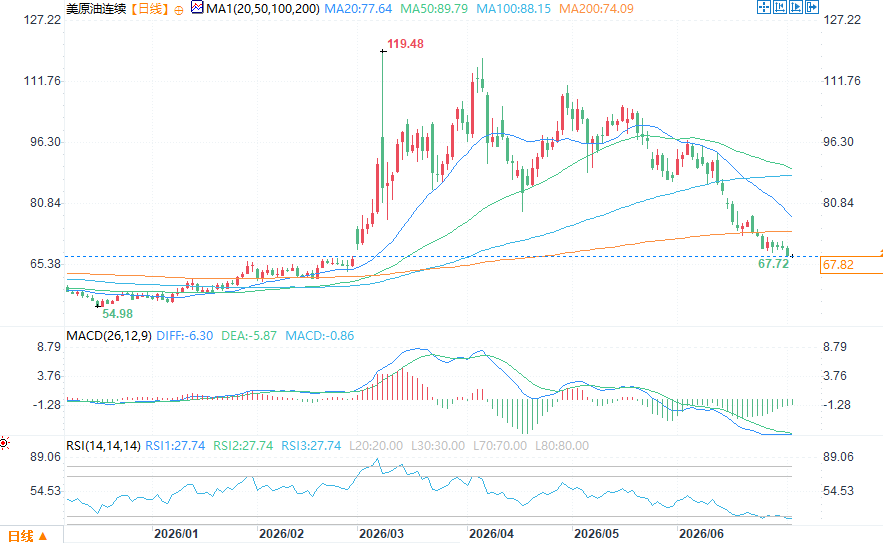
(US crude oil futures daily chart, source: FX678)
At 8:14 AM Beijing time on July 2, US crude oil futures were trading at $67.94 per barrel.
The continued recovery of crude oil flow through the Strait of Hormuz has pushed oil prices back to pre-war levels between the US and Iran, overshadowing the impact of US inventory data.
Inventories have fallen for ten consecutive weeks, but the decline has been less than expected.
According to a report from the U.S. Energy Information Administration (EIA), U.S. commercial crude oil inventories fell by 3.775 million barrels in the week ending June 26, marking the tenth consecutive week of declines and reaching the lowest inventory level since September 2018.
However, the decline was less than the market expectation of 5.1 million barrels, compared to a decrease of 6.088 million barrels the previous week. The bullish effect of the inventory decline was weakened by the weaker-than-expected data.
The Strait of Hormuz has reopened to navigation, and the geopolitical risk premium has diminished.
Crude oil prices have largely priced in geopolitical risk premiums, primarily due to the continued recovery of tanker traffic in the Strait of Hormuz following the signing of the interim peace agreement between the US and Iran last month.
However, the two sides have not yet reached a permanent agreement and still have differences on issues such as the method of verifying Iran's nuclear program and the future management of the Strait of Hormuz.
Tehran insists that the strategic waterway is within Iranian sovereignty and plans to impose transit fees on commercial vessels; while the United States maintains that the strait should remain a free passage route and free of charge.
This fundamental divergence means that geopolitical risks have not been completely eliminated, but concerns about short-term supply disruptions have been significantly alleviated.
OPEC+ meeting on Sunday is expected to approve further production increases.
Adding insult to injury to the outlook for oil prices, media reports on Wednesday indicated that the Organization of the Petroleum Exporting Countries (OPEC+) and its allies are expected to approve a new round of production increases at their meeting this Sunday.
Sources indicate that the alliance may raise its production target by approximately 188,000 barrels per day in August, aligning with the increases announced in June and July. This continued release of supply has further suppressed upward momentum in oil prices.
Market focus shifts to OPEC+ meeting
The core issue in the current oil market has shifted from geopolitical risks to supply and demand fundamentals. While continuous inventory declines have provided some support for oil prices, the smaller-than-expected decline has weakened the bullish effect; the resumption of navigation in the Strait of Hormuz and continued production increases by OPEC+ are creating a double drag on prices.
This Sunday's OPEC+ meeting will be a key short-term variable – if the production increase is implemented, oil prices may fall further; if production is unexpectedly kept unchanged, it may trigger a short-term rebound.
Technical Analysis
According to the daily chart, US crude oil futures are in a medium-term downtrend. After reaching a previous high of 119.48, the price has continued to weaken, and the moving average system is fully in a bearish alignment: the short-term MA20 (77.64), medium-term MA50 (89.79), long-term MA100 (88.15), and MA200 (74.09) are all above the price, forming layers of resistance. The price has fallen below the 200-day moving average, and the medium-term bullish trend has completely reversed.
In terms of indicators, the MACD indicator shows DIFF at -6.30 and DEA at -5.87 both lines running below the zero axis, with the green bars continuing to diverge, indicating that the bearish momentum is still being released, and there is no bottom divergence stabilization signal yet; the RSI value is 27.74, entering the oversold zone, and there is a short-term demand for a slight technical rebound, but no golden cross has appeared, so the rebound strength is limited.
(US crude oil futures daily chart, source: FX678)
At 8:14 AM Beijing time on July 2, US crude oil futures were trading at $67.94 per barrel.
- Risk Warning and Disclaimer
- The market involves risk, and trading may not be suitable for all investors. This article is for reference only and does not constitute personal investment advice, nor does it take into account certain users’ specific investment objectives, financial situation, or other needs. Any investment decisions made based on this information are at your own risk.