Ahead of the US non-farm payroll data release, the USD/CAD pair remains range-bound at high levels; caution is advised against a potential pullback after a surge.
2026-07-02 14:59:21
The USD/CAD pair remained relatively stable during Thursday's European trading session, fluctuating narrowly around 1.4210 , continuing its recent sideways consolidation pattern. The pair lacked a clear breakout direction over the past week, with the market primarily awaiting the upcoming US non-farm payroll data to reassess the path of US interest rates.

The market currently widely expects the US to add approximately 110,000 jobs in June, a significant drop from the previous month, indicating a possible marginal cooling in the labor market. However, average hourly earnings are projected to rise 3.5% year-on-year, suggesting that wage growth remains sticky. This could support inflation expectations to some extent, keeping the Federal Reserve's policy path uncertain.
On the policy front, Federal Reserve Chairman Kevin Warsh recently reiterated that inflation remains high and emphasized the importance of returning to the 2% target, meaning that market expectations for persistently high interest rates have not completely subsided. This combination of "data dependence + tight stance" provides some support for the US dollar in the short term.
On the other hand, the Canadian dollar was pressured by the decline in crude oil prices. With progress in indirect negotiations between the US and Iran, geopolitical risk premiums decreased, and international oil prices weakened overall. As a typical resource-based currency, the Canadian dollar is highly correlated with crude oil prices; the decline in oil prices weakened its fundamental support, keeping the USD/CAD pair relatively strong.
From a market structure perspective, the forces on the dollar side and the commodity side are clearly offsetting each other: the dollar is supported by interest rate expectations and remains at a high level, while the weakening of oil prices suppresses the performance of the Canadian dollar, pushing the exchange rate to remain in a high range of fluctuation.
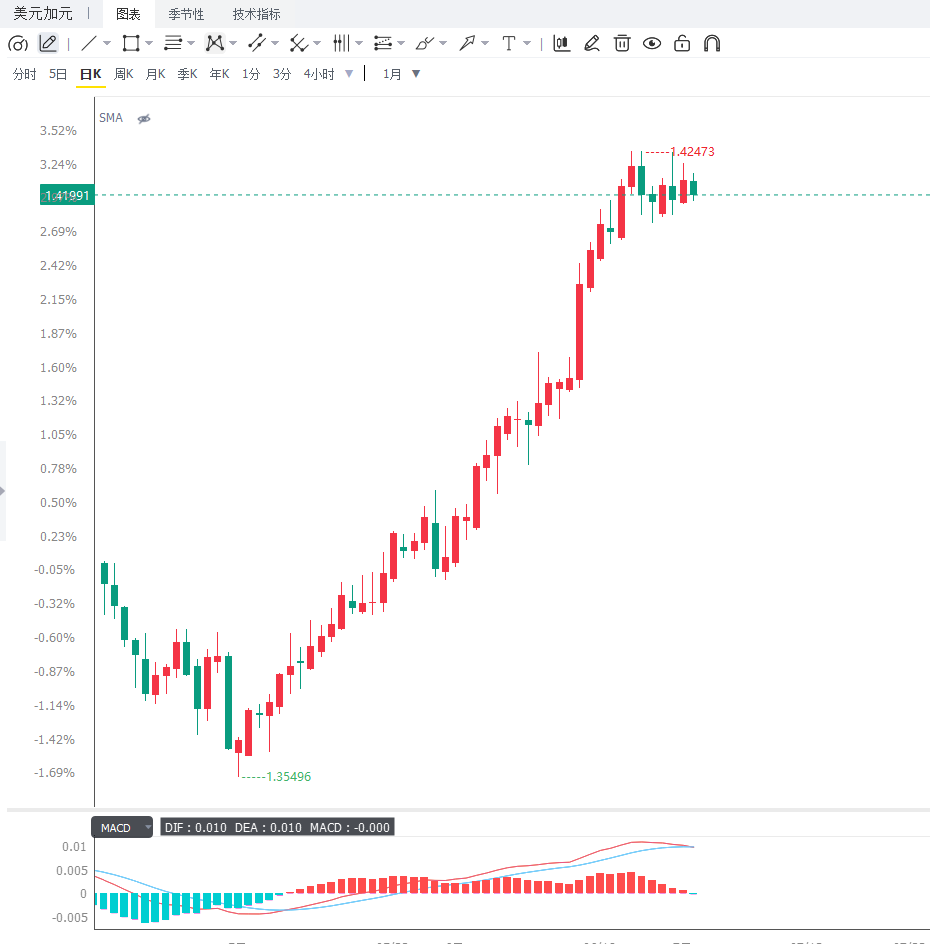
The daily chart shows that USD/CAD maintains an overall upward trend with fluctuations, trading above key moving averages, and the trend structure remains bullish. Currently, the exchange rate is consolidating within the 1.4169-1.4248 range, forming a short-term platform structure. Resistance levels to watch are 1.4248 and the historical high area of 1.4415 , while support lies at 1.4160 and 1.4100 , with the 20-day EMA at approximately 1.4103 forming a key dynamic support level.
From a 4-hour chart perspective, the exchange rate is consolidating at a high level. The short-term RSI indicator is approaching the overbought zone (around 77), indicating that upward momentum has been somewhat exhausted, but the trend has not yet been broken. The moving average system is still in a bullish alignment, suggesting that the pullback is more of a technical correction than a trend reversal. A decisive break above 1.4248 could open up upside potential towards the 1.4415 area; a break below 1.4160 could lead to a deeper correction in the short term.
Overall, USD/CAD remains in a bullish structure driven by both the US dollar interest rate advantage and weakening oil prices. The current sideways consolidation is more of a technical digestion phase within a trend continuation process than a trend reversal signal. The market is remaining cautious ahead of the non-farm payroll data, resulting in reduced volatility, but the overall direction remains bullish. As long as the key support level of 1.4100 is not broken, the medium-term structure will continue to be dominated by upward fluctuations.
Editor's Summary:
The current USD/CAD pair is driven by a dual structure: support from US interest rates and downward pressure on the Canadian dollar from falling oil prices. The market lacks a catalyst for a short-term breakout and has entered a period of high-level consolidation, but the overall trend remains bullish. Non-farm payroll data will be a key variable; weak data could put short-term pressure on the US dollar and trigger a pullback, while strong data could push the exchange rate to retest previous highs and continue its upward trend.
The market currently widely expects the US to add approximately 110,000 jobs in June, a significant drop from the previous month, indicating a possible marginal cooling in the labor market. However, average hourly earnings are projected to rise 3.5% year-on-year, suggesting that wage growth remains sticky. This could support inflation expectations to some extent, keeping the Federal Reserve's policy path uncertain.
On the policy front, Federal Reserve Chairman Kevin Warsh recently reiterated that inflation remains high and emphasized the importance of returning to the 2% target, meaning that market expectations for persistently high interest rates have not completely subsided. This combination of "data dependence + tight stance" provides some support for the US dollar in the short term.
On the other hand, the Canadian dollar was pressured by the decline in crude oil prices. With progress in indirect negotiations between the US and Iran, geopolitical risk premiums decreased, and international oil prices weakened overall. As a typical resource-based currency, the Canadian dollar is highly correlated with crude oil prices; the decline in oil prices weakened its fundamental support, keeping the USD/CAD pair relatively strong.
From a market structure perspective, the forces on the dollar side and the commodity side are clearly offsetting each other: the dollar is supported by interest rate expectations and remains at a high level, while the weakening of oil prices suppresses the performance of the Canadian dollar, pushing the exchange rate to remain in a high range of fluctuation.
The daily chart shows that USD/CAD maintains an overall upward trend with fluctuations, trading above key moving averages, and the trend structure remains bullish. Currently, the exchange rate is consolidating within the 1.4169-1.4248 range, forming a short-term platform structure. Resistance levels to watch are 1.4248 and the historical high area of 1.4415 , while support lies at 1.4160 and 1.4100 , with the 20-day EMA at approximately 1.4103 forming a key dynamic support level.
From a 4-hour chart perspective, the exchange rate is consolidating at a high level. The short-term RSI indicator is approaching the overbought zone (around 77), indicating that upward momentum has been somewhat exhausted, but the trend has not yet been broken. The moving average system is still in a bullish alignment, suggesting that the pullback is more of a technical correction than a trend reversal. A decisive break above 1.4248 could open up upside potential towards the 1.4415 area; a break below 1.4160 could lead to a deeper correction in the short term.
Overall, USD/CAD remains in a bullish structure driven by both the US dollar interest rate advantage and weakening oil prices. The current sideways consolidation is more of a technical digestion phase within a trend continuation process than a trend reversal signal. The market is remaining cautious ahead of the non-farm payroll data, resulting in reduced volatility, but the overall direction remains bullish. As long as the key support level of 1.4100 is not broken, the medium-term structure will continue to be dominated by upward fluctuations.
Editor's Summary:
The current USD/CAD pair is driven by a dual structure: support from US interest rates and downward pressure on the Canadian dollar from falling oil prices. The market lacks a catalyst for a short-term breakout and has entered a period of high-level consolidation, but the overall trend remains bullish. Non-farm payroll data will be a key variable; weak data could put short-term pressure on the US dollar and trigger a pullback, while strong data could push the exchange rate to retest previous highs and continue its upward trend.
- Risk Warning and Disclaimer
- The market involves risk, and trading may not be suitable for all investors. This article is for reference only and does not constitute personal investment advice, nor does it take into account certain users’ specific investment objectives, financial situation, or other needs. Any investment decisions made based on this information are at your own risk.