July 3rd Financial Breakfast: Unexpectedly weak non-farm payrolls data dampened interest rate hike expectations; gold prices rebounded above $4100; buyers bought on dips ahead of the Independence Day long weekend; oil bulls benefited.
2026-07-03 07:33:41
On Friday (July 3, Beijing time) in early Asian trading, spot gold was trading around $4,130 per ounce. The significantly weaker-than-expected US June non-farm payroll data significantly reduced market expectations for a Fed rate hike this year, boosting gold prices. US crude oil was trading around $68.46 per barrel, mainly driven by buyers seeking to secure supply ahead of the US Independence Day long weekend and short covering.

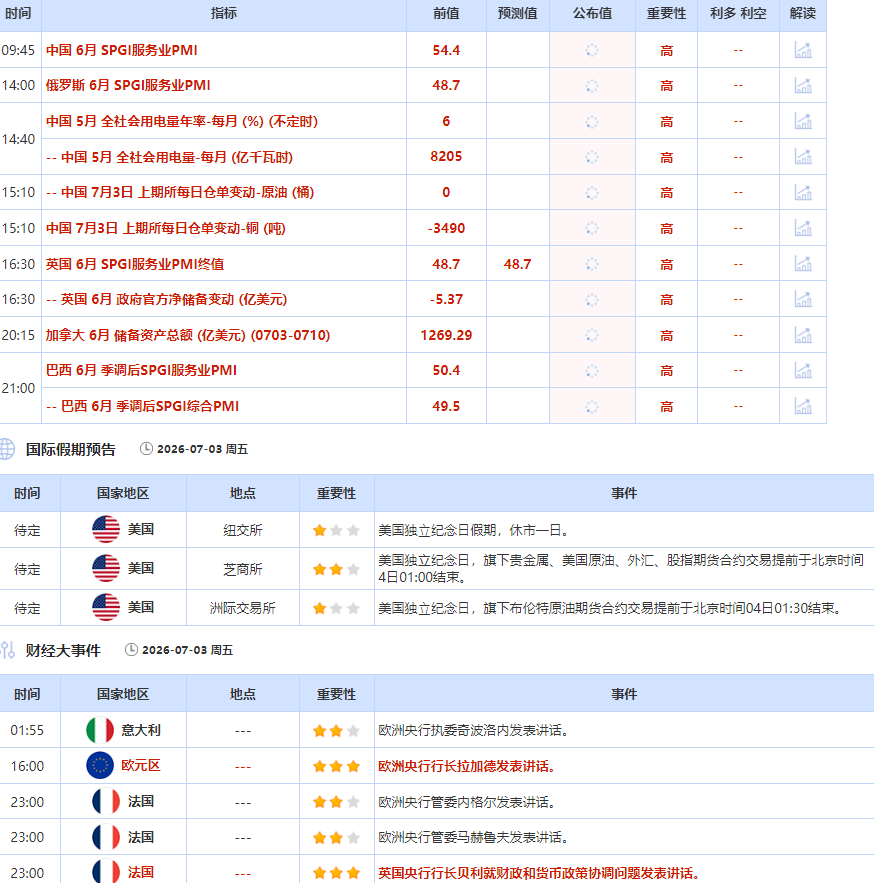
U.S. stocks closed mixed on Thursday. The Dow Jones Industrial Average rose 1.14% to close at 52,900.07, a record closing high. The S&P 500 edged up to close at 7,483.24, while the Nasdaq Composite fell 0.80% to close at 25,832.67.
The June nonfarm payrolls report showed an increase of only 57,000 jobs (far below the expected 110,000, and the unemployment rate of 4.2%, slightly lower than the expected 4.3%), easing market concerns about a Fed rate hike. According to the CME FedWatch tool, the probability of a September rate hike fell from 64.1% to 55%.
Adam Sarhan, CEO of 50 Park Investments, said the employment data did not end inflation concerns, but it eased pressure for short-term interest rate hikes. Bruce Zaro, managing director of Granite Wealth Management, believes the sharp drop in chip stocks (the Philadelphia Semiconductor Index closed down 5.4%) was due to profit-taking after a strong year-to-date rally (the index is still up about 78% this year). Nvidia fell 1.4%, SanDisk plunged 14.1%, while Apple rose 4.8% on a Nikkei Asian Review report that it would launch five new iPhone models. Tesla, despite record second-quarter deliveries, fell 7.5%, and Vimeo's parent company, Bending Spoons, plummeted 11.3% on its second day of trading. The Dow Jones Industrial Average rose about 2% this week, the S&P 500 rose 1.8%, and the Nasdaq rose 2.1%. U.S. markets were closed on Friday for Independence Day.
Gold prices rose more than 2% on Thursday, extending previous gains, with spot gold at $4,123.61 per ounce (up 2.3%). This was mainly due to significantly weaker-than-expected US non-farm payroll data for June (only 57,000 jobs were added, far below the expected 110,000, and the unemployment rate remained unchanged at 4.2%), which significantly reduced market expectations for a Federal Reserve rate hike this year. According to the CME Group's FedWatch tool, the probability of a rate hike before September has fallen from 66% before the data release to around 51%. At the same time, the dollar index fell, making dollar-denominated gold more attractive to investors holding other currencies.
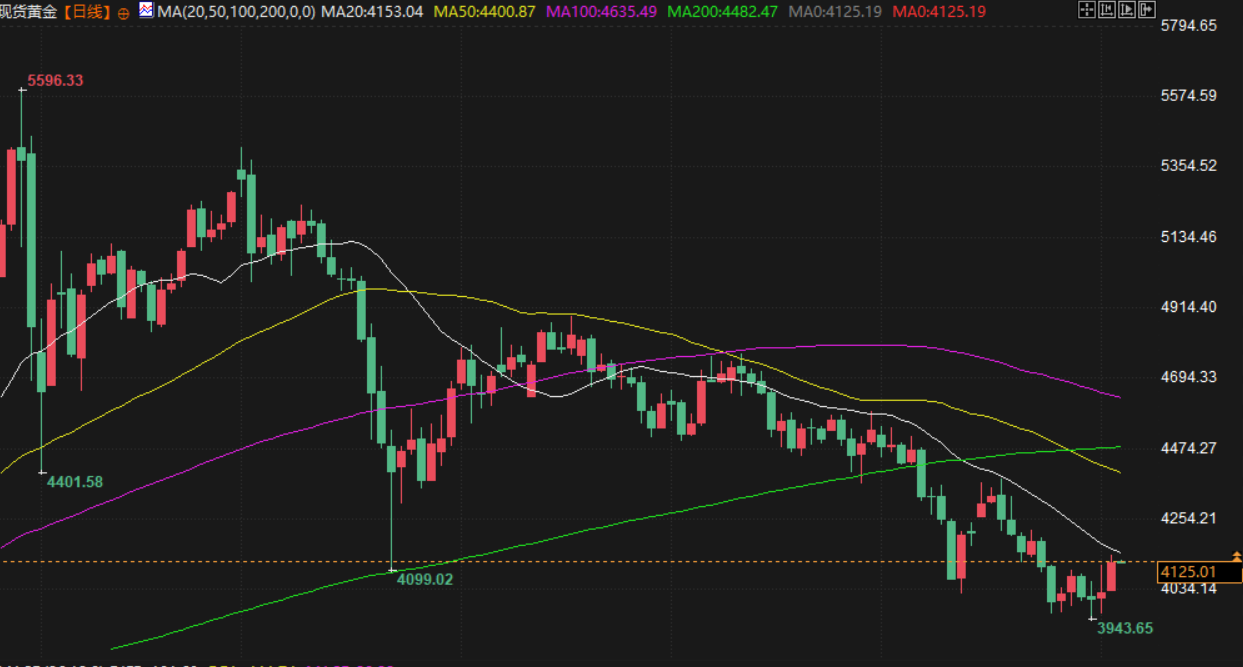
David Meger, director of metals trading at High Ridge Futures, pointed out that weaker-than-expected employment data suggests a lower probability of an interest rate hike later this year, and a low-interest-rate environment typically benefits gold.
In addition, the World Gold Council stated that central banks returned to buying mode in May, with official gold reserves increasing by a net 41 tons that month; on the geopolitical front, Iran and the United States ended a new round of indirect negotiations but there were no signs of peaceful progress.
Other precious metals also rose, with spot silver up 3.15% to $60.94, platinum up 2.6% to $1617.00, and palladium up 4.7% to $1267.14.
Oil prices rose slightly on Thursday, with Brent crude closing up 0.58% at $71.54 a barrel and WTI crude up 0.54% at $68.46 a barrel, mainly driven by buyers seeking to secure supplies ahead of the U.S. Independence Day long weekend and short covering.
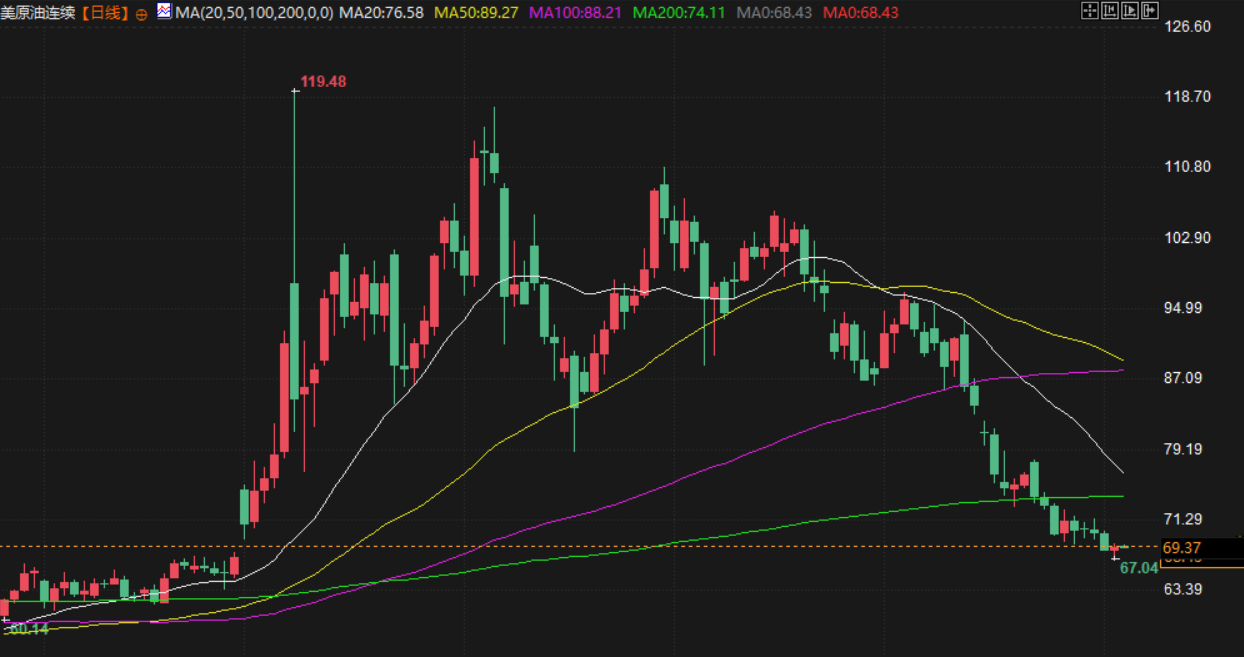
John Kilduff, a partner at Again Capital, said the market focus has shifted from "how much supply has been lost" to "how much supply has been gained." Both benchmark contracts fell to their lowest levels since before the start of the US-Israel war against Iran in late February.
Geopolitically, Qatar, the mediator, said the US and Iran have made progress in pushing for a permanent peace agreement to end the four-month-long war that has disrupted oil transport through the Strait of Hormuz. However, Bjarne Schieldrop, chief commodities analyst at Nordea Bank in Sweden, pointed out that oil is currently being transported through the strait and countries are releasing strategic reserves.
In addition, data released by the U.S. Energy Information Administration (EIA) on Wednesday showed that U.S. crude oil inventories fell to their lowest level since 2018, driven by refinery demand, while gasoline inventories declined in tandem; Nigeria became the first OPEC member to join the International Energy Agency (IEA) as an associate member; and the General Staff of the Armed Forces of Ukraine said on Thursday that it had launched an attack on the Lukoil refinery in Russia's Nizhny Novgorod region.
The dollar index fell 0.54% on Thursday to close at 100.85, after earlier hitting a low of 100.55, its lowest since June 18 and its biggest one-day drop since April 30, as the closely watched June jobs report showed that U.S. employers added only 57,000 jobs, far below economists’ expectations of 110,000, while the unemployment rate edged down to 4.2% from 4.3%.
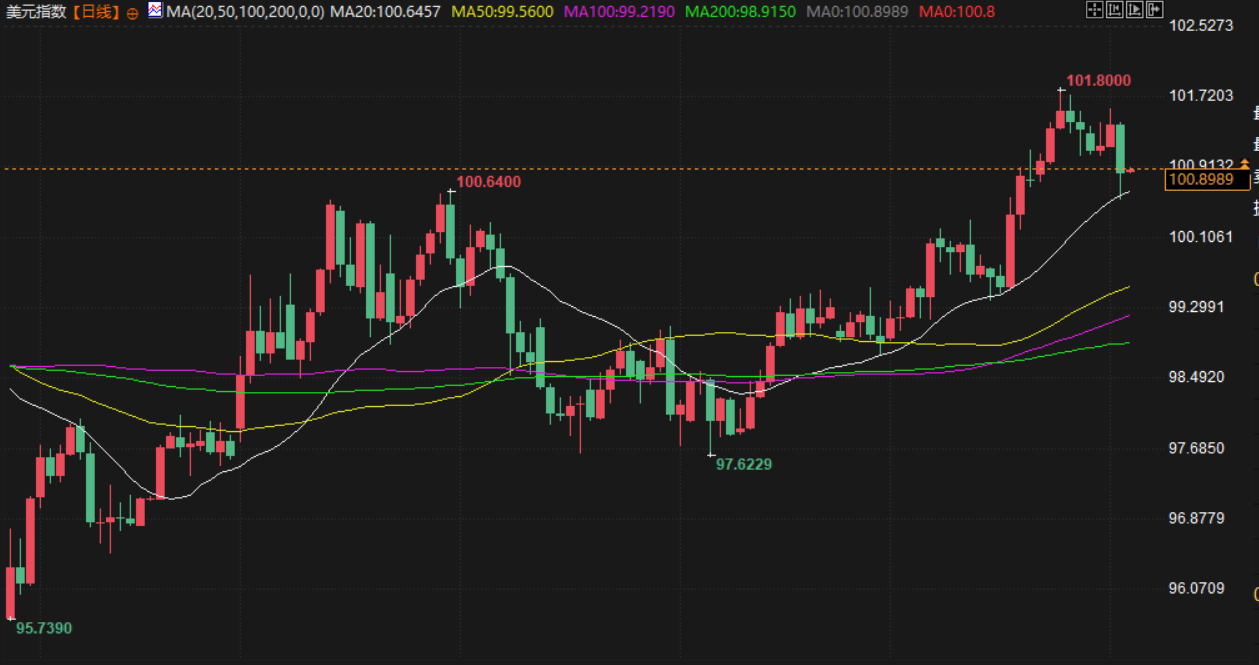
The market quickly adjusted its expectations for the Federal Reserve's policy, with federal funds futures traders now expecting a 54% probability of a rate hike before September, down from 67% before the data release.
The euro rose 0.52% to $1.1435, after earlier hitting a high of $1.1472, its highest level since June 22. Other non-US currencies, such as the pound and the Australian dollar, also generally rose.
Although Sarah Ying, head of foreign exchange strategy at CIBC Capital Markets, pointed out that the weak data mainly came from the leisure and hospitality industry, which may be driven by seasonal factors and is not serious, the market was still affected.
The dollar has been supported in recent months by market expectations that the Federal Reserve will continue to raise interest rates to combat inflation and by capital inflows driven by the AI boom. However, Fed Chairman Warsh said on Wednesday that he is firmly committed to the 2% inflation target, while noting that inflation expectations and risks have eased in recent weeks. Ying believes that unless labor data continues to disappoint, the AI narrative will continue to dominate capital flows.
Meanwhile, the dollar fell 0.91% against the yen to 161.09, having earlier touched a low of 160.63, its lowest since June 18 and also its biggest one-day drop since April 30. Traders and strategists attributed this to a shift in the intervention strategy of Japan's Ministry of Finance. Two sources familiar with the matter revealed that Japanese officials are abandoning the practice of disclosing intervention risks in advance, instead adopting a more aggressive and targeted approach to suppress speculators, increase the cost of short selling, and deliberately avoid making any specific statements on exchange rate red lines, making it difficult for traders to determine when to enter the market.
Ying stated that this is more worrying than the current situation, representing a more aggressive way for the Japanese Ministry of Finance to communicate and respond to the yen's weakness. The specific reasons for this move remain unclear, and the Ministry of Finance declined to comment. Some traders speculate that the authorities may have conducted a currency inquiry (usually indicating intervention). Abbas Keshvani, Asia Macro Strategist at RBC Capital Markets, said that data confirmation is needed to determine if intervention occurred, but the timing of the move does suggest this possibility.
Trump: Iran "almost agreed to everything we needed" in negotiations.
In an interview on Thursday, US President Donald Trump said that peace talks with Iran are progressing, adding that Iran has "almost agreed to everything we asked for." This is one of Trump's most optimistic statements since the signing of the Islamabad Memorandum of Understanding, which opened a 60-day negotiation window. In the interview, Trump made it clear that the US is not seeking regime change in Iran, and Washington's primary goal remains preventing Tehran from acquiring nuclear weapons. "My demand is very simple: they cannot have nuclear weapons," he said. This statement was intended to respond to speculation that the US might be attempting to overthrow the Iranian regime. Trump also defended the recent US military action against Iran, saying that Iran has been "completely defeated militarily." He mentioned, "I hit them hard three times last week because they sent a drone to ram a ship." He added that Iran "still has some missiles, and we can destroy them all." Regarding the follow-up arrangements for the negotiations, mediators from Qatar and Pakistan said on Thursday that the next round of US-Iran talks would be held "as soon as possible" after the funeral of former Iranian Supreme Leader Ali Khamenei. Khamenei was killed in a US-Israeli airstrike on February 28, 2026, and his funeral is scheduled for July 4-9. Despite Trump's optimism about the prospects for negotiations, Iran has not yet officially responded to his remarks. Iran has repeatedly emphasized that its negotiating position depends on whether the US fulfills its commitments to lift sanctions and release frozen assets.
Sources say Kuwait's crude oil production surged in June following the US-Iran agreement.
An informed source revealed on Thursday that the OPEC member is ramping up oil exports from the Persian Gulf following the implementation of the interim peace agreement between the US and Iran. The significant rebound in Kuwaiti crude oil production further confirms that Gulf oil shipments through the Strait of Hormuz are rapidly recovering after the disruption caused by the conflict; previously stranded tankers are gradually passing through the strait, and oil-producing countries are also gradually restoring production capacity. In late February, the US and Israel launched attacks, and Iran subsequently nearly blocked the Strait of Hormuz. Before the blockade, Kuwait's daily crude oil production was approximately 2.5 million barrels; the obstruction of the strait forced Gulf oil-producing countries such as Kuwait, Saudi Arabia, and Iraq to reduce their daily production by millions of barrels. The unnamed source added that in the last 10 days of June, Kuwait's daily production peaked at 1.9 million barrels.
The US and Afghanistan unfroze Iranian overseas funds in exchange for Iran relinquishing its toll collection fees in the Strait of Hormuz; Iran refuses to compromise.
The United States and Oman are seeking ways to force Iran to abandon its hardline stance on charging tolls for ships passing through the Strait of Hormuz. A key bargaining chip in the indirect negotiations is the US promise to unfreeze a portion of Iran's hundreds of billions of dollars in overseas assets. So far, Tehran has not accepted this condition. Senior Iranian military officials have again warned of potential action against ships passing through this busiest waterway in the world. Sources familiar with the matter revealed that US envoys Steve Vitkov and Jared Kushner traveled to Doha this week to discuss with Qatari mediators how to break the deadlock and implement the preliminary agreement reached last month to open the strait. Both US and Iranian delegations discussed the recent conflict in Lebanon with the Qatari mediators, adding a new obstacle to the negotiations. Sources also stated that US diplomats offered Iran a deal: Iran would relinquish control of the strait and cease charging tolls, in exchange for the US unfreezing billions of dollars in Iranian assets. Under the agreement reached last month, Iran could have access to some of its $100 billion in assets frozen overseas. Years of sanctions have triggered hyperinflation, and Iran's economy desperately needs an injection of foreign exchange. Sources indicate that negotiations had progressed to the point of unfreezing $60 billion in Iranian assets in Qatar, but Iran's decision to block the Strait of Hormuz has stalled this process.
Iranian armed forces say they will resolutely respond to US interference.
According to a report by the Islamic Republic of Iran Broadcasting (IRNA) today (July 2), the Central Command of the Iranian Armed Forces, Hatem Anbia, issued a statement saying that the Iranian armed forces will respond "resolutely and swiftly" to any interference by the United States in the Strait of Hormuz. The statement said that the continued presence of US warplanes over the Strait of Hormuz undermines the security of the waterway and hinders regional stability. On the issue of the Strait of Hormuz, Iran will not hesitate to take all necessary actions to crush any acts of aggression by the US military and its supporters. The US Naval Central Command stated on July 1 that a US Seahawk helicopter made an emergency water landing in the Arabian Sea that day; of the four crew members, three were rescued and one is missing. The statement said that there is currently no indication that the landing was caused by hostile action, and the specific cause of the accident is under investigation. (CCTV International News)
Iranian officials say Oman has proposed a tariff scheme for the Strait of Hormuz.
The future arrangements for the Strait of Hormuz remain one of the core issues in US-Iran negotiations. Recently, US sources indicated that Iranian officials and informed diplomatic sources stated that Oman has proposed a plan to charge service fees for ships transiting the Strait of Hormuz. Iranian officials and regional diplomats stated that Oman recently submitted a formal proposal to the US and other Western allies. According to this proposal, shipping companies using the Strait of Hormuz would need to pay service fees. Reports indicate that Oman's latest proposal partially references the arrangements for the Strait of Malacca and the Singapore Strait. In the Straits of Malacca and Singapore, there are "voluntary donations" from governments, businesses, and industry associations to promote navigation safety in the straits. This regional diplomat stated that Oman's proposal uses a voluntary payment mechanism, but Iranian officials have given the opposite statement, indicating that these fees will be mandatory. (CCTV News)
The probability of a Federal Reserve rate hike in July has slightly decreased to 17.6%, and the probability of a rate hike this year has slightly decreased to 76.5%.
According to CME's "FedWatch": The probability of the Federal Reserve keeping interest rates unchanged in July is 82.4%, and the probability of a cumulative 25 basis point rate hike is 17.6%. The probability of the Fed keeping interest rates unchanged by September is 46.8%, the probability of a cumulative 25 basis point rate hike is 45.6%, and the probability of a cumulative 50 basis point rate hike is 7.6%. The probability of the Fed keeping interest rates unchanged by December is 23.5%, the probability of a cumulative 25 basis point rate hike is 42.2%, and the probability of at least a 50 basis point rate hike is 34.3%.
Ministry of Commerce responds to the issue of tariffs on US agricultural products
At a regular press conference on July 2, Ministry of Commerce spokesperson He Yadong, responding to a question about reducing or eliminating tariffs on U.S. agricultural products, stated that agricultural trade is an important component of China-U.S. economic and trade cooperation. Following recent trade consultations, both sides set guiding objectives for expanding two-way agricultural trade and agreed in principle to include relevant agricultural products in the framework for reciprocal tariff reductions. Enterprises will follow market principles and conduct trade independently based on actual needs and market conditions. China is willing to work with the U.S. to create favorable conditions for two-way agricultural trade. (Xinhua)
Key Focus Today
stock market
U.S. stocks closed mixed on Thursday. The Dow Jones Industrial Average rose 1.14% to close at 52,900.07, a record closing high. The S&P 500 edged up to close at 7,483.24, while the Nasdaq Composite fell 0.80% to close at 25,832.67.
The June nonfarm payrolls report showed an increase of only 57,000 jobs (far below the expected 110,000, and the unemployment rate of 4.2%, slightly lower than the expected 4.3%), easing market concerns about a Fed rate hike. According to the CME FedWatch tool, the probability of a September rate hike fell from 64.1% to 55%.
Adam Sarhan, CEO of 50 Park Investments, said the employment data did not end inflation concerns, but it eased pressure for short-term interest rate hikes. Bruce Zaro, managing director of Granite Wealth Management, believes the sharp drop in chip stocks (the Philadelphia Semiconductor Index closed down 5.4%) was due to profit-taking after a strong year-to-date rally (the index is still up about 78% this year). Nvidia fell 1.4%, SanDisk plunged 14.1%, while Apple rose 4.8% on a Nikkei Asian Review report that it would launch five new iPhone models. Tesla, despite record second-quarter deliveries, fell 7.5%, and Vimeo's parent company, Bending Spoons, plummeted 11.3% on its second day of trading. The Dow Jones Industrial Average rose about 2% this week, the S&P 500 rose 1.8%, and the Nasdaq rose 2.1%. U.S. markets were closed on Friday for Independence Day.
Gold Market
Gold prices rose more than 2% on Thursday, extending previous gains, with spot gold at $4,123.61 per ounce (up 2.3%). This was mainly due to significantly weaker-than-expected US non-farm payroll data for June (only 57,000 jobs were added, far below the expected 110,000, and the unemployment rate remained unchanged at 4.2%), which significantly reduced market expectations for a Federal Reserve rate hike this year. According to the CME Group's FedWatch tool, the probability of a rate hike before September has fallen from 66% before the data release to around 51%. At the same time, the dollar index fell, making dollar-denominated gold more attractive to investors holding other currencies.
David Meger, director of metals trading at High Ridge Futures, pointed out that weaker-than-expected employment data suggests a lower probability of an interest rate hike later this year, and a low-interest-rate environment typically benefits gold.
In addition, the World Gold Council stated that central banks returned to buying mode in May, with official gold reserves increasing by a net 41 tons that month; on the geopolitical front, Iran and the United States ended a new round of indirect negotiations but there were no signs of peaceful progress.
Other precious metals also rose, with spot silver up 3.15% to $60.94, platinum up 2.6% to $1617.00, and palladium up 4.7% to $1267.14.
oil market
Oil prices rose slightly on Thursday, with Brent crude closing up 0.58% at $71.54 a barrel and WTI crude up 0.54% at $68.46 a barrel, mainly driven by buyers seeking to secure supplies ahead of the U.S. Independence Day long weekend and short covering.
John Kilduff, a partner at Again Capital, said the market focus has shifted from "how much supply has been lost" to "how much supply has been gained." Both benchmark contracts fell to their lowest levels since before the start of the US-Israel war against Iran in late February.
Geopolitically, Qatar, the mediator, said the US and Iran have made progress in pushing for a permanent peace agreement to end the four-month-long war that has disrupted oil transport through the Strait of Hormuz. However, Bjarne Schieldrop, chief commodities analyst at Nordea Bank in Sweden, pointed out that oil is currently being transported through the strait and countries are releasing strategic reserves.
In addition, data released by the U.S. Energy Information Administration (EIA) on Wednesday showed that U.S. crude oil inventories fell to their lowest level since 2018, driven by refinery demand, while gasoline inventories declined in tandem; Nigeria became the first OPEC member to join the International Energy Agency (IEA) as an associate member; and the General Staff of the Armed Forces of Ukraine said on Thursday that it had launched an attack on the Lukoil refinery in Russia's Nizhny Novgorod region.
Foreign exchange market
The dollar index fell 0.54% on Thursday to close at 100.85, after earlier hitting a low of 100.55, its lowest since June 18 and its biggest one-day drop since April 30, as the closely watched June jobs report showed that U.S. employers added only 57,000 jobs, far below economists’ expectations of 110,000, while the unemployment rate edged down to 4.2% from 4.3%.
The market quickly adjusted its expectations for the Federal Reserve's policy, with federal funds futures traders now expecting a 54% probability of a rate hike before September, down from 67% before the data release.
The euro rose 0.52% to $1.1435, after earlier hitting a high of $1.1472, its highest level since June 22. Other non-US currencies, such as the pound and the Australian dollar, also generally rose.
Although Sarah Ying, head of foreign exchange strategy at CIBC Capital Markets, pointed out that the weak data mainly came from the leisure and hospitality industry, which may be driven by seasonal factors and is not serious, the market was still affected.
The dollar has been supported in recent months by market expectations that the Federal Reserve will continue to raise interest rates to combat inflation and by capital inflows driven by the AI boom. However, Fed Chairman Warsh said on Wednesday that he is firmly committed to the 2% inflation target, while noting that inflation expectations and risks have eased in recent weeks. Ying believes that unless labor data continues to disappoint, the AI narrative will continue to dominate capital flows.
Meanwhile, the dollar fell 0.91% against the yen to 161.09, having earlier touched a low of 160.63, its lowest since June 18 and also its biggest one-day drop since April 30. Traders and strategists attributed this to a shift in the intervention strategy of Japan's Ministry of Finance. Two sources familiar with the matter revealed that Japanese officials are abandoning the practice of disclosing intervention risks in advance, instead adopting a more aggressive and targeted approach to suppress speculators, increase the cost of short selling, and deliberately avoid making any specific statements on exchange rate red lines, making it difficult for traders to determine when to enter the market.
Ying stated that this is more worrying than the current situation, representing a more aggressive way for the Japanese Ministry of Finance to communicate and respond to the yen's weakness. The specific reasons for this move remain unclear, and the Ministry of Finance declined to comment. Some traders speculate that the authorities may have conducted a currency inquiry (usually indicating intervention). Abbas Keshvani, Asia Macro Strategist at RBC Capital Markets, said that data confirmation is needed to determine if intervention occurred, but the timing of the move does suggest this possibility.
International News
Trump: Iran "almost agreed to everything we needed" in negotiations.
In an interview on Thursday, US President Donald Trump said that peace talks with Iran are progressing, adding that Iran has "almost agreed to everything we asked for." This is one of Trump's most optimistic statements since the signing of the Islamabad Memorandum of Understanding, which opened a 60-day negotiation window. In the interview, Trump made it clear that the US is not seeking regime change in Iran, and Washington's primary goal remains preventing Tehran from acquiring nuclear weapons. "My demand is very simple: they cannot have nuclear weapons," he said. This statement was intended to respond to speculation that the US might be attempting to overthrow the Iranian regime. Trump also defended the recent US military action against Iran, saying that Iran has been "completely defeated militarily." He mentioned, "I hit them hard three times last week because they sent a drone to ram a ship." He added that Iran "still has some missiles, and we can destroy them all." Regarding the follow-up arrangements for the negotiations, mediators from Qatar and Pakistan said on Thursday that the next round of US-Iran talks would be held "as soon as possible" after the funeral of former Iranian Supreme Leader Ali Khamenei. Khamenei was killed in a US-Israeli airstrike on February 28, 2026, and his funeral is scheduled for July 4-9. Despite Trump's optimism about the prospects for negotiations, Iran has not yet officially responded to his remarks. Iran has repeatedly emphasized that its negotiating position depends on whether the US fulfills its commitments to lift sanctions and release frozen assets.
Sources say Kuwait's crude oil production surged in June following the US-Iran agreement.
An informed source revealed on Thursday that the OPEC member is ramping up oil exports from the Persian Gulf following the implementation of the interim peace agreement between the US and Iran. The significant rebound in Kuwaiti crude oil production further confirms that Gulf oil shipments through the Strait of Hormuz are rapidly recovering after the disruption caused by the conflict; previously stranded tankers are gradually passing through the strait, and oil-producing countries are also gradually restoring production capacity. In late February, the US and Israel launched attacks, and Iran subsequently nearly blocked the Strait of Hormuz. Before the blockade, Kuwait's daily crude oil production was approximately 2.5 million barrels; the obstruction of the strait forced Gulf oil-producing countries such as Kuwait, Saudi Arabia, and Iraq to reduce their daily production by millions of barrels. The unnamed source added that in the last 10 days of June, Kuwait's daily production peaked at 1.9 million barrels.
The US and Afghanistan unfroze Iranian overseas funds in exchange for Iran relinquishing its toll collection fees in the Strait of Hormuz; Iran refuses to compromise.
The United States and Oman are seeking ways to force Iran to abandon its hardline stance on charging tolls for ships passing through the Strait of Hormuz. A key bargaining chip in the indirect negotiations is the US promise to unfreeze a portion of Iran's hundreds of billions of dollars in overseas assets. So far, Tehran has not accepted this condition. Senior Iranian military officials have again warned of potential action against ships passing through this busiest waterway in the world. Sources familiar with the matter revealed that US envoys Steve Vitkov and Jared Kushner traveled to Doha this week to discuss with Qatari mediators how to break the deadlock and implement the preliminary agreement reached last month to open the strait. Both US and Iranian delegations discussed the recent conflict in Lebanon with the Qatari mediators, adding a new obstacle to the negotiations. Sources also stated that US diplomats offered Iran a deal: Iran would relinquish control of the strait and cease charging tolls, in exchange for the US unfreezing billions of dollars in Iranian assets. Under the agreement reached last month, Iran could have access to some of its $100 billion in assets frozen overseas. Years of sanctions have triggered hyperinflation, and Iran's economy desperately needs an injection of foreign exchange. Sources indicate that negotiations had progressed to the point of unfreezing $60 billion in Iranian assets in Qatar, but Iran's decision to block the Strait of Hormuz has stalled this process.
Iranian armed forces say they will resolutely respond to US interference.
According to a report by the Islamic Republic of Iran Broadcasting (IRNA) today (July 2), the Central Command of the Iranian Armed Forces, Hatem Anbia, issued a statement saying that the Iranian armed forces will respond "resolutely and swiftly" to any interference by the United States in the Strait of Hormuz. The statement said that the continued presence of US warplanes over the Strait of Hormuz undermines the security of the waterway and hinders regional stability. On the issue of the Strait of Hormuz, Iran will not hesitate to take all necessary actions to crush any acts of aggression by the US military and its supporters. The US Naval Central Command stated on July 1 that a US Seahawk helicopter made an emergency water landing in the Arabian Sea that day; of the four crew members, three were rescued and one is missing. The statement said that there is currently no indication that the landing was caused by hostile action, and the specific cause of the accident is under investigation. (CCTV International News)
Iranian officials say Oman has proposed a tariff scheme for the Strait of Hormuz.
The future arrangements for the Strait of Hormuz remain one of the core issues in US-Iran negotiations. Recently, US sources indicated that Iranian officials and informed diplomatic sources stated that Oman has proposed a plan to charge service fees for ships transiting the Strait of Hormuz. Iranian officials and regional diplomats stated that Oman recently submitted a formal proposal to the US and other Western allies. According to this proposal, shipping companies using the Strait of Hormuz would need to pay service fees. Reports indicate that Oman's latest proposal partially references the arrangements for the Strait of Malacca and the Singapore Strait. In the Straits of Malacca and Singapore, there are "voluntary donations" from governments, businesses, and industry associations to promote navigation safety in the straits. This regional diplomat stated that Oman's proposal uses a voluntary payment mechanism, but Iranian officials have given the opposite statement, indicating that these fees will be mandatory. (CCTV News)
The probability of a Federal Reserve rate hike in July has slightly decreased to 17.6%, and the probability of a rate hike this year has slightly decreased to 76.5%.
According to CME's "FedWatch": The probability of the Federal Reserve keeping interest rates unchanged in July is 82.4%, and the probability of a cumulative 25 basis point rate hike is 17.6%. The probability of the Fed keeping interest rates unchanged by September is 46.8%, the probability of a cumulative 25 basis point rate hike is 45.6%, and the probability of a cumulative 50 basis point rate hike is 7.6%. The probability of the Fed keeping interest rates unchanged by December is 23.5%, the probability of a cumulative 25 basis point rate hike is 42.2%, and the probability of at least a 50 basis point rate hike is 34.3%.
Domestic News
Ministry of Commerce responds to the issue of tariffs on US agricultural products
At a regular press conference on July 2, Ministry of Commerce spokesperson He Yadong, responding to a question about reducing or eliminating tariffs on U.S. agricultural products, stated that agricultural trade is an important component of China-U.S. economic and trade cooperation. Following recent trade consultations, both sides set guiding objectives for expanding two-way agricultural trade and agreed in principle to include relevant agricultural products in the framework for reciprocal tariff reductions. Enterprises will follow market principles and conduct trade independently based on actual needs and market conditions. China is willing to work with the U.S. to create favorable conditions for two-way agricultural trade. (Xinhua)
- Risk Warning and Disclaimer
- The market involves risk, and trading may not be suitable for all investors. This article is for reference only and does not constitute personal investment advice, nor does it take into account certain users’ specific investment objectives, financial situation, or other needs. Any investment decisions made based on this information are at your own risk.