













Crude oil trading alert: Oil prices are approaching a strong support zone, and the short-term decline has slowed; prices are awaiting stabilization.
2026-07-03 09:29:47
WTI crude oil prices edged lower during Asian trading hours, hovering around $68.50 , continuing the pullback following the previous day's modest rebound. The market has entered a period of relative calm, primarily driven by the rapid easing of geopolitical tensions in the Middle East and improved supply expectations due to the resumption of global energy transport routes.

Recent developments indicate that multiple rounds of diplomatic contacts between the US and Iran have achieved some initial results in Doha. With the assistance of mediators such as Qatar and Pakistan, the two sides reached limited consensus on some key issues, significantly reducing the geopolitical risk premium that had previously driven up oil prices. The market generally believes that the direct impact of risk events on the energy supply chain is weakening, leading to adjustments in speculative long positions.
Meanwhile, shipping activities in the Strait of Hormuz are gradually returning to normal. As one of the world's most important oil transportation chokepoints, this waterway handles approximately one-fifth of global seaborne crude oil transport, and its stability directly impacts international oil price pricing logic. With the easing of the situation and the smooth resumption of commercial tanker passage, concerns about supply disruptions in the global energy market have significantly decreased, and risk premiums have continued to compress.
From the supply side, major oil-producing countries have seen a rapid recovery in exports. Saudi Arabia's crude oil exports have rebounded to approximately 90% of pre-conflict levels , indicating that its maritime transport and loading systems have largely returned to normal operation. Meanwhile, the UAE's exports have essentially recovered to 100% of pre-war capacity , with its dual-pathway system—using both regular shipping routes through the Strait of Hormuz and alternative pipelines—effectively ensuring a continuous supply to the international market. This rapid recovery on the supply side has further strengthened global market expectations for a rebalancing of crude oil supply and demand.
In terms of market sentiment, the crude oil market is gradually shifting from a "risk premium-driven" model to a "fundamental pricing phase." The short-term premium previously driven by geopolitical conflicts is fading, and trading logic is increasingly returning to supply and demand and inventory changes. Investors are focusing on the pace of global demand recovery and the impact of subsequent macroeconomic data on energy consumption.
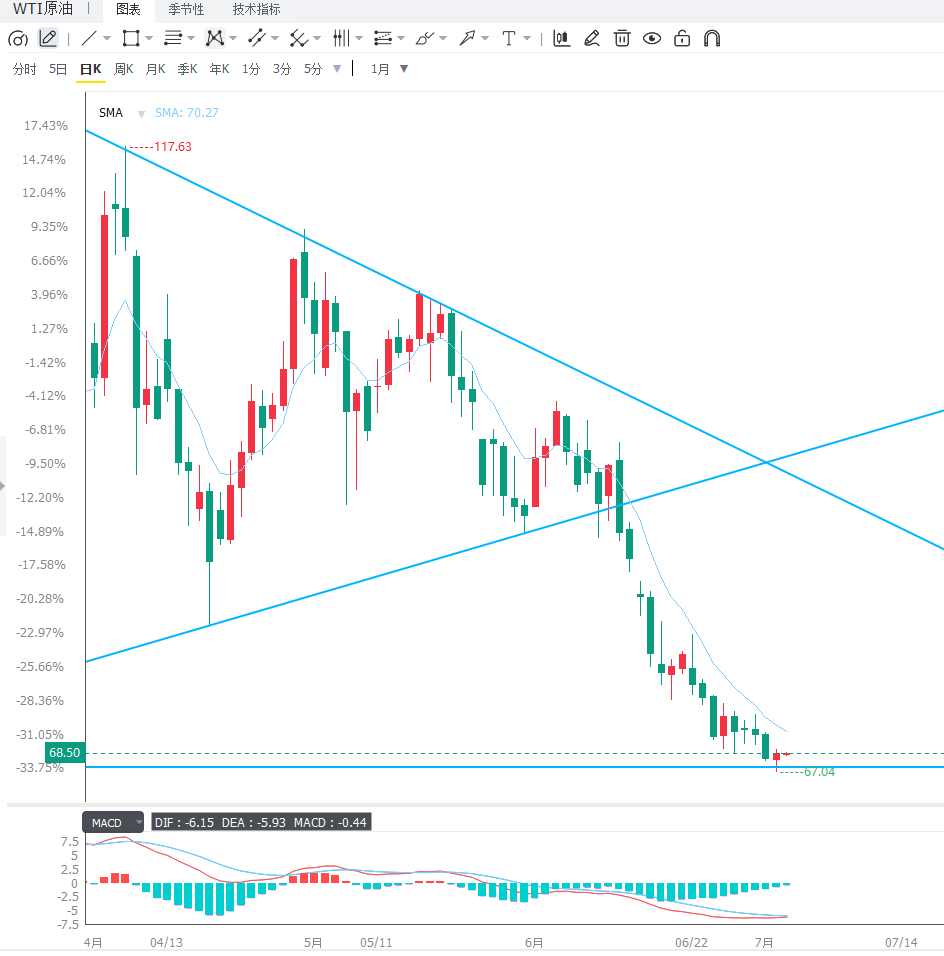
From a technical perspective, the daily chart shows that WTI crude oil has entered a high-level consolidation and pullback phase after its previous surge. The price has repeatedly faced resistance above $70 and fallen back to the $68 area, with the overall trend still within a wide consolidation range. Key support is around $66.80 , a previous area of dense trading and short-term moving average support; a break below this level could open up potential for a pullback to the $65 area. Resistance is concentrated around $70.50 , which corresponds to both a previous high and a psychological level; a break and hold above this level could reignite upward momentum.
Looking at the 4-hour chart, the short-term moving average system is starting to flatten, and the price shows signs of weakening momentum after a continuous decline. The MACD histogram has turned from positive to weak, indicating a marginal decline in bullish strength. If the price fails to quickly recover above $69 in the short term, it may continue to maintain a low-level consolidation structure; conversely, if the trading volume breaks through $70, it may trigger a short-covering rally. Overall, the short-term trend has shifted from strong to weak, but it has not yet entered a one-sided downward phase and is still mainly characterized by a weak and volatile trend.
Editor's Summary:
The recent decline in WTI oil prices was primarily driven by the rapid easing of geopolitical risks and the resumption of shipping from the Strait of Hormuz, significantly compressing market risk premiums. As exports from major oil-producing countries gradually recover, the global supply shortage has eased temporarily, shifting the focus of oil prices from geopolitical drivers to fundamental logic. In the short term, the crude oil market is entering a repricing phase, and volatility may decrease, but the risk of a second adjustment due to weaker-than-expected demand or weaker macroeconomic data remains a concern. In the medium term, if the global economic recovery proceeds at a stable pace, oil prices are expected to maintain a consolidation pattern within the $65-$72 range.
Recent developments indicate that multiple rounds of diplomatic contacts between the US and Iran have achieved some initial results in Doha. With the assistance of mediators such as Qatar and Pakistan, the two sides reached limited consensus on some key issues, significantly reducing the geopolitical risk premium that had previously driven up oil prices. The market generally believes that the direct impact of risk events on the energy supply chain is weakening, leading to adjustments in speculative long positions.
Meanwhile, shipping activities in the Strait of Hormuz are gradually returning to normal. As one of the world's most important oil transportation chokepoints, this waterway handles approximately one-fifth of global seaborne crude oil transport, and its stability directly impacts international oil price pricing logic. With the easing of the situation and the smooth resumption of commercial tanker passage, concerns about supply disruptions in the global energy market have significantly decreased, and risk premiums have continued to compress.
From the supply side, major oil-producing countries have seen a rapid recovery in exports. Saudi Arabia's crude oil exports have rebounded to approximately 90% of pre-conflict levels , indicating that its maritime transport and loading systems have largely returned to normal operation. Meanwhile, the UAE's exports have essentially recovered to 100% of pre-war capacity , with its dual-pathway system—using both regular shipping routes through the Strait of Hormuz and alternative pipelines—effectively ensuring a continuous supply to the international market. This rapid recovery on the supply side has further strengthened global market expectations for a rebalancing of crude oil supply and demand.
In terms of market sentiment, the crude oil market is gradually shifting from a "risk premium-driven" model to a "fundamental pricing phase." The short-term premium previously driven by geopolitical conflicts is fading, and trading logic is increasingly returning to supply and demand and inventory changes. Investors are focusing on the pace of global demand recovery and the impact of subsequent macroeconomic data on energy consumption.
From a technical perspective, the daily chart shows that WTI crude oil has entered a high-level consolidation and pullback phase after its previous surge. The price has repeatedly faced resistance above $70 and fallen back to the $68 area, with the overall trend still within a wide consolidation range. Key support is around $66.80 , a previous area of dense trading and short-term moving average support; a break below this level could open up potential for a pullback to the $65 area. Resistance is concentrated around $70.50 , which corresponds to both a previous high and a psychological level; a break and hold above this level could reignite upward momentum.
Looking at the 4-hour chart, the short-term moving average system is starting to flatten, and the price shows signs of weakening momentum after a continuous decline. The MACD histogram has turned from positive to weak, indicating a marginal decline in bullish strength. If the price fails to quickly recover above $69 in the short term, it may continue to maintain a low-level consolidation structure; conversely, if the trading volume breaks through $70, it may trigger a short-covering rally. Overall, the short-term trend has shifted from strong to weak, but it has not yet entered a one-sided downward phase and is still mainly characterized by a weak and volatile trend.
Editor's Summary:
The recent decline in WTI oil prices was primarily driven by the rapid easing of geopolitical risks and the resumption of shipping from the Strait of Hormuz, significantly compressing market risk premiums. As exports from major oil-producing countries gradually recover, the global supply shortage has eased temporarily, shifting the focus of oil prices from geopolitical drivers to fundamental logic. In the short term, the crude oil market is entering a repricing phase, and volatility may decrease, but the risk of a second adjustment due to weaker-than-expected demand or weaker macroeconomic data remains a concern. In the medium term, if the global economic recovery proceeds at a stable pace, oil prices are expected to maintain a consolidation pattern within the $65-$72 range.
- Risk Warning and Disclaimer
- The market involves risk, and trading may not be suitable for all investors. This article is for reference only and does not constitute personal investment advice, nor does it take into account certain users’ specific investment objectives, financial situation, or other needs. Any investment decisions made based on this information are at your own risk.

