Japanese bond yields surged to a 30-year high, while the USD/JPY pair rebounded from its lows and maintained a high level of fluctuation.
2026-07-06 09:55:12
The USD/JPY pair continued its upward trend in Asian trading on Monday, rising for the second consecutive trading day to around 161.70 , maintaining its recent strong structure. The Japanese yen is exhibiting a clearly weak and volatile pattern in the current environment, pressured by rising import costs on one hand, and failing to effectively support exchange rate stability on the other, despite rising domestic interest rates. The market structure presents a typical divergence of "rising interest rates but weakening exchange rate."

In the bond market, the yield on 10-year Japanese government bonds climbed to approximately 2.79% , a new 30-year high, reflecting a repricing of market expectations for long-term inflation and policy normalization. However, this yield increase did not lead to a corresponding improvement in the attractiveness of yen assets; instead, due to the still significant widening of overseas interest rate differentials, funds continued to flow towards dollar assets.
Regarding the US dollar, the Federal Reserve maintained its tightening stance, and the market continued to price in the probability of multiple rate hikes this year. Although global inflationary pressures have eased somewhat, and the recovery in oil supply has reduced imported inflation to some extent, the dollar has remained resilient due to its interest rate advantage. Market surveys indicate that interest rate futures tools show a probability of approximately 77.3% for a rate hike this year, and overall market pricing remains hawkish.
However, recent US economic data has shown a clear divergence. The latest non-farm payroll data shows that the US added only about 57,000 jobs, far below the market expectation of 110,000, indicating that the momentum in the job market is slowing. However, the unemployment rate unexpectedly fell to 4.2% , meaning the overall labor market did not show a one-sided deterioration. This combination of "cooling employment but remaining resilient" will likely keep the US dollar in a high-level consolidation pattern in the short term.
The market is currently highly focused on the upcoming release of the minutes from the Federal Reserve's June meeting to determine whether future policy will rebalance between slowing growth and the inflation target. Meanwhile, Fed officials reiterated their policy stance of maintaining the 2% inflation target, but also acknowledged that recent inflation expectations have eased, leaving room for future policy adjustments.
Regarding the yen, market sentiment is highly tense. Due to the rapid depreciation of the exchange rate coupled with rising import costs, Japanese authorities face greater policy pressure, and traders are generally wary of escalating risks of verbal or actual intervention. Although rising Japanese bond yields typically indicate expectations of tighter monetary policy, under the current global interest rate differential structure, capital flows still clearly favor dollar assets, and the yen's passive pressure remains unchanged.
Overall, the core driver of the USD/JPY rise remains the structural imbalance between the dollar's interest rate advantage and risk appetite, rather than a single fundamental change. Given the lack of a clear shift in global liquidity, exchange rate fluctuations are more driven by expectations than actual data changes.
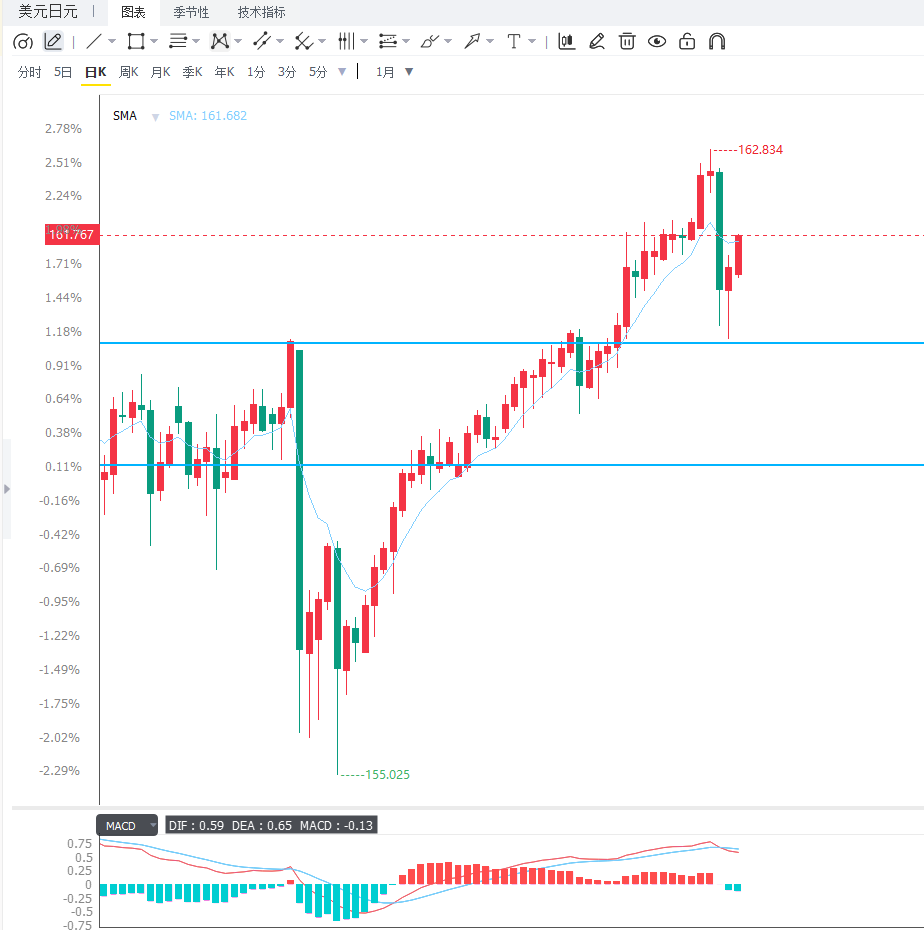
From a daily chart perspective, USD/JPY continues its medium-term upward channel structure, with the price consistently trading above multiple key moving averages, maintaining a clear bullish overall trend. After breaking out of the previous consolidation range, the exchange rate accelerated upwards and is currently forming a high-level extension structure above the 161 level . However, upward momentum is showing signs of slowing, indicating some profit-taking pressure at higher levels. If the price continues to hold above 160.50, the trend will remain bullish; however, a break below this support level could lead to a period of high-level consolidation and correction.
From a 4-hour chart perspective, the short-term trend has entered a period of high-level consolidation, with prices repeatedly oscillating within the 161-162 range, indicating increased market divergence at higher levels. In terms of momentum indicators, the MACD shows clear signs of overbought conditions, with the red bars beginning to converge, suggesting weakening upward momentum. The RSI, after approaching overbought territory, has retreated, indicating a potential short-term technical pullback. If the exchange rate fails to break through the 162 level with significant volume, it may retrace to the 160.80 or even 160.00 area to find support; conversely, if it breaks through and stabilizes above 162, it could open up new upward potential.
The overall technical structure shows that USD/JPY is still in a high-level consolidation phase within a strong trend. The trend has not been broken, but volatility is rising, and a short-term directional choice window is approaching.
Editor's Summary : The current USD/JPY exchange rate movement is essentially a result of the combined effects of the US dollar's interest rate advantage and the passive depreciation pressure on the yen. Although Japanese government bond yields have risen to a 30-year high, this has failed to effectively reverse the capital flow structure, reflecting that the global interest rate differential system still dominates exchange rate pricing logic. In the short term, the exchange rate may continue to fluctuate at high levels or even rise further, but the risk of policy intervention by the Japanese authorities and a phased correction in the US dollar due to weakening economic data should be noted. In the medium term, if the US economy slows further and the Fed's policy expectations shift, the dollar's strength may face a phased correction, and the USD/JPY volatility center may gradually rise, but at a slower pace. The overall market is entering a high-volatility repricing phase, with directional opportunities and policy risks coexisting.
In the bond market, the yield on 10-year Japanese government bonds climbed to approximately 2.79% , a new 30-year high, reflecting a repricing of market expectations for long-term inflation and policy normalization. However, this yield increase did not lead to a corresponding improvement in the attractiveness of yen assets; instead, due to the still significant widening of overseas interest rate differentials, funds continued to flow towards dollar assets.
Regarding the US dollar, the Federal Reserve maintained its tightening stance, and the market continued to price in the probability of multiple rate hikes this year. Although global inflationary pressures have eased somewhat, and the recovery in oil supply has reduced imported inflation to some extent, the dollar has remained resilient due to its interest rate advantage. Market surveys indicate that interest rate futures tools show a probability of approximately 77.3% for a rate hike this year, and overall market pricing remains hawkish.
However, recent US economic data has shown a clear divergence. The latest non-farm payroll data shows that the US added only about 57,000 jobs, far below the market expectation of 110,000, indicating that the momentum in the job market is slowing. However, the unemployment rate unexpectedly fell to 4.2% , meaning the overall labor market did not show a one-sided deterioration. This combination of "cooling employment but remaining resilient" will likely keep the US dollar in a high-level consolidation pattern in the short term.
The market is currently highly focused on the upcoming release of the minutes from the Federal Reserve's June meeting to determine whether future policy will rebalance between slowing growth and the inflation target. Meanwhile, Fed officials reiterated their policy stance of maintaining the 2% inflation target, but also acknowledged that recent inflation expectations have eased, leaving room for future policy adjustments.
Regarding the yen, market sentiment is highly tense. Due to the rapid depreciation of the exchange rate coupled with rising import costs, Japanese authorities face greater policy pressure, and traders are generally wary of escalating risks of verbal or actual intervention. Although rising Japanese bond yields typically indicate expectations of tighter monetary policy, under the current global interest rate differential structure, capital flows still clearly favor dollar assets, and the yen's passive pressure remains unchanged.
Overall, the core driver of the USD/JPY rise remains the structural imbalance between the dollar's interest rate advantage and risk appetite, rather than a single fundamental change. Given the lack of a clear shift in global liquidity, exchange rate fluctuations are more driven by expectations than actual data changes.
From a daily chart perspective, USD/JPY continues its medium-term upward channel structure, with the price consistently trading above multiple key moving averages, maintaining a clear bullish overall trend. After breaking out of the previous consolidation range, the exchange rate accelerated upwards and is currently forming a high-level extension structure above the 161 level . However, upward momentum is showing signs of slowing, indicating some profit-taking pressure at higher levels. If the price continues to hold above 160.50, the trend will remain bullish; however, a break below this support level could lead to a period of high-level consolidation and correction.
From a 4-hour chart perspective, the short-term trend has entered a period of high-level consolidation, with prices repeatedly oscillating within the 161-162 range, indicating increased market divergence at higher levels. In terms of momentum indicators, the MACD shows clear signs of overbought conditions, with the red bars beginning to converge, suggesting weakening upward momentum. The RSI, after approaching overbought territory, has retreated, indicating a potential short-term technical pullback. If the exchange rate fails to break through the 162 level with significant volume, it may retrace to the 160.80 or even 160.00 area to find support; conversely, if it breaks through and stabilizes above 162, it could open up new upward potential.
The overall technical structure shows that USD/JPY is still in a high-level consolidation phase within a strong trend. The trend has not been broken, but volatility is rising, and a short-term directional choice window is approaching.
Editor's Summary : The current USD/JPY exchange rate movement is essentially a result of the combined effects of the US dollar's interest rate advantage and the passive depreciation pressure on the yen. Although Japanese government bond yields have risen to a 30-year high, this has failed to effectively reverse the capital flow structure, reflecting that the global interest rate differential system still dominates exchange rate pricing logic. In the short term, the exchange rate may continue to fluctuate at high levels or even rise further, but the risk of policy intervention by the Japanese authorities and a phased correction in the US dollar due to weakening economic data should be noted. In the medium term, if the US economy slows further and the Fed's policy expectations shift, the dollar's strength may face a phased correction, and the USD/JPY volatility center may gradually rise, but at a slower pace. The overall market is entering a high-volatility repricing phase, with directional opportunities and policy risks coexisting.
- Risk Warning and Disclaimer
- The market involves risk, and trading may not be suitable for all investors. This article is for reference only and does not constitute personal investment advice, nor does it take into account certain users’ specific investment objectives, financial situation, or other needs. Any investment decisions made based on this information are at your own risk.