Strategist: Gold shows signs of bottoming out, gold and silver prices diverge.
2026-07-07 10:42:05
International gold prices have been consistently hampered by the key resistance level of $4,200, retreating sharply from their highs at the beginning of the year. However, Ole Hansen, head of commodity strategy at Saxo Bank, has offered a new assessment: the most severe phase of the months-long concentrated sell-off has ended, and the gold market has shifted from passive liquidation to a period of consolidation and bottoming out.
Weak US employment data, coupled with Federal Reserve Chairman Kevin Warsh's signals of easing inflation, has cooled market expectations for interest rate hikes, providing macro support for precious metals. While gold and silver have both entered a recovery window, their market size and supply-demand structure differ significantly, leading to a clear divergence in the pace of rebound and volatility. Short-term technical resistance will continue to limit upside potential.
Gold prices are primarily anchored to expectations of US monetary policy. Previously, the market had widely bet on a Fed rate hike this year, but the weak data of only 57,000 new jobs in June significantly weakened expectations of aggressive tightening.
Federal Reserve Chairman Warsh publicly stated that he would adhere to the goal of price stability, while acknowledging that inflation risks have eased significantly in recent weeks since he took office, further weakening the need for interest rate hikes.
Hansen stated that with a significant decline in long-term inflation expectations and a simultaneous drop in energy prices, there is no longer a reasonable logic for continued interest rate hikes. Once the market reaches a consensus, long-accumulated dollar bulls will exit the market en masse, leading to a weaker dollar and lower short-term US Treasury yields, which will benefit gold, a non-interest-bearing asset, from an opportunity cost perspective. However, before the Fed's policy path becomes fully clear, the path to gold price recovery faces numerous obstacles, and the current price is still 26% lower than its January high.
The support zone below $4,000 held for the time being, but gold prices encountered selling pressure again when they rebounded to around $4,200 on Monday. Many investors took advantage of the rally to reduce their positions, which is a typical recovery characteristic after a deep correction, and also means that the market needs sufficient time to build a solid bottom.
From a technical perspective, the 200-day moving average around $4485 is the first key resistance level. Above that, the 38.2% Fibonacci retracement level of the January-June decline is at $4574. Only a decisive break above these two key levels will confirm a true strengthening of the technical pattern. Currently, this rebound can only be defined as a bottoming-out phase. There has been a significant shift in market behavior, moving from panic selling to selective buying on dips. The future direction of the market will depend entirely on whether the macroeconomic environment continues to send easing signals.
Hansen also remains optimistic about the short-term trend of silver. On Monday, the price of silver stopped rising at $63.27 per ounce, but the previous deep decline stopped and stabilized at the key support level of $55, and the price successfully returned to above $60, releasing a positive recovery signal.
Silver combines the macroeconomic interest rate sensitivity of gold with a unique supply and demand logic in the real economy. A long-term supply gap coupled with steady expansion of industrial demand forms long-term fundamental support. However, the market circulation of silver is much smaller than that of gold, and its price is highly susceptible to short-term capital flows. When the market recovers, trend-following funds will quickly enter the market and push up prices, while during market sentiment reversals, there will be more intense and concentrated selling. It is a highly elastic and volatile precious metal .
The sharp decline in the past few months has severely damaged silver's technical pattern and market confidence, and the time required for price recovery will be longer than that for gold.
Considering macroeconomic policies, capital flows, and technical indicators, the concentrated selling pressure on precious metals has largely subsided, with gold officially entering a bottoming-out phase, while silver is simultaneously entering a window of stabilization and recovery. Continued weakening of US inflation and employment data is gradually mitigating the negative impact of the Fed's rate hikes, but gold faces multiple technical resistance levels that are unlikely to be broken quickly in the short term. Silver possesses long-term value based on industrial supply and demand, but traders should be wary of the trading risks associated with sharp fluctuations.
Subsequent policy statements from the Federal Reserve, the yield on US Treasury bonds, and the trend of the US dollar will directly determine the length of the bottoming process and the potential for a rebound in gold and silver prices.
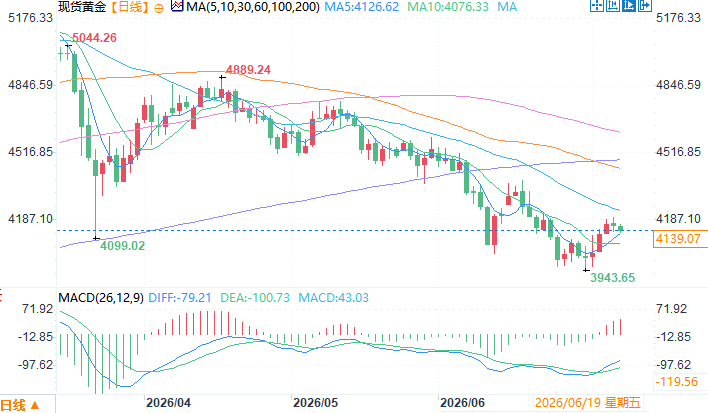
Spot gold daily chart source: EasyForex
At 10:41 AM Beijing time on July 7, spot gold was trading at $4,142.59 per ounce.
Weak US employment data, coupled with Federal Reserve Chairman Kevin Warsh's signals of easing inflation, has cooled market expectations for interest rate hikes, providing macro support for precious metals. While gold and silver have both entered a recovery window, their market size and supply-demand structure differ significantly, leading to a clear divergence in the pace of rebound and volatility. Short-term technical resistance will continue to limit upside potential.
Macroeconomic expectations are shifting towards easing, and expectations for Federal Reserve policy are reshaping the pricing logic of precious metals.
Gold prices are primarily anchored to expectations of US monetary policy. Previously, the market had widely bet on a Fed rate hike this year, but the weak data of only 57,000 new jobs in June significantly weakened expectations of aggressive tightening.
Federal Reserve Chairman Warsh publicly stated that he would adhere to the goal of price stability, while acknowledging that inflation risks have eased significantly in recent weeks since he took office, further weakening the need for interest rate hikes.
Hansen stated that with a significant decline in long-term inflation expectations and a simultaneous drop in energy prices, there is no longer a reasonable logic for continued interest rate hikes. Once the market reaches a consensus, long-accumulated dollar bulls will exit the market en masse, leading to a weaker dollar and lower short-term US Treasury yields, which will benefit gold, a non-interest-bearing asset, from an opportunity cost perspective. However, before the Fed's policy path becomes fully clear, the path to gold price recovery faces numerous obstacles, and the current price is still 26% lower than its January high.
Gold has entered a bottoming phase, with multiple technical resistance levels limiting the extent of any rebound.
The support zone below $4,000 held for the time being, but gold prices encountered selling pressure again when they rebounded to around $4,200 on Monday. Many investors took advantage of the rally to reduce their positions, which is a typical recovery characteristic after a deep correction, and also means that the market needs sufficient time to build a solid bottom.
From a technical perspective, the 200-day moving average around $4485 is the first key resistance level. Above that, the 38.2% Fibonacci retracement level of the January-June decline is at $4574. Only a decisive break above these two key levels will confirm a true strengthening of the technical pattern. Currently, this rebound can only be defined as a bottoming-out phase. There has been a significant shift in market behavior, moving from panic selling to selective buying on dips. The future direction of the market will depend entirely on whether the macroeconomic environment continues to send easing signals.
Silver prices stabilized and rebounded in tandem, reflecting a dual nature of supply and demand advantages and high volatility.
Hansen also remains optimistic about the short-term trend of silver. On Monday, the price of silver stopped rising at $63.27 per ounce, but the previous deep decline stopped and stabilized at the key support level of $55, and the price successfully returned to above $60, releasing a positive recovery signal.
Silver combines the macroeconomic interest rate sensitivity of gold with a unique supply and demand logic in the real economy. A long-term supply gap coupled with steady expansion of industrial demand forms long-term fundamental support. However, the market circulation of silver is much smaller than that of gold, and its price is highly susceptible to short-term capital flows. When the market recovers, trend-following funds will quickly enter the market and push up prices, while during market sentiment reversals, there will be more intense and concentrated selling. It is a highly elastic and volatile precious metal .
The sharp decline in the past few months has severely damaged silver's technical pattern and market confidence, and the time required for price recovery will be longer than that for gold.
Summarize
Considering macroeconomic policies, capital flows, and technical indicators, the concentrated selling pressure on precious metals has largely subsided, with gold officially entering a bottoming-out phase, while silver is simultaneously entering a window of stabilization and recovery. Continued weakening of US inflation and employment data is gradually mitigating the negative impact of the Fed's rate hikes, but gold faces multiple technical resistance levels that are unlikely to be broken quickly in the short term. Silver possesses long-term value based on industrial supply and demand, but traders should be wary of the trading risks associated with sharp fluctuations.
Subsequent policy statements from the Federal Reserve, the yield on US Treasury bonds, and the trend of the US dollar will directly determine the length of the bottoming process and the potential for a rebound in gold and silver prices.
Spot gold daily chart source: EasyForex
At 10:41 AM Beijing time on July 7, spot gold was trading at $4,142.59 per ounce.
- Risk Warning and Disclaimer
- The market involves risk, and trading may not be suitable for all investors. This article is for reference only and does not constitute personal investment advice, nor does it take into account certain users’ specific investment objectives, financial situation, or other needs. Any investment decisions made based on this information are at your own risk.