The pound is poised for a nine-day winning streak: How far can the rally, fueled by waning expectations of a Fed rate hike, go?
2026-07-07 10:48:27
On Tuesday (July 7) in early Asian trading, the pound continued its upward trend against the dollar, poised to rise for its ninth consecutive trading day, currently trading around 1.3390.
The immediate trigger for the weakening dollar was a significant cooling of market expectations for a Fed rate hike this month and in September—a muted jobs report, coupled with increased OPEC+ production and a plunge in oil prices driven by the US-Iran peace agreement, all of which eased inflationary pressures.
However, hawkish comments from Federal Reserve Governor Waller and resilient ISM services data provided a floor for the dollar.
At the same time, the pound itself is under pressure: market expectations for the Bank of England to raise interest rates this year have plummeted from two to only one with a probability of only 70%.
The core driver of the pound's nine-day winning streak against the dollar comes from the market's repricing of the Federal Reserve's policy path.
In the past few weeks, market participants had priced in consecutive interest rate hikes in July and September, but a confluence of data and events is undermining that expectation.
The job market is the first crack. The latest non-farm payroll report shows that job growth in April, May, and June all fell short of Wall Street expectations. While the modest slowdown in job growth is far from worrying, it is enough to make the market question the inflationary pressures driven by an overheated labor market. Within the framework of the Federal Reserve's emphasis on "data dependence," the marginal softening of employment directly reduces the necessity for aggressive interest rate hikes.
Crude oil prices are the second variable. OPEC+'s decision to increase production, coupled with the progress of the US-Iran peace agreement, has driven a significant decline in crude oil prices recently. The decrease in energy costs not only directly lowers overall inflation figures but also transmits to a wider range of economic sectors through transportation costs and raw material prices, alleviating the "inflation spiral" pressure that previously plagued the Federal Reserve. This supply-side deflationary effect gives the Fed greater leeway in curbing inflation.
The combined effect of these two factors has led to a significant adjustment in market expectations regarding the Federal Reserve's interest rate hikes. The weakening of the US dollar index in recent trading has provided macroeconomic support for the continued rise of the pound.
While the dollar was under overall pressure, it did not suffer a complete collapse. Federal Reserve Governor Waller's remarks on Monday provided baseline support for the dollar, and the signals they conveyed deserve careful analysis.
Waller's core argument focuses on the double-edged sword effect of forward guidance—on the one hand, he acknowledges that forward guidance is a "valuable tool" that can accelerate policy transmission; on the other hand, he emphasizes that when guidance is too rigid or faces multiple reasonable economic paths, it can become a policy constraint. This statement essentially paves the way for more flexible policy communication, implicitly correcting the possibility that current market expectations may be oversimplified.
Waller's insistence on the credibility of his 2% inflation commitment, his rejection of financing deficits through low interest rates, and his preference for an inflation target range (without changing the current target) all point to a hawkish stance. Crucially, however, he offered no explicit commentary on the near-term policy path. This "principled but uncommitted" approach echoes the communication paradigm advocated by Lagarde and Lane at the Sintra Forum—major central banks appear to be simultaneously shifting towards a "framework guidance" model. For the dollar, this means limited downside potential, but upside catalysts await further confirmation from data.
Another layer of support for the US dollar's performance comes from real economic data. The June ISM Services Purchasing Managers' Index came in at 54.0, exactly in line with market expectations, and continued to be in expansion territory (above the 50-point threshold separating contraction from expansion).
The breakdown of data reveals complex signals:
The price index fell sharply from 71.3 to 67.7, confirming that the decline in crude oil prices is being transmitted to the cost side of the service sector, which is undoubtedly a positive signal for the inflation outlook. However, the employment index rebounded significantly from the contractionary range of 47.9 to 51.2, returning to the expansionary range. This improvement contrasts somewhat with the moderate slowdown in the employment report, suggesting that demand for labor in the service sector remains resilient.
For the US dollar, the overall interpretation of this report is "neutral to stable"—there were no unexpected downward shocks, nor any upward surprises that would trigger inflation concerns. The continued expansion of the service sector, the largest sector of the US economy, provides the Federal Reserve with a reason not to rush into a shift to easing. The fact that the dollar did not experience a further significant decline after the report's release is based on this logic.
The continued strengthening of the pound sterling, without supporting fundamentals, raises questions about its sustainability. Current policy developments in the UK offer a warning sign.
The market's adjustment to expectations regarding the Bank of England's policy has been astonishing. Just weeks ago, investors were pricing in two rate hikes this year (each by 25 basis points); now, market expectations have plummeted to only one hike with a probability of just 70%. This contraction is far greater than the adjustment in market expectations for the Federal Reserve, meaning that the pound's rise is more of a "passive push" from the weakening dollar than a "proactive strengthening" of the pound itself.
In a recent statement, Bank of England Governor Bailey confirmed that inflation remains on track to return to the 2% target, but acknowledged that this will take longer than previously predicted and explicitly ruled out the possibility of a near-term interest rate cut. While this statement leans towards a hawkish stance, its impact is limited—it more accurately "denies" a rate cut than "confirms" a rate hike.
The Bank of England's monetary policy meeting on June 18th provided a more detailed picture of the internal workings: officials voted 7-2 to keep the benchmark interest rate unchanged at 3.75%. Despite holding rates steady, the hawkish camp has doubled since April – two dissenting members advocated for an immediate rate hike to 4.00%. This widening internal division suggests that the Bank of England's inclination to raise rates is building, but has not yet reached a tipping point.
The UK's current inflation rate is 2.8%, but internal forecasts from the Bank of England suggest that inflation could rebound to above 3% this autumn due to the delayed transmission of energy costs during the war. This expectation has prompted major sell-side institutions to predict that the next interest rate hike may occur around the end of 2026. In short, the Bank of England's policy path is currently in a "confirmation" phase—waiting for the energy transmission effect to fully materialize and for wage data to verify the existence of a second round of effects.
The pound is poised for its ninth consecutive day of gains against the dollar, a rare occurrence in recent G10 currency trends. However, the length of a rally does not equate to its strength—the current rise reflects more of a pullback in market expectations for a Fed rate hike than a reassessment of the Bank of England's rate hike prospects. A corrective rebound in the dollar could quickly limit the pound's gains should US economic data show signs of resilience.
US CPI data is the primary variable. If core inflation falls as expected, the probability of a Fed rate hike in September will further decline, putting pressure on the dollar and potentially allowing the pound to continue its upward trend. If core inflation remains unexpectedly strong, Waller's hawkish rhetoric will be repriced by the market, and the pound's nine-day winning streak may come to an end.
UK wage and services inflation data are equally crucial. If they indicate that a second wave of effects is forming, the market's expectation of a 70% probability of a Bank of England rate hike this year will move closer to 100%, giving the pound an endogenous boost and freeing it from its passive reliance on a weakening dollar.
The subsequent movement of crude oil prices will provide either a macroeconomic resonance or a reverse disturbance. If the decline in oil prices caused by OPEC+ production increases and geopolitical easing continues, it will simultaneously benefit a weaker dollar and a rebound in risk appetite, forming a resonance support for the pound sterling. However, if the situation in the Middle East changes again and drives a rebound in oil prices, inflation expectations will tilt back towards the Federal Reserve, and the passive upward logic of the pound sterling will be impacted. The direction and combination of these three variables will determine whether the nine-day winning streak is the beginning of a new trend or the last dance before overbought correction.
Overall, the nine consecutive days of gains indicate that a short-term overbought condition objectively exists, but the momentum of the trend should not be ignored. With both the Federal Reserve and the Bank of England operating under a "data-dependent, open-path" guidance framework, any unexpected data release from either could trigger a significant repricing of the exchange rate. Traders should currently focus not on the short-term question of "when will the nine-day winning streak end," but rather on the core contradiction of "whether the policy path differences between the two central banks have been fully priced in."
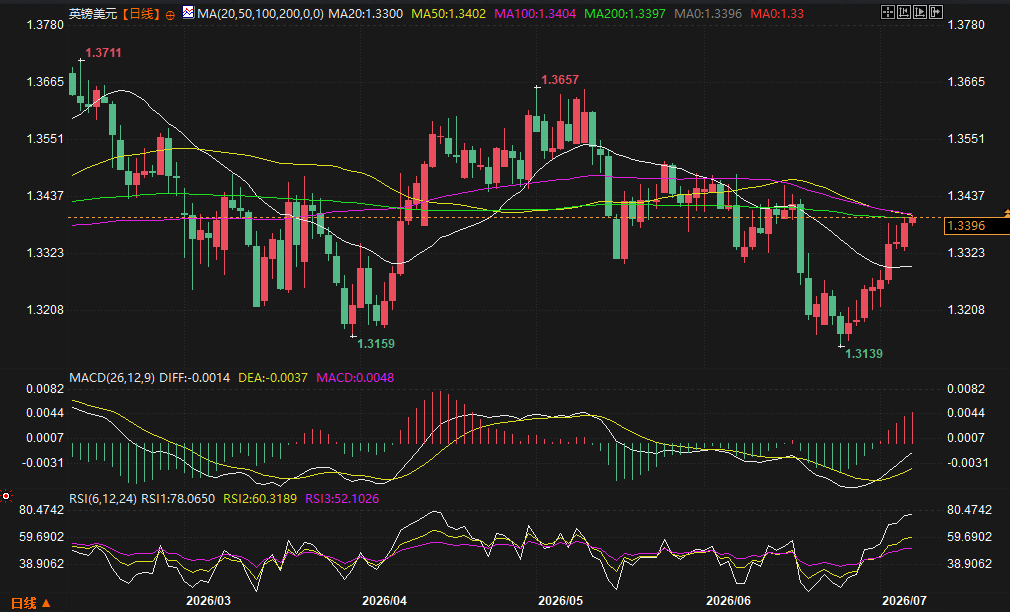
(GBP/USD daily chart, source: FX678)
At 10:47 Beijing time on July 7, the British pound was trading at 1.3391/92 against the US dollar.
The immediate trigger for the weakening dollar was a significant cooling of market expectations for a Fed rate hike this month and in September—a muted jobs report, coupled with increased OPEC+ production and a plunge in oil prices driven by the US-Iran peace agreement, all of which eased inflationary pressures.
However, hawkish comments from Federal Reserve Governor Waller and resilient ISM services data provided a floor for the dollar.
At the same time, the pound itself is under pressure: market expectations for the Bank of England to raise interest rates this year have plummeted from two to only one with a probability of only 70%.
The core narrative behind the weakening dollar: a combination of cooling employment and plummeting oil prices creating a "deflationary duopoly."
The core driver of the pound's nine-day winning streak against the dollar comes from the market's repricing of the Federal Reserve's policy path.
In the past few weeks, market participants had priced in consecutive interest rate hikes in July and September, but a confluence of data and events is undermining that expectation.
The job market is the first crack. The latest non-farm payroll report shows that job growth in April, May, and June all fell short of Wall Street expectations. While the modest slowdown in job growth is far from worrying, it is enough to make the market question the inflationary pressures driven by an overheated labor market. Within the framework of the Federal Reserve's emphasis on "data dependence," the marginal softening of employment directly reduces the necessity for aggressive interest rate hikes.
Crude oil prices are the second variable. OPEC+'s decision to increase production, coupled with the progress of the US-Iran peace agreement, has driven a significant decline in crude oil prices recently. The decrease in energy costs not only directly lowers overall inflation figures but also transmits to a wider range of economic sectors through transportation costs and raw material prices, alleviating the "inflation spiral" pressure that previously plagued the Federal Reserve. This supply-side deflationary effect gives the Fed greater leeway in curbing inflation.
The combined effect of these two factors has led to a significant adjustment in market expectations regarding the Federal Reserve's interest rate hikes. The weakening of the US dollar index in recent trading has provided macroeconomic support for the continued rise of the pound.
Waller's remarks signaled a change in hawkish stance, but the "flexible forward guidance" hinted at underlying implications.
While the dollar was under overall pressure, it did not suffer a complete collapse. Federal Reserve Governor Waller's remarks on Monday provided baseline support for the dollar, and the signals they conveyed deserve careful analysis.
Waller's core argument focuses on the double-edged sword effect of forward guidance—on the one hand, he acknowledges that forward guidance is a "valuable tool" that can accelerate policy transmission; on the other hand, he emphasizes that when guidance is too rigid or faces multiple reasonable economic paths, it can become a policy constraint. This statement essentially paves the way for more flexible policy communication, implicitly correcting the possibility that current market expectations may be oversimplified.
Waller's insistence on the credibility of his 2% inflation commitment, his rejection of financing deficits through low interest rates, and his preference for an inflation target range (without changing the current target) all point to a hawkish stance. Crucially, however, he offered no explicit commentary on the near-term policy path. This "principled but uncommitted" approach echoes the communication paradigm advocated by Lagarde and Lane at the Sintra Forum—major central banks appear to be simultaneously shifting towards a "framework guidance" model. For the dollar, this means limited downside potential, but upside catalysts await further confirmation from data.
ISM Services Data: Prices Cool but Employment Recovers, Economic Resilience Cannot Be Ignored
Another layer of support for the US dollar's performance comes from real economic data. The June ISM Services Purchasing Managers' Index came in at 54.0, exactly in line with market expectations, and continued to be in expansion territory (above the 50-point threshold separating contraction from expansion).
The breakdown of data reveals complex signals:
The price index fell sharply from 71.3 to 67.7, confirming that the decline in crude oil prices is being transmitted to the cost side of the service sector, which is undoubtedly a positive signal for the inflation outlook. However, the employment index rebounded significantly from the contractionary range of 47.9 to 51.2, returning to the expansionary range. This improvement contrasts somewhat with the moderate slowdown in the employment report, suggesting that demand for labor in the service sector remains resilient.
For the US dollar, the overall interpretation of this report is "neutral to stable"—there were no unexpected downward shocks, nor any upward surprises that would trigger inflation concerns. The continued expansion of the service sector, the largest sector of the US economy, provides the Federal Reserve with a reason not to rush into a shift to easing. The fact that the dollar did not experience a further significant decline after the report's release is based on this logic.
Concerns about the pound: Bank of England rate hike expectations shrink from "two" to "one with only a 70% probability"
The continued strengthening of the pound sterling, without supporting fundamentals, raises questions about its sustainability. Current policy developments in the UK offer a warning sign.
The market's adjustment to expectations regarding the Bank of England's policy has been astonishing. Just weeks ago, investors were pricing in two rate hikes this year (each by 25 basis points); now, market expectations have plummeted to only one hike with a probability of just 70%. This contraction is far greater than the adjustment in market expectations for the Federal Reserve, meaning that the pound's rise is more of a "passive push" from the weakening dollar than a "proactive strengthening" of the pound itself.
In a recent statement, Bank of England Governor Bailey confirmed that inflation remains on track to return to the 2% target, but acknowledged that this will take longer than previously predicted and explicitly ruled out the possibility of a near-term interest rate cut. While this statement leans towards a hawkish stance, its impact is limited—it more accurately "denies" a rate cut than "confirms" a rate hike.
The Bank of England's monetary policy meeting on June 18th provided a more detailed picture of the internal workings: officials voted 7-2 to keep the benchmark interest rate unchanged at 3.75%. Despite holding rates steady, the hawkish camp has doubled since April – two dissenting members advocated for an immediate rate hike to 4.00%. This widening internal division suggests that the Bank of England's inclination to raise rates is building, but has not yet reached a tipping point.
The UK's current inflation rate is 2.8%, but internal forecasts from the Bank of England suggest that inflation could rebound to above 3% this autumn due to the delayed transmission of energy costs during the war. This expectation has prompted major sell-side institutions to predict that the next interest rate hike may occur around the end of 2026. In short, the Bank of England's policy path is currently in a "confirmation" phase—waiting for the energy transmission effect to fully materialize and for wage data to verify the existence of a second round of effects.
Outlook: The quality of the nine-day winning streak and key variables for the next step
The pound is poised for its ninth consecutive day of gains against the dollar, a rare occurrence in recent G10 currency trends. However, the length of a rally does not equate to its strength—the current rise reflects more of a pullback in market expectations for a Fed rate hike than a reassessment of the Bank of England's rate hike prospects. A corrective rebound in the dollar could quickly limit the pound's gains should US economic data show signs of resilience.
US CPI data is the primary variable. If core inflation falls as expected, the probability of a Fed rate hike in September will further decline, putting pressure on the dollar and potentially allowing the pound to continue its upward trend. If core inflation remains unexpectedly strong, Waller's hawkish rhetoric will be repriced by the market, and the pound's nine-day winning streak may come to an end.
UK wage and services inflation data are equally crucial. If they indicate that a second wave of effects is forming, the market's expectation of a 70% probability of a Bank of England rate hike this year will move closer to 100%, giving the pound an endogenous boost and freeing it from its passive reliance on a weakening dollar.
The subsequent movement of crude oil prices will provide either a macroeconomic resonance or a reverse disturbance. If the decline in oil prices caused by OPEC+ production increases and geopolitical easing continues, it will simultaneously benefit a weaker dollar and a rebound in risk appetite, forming a resonance support for the pound sterling. However, if the situation in the Middle East changes again and drives a rebound in oil prices, inflation expectations will tilt back towards the Federal Reserve, and the passive upward logic of the pound sterling will be impacted. The direction and combination of these three variables will determine whether the nine-day winning streak is the beginning of a new trend or the last dance before overbought correction.
Overall, the nine consecutive days of gains indicate that a short-term overbought condition objectively exists, but the momentum of the trend should not be ignored. With both the Federal Reserve and the Bank of England operating under a "data-dependent, open-path" guidance framework, any unexpected data release from either could trigger a significant repricing of the exchange rate. Traders should currently focus not on the short-term question of "when will the nine-day winning streak end," but rather on the core contradiction of "whether the policy path differences between the two central banks have been fully priced in."
(GBP/USD daily chart, source: FX678)
At 10:47 Beijing time on July 7, the British pound was trading at 1.3391/92 against the US dollar.
- Risk Warning and Disclaimer
- The market involves risk, and trading may not be suitable for all investors. This article is for reference only and does not constitute personal investment advice, nor does it take into account certain users’ specific investment objectives, financial situation, or other needs. Any investment decisions made based on this information are at your own risk.