Central banks around the world are preparing to ramp up gold purchases, while institutions are sticking to their year-end target of $4,600.
2026-07-07 10:38:16
International spot gold prices have fallen sharply from their historical high of nearly $5,600 per ounce, and are currently hovering around $4,140. Market pessimism is rising, but Bernard Dahdah, a precious metals analyst at Natixis , maintains his original judgment that this round of price correction has not destroyed the long-term positive fundamentals for gold, and continues to predict that gold prices will reach $4,600 by the end of the year.
Following the easing of tensions between the US and Iran, central banks around the world will resume large-scale gold purchases. The reshaping of the geopolitical landscape weakens the credibility of the US dollar as an asset. Coupled with stable physical and official procurement demand from major Asian countries, this will continue to support gold prices. The widespread use of gold swap instruments also means that central banks do not need to permanently sell gold to obtain liquidity, thus solidifying the logic of long-term official gold hoarding.
Dahda stated that he would not arbitrarily change his medium- to long-term forecasts based on short-term fluctuations in gold prices. Even when gold prices surged to nearly $5,600, he did not raise his target price. With the current sharp decline in gold prices, his year-end forecast of $4,600 remains unchanged.
He stated that changing one's views based on slight market fluctuations lacks objectivity and professional analysis, and that short-term speculative fluctuations are insufficient to shake the underlying support logic for gold.
Previously, heightened geopolitical tensions between the US and Iran and a sharp rise in international oil prices forced many central banks to temporarily liquidate assets and reduce their gold reserves to stabilize their currencies and replenish foreign exchange liquidity, thus temporarily disrupting official gold purchases. Now, with the intensity of the conflict significantly reduced and energy markets gradually stabilizing, reserve managers worldwide will once again prioritize asset diversification.
Dahda stated that the most intense phase of the conflict has largely ended, and the monthly gold purchases by central banks are expected to break records. Only the weaker purchases in the first quarter will drag down the total for the year, so the annual gold purchase volume may not reach a new high. However, the monthly increase in the second half of the year is highly likely to exceed market expectations. The geopolitical landscape has permanently altered how countries assess dollar assets, damaging the image of the United States as a guarantor of global financial stability. Countries holding large amounts of US Treasury bonds and dollar reserves continue to worry about the safety of dollar assets, making long-term gold holdings an inevitable choice.
This crisis has proven that gold is not merely a static store of value; gold swaps offer central banks a new liquidity solution. Previously, when funds were scarce, central banks could only sell physical gold at a discount; now, through swap transactions, they can quickly obtain the necessary foreign exchange liquidity while retaining long-term ownership of their gold.
Dahda stated that for sovereign nations that manage their foreign exchange reserves prudently, gold swaps are a reasonable tool that balances liquidity and long-term strategic reserves, further alleviating long-term concerns about countries reducing their gold holdings.
The recovery in domestic demand and official gold purchases are another important pillar supporting gold prices. Although there will not be a short-term surge in consumption, the continuous and stable regular purchases can continuously raise the market bottom.
Central banks around the world are making steady monthly purchases, which is gradually strengthening the support level for gold prices. Even if there is a short-term sell-off by speculative funds, long-term official buying will limit the downside. Over the long term, the bottom of gold prices will gradually move upward.
Considering the geopolitical environment, central bank reserve strategies, and physical demand, the recent sharp pullback in gold prices is merely a technical correction, and the long-term bullish outlook remains intact. In the second half of the year, the combined forces of concentrated central bank gold purchases, weakening dollar credibility, and stable demand from major Asian countries will support a recovery in gold prices to $4,600 within the year. Furthermore, gold swap instruments optimize reserve management, eliminating the risk of central banks being forced to sell off reserves on a large scale, ensuring that the medium- to long-term upward trend in gold prices will not change.
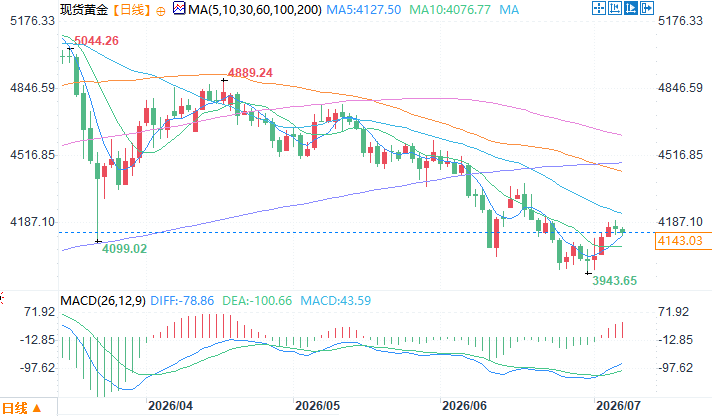
Spot gold daily chart source: EasyForex
At 10:37 AM Beijing time on July 7, spot gold was trading at $4142.36 per ounce.
Following the easing of tensions between the US and Iran, central banks around the world will resume large-scale gold purchases. The reshaping of the geopolitical landscape weakens the credibility of the US dollar as an asset. Coupled with stable physical and official procurement demand from major Asian countries, this will continue to support gold prices. The widespread use of gold swap instruments also means that central banks do not need to permanently sell gold to obtain liquidity, thus solidifying the logic of long-term official gold hoarding.
Regardless of short-term market adjustments, we firmly maintain our year-end gold price target.
Dahda stated that he would not arbitrarily change his medium- to long-term forecasts based on short-term fluctuations in gold prices. Even when gold prices surged to nearly $5,600, he did not raise his target price. With the current sharp decline in gold prices, his year-end forecast of $4,600 remains unchanged.
He stated that changing one's views based on slight market fluctuations lacks objectivity and professional analysis, and that short-term speculative fluctuations are insufficient to shake the underlying support logic for gold.
Easing tensions create room for gold purchases; central bank procurement in the second half of the year is expected to exceed expectations.
Previously, heightened geopolitical tensions between the US and Iran and a sharp rise in international oil prices forced many central banks to temporarily liquidate assets and reduce their gold reserves to stabilize their currencies and replenish foreign exchange liquidity, thus temporarily disrupting official gold purchases. Now, with the intensity of the conflict significantly reduced and energy markets gradually stabilizing, reserve managers worldwide will once again prioritize asset diversification.
Dahda stated that the most intense phase of the conflict has largely ended, and the monthly gold purchases by central banks are expected to break records. Only the weaker purchases in the first quarter will drag down the total for the year, so the annual gold purchase volume may not reach a new high. However, the monthly increase in the second half of the year is highly likely to exceed market expectations. The geopolitical landscape has permanently altered how countries assess dollar assets, damaging the image of the United States as a guarantor of global financial stability. Countries holding large amounts of US Treasury bonds and dollar reserves continue to worry about the safety of dollar assets, making long-term gold holdings an inevitable choice.
Gold swaps enhance the reserve function, moving away from the passive model of emergency selling.
This crisis has proven that gold is not merely a static store of value; gold swaps offer central banks a new liquidity solution. Previously, when funds were scarce, central banks could only sell physical gold at a discount; now, through swap transactions, they can quickly obtain the necessary foreign exchange liquidity while retaining long-term ownership of their gold.
Dahda stated that for sovereign nations that manage their foreign exchange reserves prudently, gold swaps are a reasonable tool that balances liquidity and long-term strategic reserves, further alleviating long-term concerns about countries reducing their gold holdings.
Demand from major Asian countries provides stable support, continuously raising the bottom range of gold prices.
The recovery in domestic demand and official gold purchases are another important pillar supporting gold prices. Although there will not be a short-term surge in consumption, the continuous and stable regular purchases can continuously raise the market bottom.
Central banks around the world are making steady monthly purchases, which is gradually strengthening the support level for gold prices. Even if there is a short-term sell-off by speculative funds, long-term official buying will limit the downside. Over the long term, the bottom of gold prices will gradually move upward.
Summarize
Considering the geopolitical environment, central bank reserve strategies, and physical demand, the recent sharp pullback in gold prices is merely a technical correction, and the long-term bullish outlook remains intact. In the second half of the year, the combined forces of concentrated central bank gold purchases, weakening dollar credibility, and stable demand from major Asian countries will support a recovery in gold prices to $4,600 within the year. Furthermore, gold swap instruments optimize reserve management, eliminating the risk of central banks being forced to sell off reserves on a large scale, ensuring that the medium- to long-term upward trend in gold prices will not change.
Spot gold daily chart source: EasyForex
At 10:37 AM Beijing time on July 7, spot gold was trading at $4142.36 per ounce.
- Risk Warning and Disclaimer
- The market involves risk, and trading may not be suitable for all investors. This article is for reference only and does not constitute personal investment advice, nor does it take into account certain users’ specific investment objectives, financial situation, or other needs. Any investment decisions made based on this information are at your own risk.