Explosions were heard in Hormuz, putting pressure on the US-Iran ceasefire agreement—but how long can the dollar bulls' "lifeline" last?
2026-07-07 13:59:45
On Tuesday (July 7) during the Asian session, the US dollar index (DXY) continued to consolidate below the 101.00 level.
The market is being tethered by two offsetting forces: on the one hand, escalating tensions in the Strait of Hormuz—an oil tanker was attacked by an unidentified projectile, putting pressure on the 60-day ceasefire agreement between the US and Iran—are providing support for the safe-haven dollar; on the other hand, after weak June non-farm payroll data, market expectations for a Fed rate hike this year have shrunk dramatically from "one or two" to "zero or one," curbing aggressive bets by dollar bulls.
In addition, the ISM Services PMI released on Monday came in at 54.0, in line with expectations but slightly lower than the previous value of 54.5, failing to provide additional support for the US dollar.
Market focus has shifted to the FOMC meeting minutes to be released on Wednesday, which will provide a new directional catalyst for the DXY.
Tensions in the Strait of Hormuz are escalating, providing new buying opportunities for the safe-haven dollar.
An oil tanker was reportedly attacked by unidentified projectiles while transiting the Strait of Hormuz. Meanwhile, Iran is attempting to consolidate its control over this strategic waterway and is charging commercial vessels service fees—despite strong opposition from the United States. These incidents have cast doubt on the effectiveness of the 60-day ceasefire agreement between the US and Iran, and geopolitical risk premiums are being reintroduced into the market.
Crude oil prices rose moderately as a result, which to some extent reignited inflation concerns and provided additional support for the dollar.
For the US dollar, the tensions in the Strait of Hormuz are a "double benefit": it directly benefits the dollar through safe-haven demand, and indirectly reinforces the narrative of "stubborn inflation" by pushing up energy prices, thus providing a marginal justification for the Federal Reserve to maintain a hawkish stance.
However, the positive effects of the Holmuz policy are being offset by another force – the continued waning of expectations for a Fed rate hike.
Last week's June non-farm payrolls report showed an increase of only 57,000 jobs, far below market expectations. This data has triggered a significant repricing in the market regarding the Federal Reserve's policy path: the market previously expected "one or two" rate hikes in 2026, but this expectation has now plummeted to "zero to one".
While this adjustment was not as drastic as the market's adjustment to the Bank of England's expectations, it was enough to curb the willingness of dollar bulls to continue aggressively increasing their positions at high levels.
Domestic economic data in the United States also failed to provide a significant boost. The ISM Services PMI released on Monday came in at 54.0, in line with market expectations, but lower than the previous reading of 54.5.
Although still in expansion territory, the marginal slowdown indicates that the momentum in the service sector is cooling moderately, which is consistent with the macroeconomic narrative of "weakening employment and easing inflation".
From a technical perspective, the US dollar index is currently in a consolidation phase where bulls and bears are locked in a tug-of-war.
On the downside, the 97.60 support area formed between April and May remains a crucial defense line for the bulls. While the upward trend since then has slowed somewhat, there are no signs of a trend reversal yet.
On the upside, the 101.00 level has become a significant psychological resistance in the near term. A breakthrough would require a new catalyst – either a significant escalation of the Hormuz situation driving larger-scale safe-haven buying, or a stronger-than-expected hawkish signal in the FOMC meeting minutes.
It is worth noting that the market's trading logic for the US dollar is shifting from "driven solely by expectations of interest rate hikes" to "a tug-of-war between safe-haven demand and expectations of interest rate hikes." This shift itself means that the volatility pattern of the US dollar index may change from the previous trend of strengthening to a wider range of fluctuations.
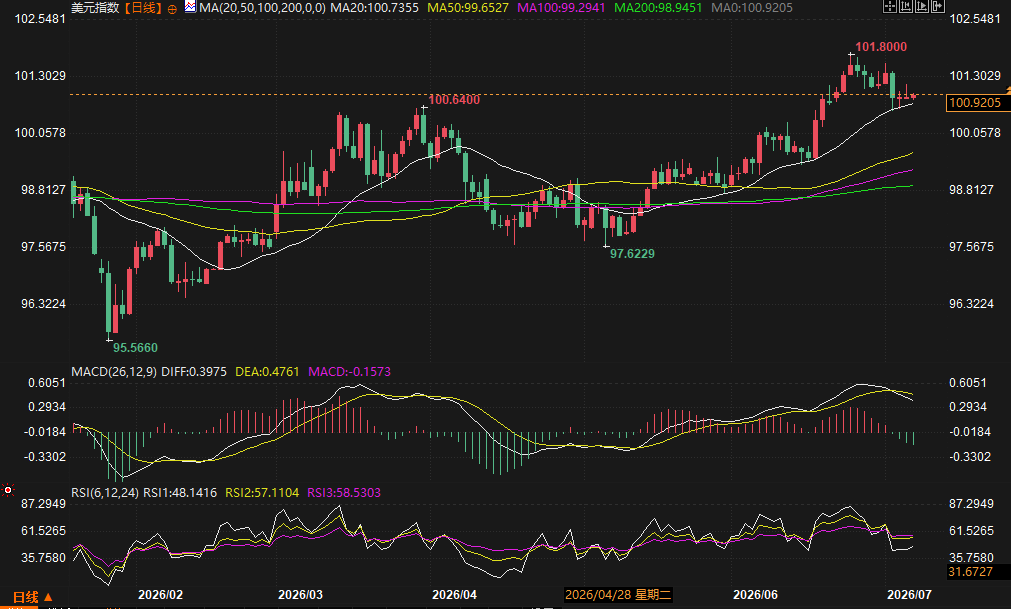
(US Dollar Index Daily Chart, Source: FX678)
Market focus has now clearly shifted to the FOMC meeting minutes to be released on Wednesday. These minutes will provide the market with the following key information:
The committee members discussed the specifics of the "data-dependent" path—whether any of them had reservations about raising interest rates.
Assessment of the transmission effect of energy shocks – whether the decline in energy prices is considered sufficient to alleviate inflationary pressures.
Tolerance for a weakening job market – Is the addition of 57,000 non-farm jobs enough to change the committee members’ assessment that the labor market is overheated?
If the minutes signal that "the threshold for interest rate hikes has been raised" or "there is greater confidence in the decline of inflation," the dollar index may further decline to the 99-100 range. Conversely, if the minutes reiterate a hawkish tone that "the 2% target is non-negotiable" and remains vigilant about inflation in the services sector, Hormuz's safe-haven buying may resonate with hawkish expectations, pushing the dollar index back above 101.00.
With the two major forces offsetting each other, the consolidation below 101.00 may be the calm before the storm—and the FOMC minutes are the most likely trigger to break this calm.
At 13:59 Beijing time on July 7, the US dollar index was at 100.92.
The market is being tethered by two offsetting forces: on the one hand, escalating tensions in the Strait of Hormuz—an oil tanker was attacked by an unidentified projectile, putting pressure on the 60-day ceasefire agreement between the US and Iran—are providing support for the safe-haven dollar; on the other hand, after weak June non-farm payroll data, market expectations for a Fed rate hike this year have shrunk dramatically from "one or two" to "zero or one," curbing aggressive bets by dollar bulls.
In addition, the ISM Services PMI released on Monday came in at 54.0, in line with expectations but slightly lower than the previous value of 54.5, failing to provide additional support for the US dollar.
Market focus has shifted to the FOMC meeting minutes to be released on Wednesday, which will provide a new directional catalyst for the DXY.
The situation in Hormuz: Geopolitical risk premium re-injected
Tensions in the Strait of Hormuz are escalating, providing new buying opportunities for the safe-haven dollar.
An oil tanker was reportedly attacked by unidentified projectiles while transiting the Strait of Hormuz. Meanwhile, Iran is attempting to consolidate its control over this strategic waterway and is charging commercial vessels service fees—despite strong opposition from the United States. These incidents have cast doubt on the effectiveness of the 60-day ceasefire agreement between the US and Iran, and geopolitical risk premiums are being reintroduced into the market.
Crude oil prices rose moderately as a result, which to some extent reignited inflation concerns and provided additional support for the dollar.
For the US dollar, the tensions in the Strait of Hormuz are a "double benefit": it directly benefits the dollar through safe-haven demand, and indirectly reinforces the narrative of "stubborn inflation" by pushing up energy prices, thus providing a marginal justification for the Federal Reserve to maintain a hawkish stance.
Interest rate hike expectations recede: Employment data is changing market pricing logic
However, the positive effects of the Holmuz policy are being offset by another force – the continued waning of expectations for a Fed rate hike.
Last week's June non-farm payrolls report showed an increase of only 57,000 jobs, far below market expectations. This data has triggered a significant repricing in the market regarding the Federal Reserve's policy path: the market previously expected "one or two" rate hikes in 2026, but this expectation has now plummeted to "zero to one".
While this adjustment was not as drastic as the market's adjustment to the Bank of England's expectations, it was enough to curb the willingness of dollar bulls to continue aggressively increasing their positions at high levels.
Domestic economic data in the United States also failed to provide a significant boost. The ISM Services PMI released on Monday came in at 54.0, in line with market expectations, but lower than the previous reading of 54.5.
Although still in expansion territory, the marginal slowdown indicates that the momentum in the service sector is cooling moderately, which is consistent with the macroeconomic narrative of "weakening employment and easing inflation".
Technical Analysis: Strong support below, further upward movement requires new catalyst.
From a technical perspective, the US dollar index is currently in a consolidation phase where bulls and bears are locked in a tug-of-war.
On the downside, the 97.60 support area formed between April and May remains a crucial defense line for the bulls. While the upward trend since then has slowed somewhat, there are no signs of a trend reversal yet.
On the upside, the 101.00 level has become a significant psychological resistance in the near term. A breakthrough would require a new catalyst – either a significant escalation of the Hormuz situation driving larger-scale safe-haven buying, or a stronger-than-expected hawkish signal in the FOMC meeting minutes.
It is worth noting that the market's trading logic for the US dollar is shifting from "driven solely by expectations of interest rate hikes" to "a tug-of-war between safe-haven demand and expectations of interest rate hikes." This shift itself means that the volatility pattern of the US dollar index may change from the previous trend of strengthening to a wider range of fluctuations.
(US Dollar Index Daily Chart, Source: FX678)
Outlook: The FOMC minutes are the next key milestone.
Market focus has now clearly shifted to the FOMC meeting minutes to be released on Wednesday. These minutes will provide the market with the following key information:
The committee members discussed the specifics of the "data-dependent" path—whether any of them had reservations about raising interest rates.
Assessment of the transmission effect of energy shocks – whether the decline in energy prices is considered sufficient to alleviate inflationary pressures.
Tolerance for a weakening job market – Is the addition of 57,000 non-farm jobs enough to change the committee members’ assessment that the labor market is overheated?
If the minutes signal that "the threshold for interest rate hikes has been raised" or "there is greater confidence in the decline of inflation," the dollar index may further decline to the 99-100 range. Conversely, if the minutes reiterate a hawkish tone that "the 2% target is non-negotiable" and remains vigilant about inflation in the services sector, Hormuz's safe-haven buying may resonate with hawkish expectations, pushing the dollar index back above 101.00.
With the two major forces offsetting each other, the consolidation below 101.00 may be the calm before the storm—and the FOMC minutes are the most likely trigger to break this calm.
At 13:59 Beijing time on July 7, the US dollar index was at 100.92.
- Risk Warning and Disclaimer
- The market involves risk, and trading may not be suitable for all investors. This article is for reference only and does not constitute personal investment advice, nor does it take into account certain users’ specific investment objectives, financial situation, or other needs. Any investment decisions made based on this information are at your own risk.