Why did silver fail to benefit from safe-haven demand as the conflict reignited in the Hormuz region?
2026-07-07 14:54:13
On Tuesday (July 7) during Asian trading hours, spot silver prices fell as much as 2.8% to $60.28 per ounce, but have since rebounded to around $61.15 per ounce, narrowing the decline to 1.4%.
News that Iran fired at least two missiles at commercial vessels transiting the Strait of Hormuz provided buying support for oil prices, but silver weakened due to the transmission chain of "energy prices → inflation expectations → interest rate hike concerns"—a pattern that has played out repeatedly during Middle East conflicts.
Market focus has shifted to the release of the FOMC June policy meeting minutes on Wednesday, where investors will seek new clues about the Fed's monetary policy outlook.
Tuesday's weakness in silver prices seemed counterintuitive: escalating tensions in the Strait of Hormuz are typically seen as a safe-haven event, which should support precious metals. However, the decline in silver actually reflects the market's replication of the "paradoxical trading logic" seen during Middle East conflicts.
Iran's firing of at least two missiles at commercial vessels transiting the Strait of Hormuz sparked concerns about disruptions to nearly one-fifth of the world's energy supply routes, providing buying support for oil prices. However, silver did not benefit from safe-haven demand; instead, it came under pressure due to the following chain of events: rising energy prices → increased inflation expectations → heightened concerns about global central bank interest rate hikes → pressure on zero-interest assets.
Over the past few months of the US-Iran conflict, the market has repeatedly witnessed this logic—silver has not only failed to fulfill its safe-haven role in the face of energy shocks, but has also suffered greater pressure due to the hawkish repricing of interest rate expectations. The more tense the situation in the Middle East and the higher oil prices rise, the stronger the market's concerns about central bank interest rate hikes become, and the higher the holding cost of zero-interest precious metals becomes.
Tensions in the Strait of Hormuz are putting double pressure on silver:
The first pressure comes from the resurgence of inflation expectations. The risk of energy supply disruptions is pushing up oil prices, which are a significant contributor to overall inflation. With the Federal Reserve still considering inflation above 2% a core concern, any rise in energy prices could be interpreted as a signal that the "justification for raising interest rates remains valid."
The second pressure comes from anticipated changes in real interest rates. Silver does not generate interest income, and its holding cost is directly affected by real interest rates. When the market expects central banks to raise interest rates to combat energy-driven inflation, the expectation of rising real interest rates will put valuation pressure on silver.
This is precisely the institutional reason why silver "underperformed" during wartime—silver's industrial attributes (sensitive to economic growth) and financial attributes (sensitive to interest rates) created a double drag in the context of energy shocks, preventing it from benefiting purely from safe-haven demand like gold, and from benefiting from the physical premium brought about by supply disruptions like industrial metals.
Market focus has shifted to the release of the FOMC June policy meeting minutes on Wednesday. At the June meeting, the Federal Reserve decided to maintain the interest rate range at 3.50%-3.75% and signaled that it would avoid providing forward guidance on policy rates at the current policy juncture.
Investors will look for the following key information in the meeting minutes:
The committee members discussed in detail the impact of energy price fluctuations on the path of inflation.
The logic behind the "pause in forward guidance"—is it due to concerns about uncertainty, or does it hint at a policy shift in the works?
Tolerance assessment for a weakening job market (non-farm payrolls increased by only 57,000 in June).
If the minutes show that committee members are more hesitant about raising interest rates, silver may get some breathing room; if the minutes reiterate the tough stance that the "2% target is non-negotiable," coupled with energy prices driven up by the Hormuz situation, silver may come under further pressure.
The technical structure of silver presents a clear bearish pattern:
Resistance is seen at the 20-day moving average of $62.97/oz, which is currently the most immediate technical barrier for silver prices. The price remains below this moving average, confirming a short-term bearish bias. Only a sustained break above this level can alleviate current downward pressure and create space for a more constructive recovery.
Support levels: $60.00 is the most critical psychological support level. If this level is breached, silver prices could further decline to test the July low of $55.59. The RSI indicator is hovering around 43, indicating that selling pressure persists but has not yet reached extreme levels—meaning further downside potential cannot be ruled out in the short term.
In terms of price action, the rebound has consistently been met with resistance near short-term moving averages, indicating that bears remain in control. Under the current technical structure, bottoming out will require time and repeated testing to verify the effectiveness of the support level.
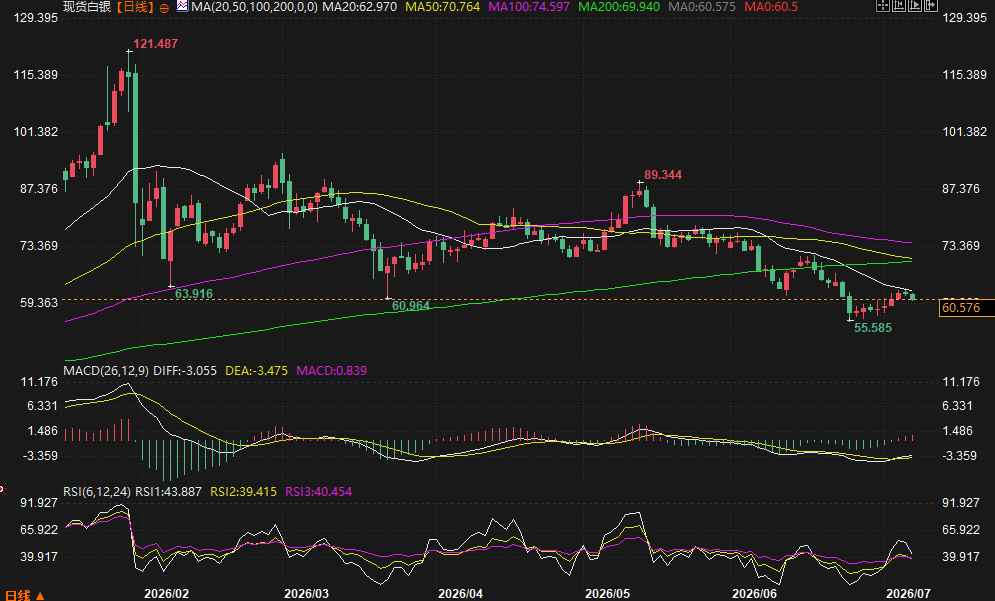
(Spot silver daily chart, source: EasyForex)
Silver is at a crossroads where bulls and bears are locked in a battle, and the following three variables will determine its short-term trend:
First, the evolution of the Hormuz situation. If tensions escalate further and oil prices continue to rise, silver will face stronger pressure from "inflation → interest rate hike" expectations; however, if the situation unexpectedly eases, the decline in energy premiums may provide room for a rebound in silver – as concerns about interest rate hikes will ease simultaneously.
Second, the FOMC minutes' implications for the interest rate path. Any discussion about "raising the threshold for interest rate hikes" or "being more confident about declining inflation" could trigger short covering in silver.
Third, the key breakout direction in the technical structure. If the silver price effectively breaks below $60.00, it will open up room for a pullback to $55.59; if it can form effective support near $60.00 and break through the 20-day moving average, then the short-term bottom may be confirmed.
At 14:52 Beijing time on July 7, spot silver was trading at $61.16 per ounce.
News that Iran fired at least two missiles at commercial vessels transiting the Strait of Hormuz provided buying support for oil prices, but silver weakened due to the transmission chain of "energy prices → inflation expectations → interest rate hike concerns"—a pattern that has played out repeatedly during Middle East conflicts.
Market focus has shifted to the release of the FOMC June policy meeting minutes on Wednesday, where investors will seek new clues about the Fed's monetary policy outlook.
Why do silver prices fall when oil prices rise? — An anomalous correlation during wartime.
Tuesday's weakness in silver prices seemed counterintuitive: escalating tensions in the Strait of Hormuz are typically seen as a safe-haven event, which should support precious metals. However, the decline in silver actually reflects the market's replication of the "paradoxical trading logic" seen during Middle East conflicts.
Iran's firing of at least two missiles at commercial vessels transiting the Strait of Hormuz sparked concerns about disruptions to nearly one-fifth of the world's energy supply routes, providing buying support for oil prices. However, silver did not benefit from safe-haven demand; instead, it came under pressure due to the following chain of events: rising energy prices → increased inflation expectations → heightened concerns about global central bank interest rate hikes → pressure on zero-interest assets.
Over the past few months of the US-Iran conflict, the market has repeatedly witnessed this logic—silver has not only failed to fulfill its safe-haven role in the face of energy shocks, but has also suffered greater pressure due to the hawkish repricing of interest rate expectations. The more tense the situation in the Middle East and the higher oil prices rise, the stronger the market's concerns about central bank interest rate hikes become, and the higher the holding cost of zero-interest precious metals becomes.
The Hormuz conflict: a boon for oil prices but a bearish factor for silver.
Tensions in the Strait of Hormuz are putting double pressure on silver:
The first pressure comes from the resurgence of inflation expectations. The risk of energy supply disruptions is pushing up oil prices, which are a significant contributor to overall inflation. With the Federal Reserve still considering inflation above 2% a core concern, any rise in energy prices could be interpreted as a signal that the "justification for raising interest rates remains valid."
The second pressure comes from anticipated changes in real interest rates. Silver does not generate interest income, and its holding cost is directly affected by real interest rates. When the market expects central banks to raise interest rates to combat energy-driven inflation, the expectation of rising real interest rates will put valuation pressure on silver.
This is precisely the institutional reason why silver "underperformed" during wartime—silver's industrial attributes (sensitive to economic growth) and financial attributes (sensitive to interest rates) created a double drag in the context of energy shocks, preventing it from benefiting purely from safe-haven demand like gold, and from benefiting from the physical premium brought about by supply disruptions like industrial metals.
The FOMC minutes are the next key catalyst.
Market focus has shifted to the release of the FOMC June policy meeting minutes on Wednesday. At the June meeting, the Federal Reserve decided to maintain the interest rate range at 3.50%-3.75% and signaled that it would avoid providing forward guidance on policy rates at the current policy juncture.
Investors will look for the following key information in the meeting minutes:
The committee members discussed in detail the impact of energy price fluctuations on the path of inflation.
The logic behind the "pause in forward guidance"—is it due to concerns about uncertainty, or does it hint at a policy shift in the works?
Tolerance assessment for a weakening job market (non-farm payrolls increased by only 57,000 in June).
If the minutes show that committee members are more hesitant about raising interest rates, silver may get some breathing room; if the minutes reiterate the tough stance that the "2% target is non-negotiable," coupled with energy prices driven up by the Hormuz situation, silver may come under further pressure.
Technical Analysis: Key Battle Around $61
The technical structure of silver presents a clear bearish pattern:
Resistance is seen at the 20-day moving average of $62.97/oz, which is currently the most immediate technical barrier for silver prices. The price remains below this moving average, confirming a short-term bearish bias. Only a sustained break above this level can alleviate current downward pressure and create space for a more constructive recovery.
Support levels: $60.00 is the most critical psychological support level. If this level is breached, silver prices could further decline to test the July low of $55.59. The RSI indicator is hovering around 43, indicating that selling pressure persists but has not yet reached extreme levels—meaning further downside potential cannot be ruled out in the short term.
In terms of price action, the rebound has consistently been met with resistance near short-term moving averages, indicating that bears remain in control. Under the current technical structure, bottoming out will require time and repeated testing to verify the effectiveness of the support level.
(Spot silver daily chart, source: EasyForex)
Outlook: Three major variables will determine the direction of silver prices.
Silver is at a crossroads where bulls and bears are locked in a battle, and the following three variables will determine its short-term trend:
First, the evolution of the Hormuz situation. If tensions escalate further and oil prices continue to rise, silver will face stronger pressure from "inflation → interest rate hike" expectations; however, if the situation unexpectedly eases, the decline in energy premiums may provide room for a rebound in silver – as concerns about interest rate hikes will ease simultaneously.
Second, the FOMC minutes' implications for the interest rate path. Any discussion about "raising the threshold for interest rate hikes" or "being more confident about declining inflation" could trigger short covering in silver.
Third, the key breakout direction in the technical structure. If the silver price effectively breaks below $60.00, it will open up room for a pullback to $55.59; if it can form effective support near $60.00 and break through the 20-day moving average, then the short-term bottom may be confirmed.
At 14:52 Beijing time on July 7, spot silver was trading at $61.16 per ounce.
- Risk Warning and Disclaimer
- The market involves risk, and trading may not be suitable for all investors. This article is for reference only and does not constitute personal investment advice, nor does it take into account certain users’ specific investment objectives, financial situation, or other needs. Any investment decisions made based on this information are at your own risk.