Gold Trading Alert: Trump's "canceling" of the US-Iran deal + hawkish Fed stance – will gold prices fall below $4,000?
2026-07-09 07:43:53
On Wednesday (July 8), spot gold prices briefly fell to around $4,020, as market sentiment quickly shifted from expectations of geopolitical conflict to a double whammy of risk aversion and concerns about tightening monetary policy. On July 8-9, 2026, with US President Trump publicly announcing the "null and void" of the temporary ceasefire agreement with Iran, tensions in the Middle East escalated sharply, causing oil prices to surge by more than 5%, hitting a more than two-week high. The latest minutes of the Federal Reserve meeting also signaled escalating high inflationary pressures, prompting institutions such as Bank of America to lower their gold price forecasts. This series of events has put downward pressure on gold, a traditional safe-haven asset, as investors closely watch whether the conflict will escalate into a protracted crisis and how the Fed's policy shift will reshape the long-term narrative for gold. On Thursday (July 9) in early Asian trading, spot gold traded in a narrow range, currently around $4,076 per ounce.

During the NATO summit, Trump made it clear that the interim agreement signed last month aimed at ending the conflict with Iran was "over," and hinted at further US military action against Iran. This statement quickly triggered a chain reaction: Iran claimed to have struck US military facilities in Bahrain and Kuwait, while US Central Command announced a new round of airstrikes against Iranian targets, with the core objective of ensuring freedom of navigation in the Strait of Hormuz.
The Strait of Hormuz, a crucial passage for one-fifth of the world's oil supply, has its security directly impacting the energy market. Iran's previous attack on oil tankers in the strait served as a trigger, causing a sharp rise in crude oil futures prices. Brent crude rose by more than 5% at one point, and WTI crude also hit a more than two-week high. This surge in energy prices not only pushed up global inflation expectations but also led to a general decline in stock markets and risk assets. David Meger, head of metals trading at High Ridge Futures, pointed out that the dominant factor driving the day's price movements was the escalating tensions between the US and Iran, resulting in adjustments across various risk assets, including gold.
In this environment, gold's safe-haven appeal appears to be temporarily suppressed by "liquidity demands amid risk aversion." Investors are more inclined to sell gold to cope with cash flow pressures and higher opportunity costs brought about by oil price shocks. This directly led to spot gold falling by about 0.69% to around $4,077.19 on Wednesday, while gold futures contracts fell even more, closing down 1.8%.
Beyond geopolitical factors, pressures at the macroeconomic policy level are equally significant. The minutes of the Federal Reserve's June meeting revealed that policymakers' concerns about high inflation are intensifying. Several participants noted that the scope of price increases is expanding, ranging from transportation and airfares to petrochemical products and agricultural inputs, with service inflation, particularly excluding housing, remaining persistently high. A few members even believed there was reason to raise interest rates immediately at the June meeting, although rates were ultimately kept unchanged.
The meeting minutes also removed a significant amount of forward guidance and shortened the overall length, reflecting Federal Reserve Chairman Warsh's preference for maintaining policy flexibility and avoiding premature commitments. Markets reacted swiftly: the CME FedWatch tool showed the probability of a September rate hike rose from 62% to approximately 69%. Simultaneously, U.S. Treasury yields rose across the board, with the 10-year Treasury note briefly hitting a seven-week high, reflecting investors' repricing of inflation and a potential tightening cycle.
Against this backdrop, Bank of America released a report lowering its 2026 average gold price forecast by 14% to $4,360. The institution believes that the Federal Reserve's increasingly hawkish stance will boost the dollar and real yields, putting downward pressure on gold, a non-interest-bearing asset. However, Bank of America also maintained an optimistic outlook: once the tightening cycle ends, gold prices still have a chance to challenge the $5,000 mark.
The bond market echoed this complex sentiment. U.S. Treasury yields retreated slightly after rising to multi-week highs, partly due to robust demand at the 10-year Treasury auction and partly because the minutes of the Federal Reserve meeting indicated no immediate urgency to raise interest rates. However, the ongoing uncertainty surrounding the situation in Iran outweighed other factors, with lingering doubts about the sustainability of the ceasefire agreement.
The persistently high oil prices have further amplified inflation risks. Russia's ban on diesel exports, Ukraine's attack on Russian refining facilities, and declining U.S. distillate fuel inventories have all exacerbated the tightness in the energy market. This forces investors to reassess the long-term impact of the Middle East conflict on global supply chains and prices: if shipping through the Strait of Hormuz is disrupted, oil prices could return to their earlier-year peaks, potentially forcing the Federal Reserve to take more aggressive measures.
In summary, the current decline in gold prices is a result of both unforeseen geopolitical events and expectations of monetary policy tightening. In the short term, if the US-Iran conflict fails to ease quickly, high oil prices will continue to push up inflation expectations, suppressing gold's performance; conversely, if the situation de-escalates substantially, gold may rebound rapidly.
From a medium- to long-term perspective, gold still possesses structural support. Global geopolitical risks have not been fundamentally eliminated, and central bank gold-buying trends, concerns about the credibility of the US dollar, and potential economic uncertainties all provide a floor for gold prices. Once the Federal Reserve confirms the end or shift of its interest rate hike cycle, gold's safe-haven and inflation-hedging attributes will regain dominance. Bank of America's forecast also suggests that $4,360 may be a reasonable valuation range after adjustments, rather than the endpoint.
Investors should remain cautious at this juncture: pay attention to the actual shipping conditions in the Strait of Hormuz, the tone of the Federal Reserve's July meeting, and the trend of crude oil prices. Also worth noting today are changes in US initial jobless claims and the annualized total number of existing home sales, as well as speeches by Federal Reserve officials.
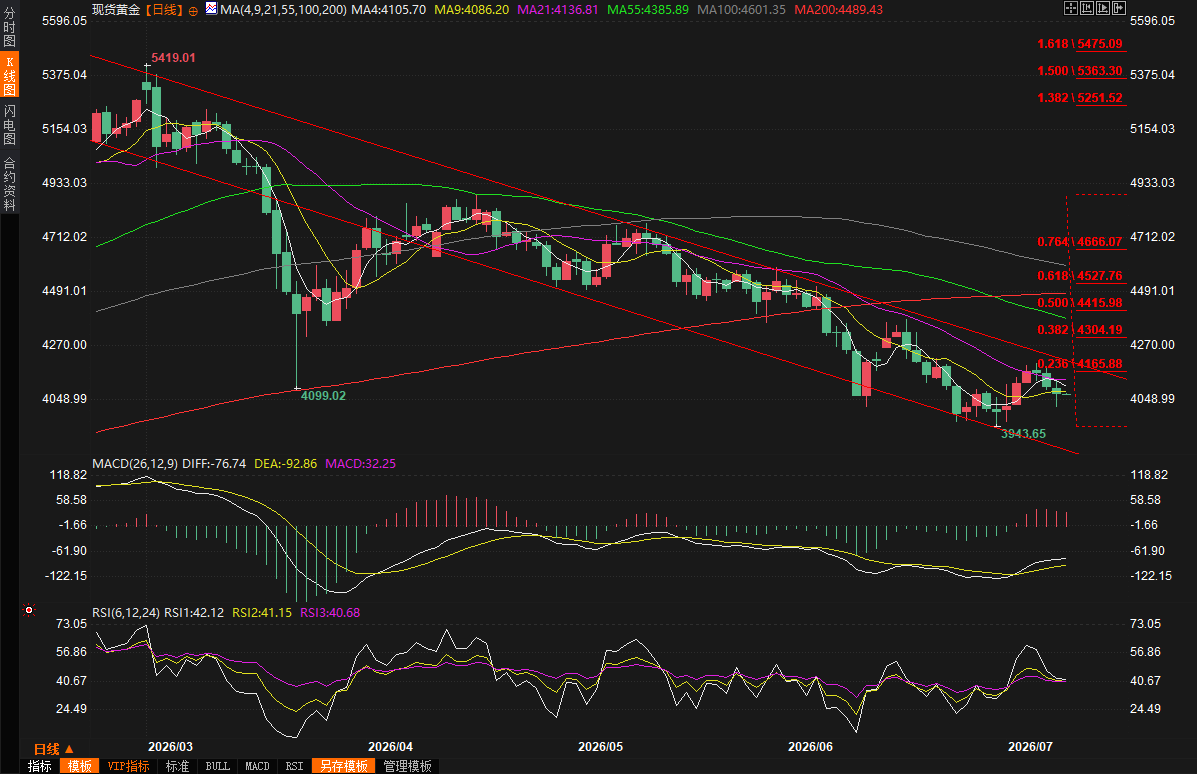
(Spot gold daily chart, source: FX678)
At 07:42 Beijing time, spot gold is currently trading at $4,075 per ounce.
The Middle East powder keg reignites: Trump's "canceling" of the agreement ignites a sell-off in fuel prices and risk assets.
During the NATO summit, Trump made it clear that the interim agreement signed last month aimed at ending the conflict with Iran was "over," and hinted at further US military action against Iran. This statement quickly triggered a chain reaction: Iran claimed to have struck US military facilities in Bahrain and Kuwait, while US Central Command announced a new round of airstrikes against Iranian targets, with the core objective of ensuring freedom of navigation in the Strait of Hormuz.
The Strait of Hormuz, a crucial passage for one-fifth of the world's oil supply, has its security directly impacting the energy market. Iran's previous attack on oil tankers in the strait served as a trigger, causing a sharp rise in crude oil futures prices. Brent crude rose by more than 5% at one point, and WTI crude also hit a more than two-week high. This surge in energy prices not only pushed up global inflation expectations but also led to a general decline in stock markets and risk assets. David Meger, head of metals trading at High Ridge Futures, pointed out that the dominant factor driving the day's price movements was the escalating tensions between the US and Iran, resulting in adjustments across various risk assets, including gold.
In this environment, gold's safe-haven appeal appears to be temporarily suppressed by "liquidity demands amid risk aversion." Investors are more inclined to sell gold to cope with cash flow pressures and higher opportunity costs brought about by oil price shocks. This directly led to spot gold falling by about 0.69% to around $4,077.19 on Wednesday, while gold futures contracts fell even more, closing down 1.8%.
The Fed meeting minutes released hawkish signals: concerns about high inflation spread, putting increasing pressure on gold prices.
Beyond geopolitical factors, pressures at the macroeconomic policy level are equally significant. The minutes of the Federal Reserve's June meeting revealed that policymakers' concerns about high inflation are intensifying. Several participants noted that the scope of price increases is expanding, ranging from transportation and airfares to petrochemical products and agricultural inputs, with service inflation, particularly excluding housing, remaining persistently high. A few members even believed there was reason to raise interest rates immediately at the June meeting, although rates were ultimately kept unchanged.
The meeting minutes also removed a significant amount of forward guidance and shortened the overall length, reflecting Federal Reserve Chairman Warsh's preference for maintaining policy flexibility and avoiding premature commitments. Markets reacted swiftly: the CME FedWatch tool showed the probability of a September rate hike rose from 62% to approximately 69%. Simultaneously, U.S. Treasury yields rose across the board, with the 10-year Treasury note briefly hitting a seven-week high, reflecting investors' repricing of inflation and a potential tightening cycle.
Against this backdrop, Bank of America released a report lowering its 2026 average gold price forecast by 14% to $4,360. The institution believes that the Federal Reserve's increasingly hawkish stance will boost the dollar and real yields, putting downward pressure on gold, a non-interest-bearing asset. However, Bank of America also maintained an optimistic outlook: once the tightening cycle ends, gold prices still have a chance to challenge the $5,000 mark.
Bond and oil markets move in tandem: Gold's positioning amid a reversal in risk appetite.
The bond market echoed this complex sentiment. U.S. Treasury yields retreated slightly after rising to multi-week highs, partly due to robust demand at the 10-year Treasury auction and partly because the minutes of the Federal Reserve meeting indicated no immediate urgency to raise interest rates. However, the ongoing uncertainty surrounding the situation in Iran outweighed other factors, with lingering doubts about the sustainability of the ceasefire agreement.
The persistently high oil prices have further amplified inflation risks. Russia's ban on diesel exports, Ukraine's attack on Russian refining facilities, and declining U.S. distillate fuel inventories have all exacerbated the tightness in the energy market. This forces investors to reassess the long-term impact of the Middle East conflict on global supply chains and prices: if shipping through the Strait of Hormuz is disrupted, oil prices could return to their earlier-year peaks, potentially forcing the Federal Reserve to take more aggressive measures.
Gold Outlook: Short-term pressure and long-term opportunities coexist
In summary, the current decline in gold prices is a result of both unforeseen geopolitical events and expectations of monetary policy tightening. In the short term, if the US-Iran conflict fails to ease quickly, high oil prices will continue to push up inflation expectations, suppressing gold's performance; conversely, if the situation de-escalates substantially, gold may rebound rapidly.
From a medium- to long-term perspective, gold still possesses structural support. Global geopolitical risks have not been fundamentally eliminated, and central bank gold-buying trends, concerns about the credibility of the US dollar, and potential economic uncertainties all provide a floor for gold prices. Once the Federal Reserve confirms the end or shift of its interest rate hike cycle, gold's safe-haven and inflation-hedging attributes will regain dominance. Bank of America's forecast also suggests that $4,360 may be a reasonable valuation range after adjustments, rather than the endpoint.
Investors should remain cautious at this juncture: pay attention to the actual shipping conditions in the Strait of Hormuz, the tone of the Federal Reserve's July meeting, and the trend of crude oil prices. Also worth noting today are changes in US initial jobless claims and the annualized total number of existing home sales, as well as speeches by Federal Reserve officials.
(Spot gold daily chart, source: FX678)
At 07:42 Beijing time, spot gold is currently trading at $4,075 per ounce.
- Risk Warning and Disclaimer
- The market involves risk, and trading may not be suitable for all investors. This article is for reference only and does not constitute personal investment advice, nor does it take into account certain users’ specific investment objectives, financial situation, or other needs. Any investment decisions made based on this information are at your own risk.