The US dollar index rose and then fell, with the market focusing on PPI and the situation in the Middle East.
2026-07-15 15:10:16
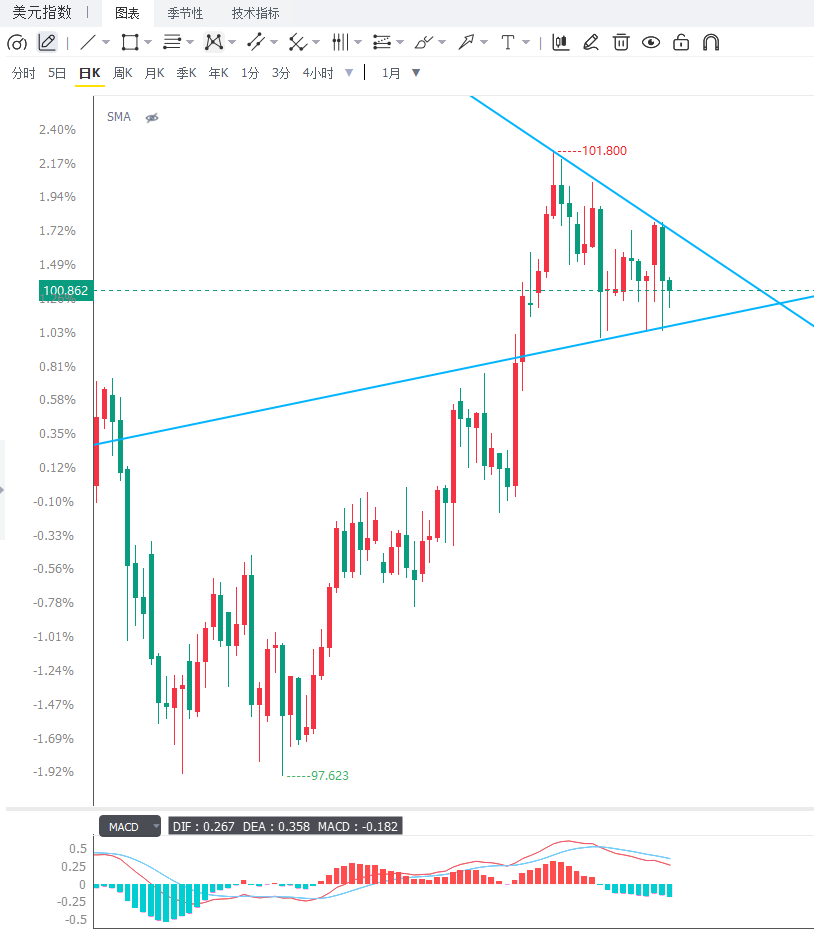
US inflation data for June showed a broad-based slowdown, prompting markets to readjust their expectations for the Federal Reserve's monetary policy. The US dollar index (DXY) fell to around 100.80 in Asian trading on Wednesday, a drop of approximately 0.12% during the session. As markets reduced their bets on short-term rate hikes, the dollar weakened against most major currencies, with the Australian dollar showing the strongest performance. Non-US currencies such as the euro and pound sterling also maintained their rebound.  Data released by the U.S. Bureau of Labor Statistics showed that the Consumer Price Index (CPI) rose 3.5% year-on-year in June, lower than the market expectation of 3.8% and also lower than May's 4.2% ; month-on-month, it fell 0.4% , a significant decline from May's 0.5% increase, indicating that overall inflationary pressures in the U.S. have eased. Core inflation, excluding food and energy prices, also fell short of market expectations. Data showed that the core CPI rose 2.6% year-on-year in June, lower than the market expectation of 2.8% and also lower than May's 2.9% , reflecting a slowdown in the rate of increase in service sector and core goods prices, further strengthening market judgments that U.S. inflation has peaked. Following the release of the inflation data, the market quickly adjusted its expectations for Federal Reserve policy. According to the CME Group's FedWatch tool, the probability of a rate hike at the July meeting has fallen from approximately 41.7% to 16.6% , reflecting that investors believe the necessity for the Fed to further raise interest rates in the short term has significantly decreased. The cooling of interest rate expectations put pressure on the dollar and simultaneously improved sentiment in global risk assets. However, the Fed's overall policy stance remains cautious. Federal Reserve Chairman Kevin Warsh stated in a speech to Congress that the Fed has "no room for tolerance" for persistently high inflation, and that if monetary policy is implemented properly, the high inflation of the past few years will gradually become history. This means that although there are recent signs of cooling inflation, the Fed still needs to see more data showing continuous improvement before it can adjust its overall policy stance. Currently, market focus has shifted to the upcoming release of the US June Producer Price Index (PPI) . Since the PPI reflects changes in wholesale prices, its trend will directly affect market expectations for future consumer inflation. If the PPI continues to fall short of market expectations, it will further strengthen market expectations that the Fed will postpone interest rate hikes, and the dollar may continue to be under pressure; if producer prices rebound, it may drive a renewed dollar rebound. Meanwhile, the situation in the Middle East remains a crucial variable affecting the dollar's trajectory. Recent escalation of tensions between the US and Iran has raised market concerns that regional security risks could affect global energy supplies and increase international safe-haven demand. Although the dollar weakened due to inflation data, geopolitical risks may still attract some safe-haven funds into dollar assets, thus limiting further declines in the dollar index. From the overall performance of the foreign exchange market, the US dollar fell to varying degrees against most major currencies on the day. The Australian dollar performed strongest, benefiting from improved market risk appetite; the euro and the pound were supported by expectations that the European Central Bank and the Bank of England would maintain tighter policies, respectively. Overall, the short-term trend of the US dollar is currently caught in a struggle between cooling inflation and safe-haven demand. Technically, the US dollar index continues to trade below the 101.00 level on the daily chart, with short-term moving averages turning downwards and the price breaking below key moving average support, indicating a generally weak trend. If the index continues to fall below 100.80 , it is expected to further test the 100.30 and 99.80 areas; initial resistance is at 101.20 , with further resistance around 101.80 . Daily momentum has weakened, but bears still hold a certain advantage. The 4-hour chart shows that the US dollar index maintains a downward trend, with the moving average system in a bearish alignment, suggesting limited short-term rebound potential. As prices approach previous lows, a short-term technical correction may occur, but if prices fail to regain a foothold above 101.20 , the overall weak trend will continue. Key support levels to watch are 100.30 and 99.80 ; a break below these levels could open up further downside potential.
  Editor's Summary: US June inflation data fell short of market expectations across the board, prompting a reassessment of the Federal Reserve's future policy path and putting downward pressure on the US dollar index. However, continued emphasis from Fed officials on the importance of controlling inflation, coupled with safe-haven demand driven by escalating tensions in the Middle East, provided some support for the dollar. Going forward, US PPI, retail sales, and employment data will be crucial in determining the dollar's trajectory. If inflation continues to slow and economic growth cools, the dollar may weaken further; conversely, if geopolitical risks escalate or US economic data strengthens again, the dollar may still have room for a rebound.
Data released by the U.S. Bureau of Labor Statistics showed that the Consumer Price Index (CPI) rose 3.5% year-on-year in June, lower than the market expectation of 3.8% and also lower than May's 4.2% ; month-on-month, it fell 0.4% , a significant decline from May's 0.5% increase, indicating that overall inflationary pressures in the U.S. have eased. Core inflation, excluding food and energy prices, also fell short of market expectations. Data showed that the core CPI rose 2.6% year-on-year in June, lower than the market expectation of 2.8% and also lower than May's 2.9% , reflecting a slowdown in the rate of increase in service sector and core goods prices, further strengthening market judgments that U.S. inflation has peaked. Following the release of the inflation data, the market quickly adjusted its expectations for Federal Reserve policy. According to the CME Group's FedWatch tool, the probability of a rate hike at the July meeting has fallen from approximately 41.7% to 16.6% , reflecting that investors believe the necessity for the Fed to further raise interest rates in the short term has significantly decreased. The cooling of interest rate expectations put pressure on the dollar and simultaneously improved sentiment in global risk assets. However, the Fed's overall policy stance remains cautious. Federal Reserve Chairman Kevin Warsh stated in a speech to Congress that the Fed has "no room for tolerance" for persistently high inflation, and that if monetary policy is implemented properly, the high inflation of the past few years will gradually become history. This means that although there are recent signs of cooling inflation, the Fed still needs to see more data showing continuous improvement before it can adjust its overall policy stance. Currently, market focus has shifted to the upcoming release of the US June Producer Price Index (PPI) . Since the PPI reflects changes in wholesale prices, its trend will directly affect market expectations for future consumer inflation. If the PPI continues to fall short of market expectations, it will further strengthen market expectations that the Fed will postpone interest rate hikes, and the dollar may continue to be under pressure; if producer prices rebound, it may drive a renewed dollar rebound. Meanwhile, the situation in the Middle East remains a crucial variable affecting the dollar's trajectory. Recent escalation of tensions between the US and Iran has raised market concerns that regional security risks could affect global energy supplies and increase international safe-haven demand. Although the dollar weakened due to inflation data, geopolitical risks may still attract some safe-haven funds into dollar assets, thus limiting further declines in the dollar index. From the overall performance of the foreign exchange market, the US dollar fell to varying degrees against most major currencies on the day. The Australian dollar performed strongest, benefiting from improved market risk appetite; the euro and the pound were supported by expectations that the European Central Bank and the Bank of England would maintain tighter policies, respectively. Overall, the short-term trend of the US dollar is currently caught in a struggle between cooling inflation and safe-haven demand. Technically, the US dollar index continues to trade below the 101.00 level on the daily chart, with short-term moving averages turning downwards and the price breaking below key moving average support, indicating a generally weak trend. If the index continues to fall below 100.80 , it is expected to further test the 100.30 and 99.80 areas; initial resistance is at 101.20 , with further resistance around 101.80 . Daily momentum has weakened, but bears still hold a certain advantage. The 4-hour chart shows that the US dollar index maintains a downward trend, with the moving average system in a bearish alignment, suggesting limited short-term rebound potential. As prices approach previous lows, a short-term technical correction may occur, but if prices fail to regain a foothold above 101.20 , the overall weak trend will continue. Key support levels to watch are 100.30 and 99.80 ; a break below these levels could open up further downside potential. Editor's Summary: US June inflation data fell short of market expectations across the board, prompting a reassessment of the Federal Reserve's future policy path and putting downward pressure on the US dollar index. However, continued emphasis from Fed officials on the importance of controlling inflation, coupled with safe-haven demand driven by escalating tensions in the Middle East, provided some support for the dollar. Going forward, US PPI, retail sales, and employment data will be crucial in determining the dollar's trajectory. If inflation continues to slow and economic growth cools, the dollar may weaken further; conversely, if geopolitical risks escalate or US economic data strengthens again, the dollar may still have room for a rebound.
- Risk Warning and Disclaimer
- The market involves risk, and trading may not be suitable for all investors. This article is for reference only and does not constitute personal investment advice, nor does it take into account certain users’ specific investment objectives, financial situation, or other needs. Any investment decisions made based on this information are at your own risk.