Geopolitical easing led to profit-taking, Asian stock markets rebounded in unison, and gold prices followed suit, but the sustainability of this rally remains questionable.
2026-07-21 15:54:15
On Tuesday (July 21), during the Asian and European sessions, spot gold opened slightly lower before trending upwards. As previously mentioned in our articles, the fact that gold prices didn't fall despite negative news suggested a potential rebound. Last night's US-Iran negotiations saw a turning point, and today Asian equity markets rebounded sharply, providing excellent trading opportunities for spot gold. Currently, gold is trading around 4072, up 1.62%. 
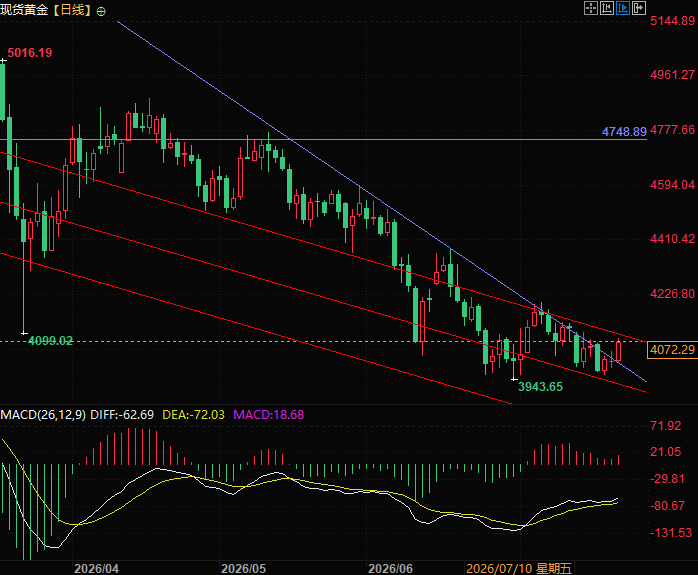 (Spot gold daily chart, source: FX678) At 15:52 Beijing time, spot gold is currently trading at $4072.27 per ounce.
The standoff between the US and Iran has reached a stalemate, and the strategy of simply launching airstrikes has exposed obvious shortcomings.
The Strait of Hormuz, a key anchor for global crude oil pricing, continues to bear the brunt of the geopolitical confrontation between the US and Iran, with both sides exchanging airstrikes and maintaining a stalemate for days. Experts have found that relying solely on escalating air strikes to exert pressure has reached its effectiveness limit and is unlikely to quickly force Iran to compromise. The US and Iran remain deadlocked over control of shipping in the Strait, the previously reached temporary ceasefire agreement has completely collapsed, US casualties continue to rise, and US gasoline retail prices have rebounded in tandem. Inflationary pressures have become a major drag on the Republican Party's midterm elections, and the market continues to question the sustainability of the US's conflict response strategy. Even with some signals of easing tensions, the tail risk of a full-scale regional war remains high. Trump has publicly stated that if Iran causes further US casualties, it will pay several times the price in retaliation. Experts on Middle East issues from multiple international think tanks unanimously point out that the root cause of this round of escalation lies in the US's fundamental misjudgment of Iran's decision-making logic and its failure to learn from past confrontations. Both the US and Iran hope to break the deadlock through escalating military confrontation, but the higher the intensity of the conflict, the narrower the space for subsequent diplomatic mediation becomes. Despite repeated assurances from the White House that the door to diplomatic negotiations remains open, and Secretary of State Rubio expressing a willingness to engage in consultations, citing Iran's repeated expressions of willingness to dialogue, market pricing only reflects concrete actions. Iran's continued use of missiles and drones to harass merchant ships in the Strait of Hormuz, a waterway carrying one-fifth of the world's oil shipments, means supply disruptions directly impact commodity prices. An anonymous US official revealed that military strikes against Iran will not cease, and diplomatic communication channels will remain open. However, industry observers generally believe that the US government, both militarily and diplomatically, has failed to find a smooth path to exit the conflict, resulting in a chaotic and inconsistent response strategy. Furthermore, several defense experts, reviewing historical conflicts, point out that relying solely on air strikes has inherent limitations; the US military's strikes on 13,000 targets over the first six weeks have not forced Iran to yield. Iran's pre-emptive dispersal and concealment of ballistic missiles and drones have depleted its easily accessible, visible targets, making long-term suppression of its long-range attacks extremely difficult. Conversely, a large-scale deployment of ground troops would face opposition from both the American public and Congress, creating significant obstacles to policy implementation. The US military is caught in a dilemma.Bilateral trust has been completely broken, and the diplomatic reconciliation process faces numerous obstacles.
On the diplomatic front, the long-standing trust rift between the US and Iran remains difficult to bridge, becoming the core obstacle to ceasefire negotiations. The Trump administration has not pursued in-depth, substantive negotiations, instead relying on a group of core advisors lacking practical experience in cross-border diplomacy, while outsourcing most of the mediation work to third-party countries such as Qatar, Pakistan, and Egypt. This lack of a core driving force for negotiation progress has resulted in a lack of mutual distrust and a complete breakdown of bilateral trust. Every step of the negotiations faces numerous obstacles, making a substantial reconciliation extremely difficult. However, recent market activity has detected several marginal signs of easing tensions, providing a slight support for de-escalation. Following the attack on US troops in Jordan, US officials have maintained relatively restrained statements and refrained from excessive retaliatory actions. Meanwhile, Iran has proactively released an Iranian-American woman who had been under travel restrictions for a long time, demonstrating clear goodwill. Many analysts interpret these statements and actions as indicating that both the US and Iran retain room for de-escalation and withdrawal from the game. However, the tail risks have not been completely eliminated. The Houthi rebels in Yemen, supported by Iran, announced a blockade of Saudi maritime shipping. If the blockade spreads further and completely cuts off the Bab el-Mandeb Strait shipping route, all the slight signs of easing will instantly become invalid, and the already fragile global energy and economic system will suffer a multi-risk shock.Key shipping routes are severely disrupted, putting continued pressure on the crude oil supply chain.
Amid escalating geopolitical conflicts, shipping chaos in the Strait of Hormuz has intensified, putting increasing pressure on the global energy supply chain. The latest statistics from maritime agency Signal Group show that as of July 15, a total of 728 empty and fully loaded oil tankers were backed up around the Strait of Hormuz. Large-scale vessel congestion has occurred in the Persian Gulf and the Gulf of Oman, highlighting severe waterway congestion and transport disruptions. Following the renewed escalation of tensions between the US and Iran on July 6, market risk aversion intensified significantly. The proportion of oil tankers transiting the strait with transparent ownership information plummeted from 67% during the interim peace agreement period to 45%. Many shipowners, to avoid the risk of attacks, have proactively disabled their Automatic Identification Systems (AIS) and navigated anonymously, drastically worsening the transparency of shipping in the strait. Short-term navigation data further reflects this extreme risk aversion. At the beginning of this week, the volume of traffic through the Strait of Hormuz shrank dramatically; only four commodity vessels successfully passed through on Monday, nearly halved from the seven the previous day. Meanwhile, vessel tracking data shows that no vessels passed through the Strait of Hormuz in the past 24 hours. Furthermore, the vessels passing through that day were mainly ordinary chemical and oil tankers, with no VLCCs (Very Large Crude Carriers) or LNG carriers transiting, effectively halting the transport of high-value energy. Coupled with the renewed threat of blockade in the Bab el-Mandeb Strait in the Red Sea, the world's two most critical maritime energy routes are simultaneously facing risks, fueling market concerns about oil supply disruptions. This has become a core fundamental positive factor supporting high oil prices, with institutions even warning that if a conflict results in damage to fully loaded oil tankers, international oil prices may experience a period of sharp fluctuations.Geopolitical risks have eased marginally, and risk appetite has rebounded in Asian equity markets.
Against the backdrop of lingering geopolitical risks and continued pressure on energy supply, market sentiment has seen a marginal recovery. Extreme pessimism and risk aversion have gradually cooled, leading to a steady rebound in global risk appetite and driving a phase of recovery in Asian equity markets. The core negative factors that previously weighed on the market—extreme expectations of a full-scale war between the US and Iran and a complete blockade of shipping lanes—have weakened, causing demand for safe-haven assets to decline and begin flowing back into risky assets.Asset trends diverged significantly, with oil outperforming gold dominating the market.
Gold prices rebounded sharply today, but oil prices did not fall significantly, indicating that the core inflationary issue suppressing gold prices has not eased. The gold rebound is more due to a recovery in risk appetite. Crude oil prices remain strong due to a rigid supply gap, and the core supporting logic has not weakened: the current situation of ship congestion and sharp declines in traffic in the Strait of Hormuz, coupled with the potential risk of blockade in the Bab el-Mandeb Strait, keeps the uncertainty of global seaborne crude oil supply high, making the tight supply-demand balance difficult to reverse, and geopolitical premiums continue to support oil prices. Gold, on the other hand, has not seen its traditional safe-haven attributes strengthen despite the realization of geopolitical risks; instead, it continues to weaken under pressure. The core reason is that high oil prices continue to raise global inflation expectations, and the market is simultaneously raising the probability of monetary policy tightening in major economies. The rising real yields on US Treasury bonds have significantly reduced the attractiveness of gold as a non-interest-bearing asset. The current market trading is driven by "recovery in risk appetite + rising expectations of inflation and interest rate hikes," rather than a systemic crisis hedging strategy; therefore, gold lacks sustained upward momentum. Overall, the short-term US-Iran conflict shows no signs of spiraling out of control. Energy supply remains a solid support level, market risk appetite continues to recover, and the divergence between strong oil and weak gold prices is expected to persist. Going forward, the focus will be on the status of the two shipping lanes and the interactions between the US and Iran. If the geopolitical situation suddenly deteriorates and risk appetite rapidly declines, gold may restart its safe-haven rebound, while oil prices will experience unexpectedly sharp fluctuations. Technically, spot gold has officially broken through the downtrend line on the daily chart, but it is still operating within a downtrend channel. The current focus is on whether it can break through the downtrend channel to change the downward trend. If it fails to break through and surpass the upper rail of the downtrend channel, the downward trend will continue. (Spot gold daily chart, source: FX678) At 15:52 Beijing time, spot gold is currently trading at $4072.27 per ounce.
- Risk Warning and Disclaimer
- The market involves risk, and trading may not be suitable for all investors. This article is for reference only and does not constitute personal investment advice, nor does it take into account certain users’ specific investment objectives, financial situation, or other needs. Any investment decisions made based on this information are at your own risk.