Bessenter reveals key details; dollar rebound may be turning around.
2026-07-21 20:38:13
The US dollar has recently exhibited a sustained, albeit volatile, rebound with a slightly stronger bias. The market has been oscillating between Middle East geopolitical risks and positive signals of cooling US inflation, with attention focused on potential turning points from the dollar. On Tuesday, the dollar strengthened slightly, while the euro and pound sterling showed weak rebounds, and the yen continued its weakness. However, the possibility of negotiations between the US and Iran is increasing. Firstly, the US Department of Defense recently held a meeting to develop more detailed plans for subsequent military operations. Secondly, US Treasury Secretary Bessenter released significant details regarding US-Iran negotiations, stating that he has seen a substantial decrease in Iranian oil purchases and is tracking Ayatollah's assets, hoping to reveal their addresses. Investigating the economic sources of Iran's top leadership could potentially undermine Iran's motivation to continue its military operations. 
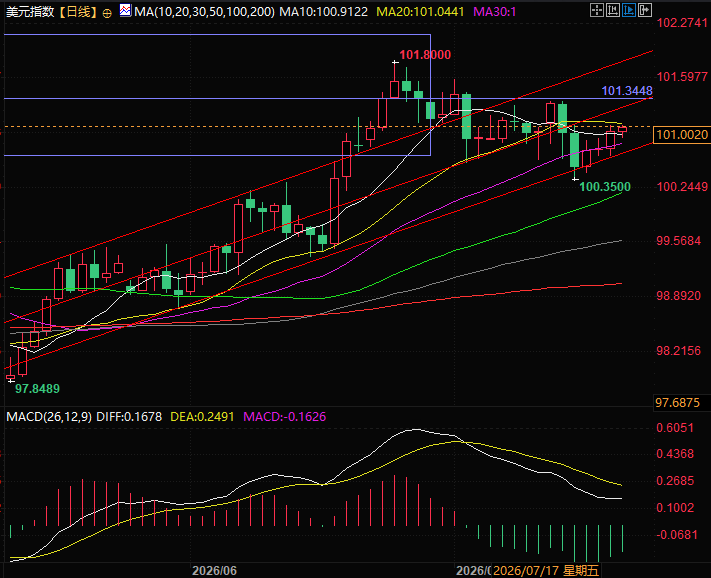 (US Dollar Index Daily Chart, Source: FX678) At 20:32 Beijing time, the US Dollar Index is currently trading at 101.00.
The ongoing geopolitical tug-of-war in the Middle East is limiting the unilateral movement of the US dollar.
The geopolitical situation in the Middle East is one of the core variables influencing the short-term trend of the US dollar. The US military has launched military strikes against Iran for ten consecutive nights, and regional tensions continue to escalate. According to conventional market logic, escalating geopolitical conflicts often generate safe-haven demand, benefiting traditional safe-haven assets such as the US dollar. However, the ongoing diplomatic efforts have offset some of the safe-haven benefits. Iranian officials have confirmed receiving a ten-day ceasefire proposal from mediators, significantly increasing the uncertainty surrounding the future of the conflict and making it difficult for the market to form a unified trading expectation. As a result, the US dollar has entered a period of consolidation, with investors generally remaining cautious and unwilling to establish large-scale one-sided trading positions. Currently, the combination of economic sanctions and military threats may have a greater impact, potentially leading to an earlier end to the conflict.The interplay of inflation and interest rate hike expectations provides a floor for the US dollar.
US inflation data and expectations of a Federal Reserve rate hike are key factors limiting the dollar's upside potential. Previously released US inflation data showed a moderate trend, effectively cooling aggressive market bets on rate hikes and weakening the dollar's upward momentum. However, the global inflation outlook remains uncertain, with key variables concentrated on the progress of shipping recovery in the Strait of Hormuz and the pace of stabilization in the international oil market. Currently, mainstream market expectations remain firm, with traders generally believing that the Federal Reserve will still implement at least one rate hike this year, providing a floor for the dollar. Volatility in the oil market further exacerbates market uncertainty, and significant fluctuations in energy prices continue to disrupt global inflation and the dollar's trajectory.Institutional Outlook: The US dollar is expected to be strong in the short term, but further depreciation is still some time away.
Institutions have provided clear predictions regarding the medium- to long-term and short-term trends of the US dollar. Jimmy Jean, chief economist and strategist at Des Jadins Bank, stated that the sustained depreciation of the dollar is unlikely to end in the short term and may become the main theme of the market in 2027. Until the US inflation situation becomes fully clear, the dollar will generally maintain a relatively strong trend in the coming months. Market data also confirms the dollar's resilience; the dollar index, which measures the dollar's performance against six major currencies, has rebounded continuously recently, and the overall bullish trend has not been broken. Furthermore, the trade friction involving the US imposing a 50% new tariff on several Canadian goods initially caused the Canadian dollar to fall to a one-month low before gradually stabilizing. Trade disruptions have become a secondary factor influencing the dollar's periodic fluctuations.Non-US currencies diverged, with the British pound rebounding and the ECB decision drawing attention.
Aside from the core performance of the US dollar, major non-US currencies showed divergent trends. The British pound entered a new phase in terms of policy and personnel, with new Prime Minister Burnham and Chancellor of the Exchequer Healy officially taking office. The new government stated it would continue the fiscal rules of the previous government, but has not yet clarified how to implement policy goals without increasing the tax burden on wage earners, as promised in its election campaign. Previously, the market believed the risk of a peaceful change of government within the Labour Party was manageable, leading to a sustained decline in the pound after the initial positive news was priced in. Today, the pound continued its pullback against the dollar, marking its fourth consecutive day of decline. Meanwhile, the market is focused on the European Central Bank's interest rate decision this week. Economists generally predict that the ECB will maintain its current interest rate, but there is still room for at least one rate hike this year. The ECB's monetary policy moves will indirectly affect the subsequent trend of the US dollar.The yen remains under pressure, with energy risks becoming the main negative factor.
The Japanese yen has become the weakest performing major non-US dollar currency, continuing its downward pressure. The USD/JPY pair is hovering near its year-to-date high, below the 163.00 level. Lee Hardman, an analyst at Mitsubishi UFJ Financial Group, points out that rising energy prices are the core negative factor suppressing the yen. This, coupled with the geopolitical conflict between the US and Iran and rising oil prices due to Red Sea shipping risks, has escalated global energy supply risks, further dragging down the yen's performance. Since the escalation of tensions between the US and Iran at the end of February, the yen's depreciation has been among the largest of major currencies, second only to the Swedish krona and the Swiss franc. Domestic policy adjustments in Japan have also reshaped market expectations for the yen, further exacerbating its weakness. The Japanese government recently formally approved its economic and fiscal policy outline for this year and a new national growth strategy, planning to complete over 370 trillion yen in domestic investment by March 2041, aiming for a nominal GDP of 1100 trillion yen. At the same time, the government explicitly recognizes the Bank of Japan's policy autonomy and will not interfere with the central bank's monetary policy adjustments, implementing a monetary policy adapted to the goal of price stability. This statement dispelled previous market concerns about government constraints on the central bank's tightening policies and eased the core logic behind the market's shorting of the yen. However, it failed to offset the negative impact of energy prices. Coupled with the overall strong dollar, the yen's short-term weakness is unlikely to reverse.Summary and Technical Analysis:
The temporary safe-haven buying stemming from the US-Iran geopolitical conflict, coupled with concerns about "double-dip inflation" triggered by the surge in oil prices (over 20% monthly increase) and the Federal Reserve's stance of at least one rate hike this year, have formed a bottom support for the US dollar. Moderate US inflation data has cooled bets on aggressive rate hikes. This, combined with diplomatic efforts to reach a ten-day ceasefire in the Middle East and new economic sanctions anticipated by the US, has offset some of the safe-haven premium, limiting bullish sentiment and leading to more cautious market positioning. Meanwhile, soaring energy prices have severely worsened Japan's terms of trade, uncertainty surrounding the new UK government's fiscal policy, and the upcoming European Central Bank (ECB) decision have hampered the euro's rebound, indirectly reinforcing the relative strength of the US dollar. Technically, the US dollar index, after its previous breakdown, remains within an upward channel, maintaining its upward trend. Currently, attention should be paid to key support levels for a potential reversal of the upward trend, namely the lower channel line and the lower edge of the previous trading range around 106. (US Dollar Index Daily Chart, Source: FX678) At 20:32 Beijing time, the US Dollar Index is currently trading at 101.00.
- Risk Warning and Disclaimer
- The market involves risk, and trading may not be suitable for all investors. This article is for reference only and does not constitute personal investment advice, nor does it take into account certain users’ specific investment objectives, financial situation, or other needs. Any investment decisions made based on this information are at your own risk.