British inflation has fallen, further reducing the need for interest rate hikes.
2026-07-23 01:40:14
The continued cooling of overall inflation in the UK has significantly weakened the Bank of England's policy basis for further interest rate hikes, providing strong support for maintaining a loose and stable monetary policy. The continued decline in food and services inflation data is a very positive signal for hawkish Bank of England officials who have consistently maintained a tight stance and are concerned about a rebound in prices. These policymakers have long been highly vigilant, fearing that the lingering effects of the energy crisis could continue to spread, plunging the UK back into long-term, recurring, and persistent inflationary pressures, making a rapid return to inflationary stability difficult. Although influenced by fluctuations in energy and commodity prices, UK inflation is likely to rise slightly to around 3.5% later this year. However, considering various economic indicators, we judge that the Bank of England will maintain a stable benchmark interest rate throughout 2026 and will not initiate interest rate hikes. UK food inflation unexpectedly continued to weaken, with prices falling for the second consecutive month. The latest inflation data released in June effectively alleviated the policy anxieties of the Bank of England's hawkish officials. Previously, the market generally worried that the current energy price shock would not subside quickly, but would gradually transform into widespread and long-term inflationary pressures, pushing up overall price levels. Looking at the specific data, the core consumer price index (core CPI) rose 2.6% year-on-year in June, slightly exceeding the market's previous consensus expectations. The global "chip inflation" effect has officially spread to the UK consumer market, becoming the core factor driving the slight increase in core inflation. Domestically, the price of portable smart devices surged 22% month-on-month, marking the largest single-month increase since the indicator was established in 2015. Industry insiders generally believe that this wave of price increases in electronic products is closely related to the price adjustments made by leading technology brands such as Apple. However, excluding this short-term special factor, the overall inflation data is positive, with two key highlights favoring hawkish policies. First, UK food prices fell for the second consecutive month. Such a continuous decline in food prices is extremely rare in recent years in the UK, completely breaking market expectations. This trend also echoes the positive trend of easing food inflation and steady price declines in most European countries during the second quarter of this year. It's important to understand that given the previous surge in energy prices, which pushed up overall production costs, the market initially anticipated continued high food inflation, rather than a sustained cooling. Objectively speaking, the transmission of energy price fluctuations to the entire food production, transportation, and processing chain has a lag; this transmission cycle takes approximately one year to fully materialize, and may still cause minor disturbances to food inflation afterward. However, for officials at the Bank of England, food and fuel are core necessities for daily consumption, and their price fluctuations directly affect public inflation expectations and consumer confidence, serving as a strong indicator of people's perceptions and economic trends. The current simultaneous decline in the prices of these two essential goods is undoubtedly a positive signal for stabilizing market expectations. It is precisely thanks to the dual decline in food and fuel prices that the UK's overall inflation rate in June fell to 2.6%, lower than the market's general forecast. Meanwhile, chip inflation has officially entered the UK market . 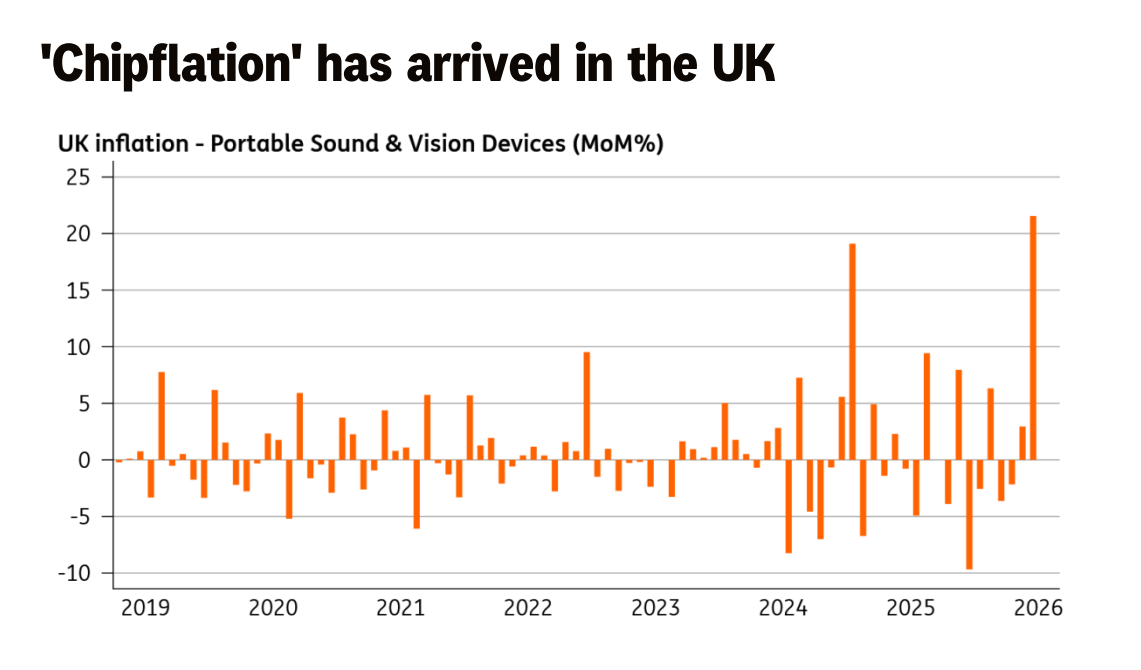 (Data source: Macrond, ING) Meanwhile, multiple detailed data points further confirm that the cooling trend in UK service sector inflation is continuing to solidify. The service sector is the core driver of UK inflation, and its performance directly determines the overall strength of endogenous inflation. According to the Bank of England's key monitored service sector inflation indicator, this figure has fallen from 3.8% to 3.6%, a significantly larger drop than the overall service sector price index, indicating a more pronounced cooling trend. This positive downward trend has strong sustainability reference value. Coupled with the continued slowdown in UK private sector wage growth and easing pressure from rising labor costs, this fully demonstrates that the current spontaneous inflationary pressure in the UK is generally moderate and controllable, and there is no risk of an out-of-control rebound. In summary, current core data on inflation, employment, and wages do not signal an urgent need for interest rate hikes, and there is no strong basis to support the Bank of England tightening monetary policy. We predict that the Bank of England will maintain the current interest rate level throughout 2026, keeping monetary policy stable, and will likely begin a gradual, small-scale interest rate cut cycle next spring, gradually and moderately easing the monetary environment. Inflation in the UK services sector continued to cool, with endogenous price pressures steadily easing.
 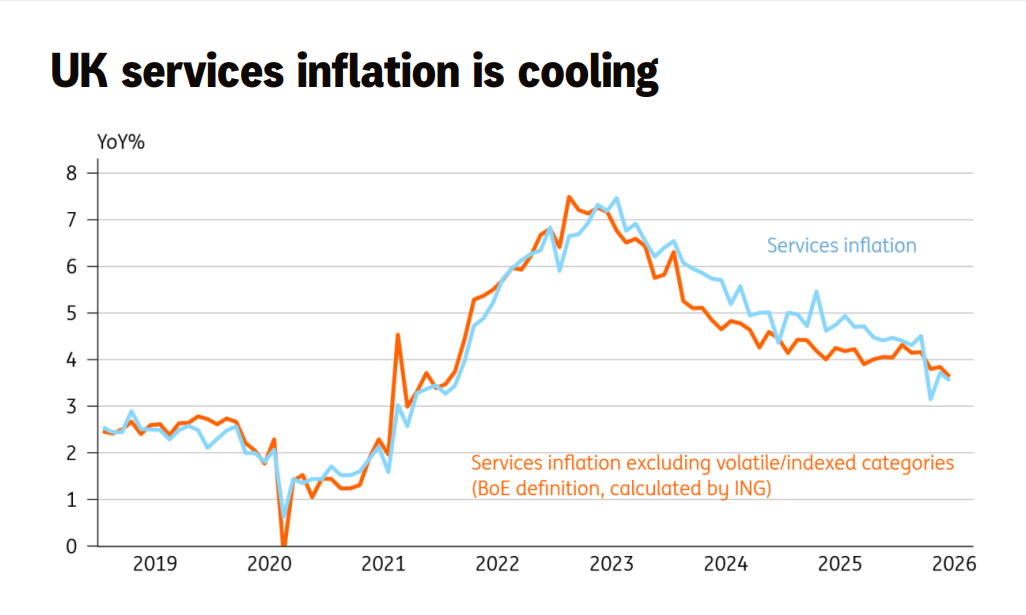 (Data source: Macrobond, ING) Our core judgment remains unchanged: only when UK inflation expectations approach the high threshold of 4% will the Bank of England have sufficient motivation and policy necessity to raise interest rates. Even though international crude oil, and especially natural gas, prices have recently rebounded, pushing up short-term inflation expectations, the current overall inflation level is still far from the 4% threshold for raising interest rates. Affected by natural gas price fluctuations, the upper limit of UK household electricity and gas prices will most likely remain flat or slightly increase in October this year; while the upward pressure on inflation brought about by rising natural gas futures prices will be effectively offset by the widely discussed VAT reduction policy on electricity bills in the UK market, significantly weakening the impact of energy price increases on people's livelihood inflation. Based on current calculations of various variables, we expect the peak of this round of UK inflation to occur at the end of this year to the beginning of next year, with a peak level slightly below 3.5%, and overall inflationary pressure will remain within a controllable range.
(Data source: Macrond, ING) Meanwhile, multiple detailed data points further confirm that the cooling trend in UK service sector inflation is continuing to solidify. The service sector is the core driver of UK inflation, and its performance directly determines the overall strength of endogenous inflation. According to the Bank of England's key monitored service sector inflation indicator, this figure has fallen from 3.8% to 3.6%, a significantly larger drop than the overall service sector price index, indicating a more pronounced cooling trend. This positive downward trend has strong sustainability reference value. Coupled with the continued slowdown in UK private sector wage growth and easing pressure from rising labor costs, this fully demonstrates that the current spontaneous inflationary pressure in the UK is generally moderate and controllable, and there is no risk of an out-of-control rebound. In summary, current core data on inflation, employment, and wages do not signal an urgent need for interest rate hikes, and there is no strong basis to support the Bank of England tightening monetary policy. We predict that the Bank of England will maintain the current interest rate level throughout 2026, keeping monetary policy stable, and will likely begin a gradual, small-scale interest rate cut cycle next spring, gradually and moderately easing the monetary environment. Inflation in the UK services sector continued to cool, with endogenous price pressures steadily easing. (Data source: Macrobond, ING) Our core judgment remains unchanged: only when UK inflation expectations approach the high threshold of 4% will the Bank of England have sufficient motivation and policy necessity to raise interest rates. Even though international crude oil, and especially natural gas, prices have recently rebounded, pushing up short-term inflation expectations, the current overall inflation level is still far from the 4% threshold for raising interest rates. Affected by natural gas price fluctuations, the upper limit of UK household electricity and gas prices will most likely remain flat or slightly increase in October this year; while the upward pressure on inflation brought about by rising natural gas futures prices will be effectively offset by the widely discussed VAT reduction policy on electricity bills in the UK market, significantly weakening the impact of energy price increases on people's livelihood inflation. Based on current calculations of various variables, we expect the peak of this round of UK inflation to occur at the end of this year to the beginning of next year, with a peak level slightly below 3.5%, and overall inflationary pressure will remain within a controllable range.- Risk Warning and Disclaimer
- The market involves risk, and trading may not be suitable for all investors. This article is for reference only and does not constitute personal investment advice, nor does it take into account certain users’ specific investment objectives, financial situation, or other needs. Any investment decisions made based on this information are at your own risk.